
What Is Conceptual Pop Art? A Clear Guide for Art Lovers
Conceptual pop art is defined as a hybrid art form that fuses Conceptual Art’s idea-first methodology with Pop Art’s iconic imagery drawn from mass culture and consumer life. The term sits at the intersection of two major movements: Conceptual Art, which treats the idea as the artwork itself, and Pop Art, which elevated advertising, celebrities, and product packaging to gallery status. Exhibitions like Fondation CAB’s “Super Conceptual Pop” (2025) have brought this hybrid into sharp institutional focus, featuring artists like Pierre Bismuth and Jonathan Monk. Understanding what is conceptual pop art means grasping how familiar images stop being decoration and start carrying organized, critical ideas.
What is conceptual pop art and how does it work?
Conceptual pop art blends Conceptual Art’s idea-centric approach with Pop Art’s visual language from mass culture and consumer life. The pop imagery is not the point. The idea that the imagery serves is the point. A soup can is not just a soup can. It is a prompt for thinking about mass production, authorship, and value.
The key distinction is subordination. Pop materials act as raw material inside a conceptual system, whether that system is a critique, a set of viewer instructions, or an algorithmic rule. When the imagery drives meaning rather than decoration, the work qualifies as conceptual pop art. When the imagery is simply eye-catching, it is just pop illustration.

This hybrid is not a formally recognized art-historical movement with fixed boundaries. Conceptual pop is better understood as a curatorial lens or interpretive category that describes how pop and conceptual strategies interact in a given work. That distinction matters for students and collectors alike.
What is conceptual art and how does it prioritize ideas over form?
Conceptual Art is defined as an art practice in which the idea or concept is the primary work, often replacing traditional craft and physical execution. Sol LeWitt summarized this with the phrase “the idea becomes a machine that makes the art.” Planning matters more than execution. The finished object, if one exists at all, is secondary.
Conceptual Art frequently uses language, documentation, and instructions as its medium. A set of written directions for a wall drawing is the artwork. The physical drawing is just one instance of it. This approach shifts the artist’s role from craftsperson to thinker and system designer.
Key principles of Conceptual Art include:
- Idea over object. The concept directs meaning, not the material.
- Language as medium. Text, instructions, and documentation replace paint and sculpture.
- Delegated execution. The artist may not physically make the work at all.
- Mental engagement. Conceptual art emphasizes intellectual consideration over emotional response.
- Documentation as art. Photographs, certificates, and written records can constitute the complete artwork.
Pro Tip: Many students assume “conceptual” means abstract or visually complex. The opposite is often true. A conceptual artwork can look extremely simple because the complexity lives in the idea, not the surface.
What characterizes Pop Art and its use of commercial imagery?
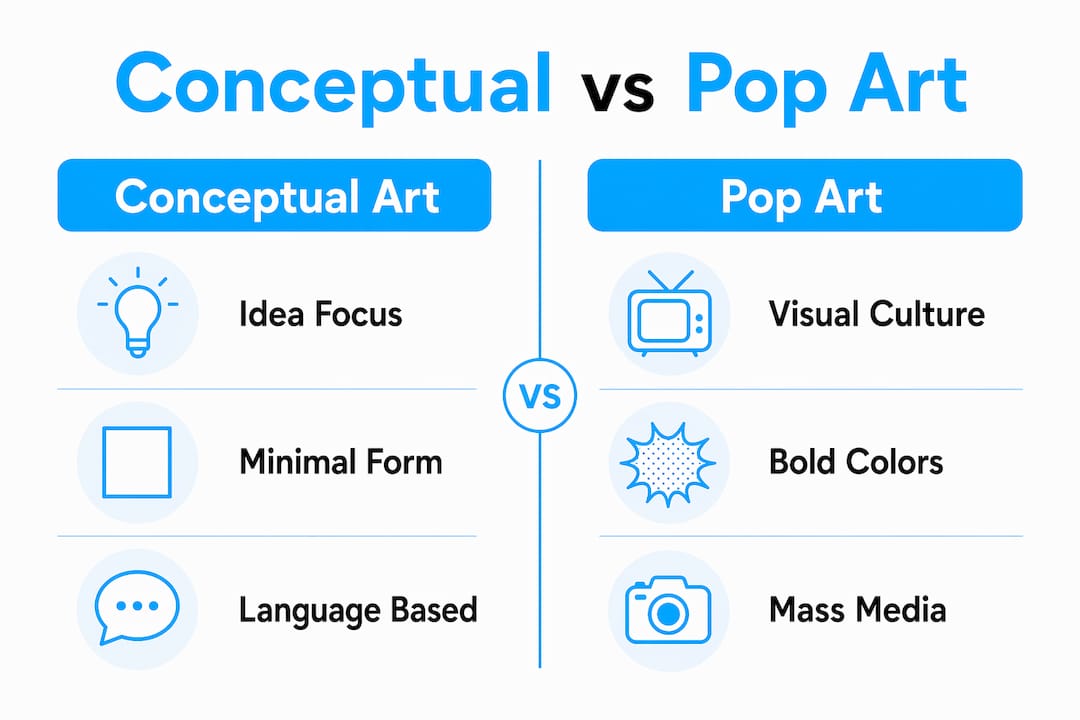
Pop Art emerged in the 1950s and 1960s, defined by its use of commercial and popular culture imagery. Pop Art elevated banal, mass-produced materials to high art status, often with irony and critical awareness of consumer culture. Advertising slogans, comic strip panels, celebrity photographs, and product packaging became the raw material of serious gallery work.
The movement’s core act was collapsing the boundary between high and low culture. Before Pop Art, fine art and commercial imagery occupied separate worlds. Pop Art made that separation look arbitrary and worth questioning.
Four defining characteristics of Pop Art:
- Commercial imagery. Advertising, product labels, and brand logos appear directly in the work.
- Celebrity subjects. Figures like Marilyn Monroe and Elvis Presley became recurring motifs.
- Mechanical reproduction. Screen printing and photographic transfer replaced handmade marks.
- Irony and detachment. The work observes consumer culture without sentimentality.
Andy Warhol is the clearest example of how Pop Art and conceptual thinking overlap. Warhol’s Soup Cans and Marilyns illustrate a blend of pop imagery and conceptual intent. The repetition is not decorative. It is a statement about mass production, identity, and the flattening of meaning in consumer culture. Warhol is often considered a conceptual artist precisely because his ideas directed his imagery, not the other way around.
Roy Lichtenstein applied a similar logic to comic strip panels, using Ben-Day dots and speech bubbles to ask what separates commercial printing from fine art. The question was the work. The image was the vehicle.
How do conceptual art and Pop Art combine to form conceptual pop art?
The fusion works through a clear hierarchy: pop imagery serves the concept, never the reverse. Pop art’s integration of mass-media imagery collapses the boundary between high and low culture, which gives conceptual frameworks a ready-made set of culturally loaded signs to work with. A rubber duck, a cereal box, or a billboard fragment carries instant cultural meaning. A conceptual artist can redirect that meaning toward a new idea system without explaining it from scratch.
Fondation CAB’s “Super Conceptual Pop” exhibition frames this relationship as “twisted” rather than smooth. The exhibition highlights artists like Pierre Bismuth and Jonathan Monk, who use pop aesthetics as a starting point for conceptual operations. Bismuth, for example, takes familiar film stills and applies systematic rules that alter how viewers read them. The pop image is the entry point. The concept is the destination.
Pro Tip: When analyzing a work that claims to be conceptual pop art, ask one question: Is the pop imagery doing the thinking, or is it being thought about? If the image carries the meaning on its own, the work is Pop Art. If the image is a tool inside a larger idea system, it is conceptual pop art.
The table below clarifies the core differences and the fusion:
| Dimension | Conceptual Art | Pop Art | Conceptual Pop Art |
|---|---|---|---|
| Primary focus | The idea or concept | The image and its cultural source | The idea expressed through pop imagery |
| Medium | Language, instructions, documentation | Painting, screen print, sculpture | Any medium where pop signs carry concepts |
| Cultural stance | Analytical, often austere | Ironic, celebratory, detached | Critical and accessible simultaneously |
| Viewer role | Intellectual engagement | Visual recognition | Recognition that triggers reflection |
| Key figures | Sol LeWitt, Joseph Kosuth | Andy Warhol, Roy Lichtenstein | Pierre Bismuth, Jonathan Monk |
What roles do exhibitions and contemporary artists play in defining conceptual pop art?
Exhibitions do more than display work. They frame how viewers read the relationship between pop and conceptual strategies. Without curatorial framing, a work using pop imagery might be read as decoration. With it, the same work becomes a proposition about culture, authorship, or meaning.
Fondation CAB’s “Super Conceptual Pop” is the clearest current example of institutional framing at work. The exhibition situates conceptual pop art between Dadaism and Conceptual Art, giving it historical depth while keeping it contemporary. That positioning is deliberate. It tells viewers to look for ideas, not just images.
Contemporary artists working in this space share several tendencies:
- Systematic recontextualization. They take familiar pop objects or images and apply rules that shift their meaning.
- Media saturation as subject. The sheer volume of commercial imagery becomes the topic, not just the material.
- Audience participation. Many works require the viewer to complete the concept through their own recognition or response.
- Institutional critique. Some artists use pop imagery to question the gallery system itself, asking why certain images belong in museums and others do not.
Flymiami’s work with UV-reactive pop art installations fits this pattern. The rubber duck sculptures created by Florence Biennale Award winner Facundo Yebne use instantly recognizable pop imagery, then transform it under blacklight to reveal hidden layers. The visible surface is the pop entry point. The hidden pattern is the conceptual payload. That structure mirrors exactly how conceptual pop art operates at its best.
Why is conceptual pop art important to understanding contemporary culture?
Conceptual pop art functions as a critical tool for reading mass culture. It takes the images that surround people daily and asks what those images actually do to thinking, desire, and identity. That question is more relevant now than it was when Warhol first posed it.
Three reasons conceptual pop art matters for contemporary art students and enthusiasts:
- It makes complex ideas accessible. Pop aesthetics facilitate accessibility by providing instantly recognizable visual prompts. A viewer who might resist a purely text-based conceptual work will engage with a familiar image that carries an unfamiliar idea.
- It challenges art categorization. Conceptual pop art refuses to sit neatly in either the conceptual or the pop tradition. That refusal is itself a statement about how rigid categories limit understanding.
- It critiques consumerism from inside consumer culture. By using advertising imagery and celebrity iconography as raw material, conceptual pop art critiques the very system that produced those images. The critique lands harder because the imagery is already familiar.
The pop culture series at Flymiami demonstrates this third point directly. Iconic imagery is reimagined through a conceptual lens, turning recognition into reflection.
Key takeaways
Conceptual pop art is the practice of using pop culture imagery as a vehicle for organized ideas, making complex concepts accessible through instantly familiar visual signs.
| Point | Details |
|---|---|
| Core definition | Conceptual pop art subordinates pop imagery to an organizing idea or concept system. |
| Conceptual Art foundation | Sol LeWitt’s principle that “the idea becomes a machine that makes the art” drives the conceptual side. |
| Pop Art foundation | Pop Art collapsed high and low culture using commercial imagery, irony, and mechanical reproduction. |
| Curatorial framing matters | Exhibitions like Fondation CAB’s “Super Conceptual Pop” show how institutional context defines the hybrid. |
| Accessibility is a feature | Familiar pop imagery makes conceptual ideas reachable for viewers who resist purely abstract or text-based art. |
Why conceptual pop art changed how I see everything
Most students I talk to arrive with the same assumption: conceptual art is cold, and pop art is shallow. Neither is true, and the fusion proves it. The moment you understand that a rubber duck in a gallery is not a joke but a proposition, your relationship with every commercial image you encounter shifts permanently.
What I find most underrated about this hybrid is its honesty. Conceptual art can feel remote when it uses only language and documentation. Pop art can feel empty when it only reflects consumer culture back at itself. Together, they create something that is both warm and rigorous. The familiar image pulls you in. The idea holds you there.
My advice to students is to resist the urge to decide quickly whether a work is “conceptual” or “pop.” Sit with the discomfort of not knowing. Ask what the image is being asked to do. That question, held long enough, is where the real engagement begins.
The artists I admire most in this space, from Warhol to Bismuth to Facundo Yebne, share one quality: they trust the viewer to do some of the thinking. The image is an invitation, not an answer.
— Facundo
Flymiami’s take on conceptual pop art
Flymiami brings the principles of conceptual pop art into three-dimensional, immersive form. Led by Florence Biennale Award winner Facundo Yebne, the studio uses rubber duck sculptures and UV-reactive materials to create works where the pop surface and the conceptual interior operate as a single system.
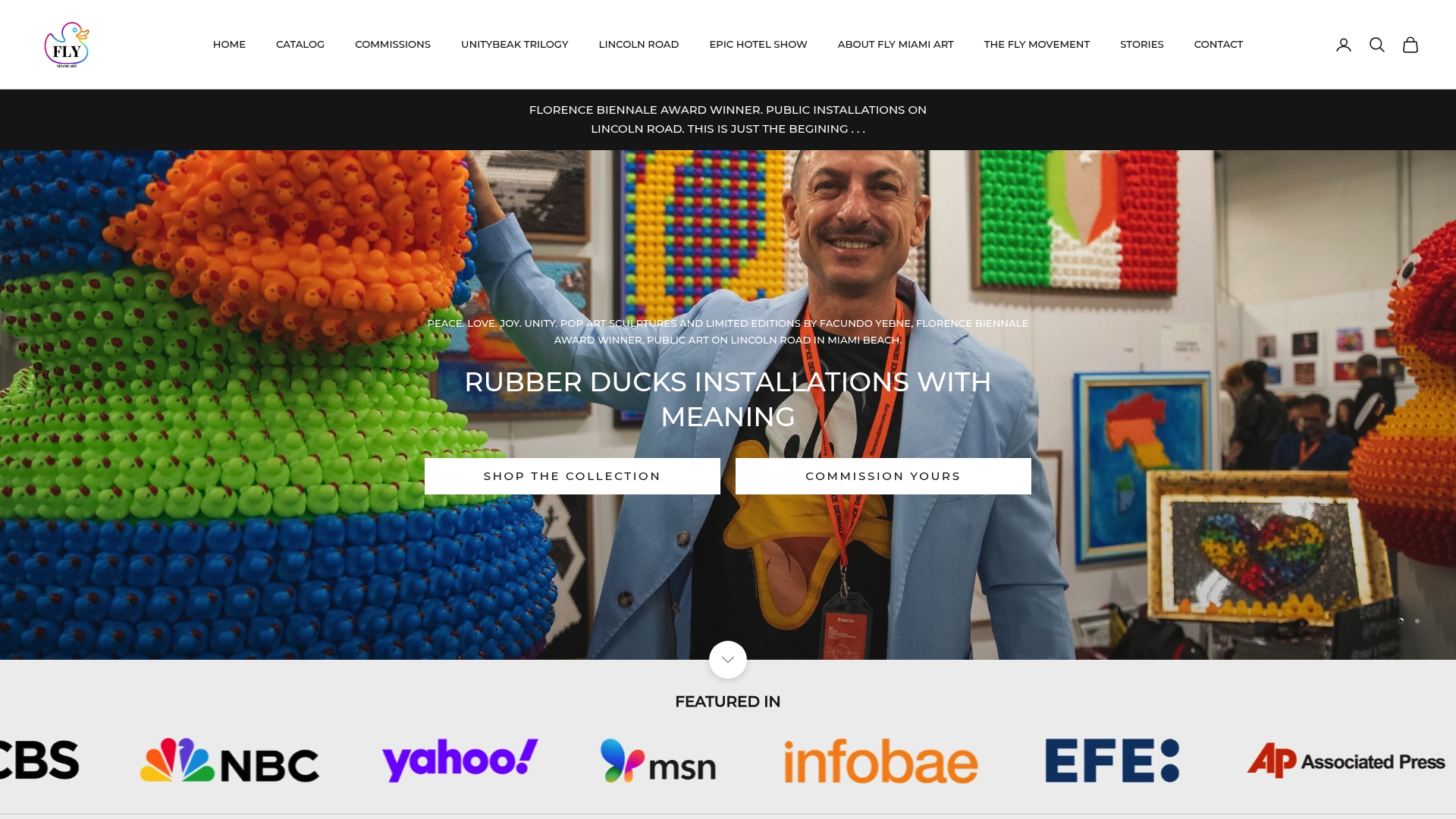
Under normal light, a Flymiami piece reads as bold, joyful pop art. Under blacklight, hidden patterns emerge, changing the meaning of what you thought you saw. That transformation is not a visual trick. It is the concept made physical. Art enthusiasts and collectors looking for works that reward sustained attention will find the wall art collection and the UV glow series at Flymiami worth serious consideration. These are pieces built to be thought about, not just looked at.
FAQ
What is the simplest definition of conceptual pop art?
Conceptual pop art is a hybrid practice where pop culture imagery serves as the vehicle for an organizing idea or concept, rather than functioning as decoration or pure visual appeal.
How is conceptual pop art different from regular Pop Art?
In regular Pop Art, the commercial or celebrity image is the primary subject. In conceptual pop art, that image is a tool inside a larger idea system, and the concept directs the meaning.
Who are the key figures in conceptual pop art?
Andy Warhol and Roy Lichtenstein laid the groundwork by blending pop imagery with conceptual intent. Contemporary practitioners like Pierre Bismuth and Jonathan Monk, featured in Fondation CAB’s “Super Conceptual Pop,” carry the hybrid forward today.
Is conceptual pop art a recognized art movement?
Not in the strict art-historical sense. It functions more as a curatorial category or interpretive lens describing how pop and conceptual strategies interact in specific works, rather than a bounded movement with a fixed manifesto.
How can I start engaging with conceptual pop art as a student?
Start by asking one question in front of any work using pop imagery: is the image doing the thinking, or is it being thought about? That single question separates pop decoration from conceptual pop art and trains the critical eye quickly.