How to Master Contemporary Art Collection Diversification Ideas
Last Updated: November 10, 2026
Quick Summary
Collection diversification means spreading your art buying across different artists, mediums, career stages, and price points so no single market shift undermines your whole body of work. Score each piece from 1 to 5 on six axes, including medium, geography, and price band, for a total out of 30.
- Write a collecting policy that names your themes, yearly budget range, and what you will walk away from.
- A score under 12 means the piece mostly repeats what you already own.
- Review the whole collection against the six axes once a year to spot hidden patterns.
- Collecting sculptures across materials adds visual variety, and most FLY work is UV reactive and glows under blacklight.
- Art is not a liquid asset, so hold for years and document provenance to support resale.
Table of Contents
- Why Collection Diversification Matters for Contemporary Art
- How to Start a Contemporary Art Collection with a Clear Strategy
- A Practical Framework for Diversifying Your Collection
- Collecting Contemporary Art Sculptures: Mediums, Materials, and Visual Variety
- Balancing Established and Emerging Artists Beyond Career Stage
- Contemporary Art Investment Risks and Realistic Expectations
- Budget Allocation, Due Diligence, and Collection Care
- Building a Coherent Collection with FLY Miami Art
- Frequently Asked Questions
Why Collection Diversification Matters for Contemporary Art
A contemporary art collection built on one artist, one medium, or one mood is a collection with a single point of failure. Collection diversification is the practice of spreading your collecting across different artists, mediums, career stages, and price points so that no single market shift or change in taste undermines the whole body of work. The collections that age well are often the ones built with range in mind.
Diversification does two jobs at once. It protects cultural value, because a mixed collection tells a richer story than a room of near identical works. It also supports financial goals, since different segments of the art market rarely move in step.
The Art Basel and UBS Art Market Report tracks how collector spending shifts between established names and newer work each year. That ebb and flow is exactly why a single artist bet is risky.
Here is what most new collectors get wrong: they treat diversification as buying more. It is not. It is buying differently.
EXTERNAL_LINK: Types of contemporary pop art sculptures: 2026 collector guide
How to Start a Contemporary Art Collection with a Clear Strategy
Start with a written collecting policy, not a wish list. A collecting policy is a short document that states what you collect, why, and how much you will spend in a given period. It sounds formal. It works.
Our advice for a first policy:
- Name two or three themes that genuinely interest you
- Set a yearly budget range before you shop
- Decide the split between established and emerging artists
- Pick the mediums you want represented
- Write down what you will walk away from
That last point matters most. A collector who knows their limits avoids impulse buys that later feel random.
Then look at how the work will live. Think about the space before the piece.
A Practical Framework for Diversifying Your Collection
Most collectors are told to diversify but never given a way to measure it. The framework below turns variety into something you can score, track, and review. It uses six axes instead of the usual four, because medium and career stage alone miss the concentration risks that show up later.
The six axes are medium, artist career stage, geography, price band, collecting theme, and representation. Score each axis from 1 to 5 for every work you own or are considering, where 1 means the piece is identical to what you already hold on that axis and 5 means it opens something entirely new. Add the six scores for a total out of 30.
| Axis | Question to Ask | What a Low Score Looks Like |
|---|---|---|
| Medium | Is this a material I already own? | A third resin sculpture in a resin heavy collection |
| Career stage | Does this artist sit at the same point as my others? | Every piece from artists with similar exhibition histories |
| Geography | Where does the artist work and show? | All work sourced from one city or one gallery network |
| Price band | Does this fit a band I have already filled? | Repeated purchases in the same narrow range |
| Theme | Does this repeat a theme I have explored? | Several works circling the same idea |
| Representation | Does this widen whose work I support? | A collection that mirrors one demographic |
A total under 12 means the piece mostly repeats what you own. A total between 12 and 20 means it adds some range. A total above 20 means it stretches the collection in a meaningful way.
Here is how it works in practice. Imagine a collector who owns four resin sculptures by artists at similar career stages, all bought in the same price band.
Watch out: scoring can become an excuse to buy things you do not actually want. The framework is a check, not a mandate.
Review the whole collection against the six axes once a year. Patterns often appear quickly, sometimes in the axes collectors never thought to track. A collection can look varied by medium while being highly concentrated by geography or price band, and the annual review is where that shows up.
EXTERNAL_LINK: Sculpture edition sizes explained | flymiami.art
Collecting Contemporary Art Sculptures: Mediums, Materials, and Visual Variety
Sculpture is where diversification gets physical. Paintings hang flat. Sculptures occupy space, change with the light, and ask different things of a room. Collecting contemporary art sculptures across materials is one of the fastest ways to add visual variety without repeating yourself.
Consider the range available today:
- Mixed media and found objects for texture and surprise
- Metalwork for weight and permanence
- Textiles for softness and warmth
- Digital and light based work for movement
- Resin and rubber for color and playfulness
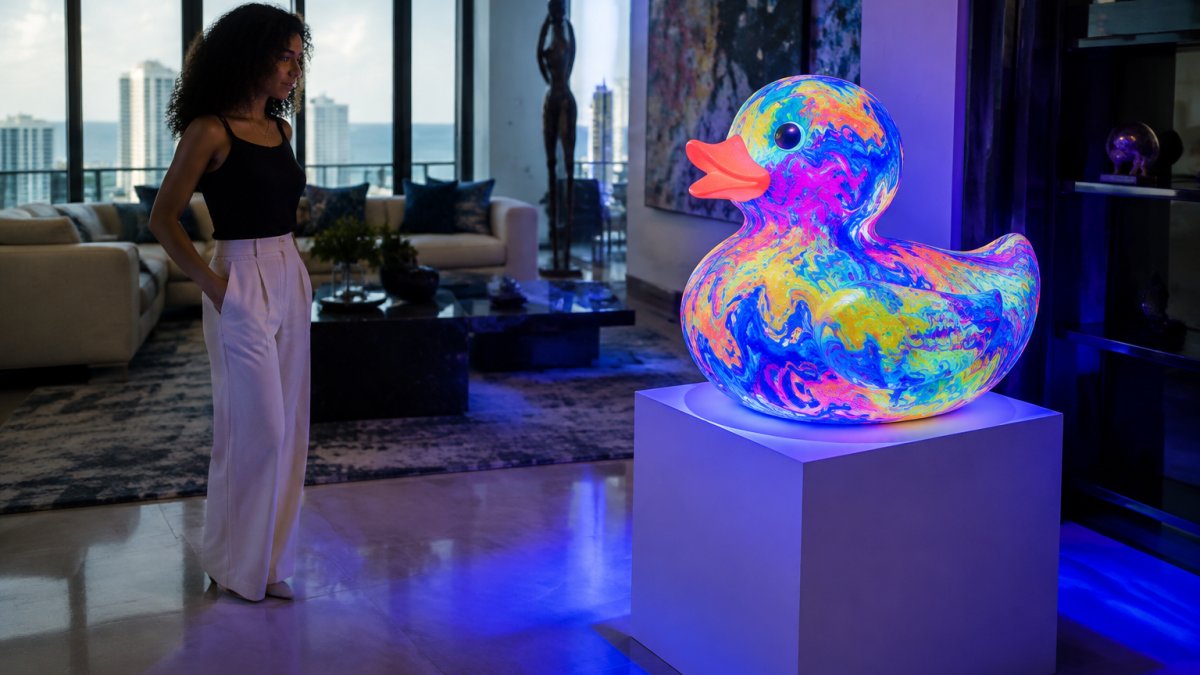
Each material carries its own care needs and its own presence. A mixed media piece might need controlled humidity. A UV reactive work shifts character entirely when the room goes dark.
That shift is the point. A sculpture that transforms under blacklight gives you two works in one space, day and night.
EXTERNAL_LINK: Sustainable sculpture materials guide | flymiami.art
Balancing Established and Emerging Artists Beyond Career Stage
Career stage is the obvious way to balance a collection. It is also the shallowest. An artist can be early in their career and already widely shown, or late in their career and quietly under collected.
Look past the label. Ask instead:
- Who represents the artist, and how consistently?
- Where has the work been exhibited?
- Is there critical writing about the work?
- Does the artist have a clear, developing body of work?
Representation and exhibition history tell you more about long term relevance than a debut date. A young artist with steady gallery support and press coverage may carry less risk than an older artist with none.
FLY, the artist behind our studio, won Fourth Prize in Installation Art at Florence Biennale XV, and the work has been featured by CBS, NBC, Yahoo, MSN, infobae, EFE, Associated Press, ABC, and Yahoo Finance. Awards and press are not guarantees. They are signals worth weighing.
EXTERNAL_LINK: What is mixed media pop sculpture? | flymiami.art
Contemporary Art Investment Risks and Realistic Expectations
Art is not a liquid asset, and the mechanics of selling explain why. A painting or sculpture is a single, unique object with no order book and no quoted price.
The costs are the part collectors underestimate. Buying and selling each carry friction. Auction houses charge seller commissions and buyer premiums, galleries take a share of resale, and advisors charge fees.
Holding periods matter for the same reason. Works bought and resold quickly often sell at a discount because the market reads a fast flip as a warning sign.
Provenance and documentation do more for resale than most collectors realize. A clear chain of ownership, a Certificate of Authenticity, exhibition records, and condition reports all reduce a buyer's risk and speed a sale.
Watch out: treating art as a portfolio allocation can lead to buying work you do not actually want to live with.
A realistic expectation is this. Some works will appreciate, many will hold roughly steady, and some will fall. Diversification across artists, mediums, and price bands softens the impact of any single outcome, but it does not guarantee a return.
Our one-of-a-kind originals come with a Certificate of Authenticity.
Budget Allocation, Due Diligence, and Collection Care
Split your yearly budget before you fall in love with a piece. A workable starting point for many collectors is a majority toward established or blue chip work, a smaller share toward emerging artists, and a reserve for care and insurance. Adjust the ratios to your risk tolerance, but write them down.
Due diligence is a checklist, not a vibe:
- Confirm the artist, title, year, and medium in writing
- Ask for the Certificate of Authenticity and any exhibition history
- Check the condition, especially on mixed media and resin
- Understand the care needs before delivery
- Insure the piece at replacement value
Care deserves its own line in the budget. UV reactive works should stay out of harsh direct sun to protect their glow. Textiles need dust control. Metalwork needs a stable, dry environment.
One more point on planning: figure out where the piece will stand before you buy it. Scale surprises people.
EXTERNAL_LINK: Sculpture vs painting: which suits your space | flymiami.art
Building a Coherent Collection with FLY Miami Art
Coherence is what separates a collection from a shopping habit. A coherent collection has a through line, a reason the works sit together, even when they differ in medium, artist, and price. That through line is usually a feeling or an idea, not a color scheme.
At FLY Miami Art, our through line is peace, love, and joy. The UnityBeak series, built from thousands of mini rubber ducks, carries that message into galleries, lobbies, and public spaces.
For collectors building range, that gives you options across the board:
- UnityBeak Trilogy: LOVE, a one-of-a-kind original in mini rubber ducks that glows under blacklight
- UnityBeak Firenze Edition, a site specific work developed with the local community during the Florence Biennale, depicting two figures meeting in a gentle kiss
- Unity Beak, the large scale pair installed on Lincoln Road and one of Miami's most photographed installations
- Proud Love, a monumental heart built in the colors of the Pride flag
Each is a one-of-a-kind original with a Certificate of Authenticity. Range does not have to mean scattering your collection across unrelated ideas. It can mean one idea, explored at different scales and in different materials.

The hardest part of diversification is not finding variety. It is knowing which axis to stretch next, and resisting the piece that only repeats what you already own. We can help you see where a FLY Miami Art original fits into the collection you are building, from a single statement piece to a commissioned installation.
Frequently Asked Questions
What is the 70/30 rule in art collecting?
The 70/30 rule is a guideline for balancing your collection: invest about 70% of your budget in established artists with a proven market track record, and reserve 30% for emerging artists who may offer higher growth potential but also higher risk. This split helps you maintain stability while still exploring new voices. Adjust the ratio based on your risk tolerance and investment horizon, but the principle of intentional balance remains central to collection diversification.
How can collectors diversify a contemporary art collection?
Diversify by varying mediums (paintings, sculpture, digital art, textiles), artist career stages (emerging, mid-career, established), geographic representation, and price points. Also consider different themes and formats, from wall works to installations. A practical framework involves setting target percentages for each category and reviewing them annually. This approach reduces reliance on any single artist or market segment and builds resilience into your collection strategy.
What are the main contemporary art investment risks?
Key risks include illiquidity (art can take months to sell), market volatility (trends shift), authenticity and provenance issues, and high transaction costs like auction fees and insurance. Emerging artists may not appreciate as expected. To manage these, research thoroughly, buy from reputable sources with clear documentation, and avoid treating art purely as a financial asset. Balance passion with realistic expectations, and never invest more than you can afford to tie up long term.
How do I balance personal taste and investment goals when collecting art?
Start by defining your collecting goals: are you building for enjoyment, investment, or both? Allocate a portion of your budget to pieces you love regardless of financial performance, and another portion to works with stronger investment potential. This way, you avoid regret purchases and still build a collection with financial upside. Review your balance periodically and adjust as your goals evolve.