How to Gift Meaningful Pride Art to Someone You Love
The strongest Pride-art gifts fall into four categories: a commissioned original, a queer-made print, wearable or home decor by an LGBTQ+ artist, and a small handmade or DIY token. Which route fits depends on your priorities.
- Meaningful and personal: Commission a custom piece from a queer artist or studio, or order a custom portrait with digital delivery for tight timelines.
- Fast and budget-friendly: Buy an archival print, enamel pin, or sticker pack directly from an LGBTQ+ maker’s shop.
- Supporting queer creators: Purchase directly from an artist’s own website or a queer-focused collective, so the full sale benefits the maker.
Key Takeaways
Gifting meaningful Pride art comes down to three decisions: who made it, how personal it is, and whether the recipient can safely display or wear it.
| Point | Details |
|---|---|
| Best gift categories | Commissioned originals, queer-made prints, wearable art, and small DIY tokens cover every budget and context. |
| Respectful selection | Match the piece to the recipient’s outness, style, and identity signals before choosing symbolism or scale. |
| Support queer makers | Buy directly from artist studios or queer-focused collectives so the full sale benefits the creator. |
| Commissioning route | Expect a 2–16 week lead time and a 30–50% deposit; provide reference images, size, and any privacy notes upfront. |
| Flymiami option | Flymiami’s UV-reactive Pride originals and limited-edition pieces are available direct from the studio, with custom commissions open for inquiry. |
Table of Contents
- What are the best Pride-art gift ideas for someone you love?
- How do you choose a Pride-art gift that feels affirming, not tone-deaf?
- Where can you buy Pride art in the U.S. while supporting queer makers?
- How does commissioning a Pride artwork actually work?
- Budget-friendly and DIY Pride-art gifts that still feel personal
- How to present a Pride-art gift so the meaning comes through
- How do you care for different types of Pride art gifts?
- What are the legal and copyright rules when commissioning or buying reproduced art?
- Packaging and shipping considerations for Pride art gifts
- Why Pride art commissions matter beyond the object itself
- Commission a Pride piece from Flymiami
- Sources
What are the best Pride-art gift ideas for someone you love?
Pride art gifts work best when they reflect the recipient’s identity rather than a generic rainbow aesthetic. Below are the categories that consistently land well, with a note on who each suits.
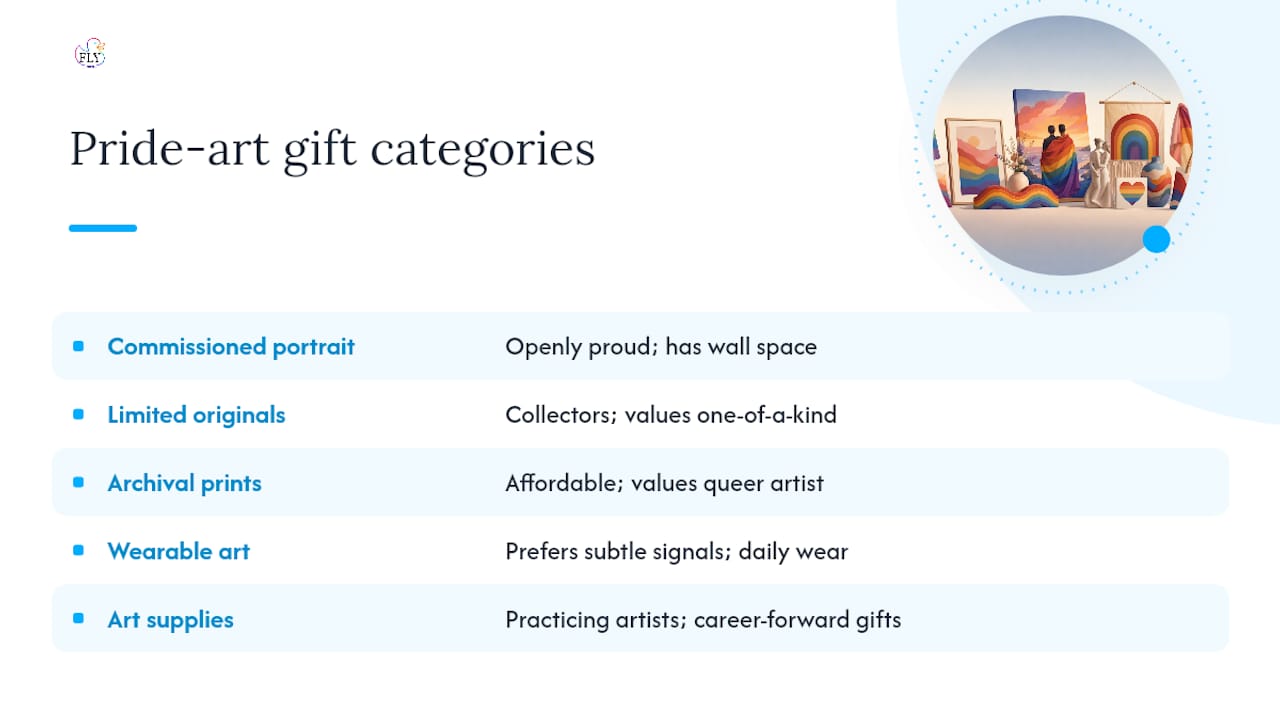
Commissioned portrait or original scene A custom piece built around the recipient’s likeness, relationship, or personal symbols is the highest-meaning option. It says you saw them specifically, not just their community. Best for someone who is openly proud and has wall space to display it.
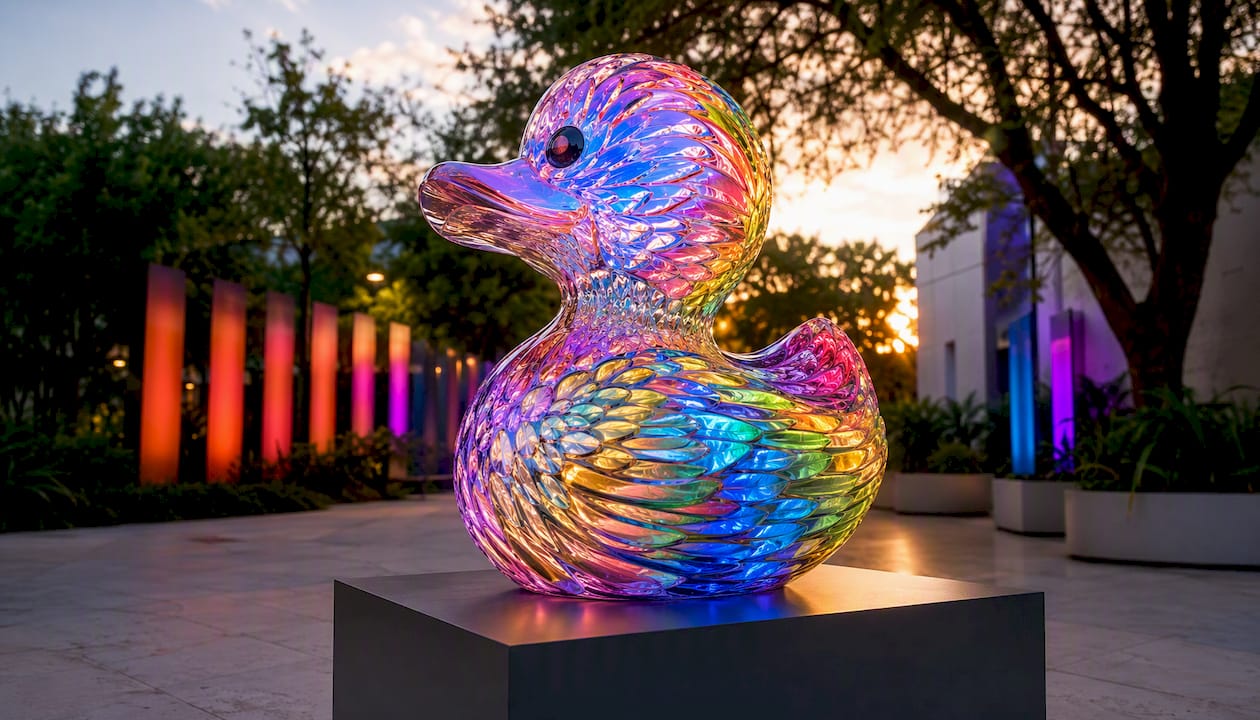
Limited-edition originals Numbered, signed originals from a queer artist carry cultural weight beyond decoration. Pieces like Flymiami’s Glowing with Pride, which reveals hidden patterns under blacklight, add an experiential layer that a standard print cannot replicate. Suits collectors or anyone who values owning something genuinely one-of-a-kind.

Archival prints and art prints A well-chosen archival print from a queer artist is affordable, ships flat, and still carries real meaning when you explain who made it and why you chose it. Look for prints on acid-free paper with UV-protective coatings so colors stay vivid for decades.
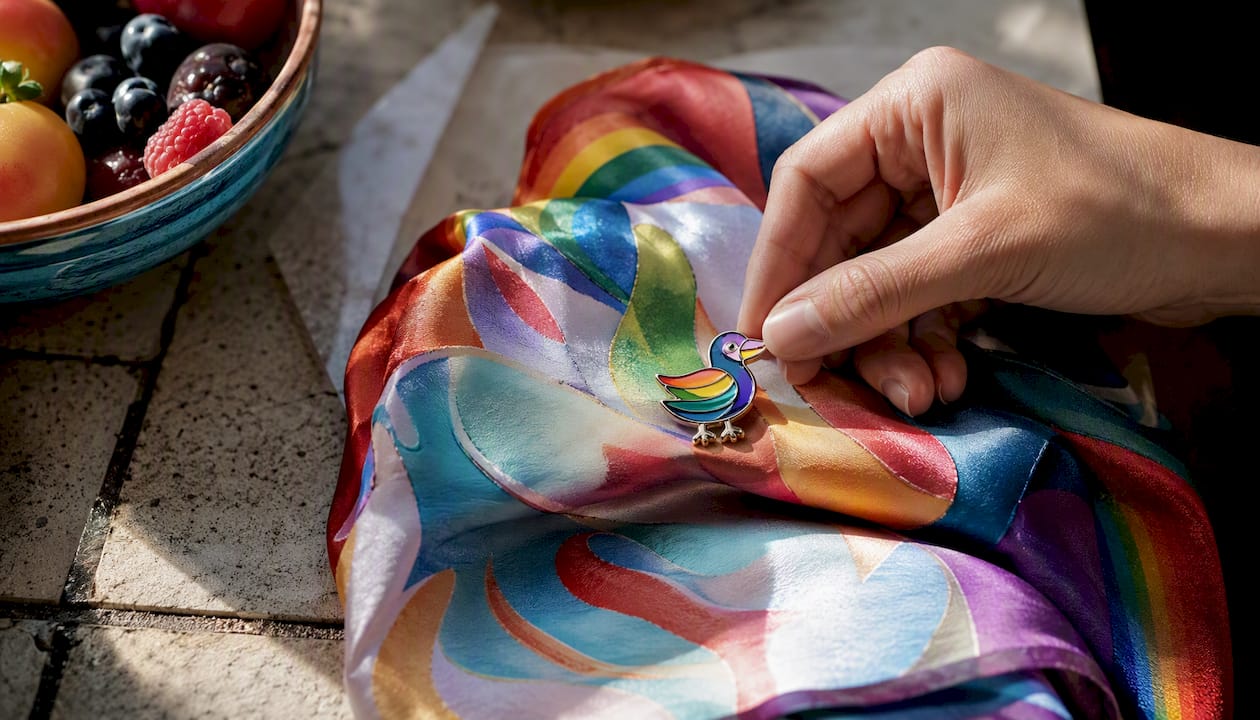
Wearable art: scarves, enamel pins, jewelry Wearable pieces let the recipient carry identity affirmation into daily life. Enamel pins and pronoun jewelry are especially useful for someone who prefers subtle signals over a statement wall piece. A hand-illustrated silk scarf from a queer textile artist sits at the elevated end of this category.
Home decor: neon signs, ceramics, throw blankets Statement home pieces work for recipients who are openly out and want their space to reflect that. A neon sign like Flymiami’s Proud Love Neon reads as art first and Pride symbol second, which is exactly the balance many people want. Ceramics and throw blankets from queer potters and weavers are quieter options for someone who prefers texture over text.
Small objects: stickers, patches, pins Sticker packs and iron-on patches are the most accessible gift in this list, and they are not trivial. For a younger recipient or someone building their identity vocabulary, a carefully chosen set of queer-made stickers can feel more personal than an expensive print they have nowhere to hang.
Art supplies and creative kits If the recipient is a practicing artist, a premium tool or a curated kit often means more than another decorative object. ArtPlacer’s gift guide makes the case that career-forward gifts, including platform subscriptions and professional-grade materials, can be more meaningful than physical art objects. Jackson’s Art Supplies and Blick both carry curated gift sets worth considering.
Experience gifts: studio classes, gallery memberships A local gallery membership or a weekend studio class gives the recipient time inside a creative community, not just an object. For someone newly exploring their artistic identity, this can be the most affirming gift of all.
Pro Tip: Balance symbolism with style. A rainbow flag motif is clear and celebratory, but a piece that uses the recipient’s preferred flag colors (bisexual, nonbinary, trans) or their personal aesthetic tells them you paid attention. Check color symbolism in Pride art before you finalize a choice.
How do you choose a Pride-art gift that feels affirming, not tone-deaf?
The wrong gift can feel like you made assumptions. These questions and steps keep the choice respectful.
- Ask about outness and safety first. Is the recipient openly out at home, at work, or both? A large statement piece is a celebration for someone fully out; it can be a liability for someone who is not. When in doubt, choose something discreet or easily stored.
- Consider their style, not just their identity. Someone who decorates in mid-century modern does not want a neon sign, regardless of how affirming it is. Match the art to the space and the taste.
- Check pronouns and identity signals. A gift that uses the wrong pronouns or the wrong flag colors is worse than a generic gift. If you are not certain, ask a mutual friend or keep the piece identity-neutral.
- Opt for queer-made work when possible. GLAAD’s representation resources consistently show that visibility and economic support for LGBTQ+ creators reinforce community well-being, not just individual pride. Buying from a queer artist doubles the meaning.
- Ask permission before commissioning something deeply personal. A portrait of someone’s relationship or a piece depicting a private moment of coming out requires consent. A brief “I want to commission something special for you, would you be open to it?” is enough.
- Avoid stereotyped or fetishizing imagery. Not every Pride-themed product is made with care. Skip pieces that reduce identity to a punchline or that sexualize queer bodies without context.
- Choose discreet packaging for safety-sensitive recipients. Plain outer boxes with no visible branding or Pride imagery protect recipients who live in unsupportive households. More on this in the packaging section below.
Two quick scenarios: A friend who is openly out and decorates boldly gets a statement piece, maybe a limited-edition original or a neon sign. A coworker you know is queer but private gets a small, beautifully made enamel pin or a framed archival print in a plain sleeve. The checklist above changes the answer completely depending on who you are buying for.
For guidance on avoiding tokenism in art selection, the partner essay on choosing art beyond flags and symbols is worth reading before you finalize anything.
Where can you buy Pride art in the U.S. while supporting queer makers?
The channel matters as much as the product. Here is where to look and how to verify your purchase actually benefits the artist.
- Artist websites and studio shops: Buying directly from the artist’s own site means the full sale price goes to the maker, not a platform taking a cut. Flymiami’s Pride Collection is one example of a studio-direct shop where every purchase supports the artist’s practice.
- Pride pop-ups and markets: Seasonal Pride markets in most U.S. cities run from May through July. These are the best places to meet artists in person, see work at scale, and confirm the maker’s identity directly.
- Queer-focused platforms and collectives: Several online collectives curate work exclusively from LGBTQ+ artists. Search for queer art collectives in your city or region; many have online shops that ship nationally.
- Galleries featuring LGBTQ+ artists: Galleries that program queer artists year-round, not just in June, are a reliable signal of genuine commitment. Ask the gallery directly whether the artist receives a majority of the sale.
- Mainstream marketplaces with queer-made filters: Etsy’s “LGBTQ+ owned” shop filter and similar tags on other platforms are a starting point, but verify by reading the artist bio and checking the “sold by” information before purchasing.
How to verify you are supporting the artist: Read the shop’s “About” page, confirm the seller is the maker (not a reseller), and prefer direct-studio purchases over third-party fulfillment when the option exists.
Pro Tip: Pair a small purchase with a donation to an LGBTQ+ organization. The Ali Forney Center supports LGBTQ+ youth experiencing homelessness in New York and accepts donations nationally. Including a donation receipt in the gift package amplifies the message that you are supporting the community, not just buying a product.
Pride-season demand peaks in June. If you are ordering anything custom or shipped, place the order by mid-May to avoid delays.
How does commissioning a Pride artwork actually work?
Commissioning is the highest-meaning route, and it is less complicated than most people expect. Here is the typical workflow.
- Inquiry: Contact the studio with a brief description of what you have in mind, the recipient, the occasion, and your budget range.
- Brief: The artist sends a questionnaire or follows up with specific questions: size, color preferences, flag elements, display context, and any reference images you can share.
- Quote and deposit: You receive a price quote and a deposit request, typically 30–50% upfront. This secures your slot in the production schedule.
- Sketches and approval: The artist shares initial sketches or a digital mockup. You review and request adjustments before production begins.
- Production: The artist creates the piece. For UV-reactive works like those from Flymiami, this includes applying blacklight-reactive materials and finishing layers, a process documented on the studio’s process page.
- Final delivery: The completed work ships with care instructions, a certificate of authenticity, and tracking information.
For urgent timelines, services like FrameArto offer digital portrait delivery so you have something to present on the day while the physical piece ships.
Ranges reflect general U.S. market conditions and vary by artist, medium, and complexity. Confirm specifics with the studio before committing.
What to provide the artist:
- Reference images (photos of the recipient, inspiration pieces, or flag color palettes)
- Desired size and orientation
- Display context (wall, shelf, outdoor space)
- Preferred color palette or flag elements
- Shipping address and any privacy notes (plain packaging, no visible branding)
Pro Tip: If the recipient is an artist themselves, a studio upgrade, such as a premium brush set or an ArtPlacer subscription, can be more meaningful than another decorative piece. Career-forward gifts say you take their practice seriously.
Budget-friendly and DIY Pride-art gifts that still feel personal
Spending less does not mean meaning less. These options work at almost any price point.
Low-cost purchases to consider:
- Archival art prints from queer artists on Etsy or direct studio shops ($15–$60)
- Sticker packs from LGBTQ+ illustrators ($8–$20)
- Enamel pins with pronoun or identity designs ($10–$25)
- Iron-on patches for jackets or bags ($5–$15)
- A small framed photo with a rainbow mat from a local print shop ($20–$40)
- Pressed-flower art kits with Pride color palettes ($15–$35)
- The Pride Chocolate Box from Flymiami’s studio shop, a small themed collectible that ships ready to give
DIY ideas that take under two hours:
- Custom photo collage: Print 6–10 photos of shared memories, arrange them on a piece of cardstock with rainbow-colored washi tape borders, and frame it. Cost: under $15.
- Hand-painted pride rock: Smooth river rocks from a craft store, acrylic paint in flag colors, and a coat of Mod Podge to seal. Specific, tactile, and genuinely one-of-a-kind.
- Pressed-flower bookmark: Press flowers in flag colors (lavender, white, green for nonbinary; pink, blue, white for trans) between parchment paper for 48 hours, then laminate with a self-seal pouch. Takes two minutes of active work.
- Pronoun embroidery patch: A simple needlepoint kit from Michaels or Joann Fabrics, stitched with the recipient’s pronouns in their flag colors, then ironed onto a canvas tote or jacket.
Presentation lifts the perceived value of every budget gift. Wrap a sticker pack in tissue paper inside a small kraft box. Add a handwritten note explaining that the artist is queer-owned. That context, as Veranda’s gift guide notes about elevated artist gifts, is what separates a thoughtful present from a transaction.
How to present a Pride-art gift so the meaning comes through
The object is half the gift. The framing is the other half.
Short note examples to include:
“I chose this piece because it was made by a queer artist whose work I’ve been following. I wanted you to have something that was made for people like you, not just about them.”
“This is a limited-edition original, so no one else has exactly this piece. I thought that fit.”
“The artist ships with a certificate of authenticity. I’ve included it so you know exactly what you have.”
Pairing ideas that amplify the gift:
- A certificate of authenticity (most studios include one; ask if they do not)
- A donation receipt to the Ali Forney Center or a local LGBTQ+ youth organization
- A screenshot or printout of the artist’s bio and their statement about the work
- A curated playlist of queer artists that matches the mood of the piece
For recipients who are closeted or safety-sensitive: Keep the note brief and identity-neutral. “I saw this and thought of you” is enough. Request plain packaging from the seller and avoid any outer labeling that signals Pride content. The gift still carries meaning; it just travels quietly.
Pro Tip: When the recipient is not fully out, frame the gift around the art itself, not the identity. “I love this artist’s use of color” lands safely anywhere. The recipient knows what it means; no one else needs to.
How do you care for different types of Pride art gifts?
Care instructions depend almost entirely on the medium, and getting this wrong shortens the life of the piece significantly.
Archival prints and paper-based works: Keep out of direct sunlight, which fades even archival inks over time. Frame behind UV-protective glass or acrylic. Store unframed prints flat in acid-free sleeves, never rolled for long periods.
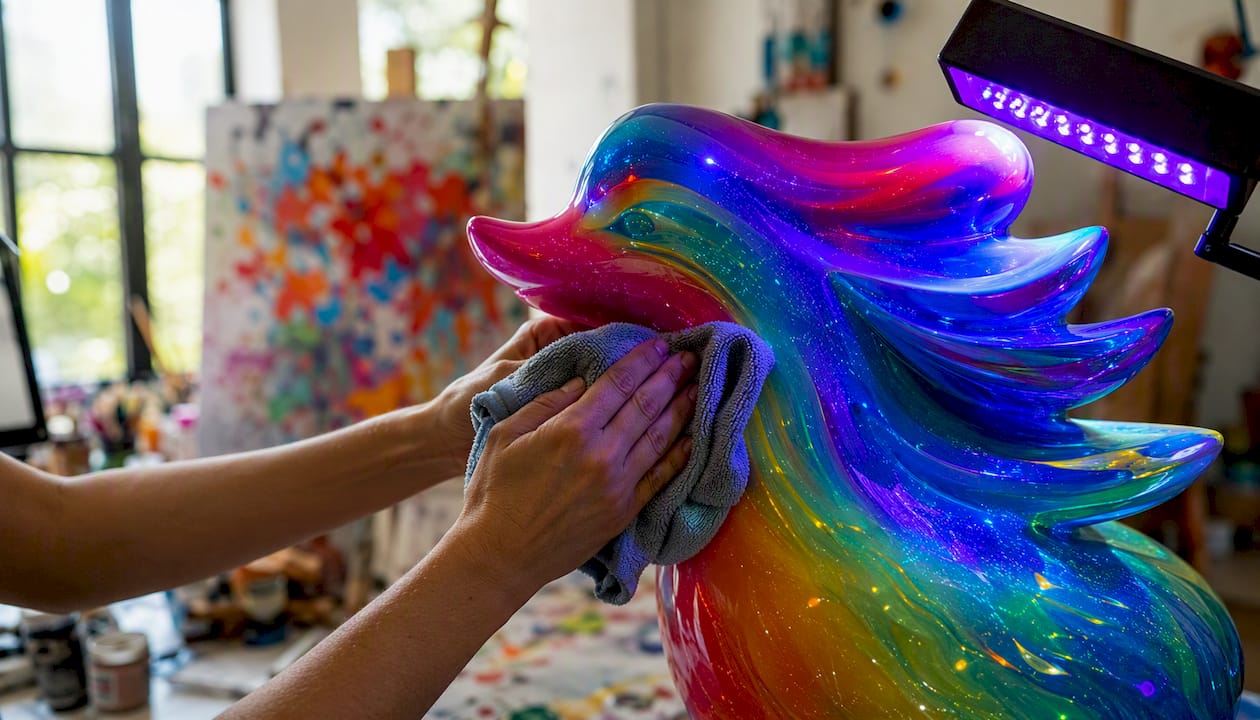
UV-reactive and blacklight art: Pieces like Flymiami’s UV glow works use specialty reactive materials that respond to blacklight. Clean the surface with a dry microfiber cloth only; no solvents or water-based cleaners, which can degrade the reactive layer. Keep away from prolonged direct sunlight, which can reduce the glow intensity over time. The studio’s process page details the materials used, which is worth reviewing before cleaning.
Neon and LED art: Dust with a dry cloth. Avoid hanging near HVAC vents where vibration can loosen connections. Most neon art ships with a power adapter; use only the included adapter to avoid voltage damage.
Ceramics and sculptural pieces: Handmade ceramics are typically not dishwasher-safe unless the artist specifies otherwise. Wipe with a damp cloth and dry immediately. Display away from edges where vibration or pets can knock them over.
Wearable art (enamel pins, jewelry): Store pins in a soft pouch or on a display board to prevent scratching. Clean enamel with a cotton swab and mild soap; avoid submerging. Silver-based jewelry benefits from an anti-tarnish strip in the storage box.
Textiles (scarves, patches, throw blankets): Follow the artist’s care label. Hand-wash or cold-machine-wash most hand-dyed or printed textiles; tumble dry low or air dry to preserve color saturation.
What are the legal and copyright rules when commissioning or buying reproduced art?
Copyright in the U.S. belongs to the artist the moment a work is created, under the Copyright Act of 1976. Buying a physical piece does not transfer copyright. That distinction matters practically.
What you own when you buy an original: The physical object. You can display it, resell it, and gift it. You cannot reproduce it, print copies, or use it commercially without a separate license from the artist.
What you own when you buy a print: A licensed reproduction. The artist retains copyright. Most print licenses are for personal display only; selling prints of someone else’s print is infringement.
Commissioning: When you commission a work, the artist still owns the copyright unless the contract explicitly transfers it. A “work for hire” agreement transfers copyright to the buyer, but this is uncommon in fine art commissions and must be in writing to be enforceable. Read the commission agreement before signing.
Reproduced art and fan art: Buying fan art of a copyrighted character (a Disney character, a Marvel hero) puts both the seller and buyer in a gray area. The original IP holder retains copyright. For Pride gifts, stick to original work or licensed reproductions to avoid this entirely.
Practical rule: Ask the artist for a written invoice that specifies what rights are included. For commissions, confirm in writing whether the artist will post the work on social media (some recipients prefer privacy). This is general information; consult an intellectual property attorney for specific legal questions.
Packaging and shipping considerations for Pride art gifts
Timing and discretion are the two variables most buyers underestimate.
Timing: Pride season peaks in June, and queer artist shops see their highest order volumes from mid-May through late June. Commission slots fill faster than print orders. If you want a custom piece for a June birthday or Pride event, place the inquiry in April. For ready-made pieces, order by early June for standard shipping or late May for ground shipping to be safe.
Discreet shipping: Many queer-owned studios offer plain outer packaging on request, with no visible branding, Pride imagery, or content description on the exterior. Ask explicitly when ordering. For recipients in unsupportive households, this is not a minor detail.
Fragile and sculptural pieces: Sculptures and neon art require double-boxing with foam inserts. Reputable studios handle this by default, but confirm the packaging method before ordering anything fragile. Ask whether the piece is insured in transit.
International shipping: If the recipient is outside the U.S., factor in customs declarations. Original art and limited-edition prints may require specific customs codes and can be subject to import duties depending on the destination country.
Digital delivery as a bridge: For last-minute gifts, a digital portrait or downloadable print gives you something to present immediately while the physical piece ships. Services like FrameArto offer this specifically for portrait commissions.
Why Pride art commissions matter beyond the object itself
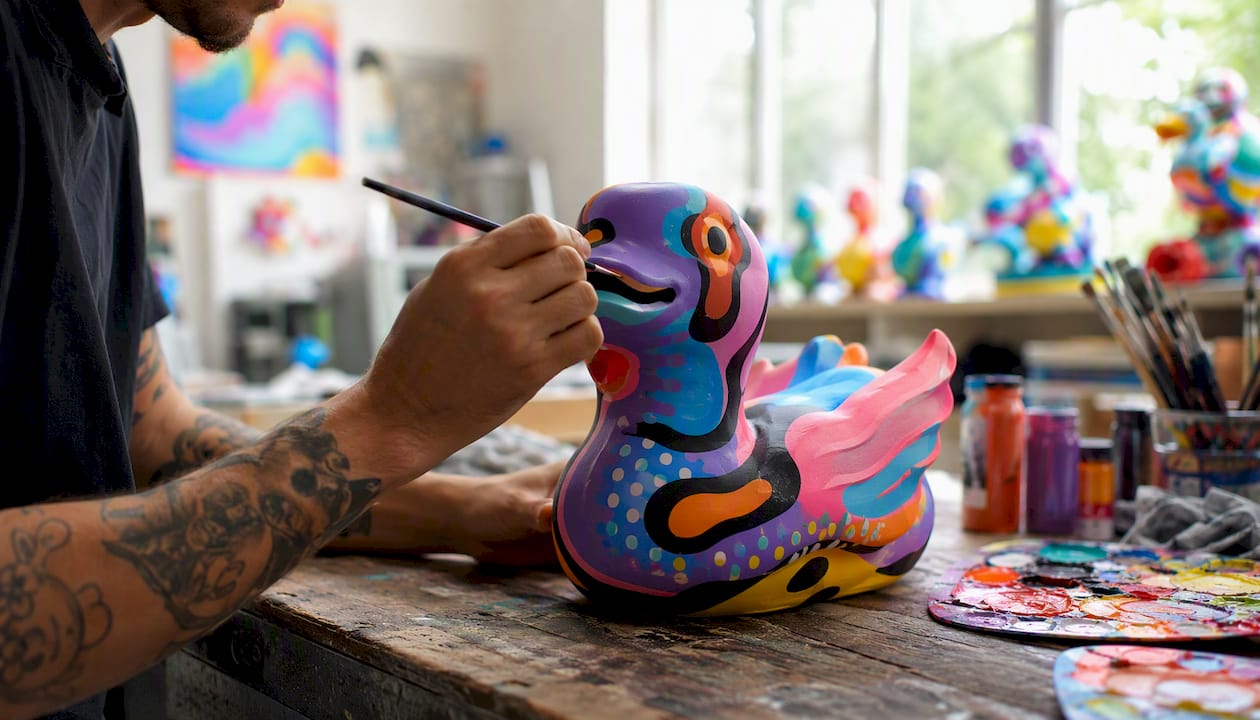
The work I make at Flymiami starts with a question I ask about every piece: does this celebrate the person, or does it just reference their community? There is a real difference. A rainbow gradient is easy. A piece that holds someone’s specific joy, their colors, their story, the way light changes it entirely under blacklight, that takes intention.
UV-reactive materials are not a gimmick in our studio. They are a way of saying that identity has layers, that what you see in one light is not the whole picture. The Glowing with Pride series came directly from that idea. The work has been featured in exhibitions and covered in press precisely because that concept resonates with people who have spent their lives being partially visible.
When someone commissions a piece for a loved one, the brief they send me is often the most honest thing I receive. They describe the person, not just the palette. That is where the real work begins. If you are considering a commission, reach out through the studio’s commission page and tell me about the person first.
Commission a Pride piece from Flymiami
Flymiami’s UV-reactive originals and sculptures are made to order for collectors, gift-givers, and anyone who wants a piece that does something no standard print can do: reveal itself differently depending on the light.
Ready-made Pride pieces ship from the studio now. Custom commissions are open for inquiry year-round. To start, you will need to share:
- A brief description of the recipient and the occasion
- Preferred size and display context (wall, shelf, outdoor)
- Color palette or flag elements to incorporate
- Your budget range and timeline
- Any privacy or packaging notes
Lead times run 2–16 weeks depending on complexity. Shipping is tracked and insured; plain outer packaging is available on request.
Browse the wall art collection for ready-to-ship pieces, or visit the UV glow collection to see the blacklight-reactive works before reaching out about a custom piece.
Sources
These are vetted starting points for finding queer artists, verifying sellers, and supporting the community alongside your purchase.
- Glaad
- Aliforneycenter
- Portrait Gift — FrameArto
- Gifts for creatives — ArtPlacer
- Gifts for artists — Veranda