Pop Art Studio Guide for Collectors, Hotels & Galleries
FLY Miami Art, led by award-winning artist Facundo Yebne, sells original Pop Art sculptures, limited editions, and accepts custom commissions for collectors, galleries, hotels, and public institutions across the United States. You can browse available works or request a commission today at Flymiami.
Ready to commission or buy? Here’s your immediate checklist:
- View the portfolio: Browse sculptures and UV-reactive pieces to identify the format and scale you need.
- Prepare a brief: Note your space dimensions, intended placement zone, opening date or deadline, and a rough budget band.
- Contact the studio: Reach out via flymiami.art with your brief; include reference images and any site constraints (ceiling height, load limits, blacklight capability).
- Expect a response: The studio reviews briefs and follows up with a concept direction and ballpark estimate before any deposit is required.
Facundo Yebne’s credentials as an award-winning artist, combined with documented exhibition history and media coverage, make Flymiami one of the most credible Pop Art studios operating in the U.S. market today. The studio process page walks through every production step, from concept sketch to mock assembly, so buyers know exactly what they’re signing up for before committing.
Key Takeaways
Commissioning a UV-reactive Pop Art sculpture from a credible studio requires a clear brief, staged approvals, engineering documentation, and a lighting plan that accounts for how the piece will actually read in your space.
| Point | Details |
|---|---|
| Start with a written brief | Include dimensions, placement zone, opening date, and budget band before contacting any studio. |
| Budget for finish quality | UV-stable lacquer and marine-grade topcoats protect long-term value; under-specifying finish is the most common buyer regret. |
| Typical timeline is 6–14 weeks | Plan several weeks for fabrication plus time for concept, prototype, engineering, and installation. |
| UV pieces need a lighting plan | Blacklight-reactive works require compatible UV or LED sources positioned for correct activation distance and angle. |
| Flymiami offers turnkey commissions | Facundo Yebne’s studio handles concept through installation for collectors, hotels, galleries, and institutions across the U.S. |
Table of Contents
- What does a Pop Art studio actually sell?
- How does the commissioning process work, step by step?
- What does a Pop Art sculpture commission cost?
- What materials and techniques define UV-reactive Pop Art?
- Shipping, installation, and what happens after delivery
- How do you choose the right Pop Art studio?
- What the studio believes about UV-reactive Pop Art
- Flymiami: commission or buy UV-reactive Pop Art now
- Sources
What does a Pop Art studio actually sell?
Flymiami’s catalog spans four main categories, each suited to a different buyer type and installation context.
One-of-a-kind originals are handcrafted, single-edition works. These carry the strongest resale trajectory and are the right choice for serious collectors who want provenance documentation and exclusivity.
Limited editions offer the same signature aesthetic at a more accessible price point. They’re popular with interior designers specifying multiple units across hotel floors or branded retail environments.
Site-specific commissions are built to a buyer’s exact dimensions, material palette, and thematic brief. A hotel lobby centerpiece, a gallery anchor piece, or a public plaza installation all fall here. The statement pieces collection shows the scale and visual weight these works can carry.
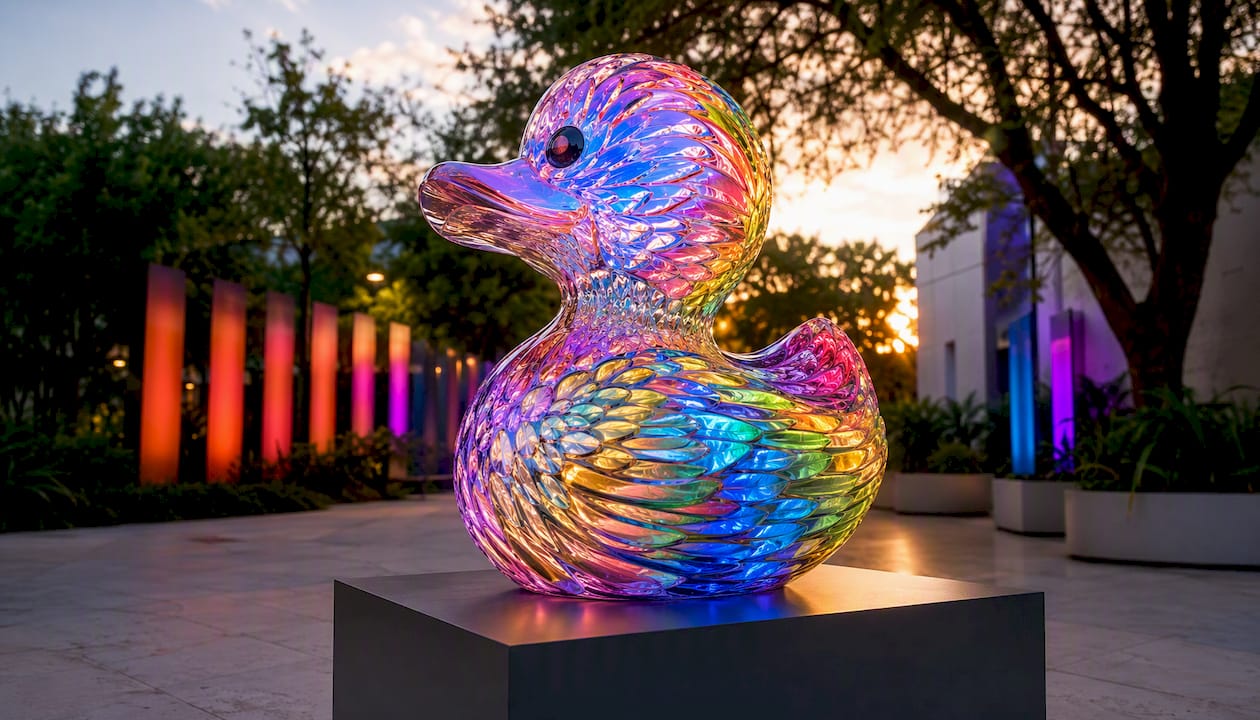
UV-reactive and blacklight installations are Flymiami’s most distinctive offering. Under standard lighting they read as vivid Pop Art objects; under UV or blacklight, hidden patterns, colors, and glowing details emerge. This dual-state effect works particularly well in hospitality environments, branded activations, and gallery shows designed around immersive experiences. For guidance on integrating this kind of lighting into a room’s architecture, the art lighting guide is a practical starting point.
| Format | Best for | Typical scale |
|---|---|---|
| Original sculpture | Private collectors, flagship galleries | Tabletop to 6 ft |
| Limited edition | Interior designers, hotels, brands | Tabletop to 5 ft |
| Site-specific commission | Hotels, institutions, public art | 3 ft to large-scale |
| UV-reactive installation | Hospitality, branded spaces, galleries | Any scale |
How does the commissioning process work, step by step?
The studio’s documented process follows a clear sequence that mirrors what professional fabricators recommend for commercial and hospitality commissions.
- Brief and concept: Buyer submits dimensions, site photos, budget band, and thematic direction. Studio returns a concept sketch or mood board for sign-off.
- Maquette or prototype: A scaled model or material sample is produced. This is the buyer’s primary approval checkpoint before full fabrication begins.
- Engineering and specifications: For larger works, structural calculations, load specs, and mounting hardware are finalized. Fabricators working in hotel and commercial contexts supply these documents for AHJ (Authority Having Jurisdiction) and fire-marshal review, per commercial sculpture standards.
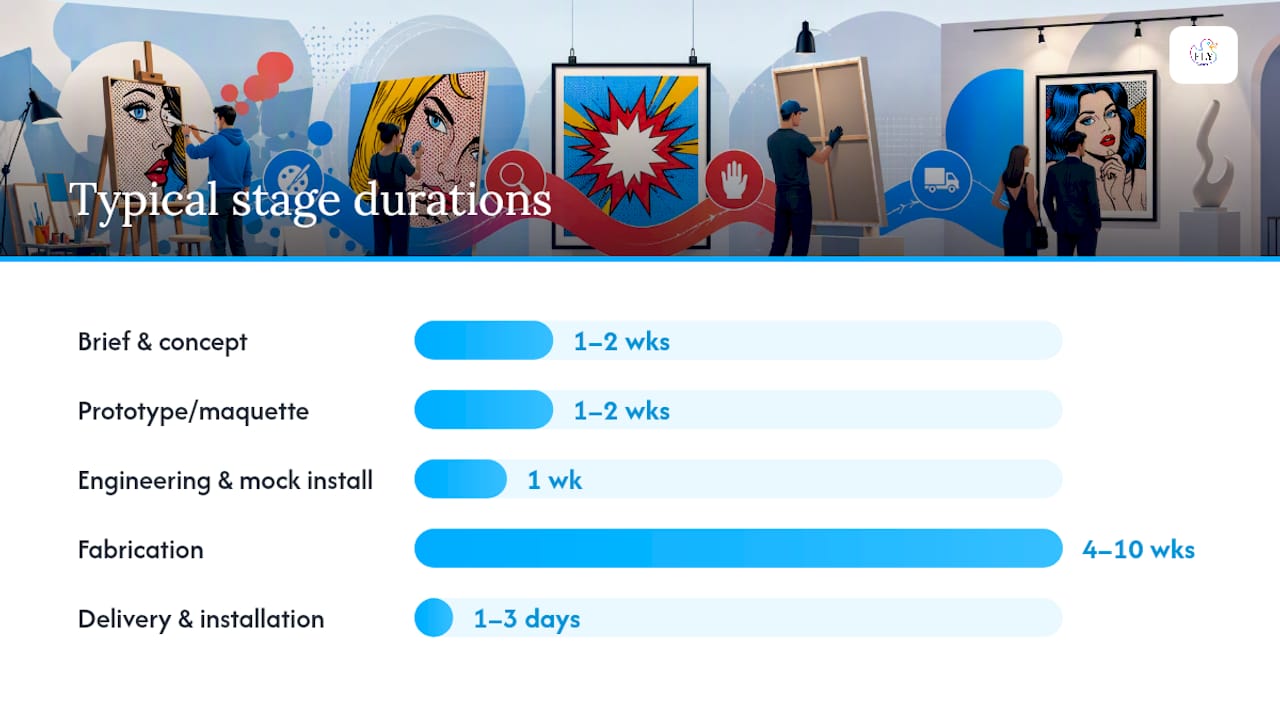
- Fabrication: Full-scale production. Typical project windows run 4–10 weeks for standard commissions; complex large-scale works with engineered armatures run longer.
- Pre-assembly and mock install: The piece is assembled in the studio before crating to catch fit and finish issues early.
- Crating and freight: Custom crating sized for standard door and elevator openings. Art shippers with white-glove handling are used for high-value pieces.
- On-site installation and sign-off: Rigging crew, GC coordination, and final buyer sign-off on placement and finish.
| Stage | Buyer action | Typical duration |
|---|---|---|
| Brief and concept | Submit brief, approve concept | 1–2 weeks |
| Prototype/maquette | Approve sample or model | 1–2 weeks |
| Engineering/specs | Review and sign off on load docs | 1 week |
| Fabrication | Milestone check-ins | 4–10 weeks |
| Mock install and crating | Final studio approval | 1 week |
| Delivery and installation | On-site sign-off | 1–3 days |
Pro Tip: Lock in your opening date before fabrication starts, then work backward. Late engineering sign-offs are the single most common cause of delays on commercial commissions. If your project involves a crane or a restricted installation window (a hotel lobby, for example), confirm rigging logistics at the engineering stage, not the week before delivery.
What does a Pop Art sculpture commission cost?
Pricing depends on five variables: scale, material, finish complexity, engineering requirements, and installation logistics. There is no universal rate card, and any studio that quotes a flat price without knowing your site and brief should raise a flag.
For interior collectibles (tabletop to roughly 3 ft), budget ranges are meaningfully lower than for lobby-scale or public-art commissions, where engineered armatures, specialty finishes, and rigging add substantial cost. Hotel and resort projects show that material selection alone, from UV-stable FRP to mirror-polished stainless, can shift a project budget significantly.
The main cost drivers, in rough order of impact:
- Scale and structural complexity: Larger works need engineered armatures and, often, modular fabrication for transport.
- Material: Mirror-polished stainless and bronze cost more upfront but last decades outdoors. FRP/composite with automotive paint is lighter and less expensive, suited to interior and short-to-medium-term outdoor use.
- Finish quality: Multi-stage base coats, color coats, and UV-stable clear lacquer add cost but protect the investment. Pop art fabrication standards recommend at least two layers of UV-stable clear lacquer for any piece with outdoor or high-UV-exposure placement.
- Lighting integration: UV-reactive pieces require compatible LED or UV light sources, which add to both fabrication and installation budgets.
- Freight and rigging: Custom crating, white-glove shipping, and crane or lift access are real line items, especially for large works.
Pro Tip: The finish is where most buyers underinvest. A marine-grade topcoat and UV-stable lacquer on a coastal or high-humidity install will cost more upfront and save you a full refinishing job within five years. Ask for the specific topcoat product and its UV and salt-air ratings before approving the finish spec.
What materials and techniques define UV-reactive Pop Art?
Pop art sculpture studios typically work across three material families, each with a distinct performance profile.
- Fiberglass/composite (FRP): Lightweight, highly moldable, and compatible with automotive paint systems. Best for interior works and medium-term outdoor pieces. Takes UV-reactive pigments well.
- Mirror-polished stainless steel: The material of choice for long-term outdoor permanence. Reflects the environment and amplifies the visual impact of surrounding light sources, including UV installations.
- Bronze and painted bronze: Heritage material with strong resale associations. Heavier and more expensive, but carries a finish longevity that FRP cannot match in harsh environments.
- Resin and acrylic: Used for light-transmitting elements and smaller sculptural details. Pairs naturally with LED and UV light sources embedded in the work.
UV-reactive pieces add a layer of engineering that standard sculptures don’t require. The pigments must be compatible with the base material and topcoat system, the UV or blacklight sources need to be positioned at the correct distance and angle for full activation, and the finish must be maintained to preserve glow intensity over time. Dan Flavin’s corner-installed fluorescent works demonstrated decades ago that light-based sculpture changes a room’s perceived scale and atmosphere, and that effect depends entirely on precise site integration. The same principle applies to blacklight-reactive Pop Art: placement, ceiling height, and reflected surfaces all affect the final result.
For hospitality buyers, material and lighting choices should connect directly to brand identity. Illuminated acrylic reads as contemporary and playful; bronze signals permanence and heritage. Flymiami’s UV-reactive works occupy a distinct position: high-energy and visually surprising, they suit lifestyle hotels, branded retail, and gallery environments where the “reveal” under blacklight becomes part of the guest experience. For more on how sculptural lamps and light-integrated objects command attention, the principles of light direction and surface reflection apply directly to UV sculpture placement.
Pro Tip: For UV-reactive pieces, ask the studio for a blacklight demonstration of the actual finished surface, not just a reference image. Pigment intensity varies by batch and topcoat, and what looks vivid in a photo may read differently at your ceiling height and room depth.
Shipping, installation, and what happens after delivery
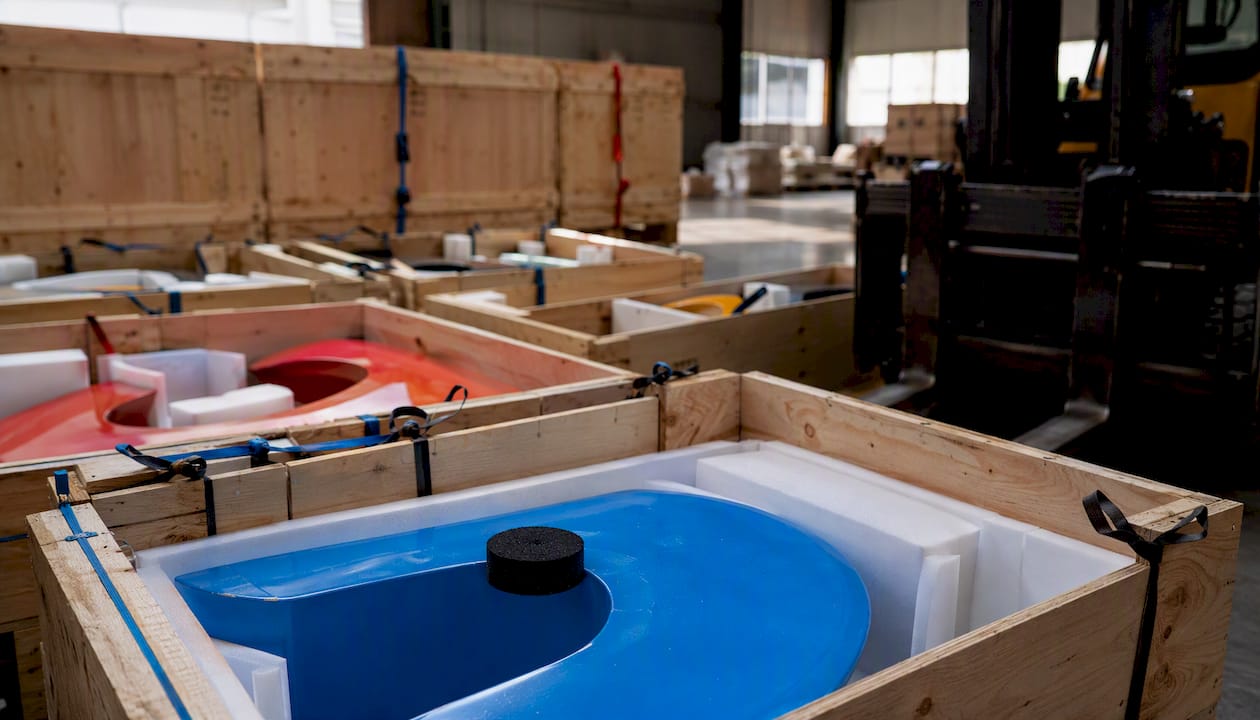
Logistics planning starts at the engineering stage, not after fabrication. Modular construction, where a large work is fabricated in sections that reassemble on site, is standard practice for anything that won’t fit through a standard door or elevator. Commercial fabricators treat large removable sculptures as FF&E for code review purposes, which means fire-retardant finish certificates, material data sheets, and engineered load calculations need to be ready before the AHJ or fire marshal signs off.
| Logistics element | What to confirm before installation |
|---|---|
| Crating and freight | Custom crate dimensions fit building access points |
| Load calculations | Structural engineer sign-off for wall or ceiling mounts |
| Fire/finish certificates | Compliance documentation for fire-retardant finish and material data sheets |
| Rigging and access | Crane schedule, GC night-shift window, guest-route protection |
| Transit insurance | All-risk coverage from studio to final placement |
| Installation insurance | Liability coverage for on-site crew and property |
Post-installation, painted composite works benefit from annual inspections and topcoat touch-ups, particularly in coastal or high-humidity environments. UV-reactive pieces should have their light sources checked and replaced on the manufacturer’s recommended cycle to maintain glow intensity. The studio can advise on specific maintenance schedules for each piece at the time of delivery.
Pro Tip: Request the installation and maintenance manual as a contract deliverable, not an afterthought. It should specify the topcoat product, touch-up procedure, UV light source model, and replacement interval. A piece without documentation is harder to maintain and harder to insure.
How do you choose the right Pop Art studio?
The portfolio is the first filter, but it’s not the only one. A studio that produces beautiful small-scale works may not have the engineering capacity for a 15-foot lobby installation. Here’s what to verify before signing anything.
Selection criteria:
- Portfolio relevance: Has the studio completed work at your scale and in your installation context (hotel, gallery, public space)?
- Engineering capability: Can they produce load calculations and material certificates for AHJ review?
- Installation experience: Have they managed rigging, GC coordination, and modular reassembly on comparable projects?
- References: Will they provide contact details for two or three past commercial clients?
- After-sales support: Do they offer maintenance guidance, touch-up services, and warranty terms in writing?
Questions to ask before committing:
- What does your prototype or maquette approval process look like?
- Who handles engineering, and will I receive stamped load calculations?
- What transit and installation insurance do you carry, and can you provide certificates?
- What are your payment stages, and what does each stage release?
- Can I visit the studio during fabrication?
- What warranty do you offer on finish and structural integrity?
Red flags to watch for:
- Vague or verbal-only timelines with no milestone schedule
- No material samples or prototype step in the process
- Reluctance to provide references or written warranties
- Missing load calculations or engineering documentation for wall/ceiling mounts
- A single lump-sum payment structure with no staged releases
Running hotel art commissions professionally requires structured briefs, well-drafted contracts, and coordinated production planning. The same discipline applies whether you’re a hotel procurement team or a private collector placing a first major commission.
What the studio believes about UV-reactive Pop Art
Most buyers focus on the visual effect of a UV-reactive sculpture and underestimate the engineering behind it. Getting the glow right is not just a materials question; it’s a site integration question. The distance between the UV source and the surface, the reflectivity of surrounding walls, the ambient light level in the room — all of these affect what the viewer actually sees. A piece that glows brilliantly in the studio can look flat in a high-ambient-light lobby if the lighting plan hasn’t been thought through.
The deeper point is that Pop Art has always been about the relationship between an object and its environment. Warhol understood that context is content. A UV-reactive sculpture that reveals a hidden image under blacklight is doing exactly that: it changes what the work means depending on who’s looking and under what conditions. That’s not a gimmick. It’s the thesis.
After-sales support from Flymiami includes:
- Maintenance guidance and recommended topcoat products specific to each piece
- Touch-up and refinishing services for painted composite works
- UV light source specifications and replacement guidance for blacklight pieces
- Written warranty terms covering structural integrity and finish
Facundo Yebne’s work has been featured in prestigious exhibitions and covered by major media outlets, and the studio’s Pop Culture Series documents the range of signature works available.
Flymiami: commission or buy UV-reactive Pop Art now
Flymiami specializes in UV-reactive Pop Art sculptures with turnkey fabrication and installation, built for collectors, galleries, hotels, and institutions that want something genuinely original, not a decorator’s safe choice.
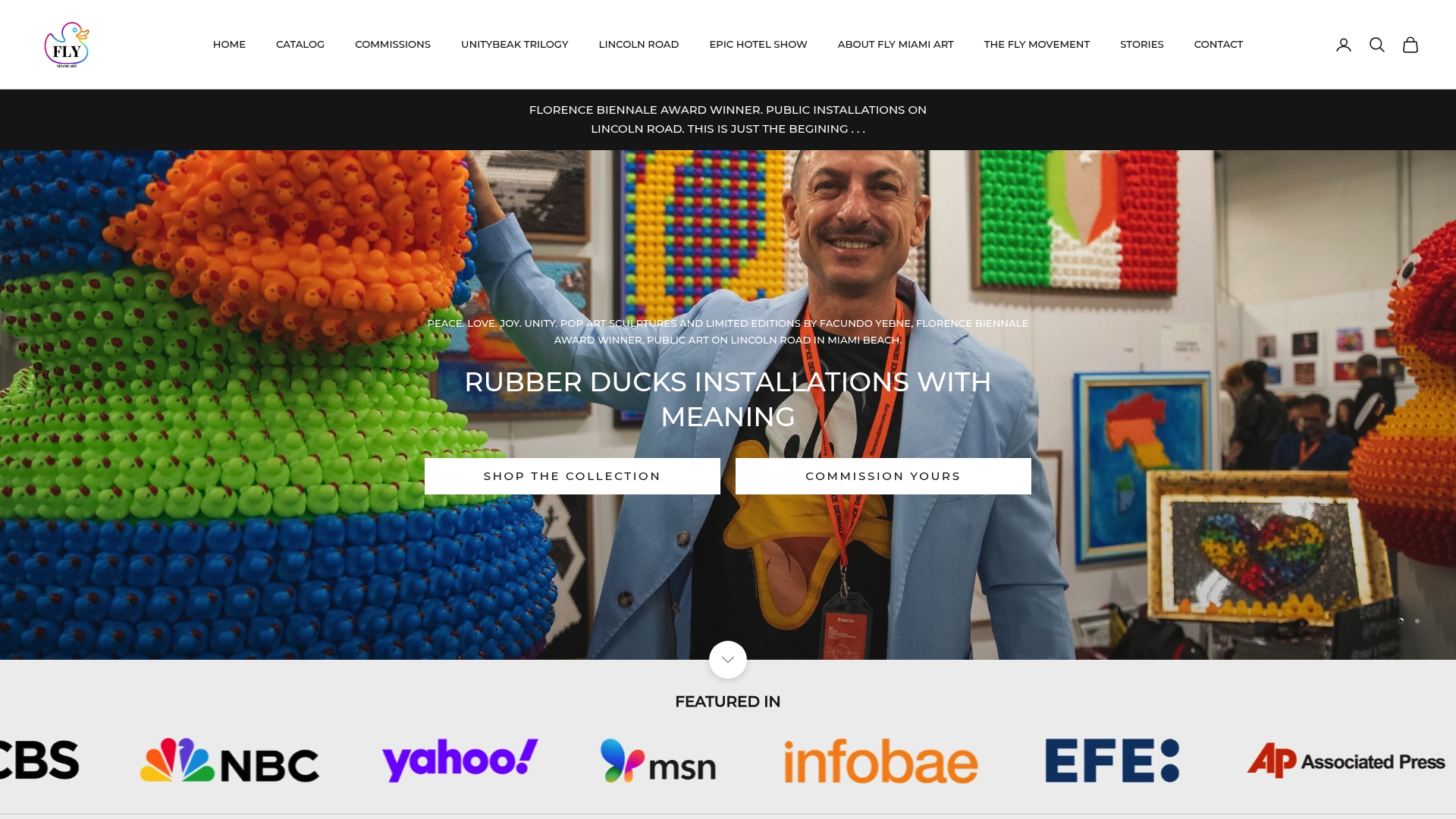
The studio handles everything from concept to on-site installation. To start, send a brief that includes your space dimensions, placement zone, opening date, and rough budget. Browse the sculpture collection and statement pieces to identify the scale and format that fits your project, or go directly to the UV-reactive works if the blacklight effect is your priority. The studio process page shows every production step so you know what to expect. Request a quote or book a consultation at flymiami.art.
Sources
- dan flavin: grids — David Zwirner Gallery, designboom
- Custom Art Sculptures for Hotels & Commercial Spaces | Weiya Art
- Pop Art Sculpture: Ideas, Materials and Placement Guide
- Hotel Sculpture Design: How Custom Art Boosts Guest Experience & Property Value — Y Sculptures
- Hotel Art Commissions: How to Work With Artists
To request a full project dossier, case studies, or client references, contact the studio directly through flymiami.art. The portfolio, process documentation, and past exhibition records are available on request.