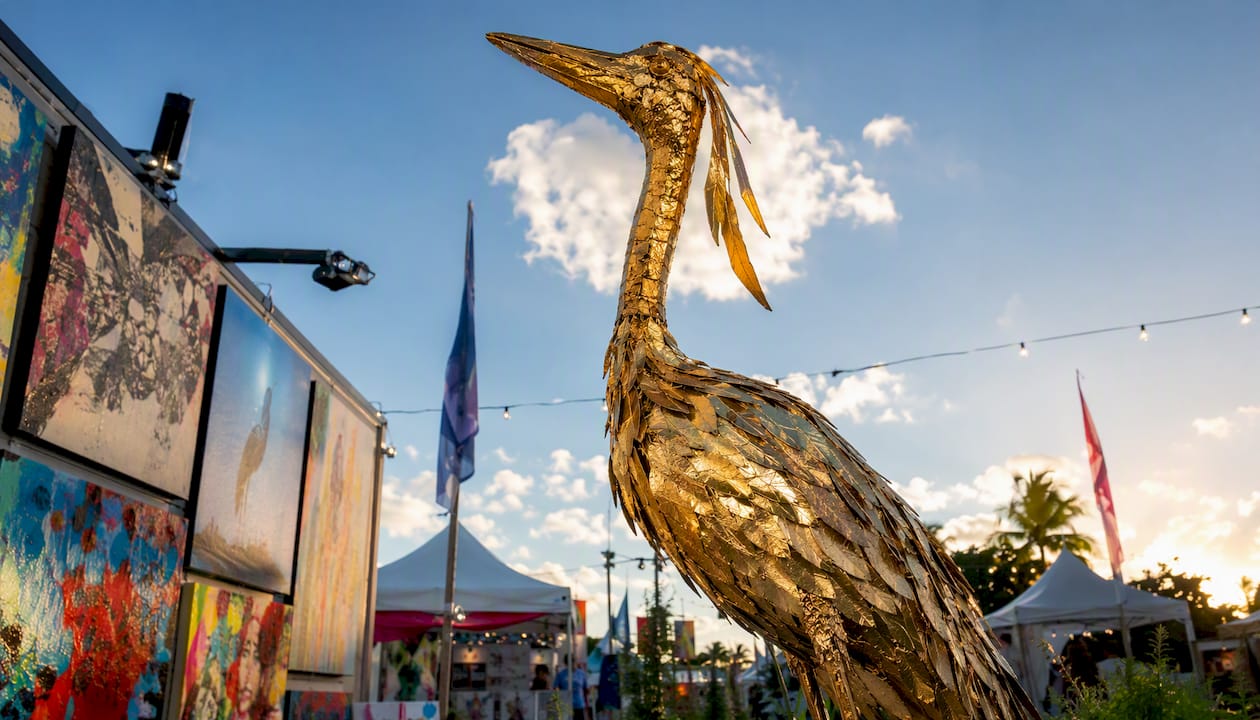
The Golden Crane: Symbolism, Art, and Cultural Meaning
The “golden crane” is a cross-cultural motif that uses the crane, often gilded, crowned, or rendered in gold tones, to symbolize longevity, peace, and high status. You’ll find it woven through Japanese senzaburu traditions, the story of Sadako Sasaki at Hiroshima Peace Park, the real-world plumage of the Gray Crowned Crane of Africa, fictional heraldry in Robert Jordan’s Wheel of Time, and contemporary studio art like the UV-reactive sculptures of Facundo Yebne at FLY Miami Art. Whether you’re researching the motif’s symbolism, shopping for wall art, or commissioning a piece, the golden crane carries centuries of layered meaning that artists still find worth exploring.
Key Takeaways
The golden crane is one of the most durable motifs in world art because its core meanings, longevity, peace, and sacred status, translate across cultures and materials without losing their force.
| Point | Details |
|---|---|
| Cross-cultural motif | The golden crane carries distinct meanings in Japanese, Chinese, Korean, and African traditions, but gold consistently signals the sacred or exceptional. |
| Senzaburu and Sadako | Folding 1,000 cranes connects to a belief that cranes live 1,000 years; Sadako Sasaki’s story made the folded crane a global peace symbol. |
| Gold’s symbolic weight | Gold signals permanence, rank, and the sacred across cultures, amplifying the crane’s existing associations with longevity and nobility. |
| Buying and displaying | Gold-leaf and metallic works need indirect light and 40–55% humidity; UV-reactive pieces require a 365nm blacklight source to reveal their secondary layer. |
| Flymiami commissions | Facundo Yebne’s studio offers limited-edition and custom golden-crane-inspired works using UV-reactive and mixed-media techniques, available via the online storefront. |
Table of Contents
- What does the golden crane symbolize across cultures?
- Where did the golden crane motif come from?
- How does the golden crane appear outside East Asia?
- How does the golden crane appear in literature and pop culture?
- How does the golden crane appear in visual art, design, and home décor?
- How do contemporary artists make golden-crane artworks?
- How should you display golden-crane art at home or in public spaces?
- How do Japanese, Chinese, and Korean artists depict the golden crane differently?
- Why does gold carry such specific meaning in the golden crane motif?
- What festivals and memorials use crane imagery?
- Why the golden crane still matters to artists working today
- Golden-crane art you can commission or buy from the studio
- Sources
What does the golden crane symbolize across cultures?
The crane’s symbolic vocabulary is unusually rich, and the addition of gold amplifies nearly every meaning it already carries.
- Longevity and immortality. In Chinese mythology, cranes are associated with immortals and frequently depicted alongside pine trees and tortoises, the other great longevity symbols of East Asian art. Taoist tradition held that immortals rode cranes to the heavens.
- Peace and healing. Sadako Sasaki’s story transformed the folded paper crane into a modern emblem of peace, and memorials worldwide now use it to mark collective grief and hope.
- Good fortune. In Japan, the crane is called the “bird of happiness,” and presenting a gift of many folded cranes is still considered a powerful wish for health and luck.
- Fidelity and marriage. Cranes mate for life, which made them natural symbols for wedding gifts and marital vows across East Asia.
- Wisdom and nobility. Gold specifically signals rank, sacredness, and visibility. A gilded crane on a painted screen or lacquered panel reads immediately as a high-status object, not merely decorative.
Gold earns its place in this motif for practical as well as symbolic reasons. On dark ink-wash backgrounds or lacquered surfaces, gold leaf catches light in ways that matte pigments cannot. Artists from 17th-century Kyoto to contemporary Miami studios use that contrast deliberately: the crane glows, and the glow is the point.
Where did the golden crane motif come from?
The crane’s symbolic life in East Asia stretches back at least two millennia. In Chinese court culture, the bird ranked just below the phoenix in the hierarchy of auspicious creatures, and its association with longevity made it a standard motif on robes, ceramics, and garden design. Japanese culture absorbed and adapted these meanings: the crane became tsuru, the bird of happiness, and the belief that cranes could live a thousand years gave rise to the senzaburu tradition of folding 1,000 paper cranes as a wish for long life.
The count of 1,000 is not arbitrary. It maps directly onto that traditional lifespan belief, so the physical act of folding becomes a ritual of accumulated intention. Origami practitioners and cultural historians both emphasize that the ritual is symbolic, not empirical: the number is the wish.
One of the most celebrated museum-grade examples of the golden crane in Japanese art is the Anthology with Cranes, a 17th-century collaboration between painter Tawaraya Sōtatsu and calligrapher Hon’ami Kōetsu. Gold and silver cranes sweep across large-format scrolls and screens, their bodies rendered in metallic pigment against ink-washed paper. The BirdLife International account of Japanese crane art describes how this work set a template for high-status decorative art that artists have returned to ever since.
Sadako’s story, documented at the Hiroshima Peace Park, did something no court artist could have planned: it democratized the crane. A motif that once signaled imperial status became a symbol in which anyone with a square of paper could participate.
How does the golden crane appear outside East Asia?
The golden crane is not exclusively an East Asian idea. Across Africa, the Gray Crowned Crane carries a literal crown of golden feathers, and that physical trait generated its own legend. According to World Birds, an African story tells of a crane that guided a lost king to an oasis; in gratitude, the king rewarded the bird with a crown of gold. The legend explains a natural feature through an act of royal recognition, which is exactly how origin myths tend to work.
In European traditions, cranes appear as vigilant sentinels, a role Aristotle described and medieval bestiaries repeated: cranes stand watch at night, holding a stone in one foot so that if they fall asleep, the stone drops and wakes them. That image of tireless watchfulness gave the crane a psychopomp quality in some Celtic traditions, where it guided souls between worlds.
Native American cultures, particularly those of the Great Plains, associated cranes with rain-making and seasonal migration, reading their arrival as a signal of environmental change. These meanings don’t overlap neatly with East Asian longevity symbolism, which is worth noting. The golden crane is not a monolithic symbol with one fixed meaning. It’s a visual form that different cultures have loaded with their own priorities, and the gold element tends to signal “sacred” or “exceptional” in nearly all of them.
How does the golden crane appear in literature and pop culture?
The motif has migrated into fiction and contemporary design in ways that range from the earnest to the purely aesthetic.
- Wheel of Time. Robert Jordan’s fantasy series uses the Golden Crane as the heraldic device of Malkier, a fallen kingdom whose banner becomes a rallying symbol for its exiled people. It functions exactly as a real heraldic crane would: as a mark of noble lineage and lost sovereignty.
- Sadako in literature and memorial culture. Eleanor Coerr’s Sadako and the Thousand Paper Cranes (1977) brought the senzaburu story to American classrooms and made the folded crane a recognizable peace symbol for generations of readers. The BirdLife International piece on Japanese crane art traces how Sadako’s story accelerated the crane’s transition from longevity symbol to peace emblem.
- Stock imagery and design. Search any major image library and you’ll find thousands of golden crane illustrations, from flat vector graphics to photorealistic gold-leaf renders. The motif is a staple of luxury branding, wedding stationery, and interior design mood boards.
- Contemporary art. Studios working at the intersection of traditional motifs and modern materials, including Flymiami, treat the crane as a starting point for exploring how ancient symbols read in a pop-art context.
How does the golden crane appear in visual art, design, and home décor?
The motif translates across a wide range of formats, and the material choice changes the emotional register considerably.
Painted screens and scrolls carry the most historical weight. Gold-leaf cranes on folding screens (byōbu) were status objects in Japanese court culture, and museum collections from the Met to the Kyoto National Museum hold examples. Gold-leaf prints bring that tradition into a more accessible format: limited-edition prints on archival paper with genuine or imitation gold leaf are widely available from fine-art publishers and studios. Wall art prints cover the broadest price range, from mass-market posters to signed artist editions. Sculptures add dimension, and contemporary studios are experimenting with mixed-media approaches that combine traditional gilding with modern finishes. Textiles (silk, embroidered panels, wallpaper) carry the motif into interiors without requiring wall space. Origami installations, sometimes featuring hundreds or thousands of folded cranes suspended from a ceiling, are used in both memorial and celebratory contexts.
For material specifics:
- Gold leaf (genuine 22–24 karat or imitation) gives the most luminous, historically authentic finish but requires careful handling and UV-protective glazing.
- Metallic inks are more durable for prints and work well in high-humidity spaces like dining rooms.
- UV-reactive finishes add a contemporary layer: the piece reads one way in daylight and reveals hidden patterns under blacklight, a technique Flymiami uses across its UV glow art collection.
- Paper for origami ranges from standard kami to washi and foil-backed sheets; foil-backed paper produces the most visually striking folded cranes for display.
For placement: entryways suit large-format gold crane prints or sculptures (the symbolism of welcoming good fortune is literal). Dining rooms work well with textile or framed prints. Meditation or memorial spaces often use origami installations or smaller sculptural pieces. Public installations tend toward large-scale sculpture or suspended origami groupings.
Pro Tip: When displaying gold-leaf or metallic prints, position them where they catch indirect natural light rather than direct sun. Direct UV exposure fades metallic finishes faster than almost any other factor.
You can see how fine art galleries present gold-toned animal motifs to understand how lighting and framing choices affect the perceived value of a piece before you buy.
How do contemporary artists make golden-crane artworks?
Studio practice for golden-crane work sits at the intersection of traditional craft and contemporary materials science.
Gilding vs. metallic paint vs. UV-reactive finishes are the three main approaches. Traditional gilding uses genuine gold leaf applied over a sized (adhesive-coated) surface, burnished to a high sheen. It’s labor-intensive and expensive, but the result has a depth that metallic paint cannot replicate. Metallic paint, including gold acrylic and oil-based formulas, is more forgiving and better suited to large-scale work where cost would otherwise be prohibitive. UV-reactive finishes are a newer category: pigments that fluoresce under blacklight while appearing as standard colors in daylight. Layering UV-reactive paint under or over metallic finishes creates pieces that shift dramatically between lighting conditions.
Facundo Yebne’s studio, FLY Miami Art on Lincoln Road, works primarily in mixed-media sculpture and wall art using UV-reactive materials. The studio’s limited-edition pieces are handcrafted and designed to create immersive experiences, revealing hidden patterns and colors under blacklight. That approach connects directly to the golden crane’s traditional logic: a surface that rewards close attention, that shows you something different depending on how you look at it.
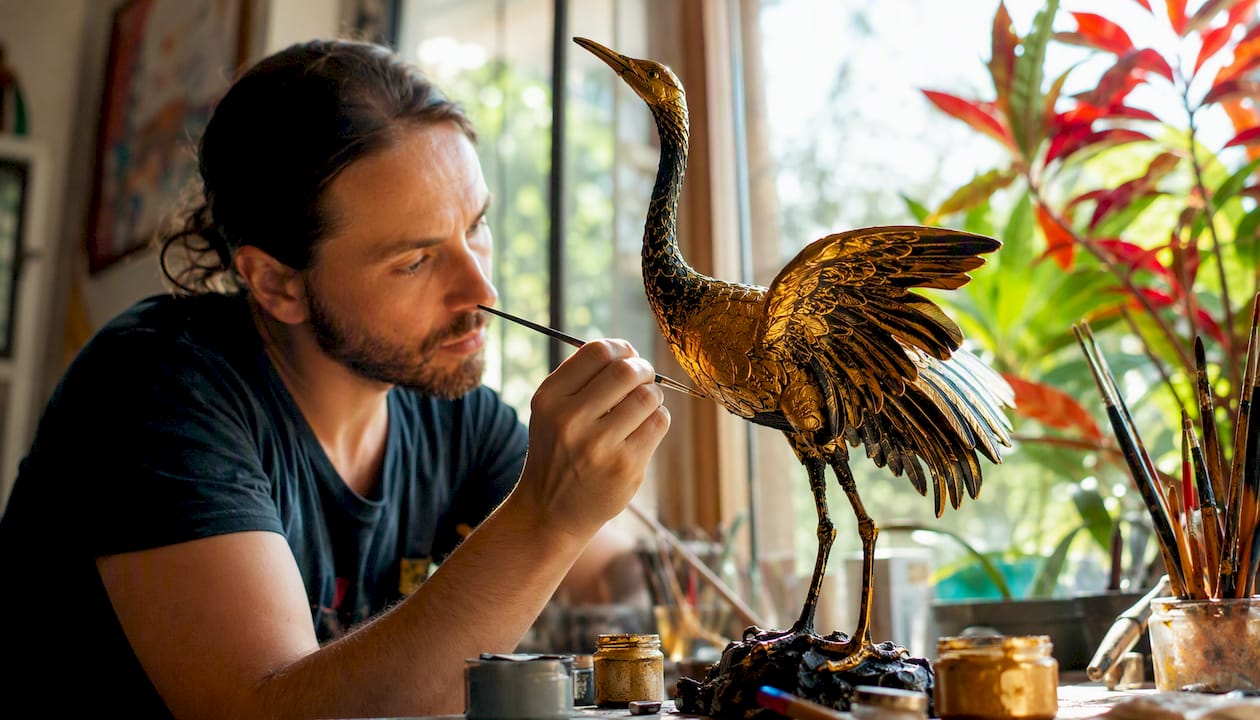
The studio process involves layering, substrate selection, and varnish choices that affect both the visual outcome and the long-term durability of the piece.
Care and handling for metallic and UV-reactive works:
- Keep pieces out of direct sunlight; UV exposure degrades both metallic finishes and UV-reactive pigments over time.
- Maintain relative humidity between 40–55% to prevent substrate warping.
- Clean with a dry microfiber cloth only; solvents strip metallic and UV coatings.
- For sculptures, handle with cotton gloves to avoid transferring oils to the surface.
- Store or ship in acid-free tissue and rigid crating.
Pro Tip: In gallery lighting, position metallic works under warm-spectrum LEDs (2700–3000K) rather than cool daylight bulbs. Warm light pulls out the yellow tones in gold leaf and metallic paint, making the piece read richer and more luminous.
How should you display golden-crane art at home or in public spaces?
Placement is where symbolism and interior design converge, and getting it right matters more than most buyers realize.
- Entryway or foyer: A single large-format crane print or sculpture here signals welcome and good fortune, which aligns with the motif’s traditional meaning. Keep the wall behind it neutral so the gold reads clearly.
- Dining room: Textile panels or framed prints work better here than sculptures, which can feel crowded on a table-adjacent wall. Gold tones pair naturally with warm wood furniture and amber lighting.
- Meditation or memorial space: Suspended origami installations or small sculptural pieces suit this context. The act of making the cranes matters as much as the display.
- Public or commercial installation: Large-scale sculptures or suspended groupings of folded cranes are the standard approach. Hotels, hospitals, and cultural institutions have all used crane installations for their associations with healing and peace.
- Blacklight rooms or immersive spaces: UV-reactive golden-crane pieces need a dedicated blacklight source (365nm UV LED strips work well) and a darkened environment to reveal their secondary layer. This format is increasingly popular in hospitality and gallery contexts.
Pro Tip: Pair gold-toned crane art with matte black, deep navy, or warm charcoal walls. High contrast makes the gold pop without competing with it. Avoid pairing with other metallic finishes in the same room unless you’re deliberately going for maximalism.
How do Japanese, Chinese, and Korean artists depict the golden crane differently?
The three traditions share a common symbolic vocabulary but apply it with distinct visual conventions.
Japanese depictions tend toward elegant minimalism: a single crane or a pair against a gold-leaf ground, often with negative space doing as much work as the painted form. The Rinpa school (Sōtatsu, Kōetsu, Ogata Kōrin) established this template in the 17th century, and it remains the dominant reference point for Japanese crane art. Gold is used as background, not just as a color applied to the bird.
Chinese depictions are typically more narrative. Cranes appear in groups, often with pine trees, clouds, and other longevity symbols, and the composition tells a story rather than presenting a single iconic form. Chinese mythology places cranes in the company of immortals, so the bird is often shown in flight toward a mountain or celestial realm. Gold appears as an accent, on feathers or halos, rather than as a ground.
Korean depictions (hak) occupy a middle position. The crane was a symbol of the Joseon dynasty’s scholarly class, and Korean crane art often appears on official robes (hak-chang-ui) and celadon ceramics. The rendering is precise and naturalistic compared to Japanese stylization, and gold is used sparingly, often as embroidery thread rather than paint or leaf.
Why does gold carry such specific meaning in the golden crane motif?
Gold’s symbolic weight in this motif goes beyond aesthetics. Across cultures, gold signals permanence: it doesn’t tarnish, corrode, or fade, which made it a natural material for objects meant to outlast their makers. In East Asian court culture, gold was a restricted material, its use on robes, screens, and temple objects regulated by sumptuary laws. A golden crane on a painted screen wasn’t just beautiful; it was a statement about who was allowed to own it.
In religious contexts, gold signals the sacred. Buddhist and Taoist iconography both use gold extensively to mark divine or enlightened figures, and cranes depicted in gold inherit that sacred register. The bird becomes not just a longevity symbol but a vehicle for transcendence.
In contemporary art, gold retains its luxury signal while gaining a layer of irony when used in pop or street-art contexts. That tension, between traditional reverence and contemporary irreverence, is exactly what makes the golden crane a productive motif for artists working at the intersection of cultural traditions and modern visual language.
What festivals and memorials use crane imagery?
The most significant memorial use of crane imagery in the world is the Hiroshima Peace Memorial, where paper cranes are left year-round at the statue of Sadako Sasaki. The Portland Japanese Garden’s Golden Crane Society names its highest-level donor recognition tier after the crane, connecting the symbol’s cultural prestige to institutional philanthropy.
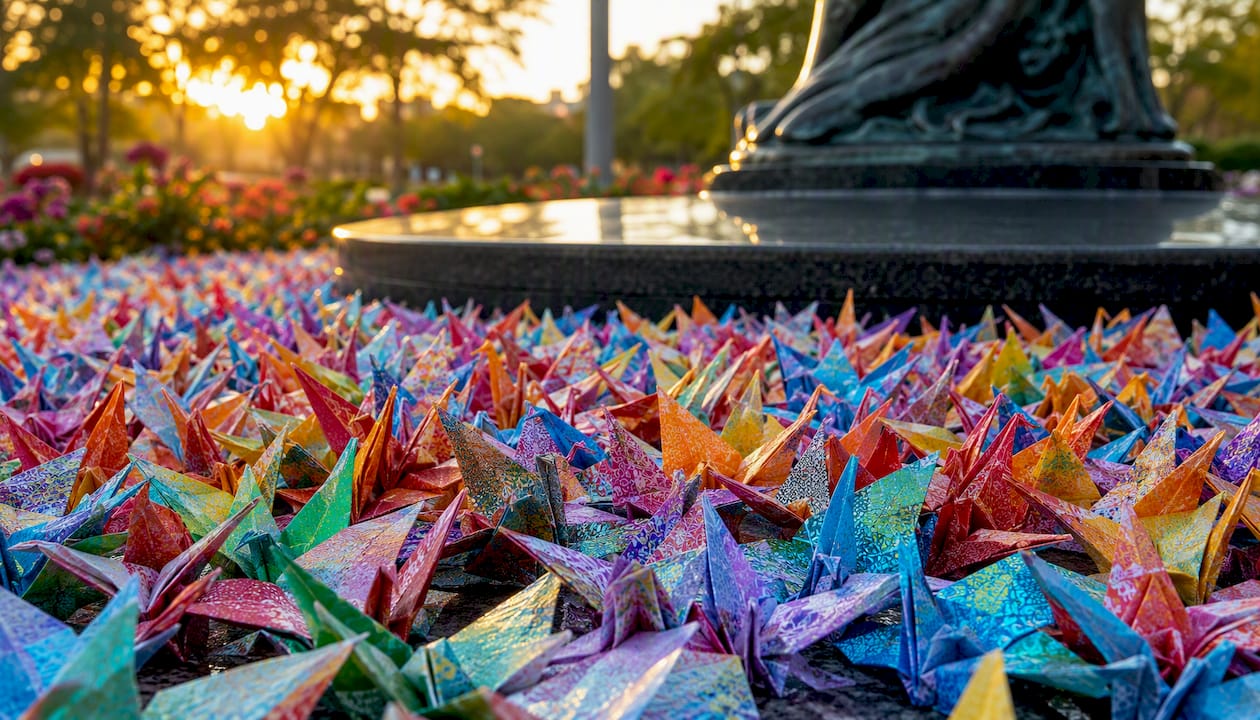
In Japan, the Tanabata festival (held in July or August depending on region) often incorporates origami cranes as part of wish-making traditions. Community groups fold cranes collectively for hospitals, disaster relief efforts, and anniversary memorials. After the 2011 Tōhoku earthquake and tsunami, thousands of crane installations were created worldwide as expressions of solidarity.
In Korea, crane dances (hakchum) are performed at court music festivals and UNESCO-recognized intangible heritage events. The dancer wears a crane costume and moves to represent the bird’s grace and longevity. In African communities where the Gray Crowned Crane is native, the bird appears in ceremonial contexts tied to rain-making and seasonal ritual, though specific festival practices vary widely by region and ethnic group.
Why the golden crane still matters to artists working today
The conventional wisdom about traditional motifs in contemporary art is that they need to be “subverted” or “deconstructed” to be relevant. I’d push back on that. The golden crane endures not because artists keep ironizing it, but because its core meanings, longevity, peace, the wish that something beautiful will last, are genuinely what people want to put on their walls and in their spaces.
What changes is the material. Sōtatsu used gold leaf on paper. Contemporary studios use UV-reactive pigments that reveal a second image under blacklight. The gesture is the same: make the crane glow, make it feel like it carries more than it shows. That continuity between a 17th-century Kyoto workshop and a Miami studio is not nostalgia. It’s evidence that the motif is structurally sound, that it holds meaning across contexts without requiring explanation.
The FLY movement’s focus on peace, love, joy, and unity maps directly onto what the crane has always represented. When Flymiami uses animal motifs, including the way a rubber duck became a symbol of peace and unity, the studio is doing what artists have always done with the crane: taking a recognizable form and asking what it can carry.
Golden-crane art you can commission or buy from the studio
Flymiami offers original and limited-edition works through its online storefront, with custom commissions available for collectors, hotels, galleries, and public institutions. Custom commissions typically involve a consultation on scale, materials, and thematic direction, with lead times that vary by complexity (estimates for bespoke pieces generally run several weeks to a few months; the studio can provide a specific timeline at inquiry).

Ready-to-ship pieces are available now across the wall art collection and statement pieces, including UV-reactive works that reveal hidden layers under blacklight. Pricing varies by scale, edition size, and media; the studio does not publish fixed price lists for commissions, so contact directly for a quote. For collectors who want something that reads as both culturally grounded and visually contemporary, Flymiami’s limited editions are worth a close look.
Sources
These are the primary sources and institutional references drawn on throughout this article, listed for readers who want to go deeper.
- Enfolded into culture: the symbolism of cranes in Japanese art - BirdLife International
- THE MAJESTIC CRANE – Portland Japanese Garden
- Crane Symbolism & Meaning (+Totem, Spirit & Omens) | World Birds
- Cranes in Chinese mythology