Why Rainbow Art Carries Cultural Meaning for Collectors
Rainbow art carries cultural meaning because the rainbow functions as a layered sign: it simultaneously signals hope after crisis, social visibility and diversity, and a mythic pathway between worlds. The specific meaning a work activates depends on material, context, and artist intent. For collectors evaluating contemporary pieces, especially UV-reactive pop art, that layering is the whole point. Flymiami’s artist Facundo Yebne builds exactly this ambiguity into his work, and the LGBTQ rainbow flag, in continuous use since 1978, is the most immediate modern reference point any viewer brings to rainbow imagery today.
TL;DR for buyers: A rainbow motif is never just decorative. Ask what the artist intends, how the material activates meaning, and who the expected audience is.
- Material: Does the work use UV-reactive pigments, standard paint, or digital projection? Each changes what the rainbow “does.”
- Context: Where was it exhibited, and for whom? A pride event reading differs from a hotel lobby reading.
- Artist intent: Is there a written statement or provenance note that anchors the symbolic layer the artist chose?
Table of Contents
- How have rainbows carried cultural meaning throughout history?
- What does rainbow imagery actually mean in contemporary art?
- How do UV-reactive materials change what a rainbow means?
- What should collectors ask before buying rainbow-forward art?
- How Facundo Yebne uses rainbow and UV materials at FLY Miami Art
- Key Takeaways
- The rainbow as a collector’s responsibility
- Flymiami’s UV-reactive works: how to view, buy, or commission
- Useful sources and further reading
How have rainbows carried cultural meaning throughout history?
The rainbow appears across art and religion as one of the most persistent symbolic motifs in human visual culture. That longevity is worth pausing on: no other meteorological phenomenon has generated as many competing, overlapping meanings across as many traditions.
A rough timeline of the dominant readings:
- Mythic bridge/pathway: In Norse mythology, Bifröst is a burning rainbow bridge connecting earth to Asgard, accessible only to gods and warriors killed in battle. The Greek goddess Iris personifies the rainbow as a divine messenger, her path forming the arc itself.
- Archer’s bow and authority: Hindu mythology depicts Indra, god of thunder and war, wielding the rainbow as a bow to shoot lightning. In Akan/Ashanti tradition, the rainbow is literally “Sky God’s bow” (nyankontɔn).
- Covenant and hope: The Genesis narrative establishes the rainbow as a divine promise after the flood, a reading that has shaped Western art from medieval manuscript illumination through Romantic landscape painting.
- Serpent and creation: Aboriginal Australian traditions include the Rainbow Serpent, a creator deity that also controls rain and destruction, with rock paintings scattered across western Arnhem Land.
- Taboo and danger: In Amazonian cultures, rainbows are associated with malign spirits and disease. Over a hundred cultural traditions include taboos against pointing at rainbows.
- Modern political symbol: The rainbow pride flag, created by Gilbert Baker in San Francisco in 1978, made the rainbow the global emblem of LGBTQ+ visibility.
In Western art history, Romantic painters like John Constable and Frederic Edwin Church used the rainbow to signal sublimity and personal grief. Constable added a precisely dated rainbow to Salisbury Cathedral from the Meadows to mark the death of his closest friend. Contemporary artists including Ugo Rondinone have used the motif to emphasize celebration and spectacle. Native American rock art in the Great Basin and Southwest integrated rainbow imagery into ceremonial traditions spanning thousands of years, typically alongside rain, lightning, and anthropomorphic figures.
What does rainbow imagery actually mean in contemporary art?
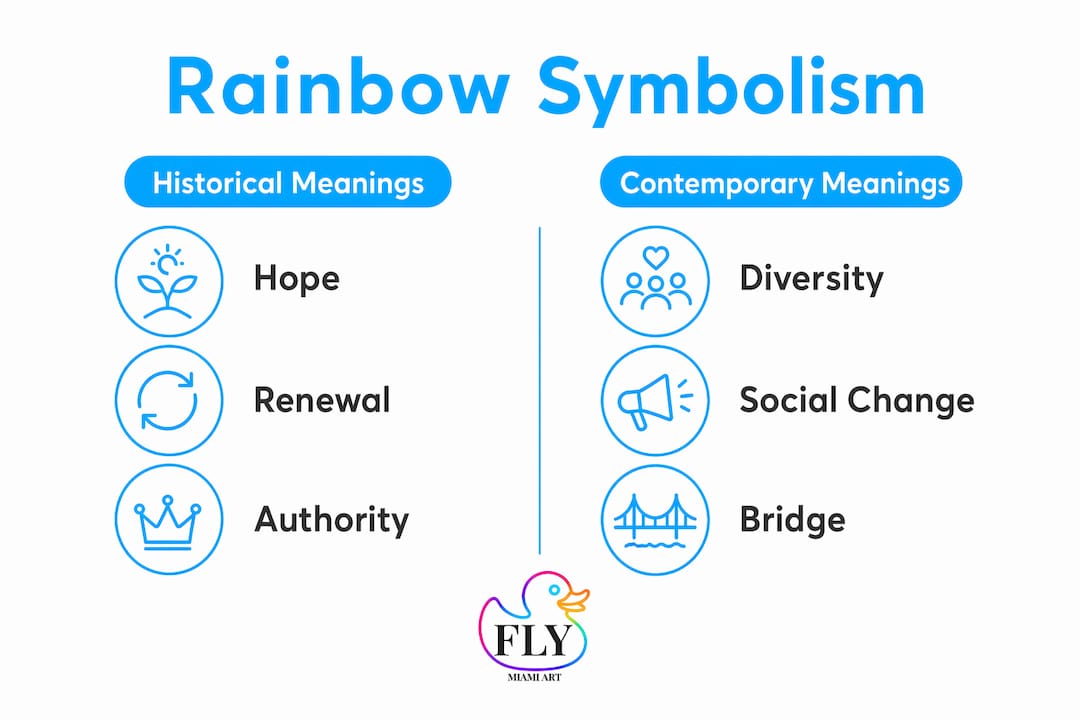
The rainbow is what semioticians call a floating signifier: it carries multiple, overlapping meanings that shift depending on audience and setting. Four dominant readings operate simultaneously in contemporary work.

Hope and renewal is the oldest Western layer. BBC Culture frames the Genesis rainbow as a promise after the deluge, a reading that persists in public art deployed during crises, from COVID-19 window paintings to post-disaster murals.
Diversity and social change. A SAGE journal analysis argues the rainbow’s spectrum suggests diversity and has functioned as a sign for social movements. The pride flag’s six stripes each carry assigned meanings: red for life, orange for healing, yellow for sunlight, green for nature, blue for harmony, violet for spirit.
Bridge and pathway. A scholarly chapter on rainbow symbolism identifies bridge and messenger archetypes across cultures and languages, a reading that maps directly onto installation art where the viewer physically moves through or under a rainbow form.
Authority and power. The Hebrew word qešet in Genesis 9 is the same word used elsewhere for a war bow or hunting bow, which means the covenant rainbow carries latent authority alongside its beauty. Institutional buyers who want depth in their acquisition narrative can draw on this dual reading.
One misconception worth naming: rainbow imagery is not universally celebratory. “Rainbow-washing” describes the use of rainbow colors by brands or institutions to signal inclusion without substantive commitment. Collectors should ask whether a work’s rainbow motif is anchored in a specific cultural or political argument, or whether it is purely decorative. The difference matters for long-term value and institutional reception.
Pro Tip: When evaluating a rainbow-forward work, request the artist’s statement before the price sheet. A piece with a documented symbolic argument holds its meaning across exhibition contexts; one without it depends entirely on the wall it hangs on.
How do UV-reactive materials change what a rainbow means?
Materials and lighting transform the rainbow from a static symbol into a performative revelation. That shift from hidden to revealed is itself a meaning, not just a technique.
Relevant material and technical features for collectors:
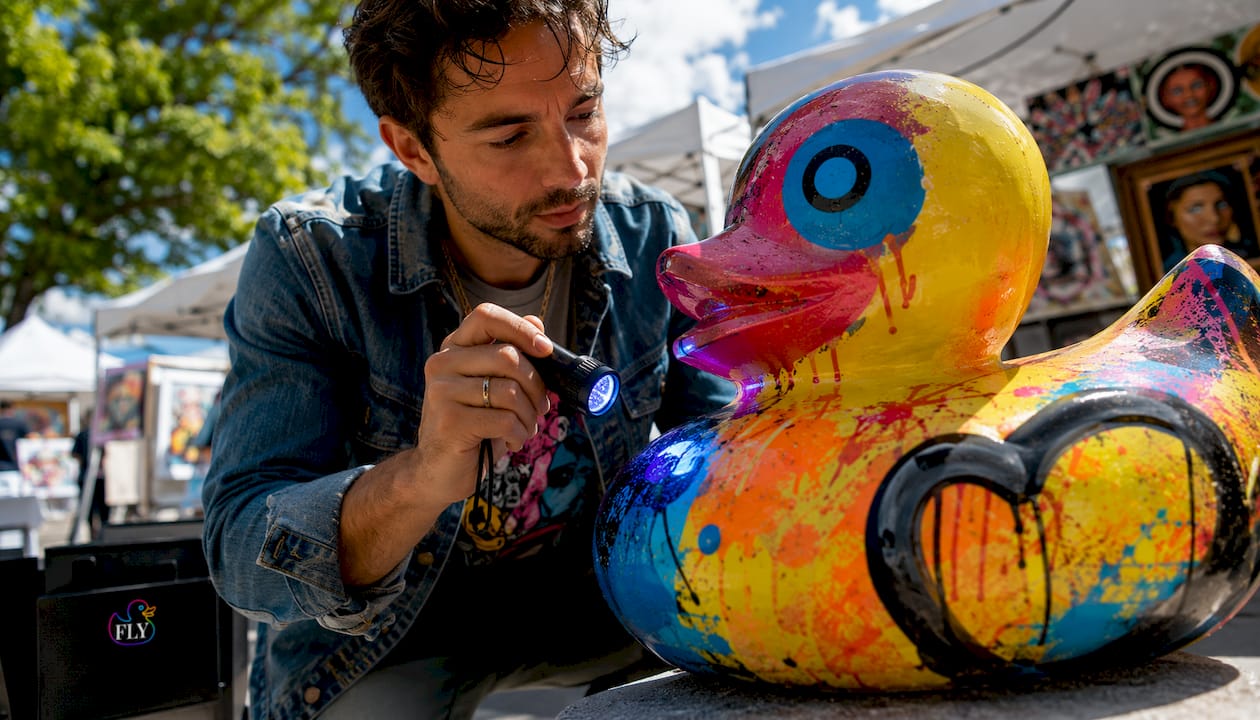
- UV-reactive pigments: Fluoresce under blacklight, remaining invisible or muted in daylight. The reveal becomes a narrative event.
- Fluorescent vs. phosphorescent media: Fluorescent pigments glow only under active UV light; phosphorescent ones absorb and re-emit, creating a slow fade. Each produces a different emotional register.
- Layering: Multiple pigment layers can encode different images for daylight and blacklight viewing, effectively giving one work two symbolic states.
- Reflective and metallic surfaces: Amplify color saturation under both standard and UV lighting, intensifying the rainbow’s emotional impact at scale.
- Installation lighting design: The angle, intensity, and color temperature of ambient light determine which symbolic layer is dominant at any moment.
The fleeting quality of a natural rainbow, visible only when you are in exactly the right place, maps onto UV-reactive work that is fully legible only under specific lighting conditions. That parallel is not accidental in well-conceived pieces. Flymiami’s UV-reactive rubber duck art uses this logic deliberately: the blacklight reveal is part of the provenance story, not an afterthought.
For conservation, UV-reactive pigments vary significantly in lightfastness. Ask for a material spec sheet that identifies pigment brands and rated lightfastness scores. Display away from prolonged direct sunlight, and document the recommended UV lamp specifications in the acquisition file.
Pro Tip: For evening events or gallery openings, time the blacklight activation as a scheduled reveal rather than leaving UV lamps on continuously. The transition from ambient to blacklight is the moment the work’s second symbolic layer becomes visible, and it lands harder when it is unexpected.
What should collectors ask before buying rainbow-forward art?
Due diligence for UV-reactive and rainbow-themed works follows a specific sequence.
- Request the artist statement. Confirm which symbolic layer the artist intended and whether that intent is documented in writing.
- Verify provenance and edition details. Is the work a unique original, a numbered limited edition, or an open edition? Get this in writing with the edition size and number.
- Obtain the material spec sheet. Pigment types, substrate, lightfastness ratings, and any coatings applied.
- Confirm exhibition history. Previous shows, press coverage, and institutional loans all affect resale value and cultural credibility.
- Clarify lighting requirements. What UV lamp specifications does the artist recommend? What ambient light conditions are optimal?
- Ask about cultural sensitivity. For works intended for public display or multinational loans, confirm the artist has considered how the rainbow motif reads across different cultural contexts.
Additional questions worth asking:
- Has the work been reviewed or covered by press? Media coverage is a verifiable trust signal.
- Are there conservation notes specific to the UV-reactive elements?
- What is the resale history for comparable works by this artist?
Pro Tip: For hotel or commercial installations, site-specific lighting planning should happen before the work ships. Retrofitting a UV installation into a space with incompatible ambient lighting is expensive and often compromises the intended symbolic effect.
How Facundo Yebne uses rainbow and UV materials at FLY Miami Art
Facundo Yebne is the Miami-based artist behind Flymiami, a studio that has built its practice around UV-reactive pop art sculptures and installations. His work has been featured in prestigious exhibitions and covered by major media, with the rubber duck as his recurring motif: a deliberately accessible, globally recognized form that carries the symbolic weight of peace, love, and unity without requiring art-world fluency to read.
Three works illustrate how the rainbow and UV approach operates in practice:
- Glowing with Pride: A pride-themed UV-reactive piece that activates the LGBTQ+ visibility reading directly. Under blacklight, the rainbow spectrum emerges across the duck form, turning a familiar shape into a statement about inclusion and joy. The work’s meaning is legible in both lighting states, but the blacklight version adds urgency.
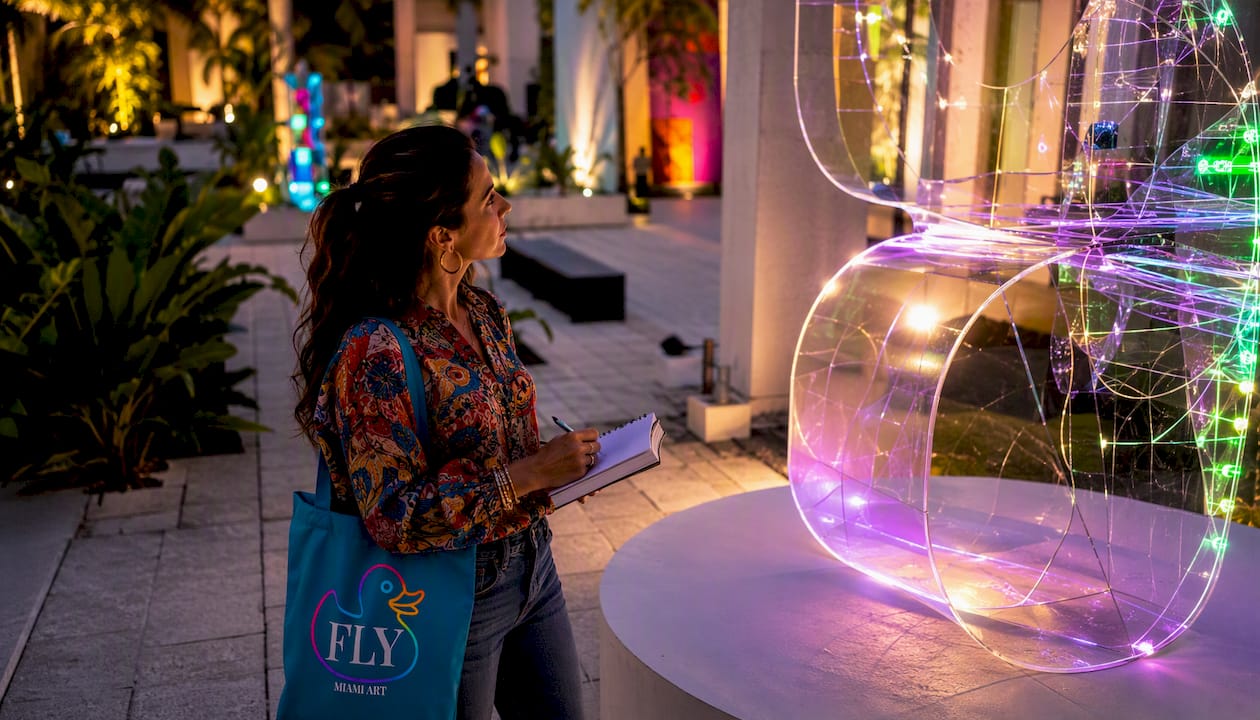
- Nocturnal Ascension: A limited-edition sculptural work where the UV reveal operates as the “bridge/pathway” reading. The ascension implied by the title becomes literal when blacklight activates the hidden color spectrum, suggesting movement from one state to another.
- Smiley Black Glow: A blacklight-reactive piece that uses the pop-art vocabulary of the smiley face alongside UV pigments, connecting the rainbow’s “celebration” reading to the broader pop culture series tradition.
Each piece ships with provenance documentation that includes the recommended UV lamp specifications, edition details, and the artist’s statement. That documentation is part of the work’s collectible value.
Key Takeaways
Rainbow art carries layered cultural meaning because the rainbow itself is a floating signifier: its dominant reading shifts with material, lighting, context, and artist intent, and collectors who understand that layering are better positioned to evaluate, display, and preserve what they acquire.
| Point | Details |
|---|---|
| Layered symbolic meanings | Rainbows simultaneously signal hope/renewal, diversity/inclusion, bridge/pathway, and authority depending on context and audience. |
| Material activates meaning | UV-reactive pigments create a hidden-to-revealed narrative that mirrors the rainbow’s fleeting, transformative quality in nature. |
| Provenance documentation matters | Request artist statement, edition details, material spec sheet, and lighting requirements before completing any acquisition. |
| Cultural sensitivity is real | Rainbow imagery carries taboo or fearful meanings in some traditions; confirm artist intent for public or multinational placements. |
| Flymiami as a collecting option | Facundo Yebne’s UV-reactive sculptures ship with full provenance notes and lighting specs, making acquisition and display straightforward. |
The rainbow as a collector’s responsibility
Most collectors treat rainbow imagery as self-evidently positive. That assumption is worth questioning. The same arc that signals hope in a Western gallery context can carry entirely different weight for a viewer from a tradition where rainbows are associated with taboo or danger. The pride flag reading is so dominant in contemporary American art contexts that it can crowd out every other layer, including the authority reading embedded in the Hebrew qešet, which adds genuine depth for institutional buyers who want a more complex acquisition narrative.
What I find most underestimated is the obligation the UV-reveal creates. When a work has two symbolic states, the collector is responsible for both. That means the lighting protocol is not a technical footnote; it is part of the work’s meaning. A UV piece displayed only under ambient light is, in a real sense, an incomplete work. The hidden layer is not a bonus; it is half the argument.
Flymiami’s UV-reactive works: how to view, buy, or commission
Flymiami’s collection of UV glow art and sculptures is available directly through the online studio. Each piece in the UV-reactive series comes with full provenance documentation, edition details, and recommended lighting specifications so collectors can plan installation before the work arrives.
For custom commissions, including hotel lobbies, public installations, and private collections, the studio works through a structured brief process: concept, material selection, lighting plan, and delivery timeline. Collectors interested in wall-mounted works can browse the wall art collection for available originals and limited editions. To start a commission or purchase inquiry, visit the studio online at flymiami.art.
Useful sources and further reading
These are the primary sources behind the claims in this article, annotated for collectors who want to verify or go deeper.
- Rainbows in Culture, Wikipedia: Broad overview of rainbow symbolism across art history and religion; useful starting point for cross-cultural comparison.
- Rainbows in Mythology, Wikipedia: Detailed entries on Bifröst, Iris, Rainbow Serpent, Indra’s bow, and Genesis; the most comprehensive single reference for mythic readings.
- BBC Culture: Rainbows as Signs of Hope and Solidarity: Documents both the hope/renewal reading and the taboo/fear traditions; essential for collectors considering public or multinational placements.
- SAGE Journals: “I Have Set My Bow in the Clouds”: Scholarly analysis of the Hebrew qešet and the diversity/authority dual reading; the most rigorous source for the power layer in rainbow symbolism.
- What, If Anything, Is a Rainbow? (DOI chapter): Academic treatment of bridge and messenger archetypes across cultures; useful for installation art contexts where the viewer moves through the work.
- LGBT Rainbow Flag, Wikipedia: Documents the flag’s origin in 1978, its color symbolism, and its evolution through the LGBTQ+ movement.
- Rainbows in Indian Rock Art of Desert Western America, Academia.edu: Peer-reviewed study of Native American rainbow imagery spanning thousands of years; relevant for collectors interested in the deep history of the motif in North American art.
- The Rainbow as a Symbol of Hope in Evelyn De Morgan’s Paintings, Art UK: Focused case study on how a single artist deployed rainbow symbolism across a body of work; useful model for reading artist intent in contemporary pieces.