Why Award-Winning Art Elevates Gallery Prestige
Award-winning art raises a gallery’s prestige by supplying third-party validation, concentrated media attention, and documented provenance that together increase collector confidence and willingness to pay. The mechanism is not mysterious: when a credible jury singles out a work, it converts ambiguous artistic merit into a legible market signal. Galleries representing that work inherit the signal.
The core pathways work like this:
- Institutional labeling: expert juries certify quality in a way that personal taste cannot
- Media amplification: award announcements generate press coverage galleries could not buy
- Brokerage effects: curators and dealers use the award to open doors at fairs, museums, and private collections
- Provenance enhancement: the award becomes a permanent, verifiable part of the work’s history
- Market signaling: collectors, especially in emerging markets, use awards to reduce purchase uncertainty
Short-term, an award typically produces a demand spike and press surge. Long-term, sustained prestige depends on whether the gallery pairs that momentum with consistent aesthetic quality and curated exhibition programming.
Table of Contents
- Why award-winning art elevates gallery prestige: the causal pathways
- What the evidence shows — and where awards fall short
- How galleries convert awards into lasting prestige and market value
- How collectors should interpret awards when evaluating gallery shows
- Facundo Yebne and Flymiami: award-winning immersive pop art in practice
- Key Takeaways
- Awards are a multiplier, not the foundation
- Flymiami’s immersive sculptures: view the collection
Why award-winning art elevates gallery prestige: the causal pathways
The mechanisms above do not operate independently. They reinforce each other in a sequence that begins the moment an award is announced.
1. Institutional labeling A jury’s verdict does something no marketing campaign can replicate: it attaches an objective third-party endorsement to the work. Academic analysis of the Turner Prize connects this labeling directly to faster market ascension for represented artists, as curators and dealers treat the prize as a shortcut through the usual deliberation process.
2. Brokerage and network effects Awards change an artist’s position in co-exhibition networks. Research published in Science found that network centrality strongly predicts institutional prestige: artists who exhibit at high-prestige venues attract further high-prestige invitations, and their galleries rise with them. An award accelerates that centrality shift.
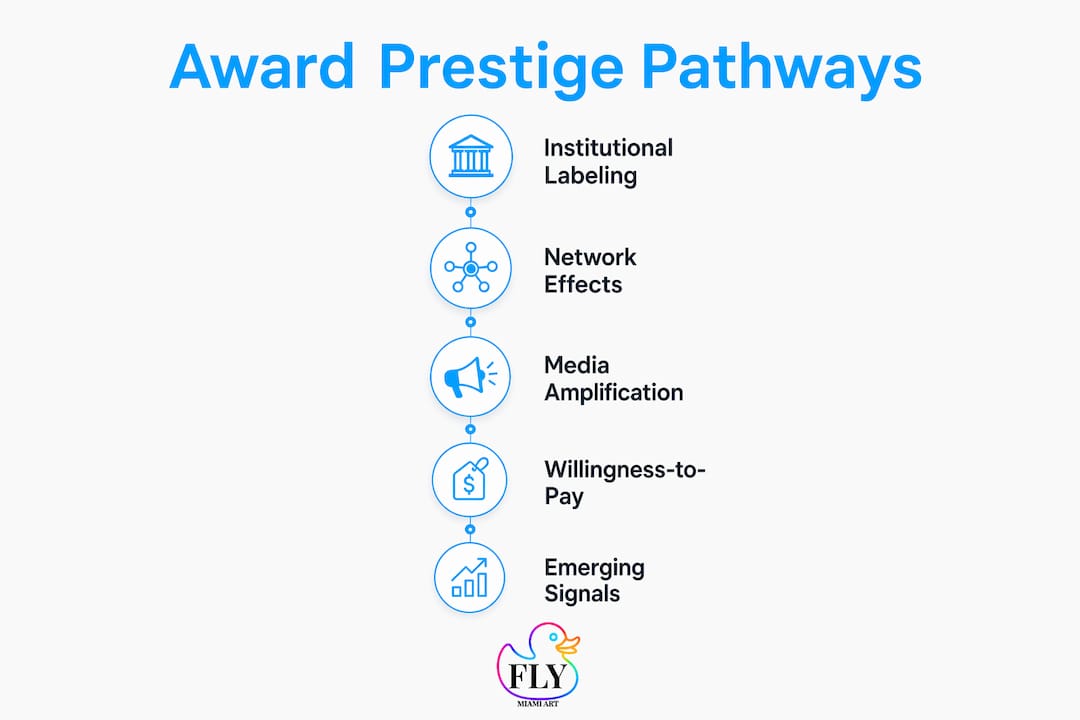
3. Media amplification Prize announcements function as publicity events. Historical analysis of the Turner Prize shows awards drew young audiences and expanded patron networks for Tate, demonstrating that prizes can reposition an institution’s audience profile, not just its reputation.
4. Willingness-to-pay This is where the financial case is clearest. A PLOS ONE study on expert approval found that monetary willingness-to-pay correlates more strongly with expert endorsement than with personal liking. Collectors may love a work aesthetically, but they pay more when a credible authority has already said it matters.
5. Emerging-market signaling In markets where professional appraisal infrastructure is thin, awards carry even more weight. Research in Nature Scientific Reports shows collectors in those contexts rely heavily on social signals like prizes to reduce acquisition uncertainty.
Pro Tip: Update provenance records and press kits within 48 hours of an award announcement. Collectors and curators who reach out in that window are the most motivated; a polished, documentation-ready response converts inquiries into sales.
What the evidence shows — and where awards fall short
The research is consistent on the upside. Awards hasten valuation, expand networks, and increase willingness-to-pay. But the evidence is equally clear on the limits.
Gallery observers and curators stress that awards amplify visibility without replacing the intrinsic strength of the work. A prize attached to weak or inconsistent practice produces a short spike, then a credibility problem.
The risks galleries and collectors should watch for:
- Short-term hype without follow-through: a single award with no subsequent exhibition program fades quickly
- Prize volatility: not all awards carry equal prestige; a poorly juried prize can actually signal low selectivity
- Inflated pricing without institutional support: raising prices post-award without museum or fair validation alienates serious collectors
- Uneven award prestige: popular-vote prizes and regional awards rarely move secondary-market prices the way juried international prizes do
When evaluating which awards to pursue or highlight, galleries should weigh: jury composition and independence, whether the award includes an exhibition or residency component, the cash or prize size, the award’s media reach, and the partnership opportunities it unlocks. Awards like the MacArthur Fellows Program or the Hugo Boss Prize carry durable career effects precisely because they bundle exhibition support with financial recognition.
How galleries convert awards into lasting prestige and market value
A gallery that treats an award as a press release misses most of the value. The galleries that extract durable benefit follow a deliberate sequence.
- Issue press immediately. Send a targeted release to art-world press, fair organizers, and museum curators within 24 hours. The announcement window is short; collectors and institutions make decisions fast.
- Mount a curated exhibition. A post-award show gives the work a formal institutional frame. Learning how to curate an immersive pop art show that holds attention is what separates a publicity moment from a prestige-building event.
- Adjust pricing strategically. A modest, documented price increase tied to the award is credible. A sudden doubling without supporting sales history is not.
- Update all provenance and catalog records. The award must appear in every future catalog entry, loan request, and auction estimate. This is the provenance enhancement that compounds over time.
- Pursue museum loans and fair placements. Use the award as leverage to secure a loan to a public institution or a booth at a major fair. These placements feed back into the co-exhibition network, raising the gallery’s eigenvector centrality and attracting further high-prestige invitations.
The timeline matters. Press effects are immediate. Market effects typically consolidate over 6–18 months as secondary-market data catches up. Long-term institutional partnerships take two to five years to materialize but are the most durable outcome.
How collectors should interpret awards when evaluating gallery shows
Treat an award as a signal, not a purchase mandate. The award tells you that credible people found the work significant. It does not tell you whether the price is fair, whether the gallery has institutional support, or whether the work fits your collection.
Collector checklist for award-winning works:
- Verify the award: who juried it, what the selection criteria were, and whether it included an exhibition component
- Check exhibition history before and after the award
- Review press coverage for quality, not just quantity
- Ask for prior sales records or auction results
- Confirm provenance documentation is complete and current
- Assess whether the gallery has pursued museum loans or fair placements since the award
Questions to ask gallery staff:
- Which jury or institution granted the award, and what were the criteria?
- How has collector inquiry changed since the announcement?
- Has the work been exhibited in a museum or public institution post-award?
- Is the award documented in the provenance certificate?
- What is the secondary-market history for this artist?
- Are there comparable sales to support the current asking price?
- Has the gallery secured any fair placements on the strength of this work?
- What is the artist’s exhibition schedule for the next 12 months?
Pro Tip: Post-award price spikes are real but often temporary. If you are buying for long-term value, waiting 6–12 months for the initial excitement to settle frequently gives you a more accurate price and a cleaner negotiating position — without sacrificing the provenance benefit.
Understanding what makes pop sculpture valuable beyond the award is the most useful due-diligence habit a collector can build.
Facundo Yebne and Flymiami: award-winning immersive pop art in practice
Facundo Yebne’s practice at Flymiami illustrates every mechanism described above. The studio specializes in UV-reactive immersive pop sculptures: handcrafted works that reveal hidden patterns and colors under blacklight, creating an experiential dimension that standard gallery photography cannot capture.
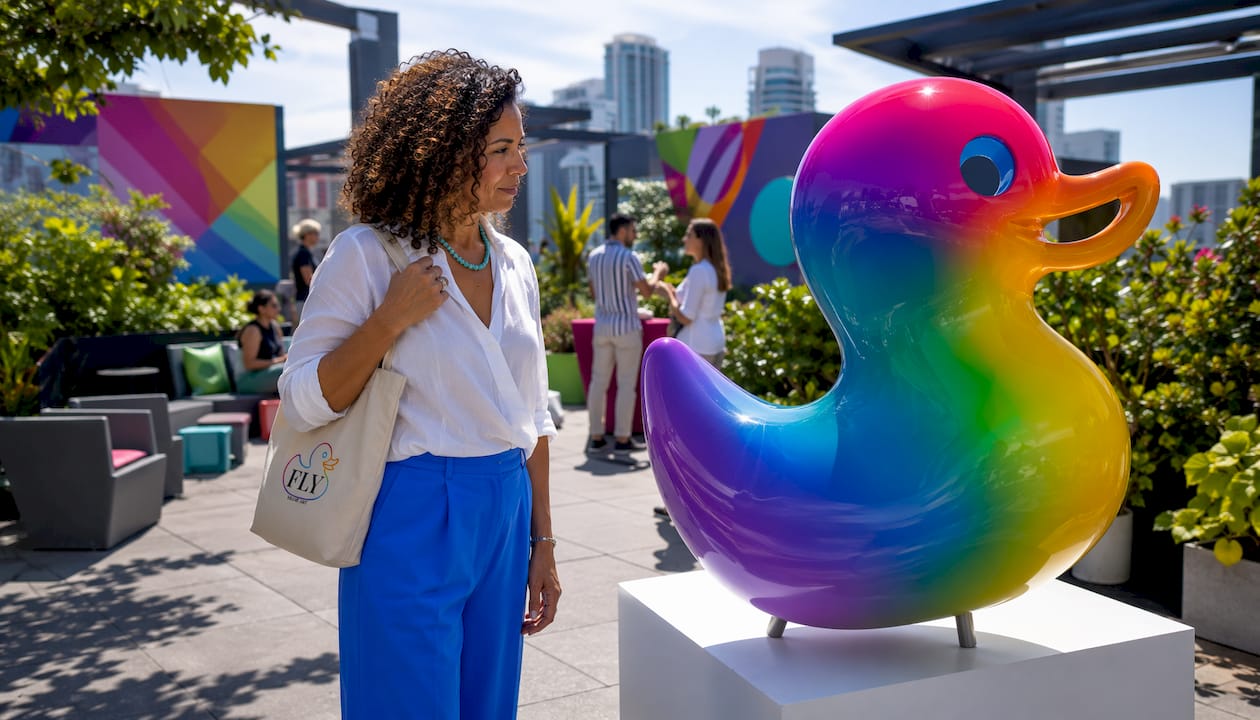
The award connection is concrete. Yebne’s Lincoln Road duck sculpture won fourth prize in installation art at the Florence Biennale XV, one of the most internationally visible juried exhibitions in contemporary art. That recognition did exactly what the research predicts: it attached institutional labeling to the work, generated press coverage, and opened curatorial conversations that a studio operating without that credential would have had to build over years.
Key proof points for collectors evaluating Flymiami’s work:
- UV-reactive materials create a dual-state viewing experience unavailable in most gallery contexts
- Significant media coverage of exhibitions supports provenance documentation
- The Florence Biennale prize is a verifiable, juried credential with international jury composition
- Studio process documentation is publicly available, supporting full provenance transparency
Flymiami’s UV-reactive rubber duck works sit at the intersection of pop art accessibility and immersive installation practice, a combination that remains culturally relevant and positions the studio well for the kind of museum-loan and fair-placement follow-through that converts a single award into lasting gallery prestige.
Key Takeaways
Award-winning art elevates gallery prestige through institutional labeling, media amplification, and provenance enhancement, but only when galleries actively leverage those mechanisms with consistent exhibition programming and documentation.
| Point | Details |
|---|---|
| Awards as expert signals | Willingness-to-pay correlates more strongly with expert endorsement than personal liking, per PLOS ONE research. |
| Network centrality matters | Co-exhibition network position predicts institutional prestige; awards accelerate an artist’s centrality shift. |
| Limits are real | Awards without sustained aesthetic quality and exhibition follow-through produce short-term spikes, not lasting prestige. |
| Collector due diligence | Verify jury composition, exhibition history, and provenance documentation before attributing value to an award. |
| Flymiami case study | Facundo Yebne’s Florence Biennale XV prize illustrates how a juried international award converts into verifiable gallery credibility. |
Awards are a multiplier, not the foundation
The galleries I have watched build real prestige over time share one habit: they treat an award as the beginning of a strategy, not the end of one. The prize opens a door. What you do in the next 18 months determines whether that door leads somewhere. Consistent work, documented provenance, and curated exhibition programming are what the award amplifies. Without them, the amplification has nothing to work with. At Flymiami, the approach after the Florence Biennale recognition was straightforward: update documentation, pursue exhibition opportunities that matched the work’s scale, and let the UV-reactive immersive format speak for itself in person. Collectors who want to see that documentation or arrange a studio viewing are welcome to reach out directly.
Flymiami’s immersive sculptures: view the collection
Collectors who want to move beyond the theory and see award-validated, UV-reactive pop sculpture in person will find Flymiami’s full range at the sculpture collection. Each piece comes with provenance documentation, exhibition history, and press records, the same materials a serious collector should request from any gallery.
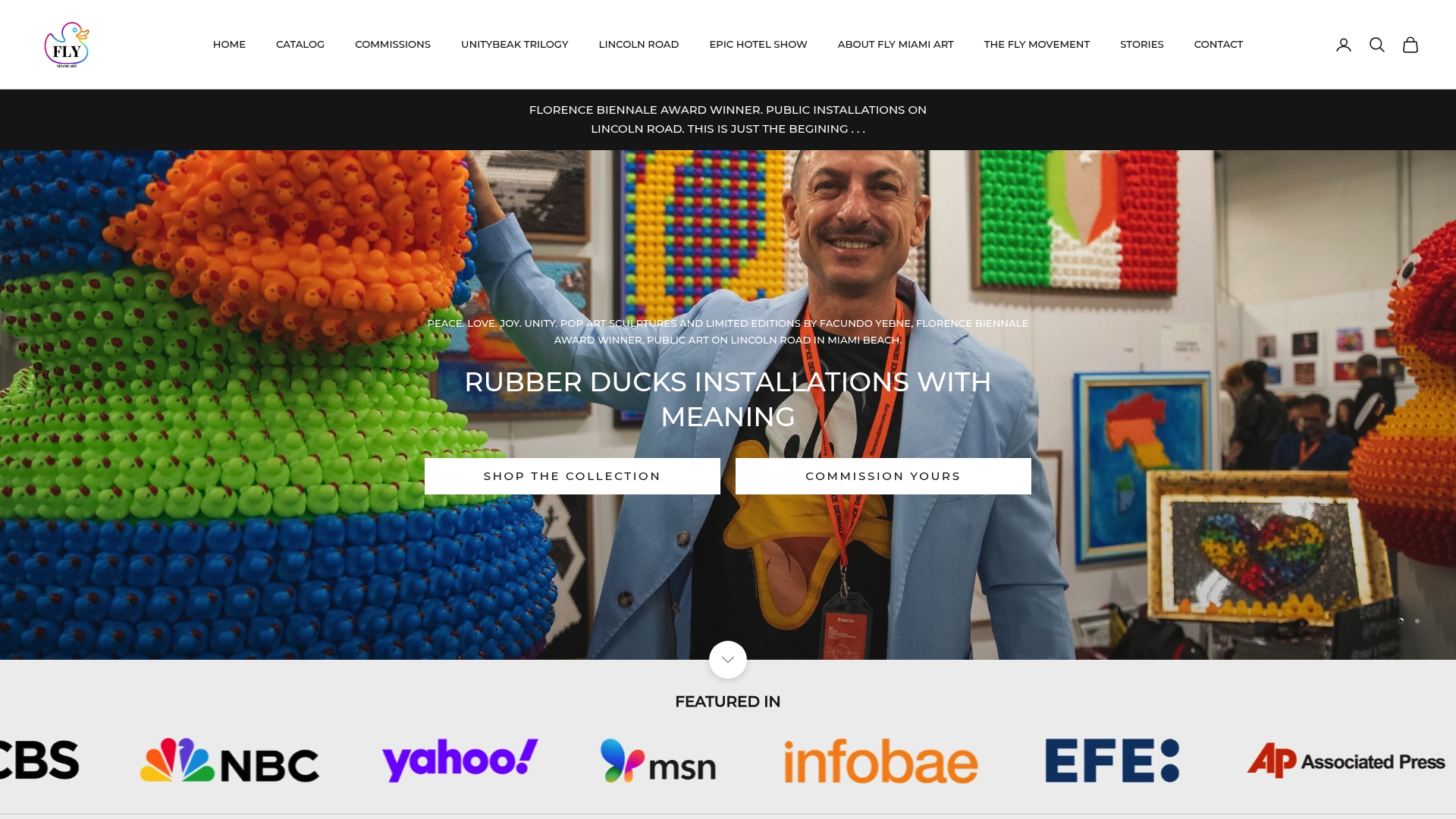
Featured works include Nocturnal Ascension, a high-interest piece that demonstrates the dual-state UV experience at its most striking. The studio process page details how each sculpture is made, from material selection through the UV-reactive finishing that makes the work exhibition-ready. Provenance records and press documentation are available on request. To arrange a viewing or discuss acquisition, contact Flymiami directly through the website.