Temporary Kitsch, Studio Practice, and Rubber Duck Sculpture Meaning
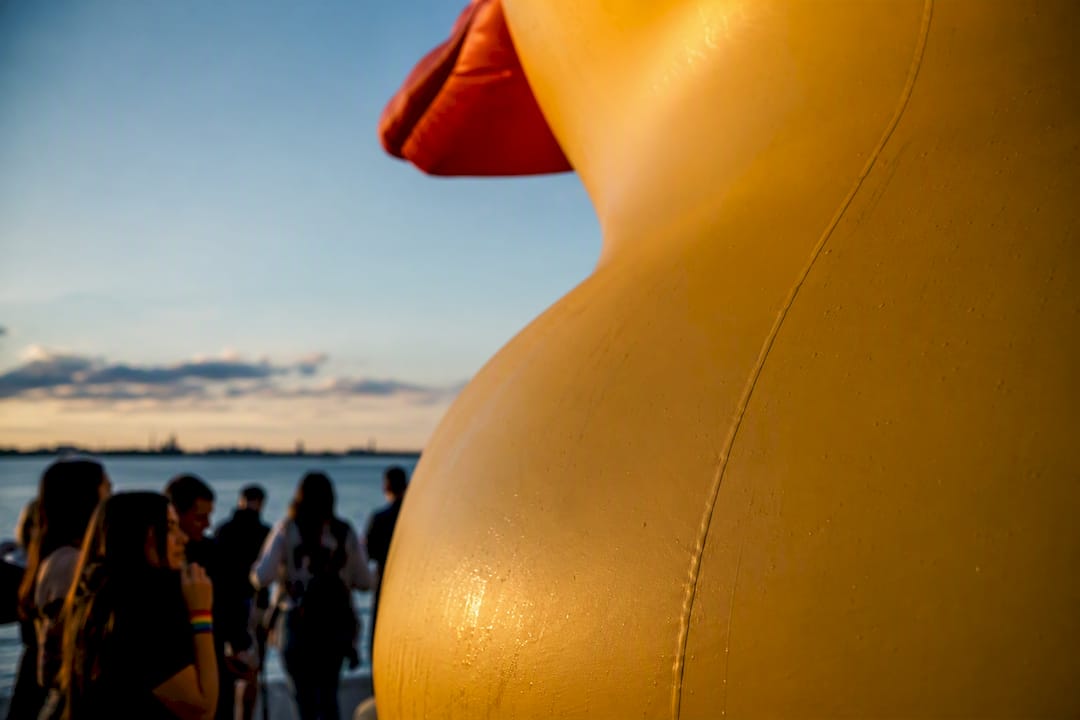
Florentijn Hofman’s Rubber Duck is a giant inflatable sculpture that reads as a playful, nostalgic stand in for shared human experience. Hofman scales up an ordinary bath toy until it dwarfs a harbor, and that jump in size turns a private childhood object into a public event. The meaning shifts by city and crowd, but the through line is consistent: kitsch and scale, working together, pull strangers into the same conversation.
TL;DR:
- Each rubber duck sculpture is locally reconstructed to adapt to water and site conditions, ensuring the work remains temporary and cost-effective.
- The giant sculptures are inflatable, buoyant, and anchored to barges, allowing them to be deflated, repositioned, or removed within hours, emphasizing their impermanence.
- Scale enlarges the familiar shape to about 18 meters, transforming viewers’ perceptions and evoking awe through size rather than complexity.
- Public reactions vary from crowd admiration to vandalism, often fueling debates about public funding and use of civic space.
- The sculpture’s meaning shifts based on location, with site context influencing whether it signifies nostalgia, civic unity, or social commentary.
Table of Contents
- The Artist Behind the Rubber Duck Sculpture Meaning
- Common Symbolic Interpretations of the Rubber Duck Art Piece
- How Big Is the Rubber Duck, and Why Scale Changes the Message
- Public Reaction: Crowds, Vandalism, and Viral Moments
- Case Studies: Saint-Nazaire, Pittsburgh, and Seoul
- What a Working Art Studio Notices About Playful, Oversized Public Art
- Why the Duck Still Works as Public Art
- Bring That Same Playful Scale Into Your Own Space
- Sources
- FAQ
The Artist Behind the Rubber Duck Sculpture Meaning
Hofman first floated a version of the Rubber Duck in Saint Nazaire, France, in 2007, and the piece has traveled the world ever since, rebuilt fresh at every stop rather than shipped as a single object. That distinction matters more than it sounds. Hofman doesn’t crate up one duck and mail it from port to port. He and his team fabricate a new skin locally for each city, using the same basic design but adapting it to local water conditions, docking structures, and climate.
The Dutch artist has described his oversized animal works as metaphors for people, not just spectacle for spectacle’s sake. In interviews tied to the piece’s return to Seoul, Hofman called the duck a “yellow catalyst,” a phrase that gets at what he’s actually after: an object bright and dumb enough to stop a stranger mid-stride, then make them talk to whoever is standing next to them, as The Korea Times reported.
Three things define Hofman’s approach and separate this project from a simple traveling attraction:
- Each installation is temporary by design, staying for weeks rather than becoming a permanent fixture.
- The duck gets rebuilt locally rather than shipped as one physical object, which keeps costs and logistics tied to each host city.
- Hofman treats accessibility as part of the concept. No ticket, no gallery wall, no barrier between the art and whoever happens to walk by the water that week.
Gallery notes on the touring history back this up, framing the impermanence itself as intentional resistance to owning or commodifying the piece, according to Whitestone Gallery’s coverage of the work’s public art history.
Common Symbolic Interpretations of the Rubber Duck Art Piece
Ask five people what the duck means and you’ll likely get five overlapping but distinct answers. That’s not a flaw in the work. It’s the point.
- Nostalgia. Most adults had a rubber duck in the bathtub as a kid. Seeing that exact shape, at building height, floating in a real harbor, short circuits the brain in a satisfying way. It’s instant, it needs no explanation, and it works on nearly anyone regardless of art background.
- Kitsch turned into shared ritual. Academic analysis of the touring Rubber Duck project argues that its repetition across cities and its unapologetically mass-produced aesthetic are exactly what let it dodge a single, fixed meaning, a topic explored in depth by The Australian art + collectibles marketing. Instead of anchoring the work to one site’s history, the kitsch framing invites each new audience to bring their own story to it, turning viewers into something closer to co-creators, according to scholarly analysis of the project’s cultural context.
- Human metaphor. Hofman has said directly that his oversized animals stand in for people. The duck’s exaggerated, cartoonish innocence becomes a mirror. When you’re standing next to something 100 times your size that’s still recognizably a bath toy, the disproportion says something about vulnerability and scale in human life too.
- Civic unity. Because the duck requires no entry fee and no prior knowledge, it tends to draw an unusually broad cross-section of a city’s population to one waterfront at the same time. That shared, ordinary presence is its own kind of statement.
Pro Tip: If you’re trying to read the “real” meaning of a specific installation, look at where it was placed. A duck floating near a shipping port reads differently than one anchored beside a tourist boardwalk. Site context changes the interpretation even when the object stays the same.
The role duck art plays in public installations generally follows this same logic: familiar shapes, blown up past the point of comfort, do more conversational work than abstract sculpture ever manages in the same space.
How Big Is the Rubber Duck, and Why Scale Changes the Message
The technical build matters here, not as trivia, but because the engineering decisions are part of the meaning. Hofman’s team constructs each duck from inflatable PVC, keeps it filled and buoyant using internal fans running around the clock, and anchors the whole structure to barges or platforms rather than the seabed itself.
That construction method carries several real world consequences:
- The duck can be deflated, packed, and effectively “disappear” in hours, reinforcing the point that the work was never meant to stay.
- Fans need constant power and monitoring, meaning a visible maintenance crew becomes part of the installation’s daily rhythm, whether audiences notice or not.
- Because it floats on a barge instead of a fixed foundation, the duck can be repositioned within a harbor if weather or crowd flow demands it.
The largest recorded version of the sculpture set a scale benchmark for bath toy art, a distinction tracked by Guinness World Records’ entry on the largest bath toy. Seoul’s 2023 return of the piece stood roughly 18 meters tall, about six stories, a height Hofman has directly connected to his idea that enlargement changes how people see themselves in relation to the object, per The Korea Times’ interview. Stand next to something that size and the usual bath toy indifference turns into something closer to awe.
Public Reaction: Crowds, Vandalism, and Viral Moments
Reception has never been uniformly gentle, and that friction is part of the story too. The duck tends to pull enormous, sustained crowds wherever it lands, with museum and exhibition coverage from U.S. stops describing dense foot traffic and extended visitor stays near the water, based on the Chrysler Museum’s exhibition notes.
That popularity has a flip side.
- Multiple installations globally have faced vandalism or attempted damage, which local media routinely frames as commentary on public art funding or civic priorities.
- Some cities have debated whether hosting the duck is a worthwhile use of waterfront space and municipal resources, especially when installation costs come from public budgets.
- Social media amplifies both the joy and the criticism almost instantly, turning a single city’s local reaction into a global talking point within days.
The duck’s most consistent trigger for backlash isn’t the art itself. It’s the debate over public money and public space that inevitably follows any large scale civic installation.
Case Studies: Saint-Nazaire, Pittsburgh, and Seoul
Three stops in the duck’s global tour show how the same object generates entirely different local stories.
- Saint Nazaire, France (2007). The debut installation set the template: a floating landmark, no entry fee, and immediate local curiosity about how something this strange got approved for a working harbor.
- Pittsburgh and other U.S. stops. American appearances drew dense crowds along riverfronts, and museum coverage notes the piece sometimes got folded into broader civic moments, including conversation around river cleanup efforts and local waterfront pride, according to the Chrysler Museum’s account.
- Seokchon Lake, Seoul, and Hong Kong’s harbor. Both installations used the duck against dense, vertical skylines, which sharpened the contrast between the toy’s cartoonish softness and the surrounding concrete. Hofman’s comments about scale and perspective land hardest in these settings, where the duck looks genuinely tiny against a skyline one moment and monumental at water level the next.
Repeated appearances across continents, each remade with local materials and crews, have slowly built the duck into something closer to a translocal icon than a single artwork. Wikipedia’s running summary of the sculpture’s history) lists dozens of stops, and that sheer number is itself part of the meaning: no single city gets to claim the “real” duck.
What a Working Art Studio Notices About Playful, Oversized Public Art
Building large scale playful work for public spaces means solving problems Hofman’s touring installations solved first: crowd flow, sightlines, and how a piece reads from fifty feet away versus five.
- Audience movement has to be planned before fabrication starts, since a piece that draws crowds needs safe viewing distances built into its footprint from day one.
- Materials that hold up outdoors and reward close inspection, the way UV reactive pigments reveal hidden detail under blacklight, extend a single work’s story instead of letting it end at first glance.
- Themes of unity and shared joy translate across scales, whether the piece fills a harbor or a gallery wall.
Fly Miami’s own UV reactive rubber duck work draws directly from that same instinct: recognizable, joyful imagery, scaled and lit to reward a longer look than most viewers expect to give it.
Why the Duck Still Works as Public Art
Temporary public art earns its keep by doing something permanent installations rarely manage: it disappears before the novelty wears off, which is exactly why people remember it so clearly. The Rubber Duck’s trick isn’t subtlety. It’s using an object every adult already has an emotional relationship with, then making it too large to ignore.
Scale and playfulness remain effective civic tools precisely because they ask nothing of the viewer beforehand. No context, no wall text, no admission fee. You either laugh, take a photo, or start talking to a stranger next to you, and any of those reactions is the artwork doing its job.
The lesson worth carrying forward is simple: the duck was never really about the duck. It was always about what a whole city does when something absurd shows up and refuses to explain itself.
— Facundo
Bring That Same Playful Scale Into Your Own Space
Some artists build on the same instinct Hofman’s Rubber Duck runs on: familiar, joyful imagery rendered at a scale and with a material choice that rewards a second look. Where Hofman’s ducks exist for a few weeks in a public harbor, some pieces are handmade, one of a kind works built to stay in a collector’s space permanently, using UV reactive pigments that reveal hidden colors and patterns under blacklight, an effect no photograph of a touring installation can replicate at home.
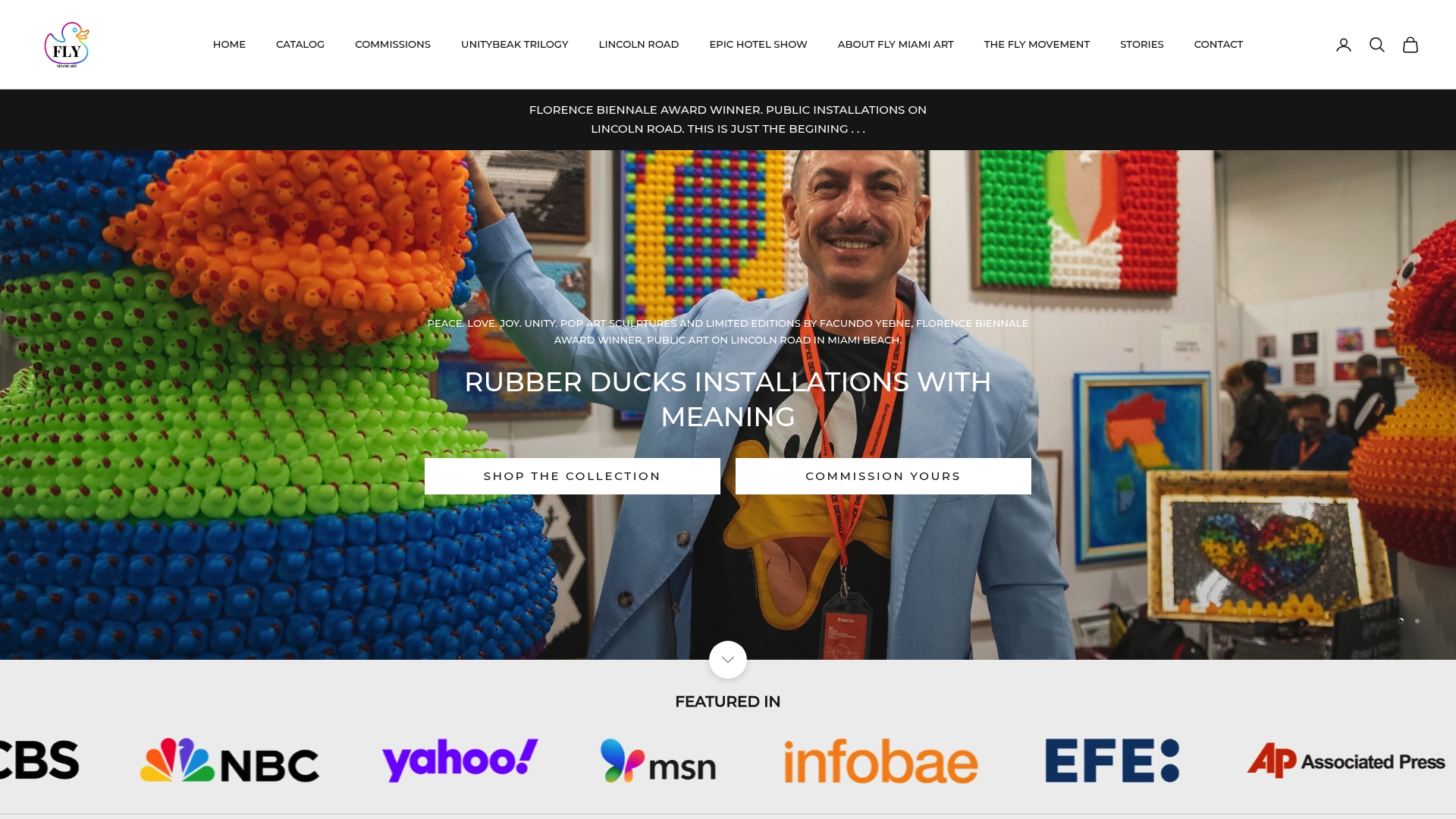
The current lineup includes original rubber duck pieces, wall art, and full sculpture pieces, alongside a dedicated Pride Collection built around themes of unity and joy. If you want something built specifically for your space, Facundo Yebne takes on custom UV reactive rubber duck commissions for collectors, galleries, hotels, and public institutions. Browse the current collection and commission options to start the conversation about a piece built for your walls, not a harbor.
Sources
- Guinness World Records — Largest bath toy
- The Korea Times — Meet the man behind giant rubber ducks that once took over Seoul
- Travelling public art - An analysis of Rubber Duck project in cultural context of kitsch and creative consumption
- The Chrysler Museum — Florentijn Hofman’s Rubber Duck exhibition notes
- Whitestone Gallery — The Transformative Journey of Florentijn Hofman’s Public Art
FAQ
What does the rubber duck symbolize?
It’s most commonly read as a nostalgic, human metaphor: a familiar childhood object enlarged to civic scale, meant to spark shared public moments rather than deliver one fixed message.
Why do people collect small rubber duck art and figurines?
Collecting taps the same nostalgia the giant sculptures rely on, and pieces like Fly Miami’s rubber duck art for sale extend that appeal into UV reactive collectible works for home display.
How big is the largest rubber duck sculpture?
Hofman’s installations have reached roughly 18 meters, about six stories, with the largest recorded version tracked by Guinness World Records.
Is the giant rubber duck a permanent sculpture?
No. Each installation is intentionally temporary, typically staying for a few weeks before being deflated and removed, which the artist and gallery notes describe as central to the work’s meaning.