Public Art Community Engagement for U.S. Cities and Artists That Lasts
Participatory public art is a two-way, artist-led process that turns residents from passive viewers into co-authors of public space. Done right, it produces artwork that a neighborhood recognizes as its own, protects instead of vandalizes, and returns to for years. The outcomes that matter most are shared authorship, local relevance, and long-term civic attachment, and each depends on the engagement methods, planning discipline, and evaluation practices covered below.
TL;DR:
- Genuine participatory public art involves early community conversations that shape the artwork’s design, not just as a formality after decisions are made.
- Effective engagement methods include outdoor living room talks, stakeholder roundtables, pop-up workshops, youth mentorships, and multi-format convenings, all requiring high facilitation quality.
- Maintenance plans should start at site approval, include detailed materials, budgets, stewardship roles, and be embedded into policy to prevent future funding crises.
- Measuring success involves tracking short-term participation, mid-term site usage, and long-term community recognition, using simple qualitative and quantitative tools.
- Successful projects are transparent, document all stages, match meeting times and languages to residents, and treat relationship-building as part of the process.
Table of Contents
- What Public Art Community Engagement Actually Means
- Engagement Methods That Actually Get People Talking
- Planning, Governance, and the Maintenance Plan Most Projects Skip
- Measuring Whether the Engagement and the Artwork Actually Worked
- What a Documented Engagement Process Looks Like in Practice
- The Biggest Mistake Artists Make Before They Even Start
- Commissioning Community-Focused Public Art With FLY Miami
- Sources
- FAQ
What Public Art Community Engagement Actually Means
Public art community engagement is not the same thing as a public meeting where a design gets unveiled and residents get five minutes to react. That model, still common in top-down commissioning, treats input as a formality after the real decisions are made. Participatory public art flips the order: the artwork’s direction gets shaped by conversations that happen before a sketch exists.
The distinction matters because the two approaches produce different objects and different relationships. A top-down commission installs a sculpture; a participatory process installs a sculpture that a block association already feels ownership over before the crane shows up. New York City’s Department of Cultural Affairs built an entire pilot around this idea. Its Public Art as Community Engagement (PACE) program relies on artist-led temporary interventions and convenings rather than standard meetings or surveys, on the theory that a temporary installation or a shared activity surfaces what a neighborhood actually values more honestly than a comment card ever could.
Participatory work takes several forms, and the format shapes what kind of participation is possible:
- Community murals where residents contribute imagery, stories, or hands-on painting time alongside a lead artist.
- Temporary interventions such as pop-up installations, chalk projects, or light works that test an idea in public before anything gets fabricated permanently.
- Performance and activation events that draw people to a site and generate conversation as a byproduct.
- Co-created sculpture and permanent installations where community input shapes material choice, siting, and symbolic content, even when a single artist executes the final piece.
The social payoff of this work is well documented in practice, if harder to quantify than a sales figure. Done consistently, participatory public art strengthens local identity by putting neighborhood-specific stories into permanent form. It builds cohesion by giving disparate groups, block associations, youth programs, faith communities, a shared project to rally around. It also functions as a quiet defense against erasure: a piece that embeds a community’s own language, landmarks, or history is harder to dismiss during rezoning fights or redevelopment pressure than an artwork imposed from outside. Municipal maintenance policy reinforces this civic-asset framing rather than treating public art as decorative afterthought, which is a separate governance layer worth understanding before any project starts.
None of this happens automatically just because a project calls itself “community art.” The label gets applied loosely, and plenty of projects that use participatory language still make every real decision behind closed doors. The methods in the next section are what separate genuine co-creation from a consultation exercise dressed up in the same vocabulary.
Engagement Methods That Actually Get People Talking
Good facilitation starts with sequencing. Listen first, develop concepts second, test prototypes third, and show your trade-offs openly at every stage after that. Skip the listening phase and you get a technically participatory project that residents still experience as something done to them.
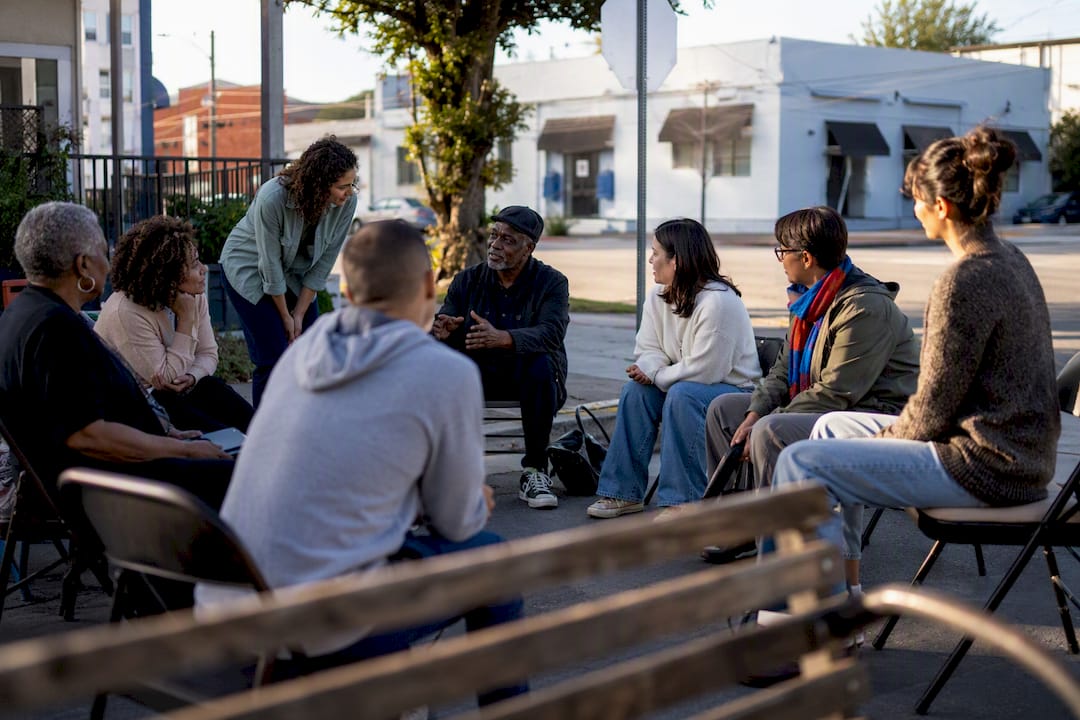
- Outdoor Living Room sessions. This format sets up informal, living-room-style seating in a public space, often the actual site under consideration, and invites people to talk while they wait for a bus, walk a dog, or grab lunch. It works because it meets people where they already are instead of asking them to show up to city hall on a Tuesday night.
- Stakeholder roundtables. Smaller, more structured sessions with block captains, nonprofit directors, school administrators, and business owners who carry institutional memory a general open house won’t surface.
- Pop-up workshops. Portable, low-commitment activities set up at farmers markets, libraries, or transit stops that let people contribute in two minutes rather than two hours.
- Artist-led temporary interventions. Short-lived installations that test a concept publicly and generate reaction the artist can actually use, an approach the PACE program built its entire pilot around.
- Youth mentorship programs. Pairing teens or young adults with professional artists, a model the Museum of Fine Arts, Boston runs through its community partnerships, builds a pipeline of future advocates while widening whose voice shapes the work.
- Multi-format convenings. Combining open sessions, roundtables, and workshops in a single project captures both breadth of participation and depth of institutional knowledge, exactly the mix the Glendale Park engagement in Salt Lake City used, including Spanish-language facilitation to reach residents a monolingual process would have missed.
Facilitation quality determines whether any of these methods work. Drop jargon like “iterative design process” and ask instead what people remember about a corner, a tree, or a smell from childhood. Schedule sessions at hours that fit shift workers and parents, not just people with 9-to-5 flexibility. Recruit through trusted intermediaries, a church, a bodega owner, a youth center director, rather than a flyer alone, since a known face vouching for the project carries more weight than any city seal. And when trade-offs happen, budget cuts a material, a site gets scaled down, say so publicly instead of letting residents discover the compromise after the ribbon cutting.
Pro Tip: Never open a session by asking “what art do you want here?” Ask what a corner smells like in summer, or what a grandmother used to say about the block. Local details like that, not design opinions, are what turn into a strong concept later.
Planning, Governance, and the Maintenance Plan Most Projects Skip
Maintenance planning is not a phase you add after the ribbon cutting. Municipal policy increasingly requires it to start at site-plan approval and be finalized before a certificate of occupancy gets issued, which means the conversation about who cleans, inspects, and repairs a piece has to happen before fabrication even begins.
A functional maintenance plan needs several concrete components, and skipping any of them tends to surface as a budget crisis three or five years down the line:
- Material specifications and product sheets for every surface, coating, and structural element.
- Fabrication notes detailing how the piece was built, so future repairs don’t require reverse-engineering the artist’s process.
- A projected annual maintenance budget, not a one-time estimate, since maintenance plan templates like Reston’s require staged deliverables tied to specific project milestones.
- Clearly assigned stewardship roles: who inspects, who cleans, who authorizes repair funding, and how disputes over responsibility get resolved.
- A reapplication schedule for protective finishes, since UV-reactive and outdoor-rated coatings degrade on a predictable cycle that should be budgeted for in advance rather than discovered after fading sets in.
Cities that take this seriously write it into policy rather than leaving it to goodwill. Alexandria, Virginia’s public art maintenance guidance requires conservation assessments and a documented maintenance manual before a piece is considered complete. Minneapolis goes further, spelling out inspection intervals, routine cleaning schedules, staff training requirements, and a dedicated maintenance fund so conservation isn’t competing for cash against a city’s general operating budget every year.
A dedicated maintenance fund isn’t a courtesy line item. Minneapolis policy treats it as a structural requirement, alongside inspection schedules and mandatory staff training, precisely because public art that isn’t budgeted for upkeep tends to become the first thing deferred when city budgets tighten.
If you’re commissioning or fabricating a piece, build these requirements into the contract, not a handshake agreement. Specify conservation standards in the procurement document itself, require the artist to deliver material and fabrication documentation as a contract milestone, and train whichever municipal or facilities staff will inspect the piece before installation, not after the first complaint about graffiln or peeling finish comes in.
Measuring Whether the Engagement and the Artwork Actually Worked
Impact measurement doesn’t require an academic research budget. It requires picking a small set of indicators before the project starts and tracking them consistently afterward.
- Short-term indicators, first three months. Track participant diversity across sessions (age, language, neighborhood block), workshop turnout numbers, and qualitative quotes gathered during engagement. Immediate local reaction, foot traffic near the site, comments on neighborhood social media groups, informal praise or complaints to a business owner nearby, counts too, even though it’s messier data.
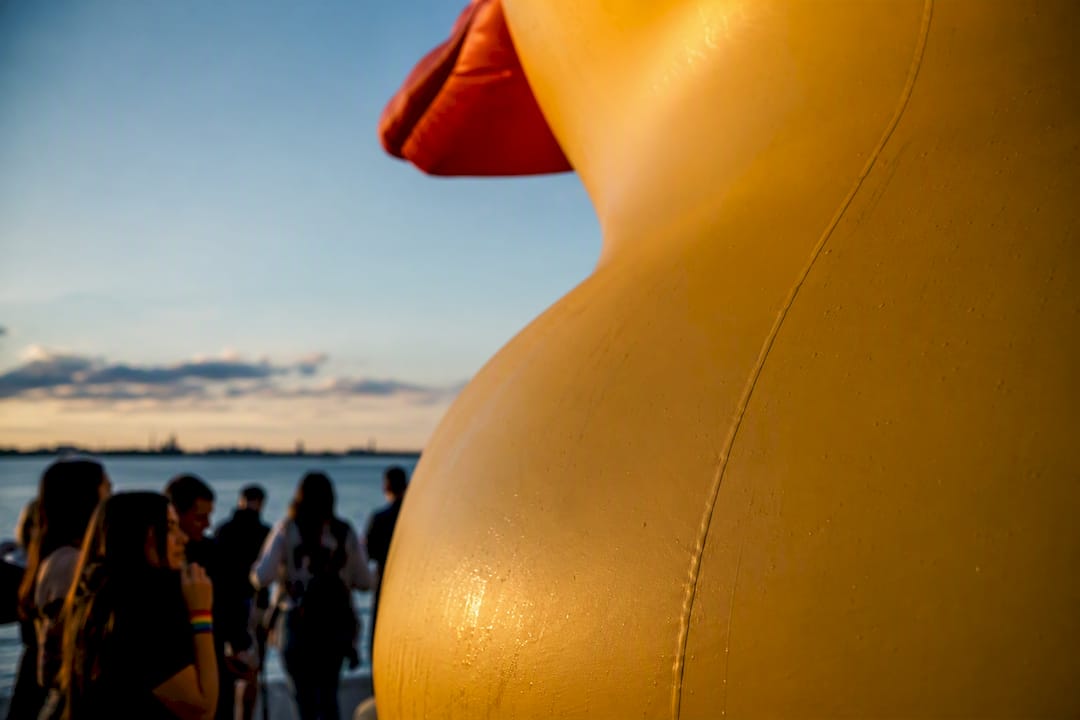
- Medium-term indicators, six to twelve months. Watch for repeated use of the site: people meeting at the piece rather than just walking past it, local narratives that start referencing the artwork as a landmark (“meet me by the ducks”), and whether schools or community programs start incorporating it into field trips or curriculum.
- Long-term indicators, one year and beyond. Look for the artwork becoming a fixture in how the community describes itself, appearing in local tourism materials, neighborhood branding, or resident-generated content without prompting from the artist or city.
The tools for tracking this stay simple by design. An observation log kept by a single staff member or volunteer, checking the site at consistent intervals, catches informal use patterns that no survey captures. Short interviews at the three, six, and twelve-month marks generate usable qualitative evidence without a research grant. Partner surveys, checking in with the schools, nonprofits, and business associations who helped recruit participants originally, close the loop and often surface stories the artist or city missed entirely.
None of this data is academic exercise. Evaluation findings should feed directly into the next maintenance budget cycle, shape what programming gets planned around the piece going forward, and become the evidence base for the next grant application, since funders increasingly want proof of social outcome, not just photos of a finished sculpture.
What a Documented Engagement Process Looks Like in Practice
Salt Lake City’s Glendale Park West Side Public Art Project offers one of the more transparent public records of how these methods play out on the ground. The engagement report documents a process that combined Outdoor Living Room sessions with stakeholder roundtables and targeted workshops, deliberately including Spanish-language facilitation to reach residents a single-format, English-only process would have missed.
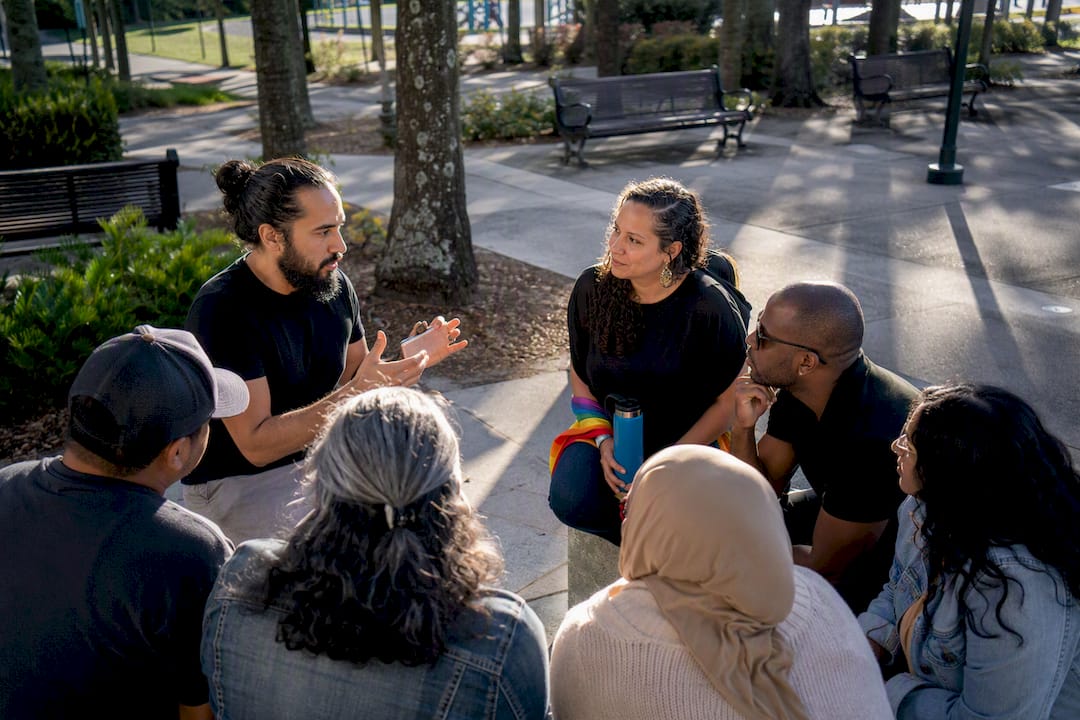
The themes that emerged, social gathering, cultural richness, neighborhood history, weren’t collected as design requests. They were synthesized into a general design direction, giving the artist real creative latitude while ensuring the final piece reflected what residents actually valued about the site.
That distinction, between gathering direction and gathering design specs, is the one practitioners return to most often. Helen Yentus, writing about how to engage local communities with public art, put it directly:
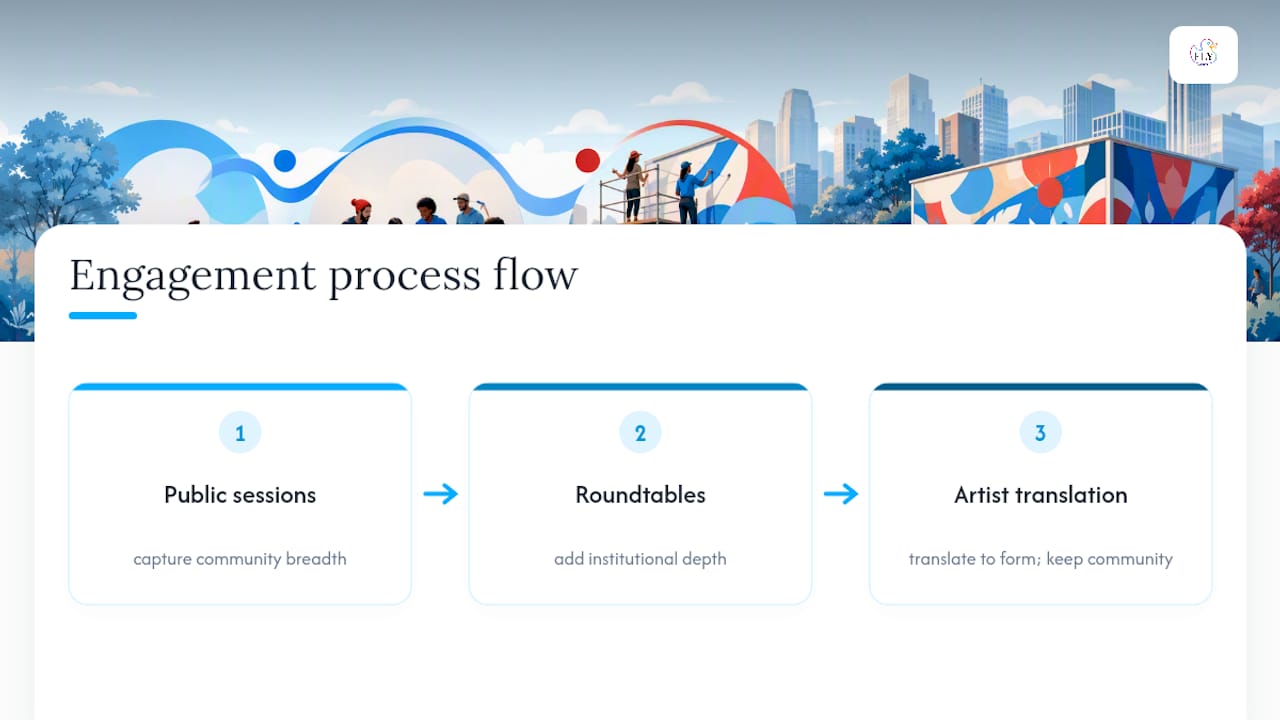
That guidance lines up with what the Glendale Park process shows at scale: broad public sessions capture breadth, roundtables capture institutional depth, and the artist’s job is to translate both into form, not to hand over the pencil. Facundo Yebne works from a version of that same principle: gather the story first, let the material and the glow effect carry the symbolism, and keep the community in the room through fabrication rather than just at the kickoff meeting.
The Biggest Mistake Artists Make Before They Even Start
The most common failure in this work isn’t a bad concept. It’s an artist walking into a first community meeting trying to sell an idea instead of trying to listen to one. Residents can tell the difference immediately, and once a group decides an artist is there to pitch rather than to hear them, no amount of later engagement fully repairs that first impression.
Trust gets built in smaller, less glamorous ways than a big unveiling. Documenting every session, publicly, so people can see their comments were actually recorded. Naming trade-offs out loud when budget or material constraints force a compromise, instead of hoping nobody notices. Holding meetings at times and in languages that match who actually lives on the block, not who shows up when a meeting is scheduled for 6 p.m. on a Wednesday for people working evening shifts.
None of this requires a huge budget. It requires treating the relationship as the actual project, and the sculpture as one of its outputs. Artists and cities that get this backwards end up with technically finished public art that a neighborhood never claims as its own.
— Facundo
Commissioning Community-Focused Public Art With FLY Miami
If your project needs a piece designed with a neighborhood rather than dropped onto it, commissions run the way the practitioner guidance above recommends: engagement and documentation first, fabrication second. The sculptures and installations are handmade and original rather than mass produced, and commissions can be offered to private collectors, hotels, brands, and public institution representatives on site-responsive projects.
Every custom commission starts with a conversation about the site and the story behind it, the same story-first approach outlined earlier in this guide, before any material or glow-pattern decisions get made. That collaborative process extends into stewardship planning, so the people responsible for the piece long-term know what it needs to stay vivid under blacklight for years, not just for the opening night. FLY Miami’s installation work spans hotel lobbies, public spaces, and gallery settings, and the studio’s custom UV-reactive commissions are built for exactly this kind of site-specific, community-informed brief. If you’re planning a participatory public art project and want a piece that glows with real local meaning, start a commissioning conversation through FLY Miami.
Sources
For maintenance requirements, see Alexandria’s and Minneapolis’s public art policies. For engagement methodology, see NYC’s PACE program and the Glendale Park report. For place-based programming context, see ExperienceByLocals.
- Public Art as Community Engagement (PACE) — NYC DCLA
- Glendale Park West Side Public Art Project engagement report
- Alexandria public art maintenance guidance
FAQ
What are the 5 C’s of community engagement?
Definitions vary across organizations, but most versions emphasize communication, collaboration, capacity building, commitment, and continuity, the idea being that engagement needs to be ongoing rather than a single event.
What is the 70/30 rule in art?
This isn’t a standard or documented rule in public art practice or municipal policy; it doesn’t appear in established engagement or commissioning frameworks, so treat any reference to it with caution.
What does public art do for a community?
Well-executed participatory public art strengthens local identity, builds cohesion across different groups, and creates a shared landmark that residents actively protect rather than ignore, outcomes documented in programs like NYC’s PACE.
What are examples of community engagement activities?
Outdoor Living Room sessions, stakeholder roundtables, pop-up workshops at markets or libraries, youth mentorship pairings, and artist-led temporary interventions all count, each suited to a different mix of breadth and depth of input.
How much does a custom public art commission from FLY Miami cost?
Pricing depends on scale, materials, and site requirements for each commission, so current details are available directly through FLY Miami’s site.