Hofman's 'Yellow Catalyst': Why Rubber Duck Art Still Sparks Joy
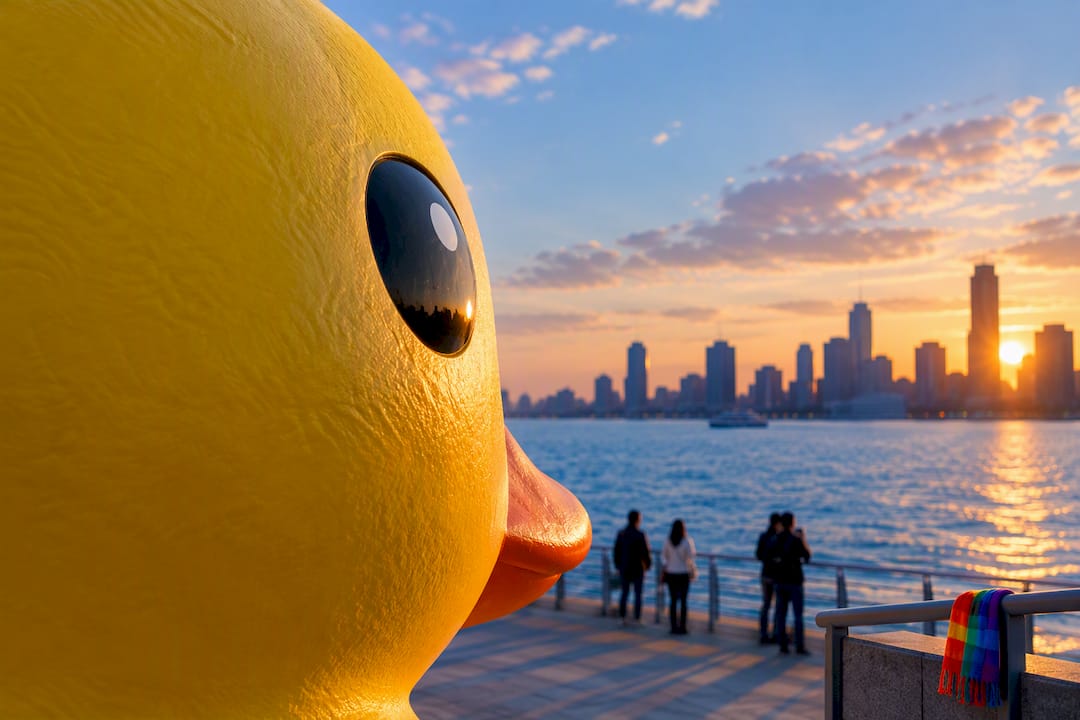
Florentijn Hofman’s Rubber Duck is a large-scale, site-specific gesture that uses nostalgic childhood imagery and oversized scale to catalyze communal play and a brief suspension of adult concerns. The artist frames it as a symbol of friendship and joy, but its size, materials, and travels around the world have opened it to political and environmental readings that Hofman never intended.
TL;DR:
- Hofman emphasizes that the rubber duck is meant to symbolize joy and connection for adults, not as a political or protest tool.
- The meaning of the sculpture shifts depending on site context, with its scale and location creating various emotional and social interpretations.
- Its inflatable PVC construction and temporary installations highlight the work’s ephemeral nature, reinforcing its status as an event rather than a permanent monument.
- The work is often linked to environmental concerns due to its plastic composition and the historical reference to the 1992 Friendly Floatees spill, which spread plastic toys across oceans.
- Ambiguity in the sculpture’s symbolism is intentional, fueling ongoing debate and conversation that extend beyond Hofman’s original intent.
Table of Contents
- What the artist says about his rubber duck art meaning
- How scale and site change the sculpture’s meaning
- Common symbolic interpretations and critical readings
- Public reaction, controversies, and unintended uses
- Materials, production, and the sculpture’s ephemeral logistics
- Why the rubber duck keeps resonating across contexts
- How FLY Miami Art interprets duck themes in UV glow work
- The debate over intent versus appropriation
- Sources
- FAQ
What the artist says about his rubber duck art meaning
Hofman has been direct about his goals, and his own words are the clearest starting point for anyone trying to parse the sculpture’s rubber duck art meaning. In an interview tied to the piece’s Hong Kong showing, Hofman described the Rubber Duck as a “yellow catalyst,” a device for triggering play and connection rather than a statement about any government or ideology.
He has also pushed back on the idea that the work is really for children. Adults, he argues, are the ones who need the reminder most.
- Hofman calls the duck a “yellow catalyst” for joy and friendship, not a political symbol.
- He says the piece is “more for adults,” who project their own childhood memories onto it.
- He has publicly rejected attempts to read the duck as a statement against any regime or cause.
That insistence on innocence matters because almost everything that happens after the duck arrives in a city works against it.
How scale and site change the sculpture’s meaning
An ordinary bath toy is forgettable. Blown up to the height of a building and floated in a harbor, it becomes disorienting in a way that resets how people move through public space. The gigantism flips the usual relationship between viewer and object: adults suddenly experience the world the way a toddler does, with a familiar item looming far larger than they are.
Site amplifies that effect. A duck bobbing in an industrial harbor reads differently than one parked in a plaza, and Hofman has used both settings to sharpen the contrast between the toy’s softness and the hardness of its surroundings.
- Saint-Nazaire, the debut location in 2007, set the template of a working harbor made suddenly playful.
- Hong Kong’s Victoria Harbour placed the duck against a dense skyline, heightening the scale contrast.
- Pittsburgh’s rivers gave the piece a civic, reunion-like framing tied to the city’s waterfront.
Each site borrows the same object but produces a distinct emotional register, which is part of why the work keeps finding new audiences.
Common symbolic interpretations and critical readings
Readers encounter several overlapping interpretations of the duck, and each has its own logic.
- Nostalgia and childhood projection: adults recognize the bath toy from their own early years, and the oversized version turns a private memory into a shared public one.
- Communal unity and uplift: crowds gathering around one object, at one time, in one place, generate a kind of collective mood that Hofman treats as the real point of the work.
- Political appropriation: protesters and even officials in several countries have repurposed duck imagery for their own messaging, something Hofman has objected to as a distortion of his intent.
- Environmental critique: critical writing connects the duck’s plastic body to wider anxieties about ocean debris, most often by pointing to the 1992 Friendly Floatees spill, in which 28,800 plastic bath toys entered the ocean and later became a tool for tracking ocean currents.
None of these readings cancels the others out. Scholarly work on the topic treats the duck as a polyvalent object that can carry nostalgia, trade critique, and pollution anxiety at once, which is exactly what makes it durable as a subject for both casual viewers and critics.
Public reaction, controversies, and unintended uses
Wherever the duck appears, it draws crowds fast and often reshapes how a city thinks about its own waterfront for the length of the installation. Reportage on the Pittsburgh installation documented the piece pulling large numbers of visitors to the riverfront, a pattern that has repeated in other host cities.

One documented fact anchors the environmental angle: the 1992 Friendly Floatees spill released 28,800 plastic bath toys into the ocean, a real event that later informed ocean current research and gave critics a concrete reference point for reading floating toys as pollution symbols.
Not every response has been celebratory. Unauthorized replicas have popped up in multiple countries, some of them recast with political messaging Hofman never signed off on, and he has spoken against that kind of rebranding. Practical mishaps have followed the duck too.
- Copycat ducks have appeared without licensing, sometimes carrying protest or nationalist messaging.
- Deflations and weather damage have forced early takedowns at several sites.
- Local authorities have occasionally restricted or removed duck imagery over political sensitivities.
Materials, production, and the sculpture’s ephemeral logistics
The Rubber Duck is not cast or carved. It is built from PVC sheeting, assembled into an inflatable membrane, and custom-fitted to whatever body of water or plaza will host it. Every installation is rebuilt on site and taken down afterward, which is a deliberate choice rather than a limitation.
- The sculpture is fabricated from PVC and inflatable sections specific to each location.
- Temporariness keeps the memory tied to a single moment rather than a permanent fixture.
- The plastic material itself invites the same debris associations that critics raise about ocean pollution.
That combination of softness, air, and short lifespan is part of what lets the piece feel like an event rather than a monument.
Why the rubber duck keeps resonating across contexts
The Rubber Duck holds together because it refuses to settle on one meaning. It can be a private memory of bath time, a civic celebration on a riverfront, a protest icon, or a prompt for talking about ocean plastic, often within the same installation and the same week.

Scale and temporariness both feed that mutability. A piece this large forces a reaction, and a piece this short-lived turns the reaction into something people talk about long after it deflates. The tension between Hofman’s stated intent and the readings people layer onto the work is not a flaw in the concept. It is the mechanism that keeps the duck circulating in conversation years after Saint-Nazaire.
How FLY Miami Art interprets duck themes in UV glow work
Hofman’s core idea, that a familiar shape at an unfamiliar scale can produce shared joy, shows up in a different form in FLY Miami Art’s studio practice. The studio builds handmade, one-of-a-kind pieces using UV-reactive pigments that reveal hidden patterns and colors under blacklight, turning a single object into two distinct experiences depending on the light in the room.
- Every FLY Miami Art piece is handmade and original, never mass produced.
- UV-reactive pigments let a duck-themed sculpture or wall piece shift its meaning entirely once the lights go dark.
- The studio’s rubber duck sculpture meaning essay expands on how playful icons carry weight in fine art contexts.
Pro Tip: If you are commissioning a themed installation, ask about UV-reactive elements early, since they change how a piece should be lit and displayed once it leaves the studio.
The debate over intent versus appropriation
The most useful takeaway here is that Hofman’s own framing deserves more weight than it usually gets. Commentary on the duck tends to jump straight to political or environmental readings because they make for sharper headlines, but the artist’s stated goal, a shared moment of childlike joy in an adult’s daily grind, is the reading best supported by his own repeated statements.
That does not make the other readings wrong. Scale, plastic, and global travel genuinely do invite critique, and pretending otherwise would flatten the work. What the conventional coverage gets wrong is treating appropriation as evidence against Hofman’s intent, when it is really evidence of how strong an image has to be before people fight over what it means. The lesson for anyone building public or collectible art on a shared symbol, ducks included, is that ambiguity is not a weakness to design around. It is the feature that keeps a piece alive in conversation.
— Facundo
Sources
Two sources anchor the claims here: the South China Morning Post interview with Hofman, which supplies his direct quotes on intent, and Dr. Jane Frances Dunlop’s presentation, which situates the duck within environmental and critical theory. Both are useful starting points for readers who want the primary material behind the interpretations above.
FAQ
What does a rubber duck symbolize?
A rubber duck most commonly symbolizes childhood nostalgia, playfulness, and a shared sense of communal joy, which is how Florentijn Hofman has described his own large-scale sculpture. Critics also read it as a stand in for global trade and ocean plastic, largely through references to the Friendly Floatees spill.
What does “rubber duck” mean as slang?
Outside of art contexts, “rubber duck” is used informally in debugging culture, where explaining a problem out loud to an inanimate object, often literally a rubber duck, helps a person spot their own mistake. This usage is unrelated to Hofman’s sculpture but shares the same object as a stand in for a simple, approachable presence.
What does a rubber duck on a car door handle mean?
There is no verified, documented meaning tied to Hofman’s artwork or academic sources for finding a rubber duck on a car door handle. Claims about this practice circulate informally online, but no credible source in art history or journalism ties it to the sculpture discussed here.
What was the rubber duck craze about?
The craze followed Hofman’s touring inflatable sculpture, which drew large crowds at each stop, from its 2007 debut in Saint-Nazaire through later installations in cities including Hong Kong and Pittsburgh. Part of the appeal was the sculpture’s temporary nature, since each version existed for a limited run before being taken down, which pushed people to see it in person while they could.