Keep UV Glow Years Not Months: Blacklight Damage Rules for Collectors
Short answer: yes, blacklight accelerates fading and color shifts in UV-reactive artworks, so display has to be planned rather than left running indefinitely. That does not make these pieces fragile in a fatal sense. It means the glow effect that makes them extraordinary is finite, and treating it that way, with limited hours and proper storage, keeps a piece vibrant for years instead of months.
TL;DR:
- UV-reactive pigments degrade due to repeated exposure to UV and visible light, causing fading, hue shifts, and reduced fluorescence over time.
- Different pigment formulations have varying longevity under blacklight, so understanding the artist’s material choices is crucial for estimating display life.
- Limiting exposure hours, using low-intensity LEDs, and controlling lighting conditions can significantly extend a piece’s vibrant lifespan.
- Protective varnishes and UV filters slow damage but also diminish fluorescence brightness, creating a trade-off between appearance and preservation.
- Documenting initial condition and setting clear exposure limits in commissions helps monitor aging and plans for storage or retirement.
Table of Contents
- How blacklight affects UV-reactive pigments and why they degrade
- Practical display guidelines to minimize damage while preserving the blacklight effect
- Conservation trade-offs: varnish, filters, and the look versus life decision
- Documenting condition and planning a display budget
- Working with the artist: commissioning, display agreements, and practical collaboration
- Accepting some works as time-limited experiences
- How FLY Miami Art helps with commissions and display planning
- Sources
- FAQ
How blacklight affects UV-reactive pigments and why they degrade
Fluorescent pigments glow because their dye molecules absorb UV or visible light and re-emit it at a different wavelength. That process, repeated over hours of exposure, breaks down the dye itself. A colorimetric and spectroscopic study of daylight fluorescent paints found measurable color and fluorescence loss under both visible and UV exposure, meaning the damage is not something you avoid simply by keeping the blacklight off between showings. Ambient room light contributes too.
At the molecular level, the degradation follows identifiable chemical pathways. Analytical work using HPLC and mass spectrometry has traced these changes to processes like N-deethylation and oxidation in fluorescent dyes, which alter how the dye absorbs and emits light. That is why an aging fluorescent piece does not just get dimmer: it often shifts hue, since different dye classes such as rhodamines and coumarins degrade at different rates and through different chemical routes.
This is also why pigment composition matters so much when you commission or buy a UV-reactive piece. Not every fluorescent paint or resin behaves the same way under a blacklight. Some formulations hold their glow considerably longer than others, and the only way to know what you are getting is to ask the artist or manufacturer what dyes and resins went into the work. A duck sculpture painted with one pigment set and a wall panel painted with another can age on completely different timelines even if they hang in the same room. If you are working through the color choices on a commissioned piece, it helps to understand how bold pop art palettes are built for UV sculptures before locking in a design.

Practical display guidelines to minimize damage while preserving the blacklight effect
Once you accept that exposure causes wear, the job becomes managing it. A few habits make the biggest difference:
- Cap cumulative exposure by setting a fixed number of display hours per week or year rather than running the blacklight continuously.
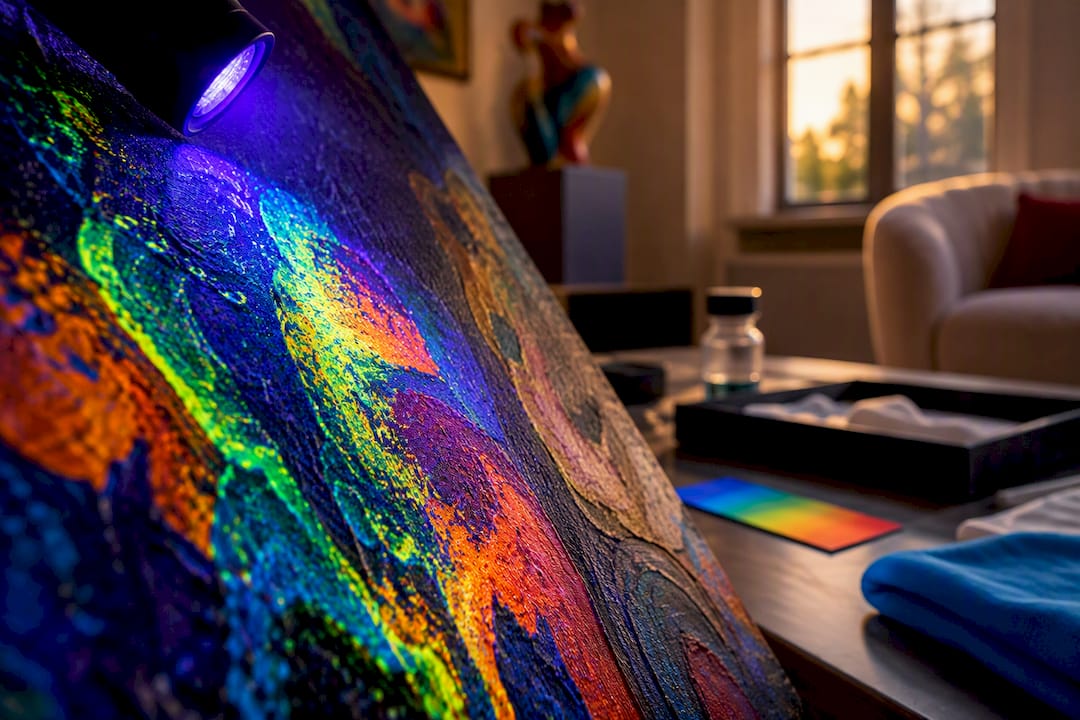
- Choose low-intensity UVA LEDs tuned to longer wavelengths instead of high-output UV lamps, and keep them at a reasonable distance and angle from the surface.
- Install timers or occupancy sensors so the blacklight only runs when someone is actually in the room.
- Store the piece in complete darkness when not on display, in a space with stable temperature and humidity.
- Avoid placing pieces near reflective surfaces that scatter stray UV and visible light onto the artwork from unintended angles.
Framing and placement decisions matter as much as the lamp itself. A recessed or angled fixture that lights the piece without bouncing light off a glossy floor or mirrored wall reduces the total dose the pigment absorbs over time. For gallery and hospitality spaces building out a full room, the setup principles in this blacklight room setup guide cover lamp selection and placement in more depth, and the broader considerations for hospitality lighting are laid out in this room mood and art lighting guide.
Pro Tip: Log every display session (date, duration, lamp type, distance) in a simple spreadsheet. That record becomes your evidence when deciding how much display life a piece has left.
Conservation trade-offs: varnish, filters, and the look versus life decision
Protective coatings help, but they come at a visual cost. UV-inhibiting varnish slows the photochemical reactions that cause fading, yet the same coating tends to dampen how brightly the pigment fluoresces under blacklight. Conservation research on daylight fluorescent pigments notes this directly: varnish reduces fading but also reduces fluorescence intensity, which puts preservation and spectacle in direct tension. UV-filter glazing and films work similarly, cutting UV exposure at the cost of some perceived brightness.

The right choice depends on what the piece is for. A short-term installation at a nightlife venue or a temporary exhibition can lean toward spectacle, since the glow only needs to hold up for weeks. A museum-accessioned or long-term collector piece should lean toward preservation, accepting a slightly muted glow in exchange for a much longer usable life. There is rarely a version of the piece that maximizes both.
Documenting condition and planning a display budget
Treating a UV-reactive piece well means tracking it the way a conservator would. That starts before the first display and continues for as long as you own it.
- Capture baseline photographs and colorimetric readings before the piece is ever shown under blacklight, so you have an objective starting point.
- Re-photograph and re-measure at fixed intervals, watching for percentage brightness loss and shifts in hue rather than relying on memory.
- Log cumulative light hours alongside the condition checks, since hours of exposure are the variable driving the change.
- Negotiate an annual exposure limit with the artist at the time of purchase or commission, along with a retirement trigger such as a specific brightness loss threshold.
- When monitoring shows the piece has crossed that threshold, move it into dark storage and communicate the decision to stakeholders, whether that is a co-owner, an insurer, or an institution’s board.
Multimodal imaging and fiber optic spectroscopy have been used in conservation research to evaluate exactly this kind of aging, and the same principle scales down to a simple photo-and-spreadsheet routine for a private collector or a single hotel installation.
Working with the artist: commissioning, display agreements, and practical collaboration
Before buying or commissioning a UV-reactive piece, ask the artist directly what pigments and resins were used and what exposure limits they recommend. That single conversation resolves most of the guesswork described above, since the person who made the work usually knows how its specific materials age.
It is worth building that expectation into the commission agreement itself: a display-budget clause that states an agreed number of annual light hours, plus a commitment to baseline documentation, gives both sides a shared reference point later. FLY Miami Art works with collectors, designers, and institutions on room setup and lifecycle expectations as part of the commissioning process, so a piece is designed with its display environment in mind from the start rather than adapted to it afterward.
Accepting some works as time-limited experiences
The honest position for anyone exhibiting UV-reactive art is to treat the glow as an experience with a lifespan, not a permanent fixture. Label pieces accordingly, tell visitors the fluorescence will diminish with display, and keep condition records that travel with the work to its next owner or institution. Conservation case studies on fluorescent works frame this as an ethical choice as much as a technical one, and it is the right one.
— Facundo
How FLY Miami Art helps with commissions and display planning
Buying a UV-reactive piece should not mean guessing how long the glow will last. The artist builds each handmade original with its display life in mind, and offers a consultation on room setup and exposure planning alongside commissions.

Whatever stage you’re at, there’s a path in:
- Browse finished pieces in the UV/Glow Art collection or Originals if you want something ready to install.
- Start a custom glow piece commission built around your space and display budget from day one.
- Explore Wall Art or Sculpture formats depending on the venue.
Reach out through Flymiami to talk through a commission or set up a display consultation before your next installation goes up.
Sources
- The light aging behavior of daylight fluorescent paints: a colorimetric, photographic, Raman spectroscopic and fluorescence spectroscopic study | npj Heritage Science
- Following the Light: Use of Multimodal Imaging and Fiber Optic Spectroscopy to Evaluate Aging in Daylight Fluorescent Artists’ Pigments
FAQ
Does blacklight actually fade UV-reactive art over time?
Yes, both UV and visible light drive measurable fading and fluorescence loss in daylight fluorescent pigments. The rate depends on the specific dyes and resins used, so pieces from different artists or batches can age at different speeds.
How many hours a year can I safely display a blacklight piece?
There is no universal number, since it depends on the pigment formulation and lamp intensity. Ask the artist for their recommended exposure limit and negotiate a display budget in your purchase or commission agreement.
Does UV-filtering varnish stop the damage completely?
No. Varnish reduces fading but also dampens the fluorescence effect, so it trades some visual intensity for a longer usable life rather than eliminating the trade-off.
Can I restore a UV piece once the glow has faded?
Restoration is difficult because degraded dyes often produce different byproducts that shift the emission color, making an exact color match hard to achieve. Careful documentation from the start, including baseline photos and colorimetry, gives a conservator far more to work with if restoration is attempted.
Does FLY Miami Art offer guidance on display and exposure limits?
Yes, FLY Miami Art provides room-setup advice and can discuss display expectations as part of its commission process for custom glow pieces. Reach out through Flymiami to set up a consultation before installing a new piece.