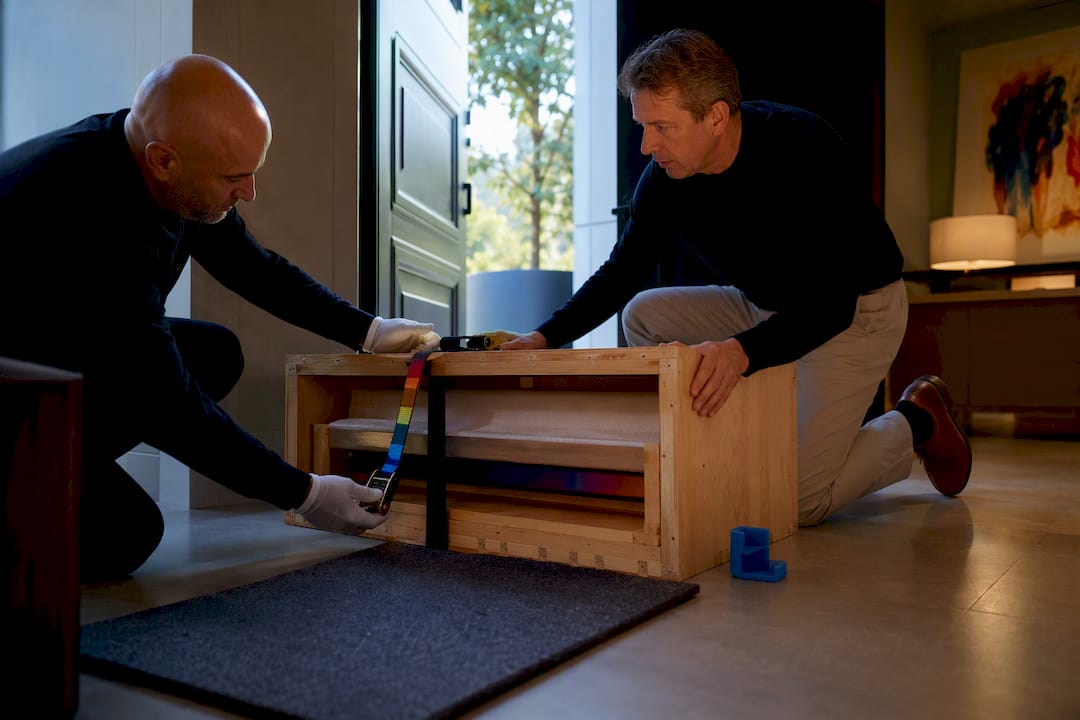
Avoid Costly Damage with White Glove Art Delivery for Collectors
White glove art delivery is museum-grade transport and installation that preserves an artwork’s condition and maintains a full chain of custody from pickup to final placement. It matters most for collectors moving high-value, fragile, or environmentally sensitive pieces, where a dent or a humidity swing can cost far more than the shipping bill. The service worth paying for includes custom crating, climate control, and documented condition reporting at every handoff.
TL;DR:
- Proper vehicle standards with active climate control and GPS tracking are crucial for protecting high-value art during transit, especially for Tier 1 works.
- Genuine white glove service requires exclusive-use transport, custom museum-grade crating, and documented condition reports at all transfer points.
- Insurance coverage should be specifically ad valorem or declared value, with clear details on policy limits and coverage for restoration and market loss.
- Preparing artwork with provenance, certificates, and proper packing significantly reduces delays and damage risks during pickup and transit.
- Booking several weeks in advance and confirming contingency plans for delays or accidents are essential for secure, efficient art movement.
Table of Contents
- What services should you expect from white glove art delivery?
- The technical standards behind museum-grade handling
- How do you vet and choose a provider?
- What do white glove delivery costs and timelines actually look like?
- How do you prepare your artwork and site before pickup?
- Common mistakes collectors make with art shipping
- What happens if something goes wrong during transit?
- What permits and regulations apply to high-value art shipments?
- Stewardship over spectacle
- How FLY Miami supports collectors planning installation and commissions
- Sources
- FAQ
What services should you expect from white glove art delivery?
True white glove service is a defined set of steps, not a marketing label a general mover slaps on a quote. According to Convelio, the term is often misused, and genuine fine art logistics mean exclusive-use vehicles, fine-art shuttle routes, or trained couriers rather than a shared freight truck with a padded blanket thrown over your painting.
Pickup itself comes in a few forms. Exclusive-use transport dedicates the vehicle to your piece alone, a shuttle service consolidates several collectors’ works on a scheduled fine-art route, and a courier physically accompanies especially valuable pieces from door to door.
From there, the process should include:
- Onsite packing with archival materials suited to the medium, not generic foam or shrink wrap.
- Custom crating built to museum specifications, sized and cushioned for the specific piece.
- Climate-controlled transport with active temperature and humidity monitoring during transit.
- Installation, hanging, de-installation, and debris removal handled by the same team.
- Chain-of-custody documentation with photographic condition checks at each transfer point.
That last item is easy to overlook until something goes wrong. A provider who cannot describe how they log condition at pickup, in transit, and at delivery is not offering white glove service, whatever the invoice calls it.
The technical standards behind museum-grade handling
Crate design does more work than most collectors realize. According to the Smithsonian’s Art in Transit handbook, proper case design with backing boards and controlled internal humidity slows temperature and humidity swings and protects sensitive materials during transport. The crate is not just a box. It is a buffer that keeps the artwork’s immediate environment stable while the outside world changes.
Condition reports are the paper trail that makes accountability possible. A usable report photographs the front, back, and edges of a piece, notes any existing wear, and carries a signature and timestamp at each point of transfer. Skipping this step means you have no baseline if damage shows up later.
Vehicle standards matter just as much as what happens inside the crate. NARA policy sets minimum requirements for moving sensitive holdings, including air-ride suspension, active climate control, 24-hour GPS tracking, and dual-driver non-stop service for the highest-value works. Air-ride suspension absorbs road vibration before it reaches the artwork, and GPS tracking means you always know where a piece is, not just when it left and when it should arrive.
For Tier 1 works, that is often where you insist on couriers, sealed containers, or a security escort. Unattended transit and unnecessary handling transfers are where most damage and loss actually occur, so reducing the number of hands and stops on a route is one of the more effective ways to protect a piece in motion.
How do you vet and choose a provider?
Choosing a provider is closer to vetting a contractor for a home renovation than picking a shipping company off a search results page. The questions you ask upfront determine whether your piece arrives the way it left.
- Ask for institutional references and past project experience with museums, auction houses, or galleries.
- Request full insurance details, including whether coverage is ad valorem (declared-value) rather than standard cargo insurance, plus a sample certificate.
- Confirm the provider’s crate shop can build to museum specifications and ask whether staff are trained to PACCIN or equivalent packing standards.
- Walk through their operational checklist: vehicle specs, climate control ranges, GPS tracking, and their condition reporting protocol.
- Ask whether load-only/first-off (LOFO) or non-stop routing is available for higher-value pieces.
The Arts & Artifacts Indemnity Program illustrates why the insurance conversation deserves real scrutiny: the program sets specific courier requirements and indemnity limits for eligible exhibitions, and ad valorem coverage is built for fine art in a way standard cargo policies are not, covering restoration costs and market value loss rather than a flat replacement figure.
Watch for red flags along the way: vague answers about packing materials, a refusal to share a sample condition report, or insurance limits the provider cannot clearly explain. Any of those should end the conversation before a contract does.
Pro Tip: Ask a provider to walk you through their condition reporting process before you ask about price. How they answer tells you more than the quote does.
What do white glove delivery costs and timelines actually look like?
Pricing depends heavily on distance, crate complexity, and insurance coverage, and quotes vary enough that a single number is not useful. VIP Transport publishes examples showing local pickups for small pieces commonly running in the low hundreds of dollars, while cross-country moves involving custom crating and installation can reach several thousand dollars depending on size, distance, and declared-value coverage.
Exhibition-level projects, where multiple pieces travel together with couriers and installation crews, sit at the higher end of that range and scale with the number of works and the complexity of the venue. Exclusive-use vehicles, dedicated couriers, LOFO scheduling, and security escorts all add cost, because each one reduces handling risk at the expense of shared logistics efficiency.
Lead time matters as much as price. Saatchi Art’s shipping guidance notes that collectors should expect several weeks for local moves and four to eight weeks or more for cross-country or exhibition projects, with booking early essential during busy seasons when specialized teams are stretched thin.
How do you prepare your artwork and site before pickup?
Preparation on your end speeds up the process and reduces the chance of a delay or a damage dispute later. Have your documentation ready before the crew arrives:
- Provenance records, certificate of authenticity, exact dimensions, and recent condition images.
- Frames stabilized and, when the handler advises it, glass removed to prevent shattering in transit.
- Accessories, hardware, and detachable elements packed separately and labeled.
- Parking, elevator access, and any building restrictions confirmed with a local contact in advance.
If you are missing a certificate of authenticity or your provenance paperwork is thin, GothMarket’s guidance on building a defensible certificate is worth reviewing before the piece ships, since insurers and future buyers both rely on that documentation.
On pickup day, expect the handler to photograph the piece, complete a condition report with you present, and have you sign off on the documentation before it leaves your custody. If any of those steps get skipped, ask why before the truck pulls away.

Common mistakes collectors make with art shipping
Most damage claims trace back to decisions made weeks before the truck ever arrives. Booking too late forces collectors into whatever capacity is left during peak season, often with a less experienced crew. Accepting vague insurance language, rather than confirming ad valorem coverage in writing, leaves a real gap if something goes wrong. Skipping a condition report because “it’s just going across town” removes your only leverage if a claim comes up later.
Insist on photographic documentation at every transfer point, not just at pickup and delivery. For UV-reactive and mixed-media works, materials sensitivity adds another layer: certain plastic wraps can trap off-gassing, and light exposure during staging can affect pigments differently than it would a traditional canvas. Coordinating packing materials with the studio before pickup, rather than leaving it to a generalist mover’s default kit, is a small step that prevents an outsized problem.
What happens if something goes wrong during transit?
Even a well-vetted provider needs a contingency plan, and asking about it before you sign is part of due diligence. A serious operator can describe what happens if a vehicle breaks down, a route is blocked, or weather forces a delay: where the piece is stored in the interim, how climate control is maintained during an unplanned stop, and who is notified.
GPS tracking, required under NARA’s policy for sensitive holdings, matters here specifically because it lets both you and the provider confirm a piece’s location and status in real time if a delay occurs, rather than waiting for a phone call. Dual-driver non-stop service exists partly to avoid the scenario where a single driver has to leave a loaded vehicle unattended at a rest stop overnight.
Ask providers directly how they handle a damaged crate discovered mid-route, an accident, or a missed delivery window. The answer should include immediate photographic documentation, a call to you and your insurer, and a clear protocol for whether the piece continues, returns, or moves to a secure interim location. If a provider has no answer beyond “that hasn’t happened to us,” treat that as a gap, not a reassurance.

Security escorts and sealed containers, mentioned in the vehicle standards above, exist specifically to reduce the odds you ever need a contingency plan in the first place. For pieces with unusual value or fragility, that upfront cost is often the cheaper option compared to what a mid-route incident could cost in restoration or diminished value.
What permits and regulations apply to high-value art shipments?
Domestic art transport does not typically require special permits the way, say, hazardous materials shipping does, but high-value pieces moving for exhibition or loan can fall under specific institutional and federal frameworks. The Arts & Artifacts Indemnity Program is the clearest example: it sets courier requirements for eligible domestic and international exhibitions and establishes indemnity limits and eligibility criteria that museums and lenders must meet to qualify for federal coverage.
If you are lending a piece to an institution, ask whether the exhibition qualifies for indemnity coverage under that program, since it can materially change your insurance costs and courier obligations. Outside of institutional loans, private collectors moving art between states generally deal with standard interstate carrier regulations rather than art-specific permits, but international shipments introduce customs declarations, export documentation, and potential cultural property rules that vary by the work’s origin and destination.
The NPS Museum Handbook also notes that professional packers and shippers, even competent ones, often lack museum-specific knowledge of handling requirements, which is why institutions default to specialist couriers for fragile or historically significant objects. The same logic applies to private collections: a generalist freight company may be fully licensed and still not know what your specific piece requires.
Stewardship over spectacle
Conservators treat handling as conservation, not an afterthought after the real work of framing and display. Every careful transfer is a small act of preservation, and that discipline, not the flash of a gallery opening, is what protects a collection’s value over decades.
— Facundo
How FLY Miami supports collectors planning installation and commissions
If you are commissioning a custom piece or planning where an original will live, FLY Miami can help you think through installation logistics and staging before a shipper ever gets involved, particularly for UV-reactive and mixed-media work that needs specific handling notes.
Whether you are exploring the Originals collection, considering a custom glow piece, or coordinating placement for a sculpture already in transit, reach out through Flymiami and the studio will help you plan the handling and installation details specific to your piece.
Sources
- White glove delivery: the art of fine‑art logistics — Convelio
- NARA holdings movement policy — National Archives
- Art in Transit: Handbook for packing and transporting paintings — Smithsonian / Art in Transit
- Fine art transport & crating services — VIP Transport
- Arts & Artifacts Indemnity Program — National Endowment for the Arts
FAQ
What does white glove delivery mean for artwork?
White glove delivery means museum-grade handling from pickup to final placement, including custom crating, climate-controlled transport, and documented condition checks at every transfer. It goes beyond standard shipping by adding installation, de-installation, and debris removal as part of the same service.
How much does white glove art delivery cost?
Local pickups for small pieces commonly run in the low hundreds of dollars, while cross-country moves with custom crating and installation can reach several thousand dollars depending on size, distance, and insurance, according to VIP Transport’s published examples. Exhibition-level projects with couriers and multiple pieces tend to sit at the higher end of that range.
Do you tip if you paid for white glove delivery?
Tipping practices vary by provider and region, and it is not a standard requirement the way it is with furniture delivery. If the crew went beyond the agreed scope, a modest tip is a reasonable gesture, but it is worth checking your service agreement first since some fine-art logistics contracts build gratuity into the fee.
What documentation should I expect at pickup?
You should expect a photographic condition report covering the front, back, and edges of the piece, along with a signed and timestamped document before the crew takes custody. This same documentation should repeat at each transfer point and again at final delivery.
How far in advance should I book art shipping?
Saatchi Art’s shipping guidance recommends allowing several weeks for local moves and four to eight weeks or more for cross-country or exhibition projects, with earlier booking especially important during peak seasons. Booking late often means settling for whatever crew and vehicle capacity remains available.