Collectors: Museum and Insurer Grade 2 Inch Art Crating Requirements
Proper art crating starts with a documented condition report and photographs, then builds outward: primary wrap and mounts suited to the object, cavity packing with at least two inches of cushioning on every side, and a skid-mounted, ventilated crate with a removable lid and secure fasteners. Add environmental limits, a vetted carrier, and a paper trail that travels with the piece. Anything delicate, delaminating, or multi-material needs a conservator’s input before you cut a single piece of foam.
TL;DR:
- Have a conservator assess flaking paint, unstable joints, fragile frames, or moving panels before packing, because mounts and foam must suit the object’s condition.
- Use glassine or Tyvek against the artwork, not plastic, then shape a foam cavity with at least two inches of clearance on every side.
- For repeat openings, use bolted removable lids; one way shipments can use nails, but every crate needs skids and a checked, secure lid.
- Choose a specialist carrier with air ride and climate control for fragile works; add a data logger for high value or irreplaceable shipments.
- For shipments entering or crossing the U.S., solid wood must be debarked, heat treated or fumigated, and stamped with ISPM 15; noncompliant crates risk refusal.
Table of Contents
- Assessing the object and planning before you build anything
- Interior packing: primary wrap, cavity packing, and cushioning rules
- Crate construction: skids, lids, fasteners, and ventilation
- Transport, environmental limits, and handling on arrival
- Documentation, labeling, and chain-of-custody procedures
- Notes from the studio on mixed-media and glow sculptures
- Why most crating advice undersells the engineering
- A managed option for collectors who would rather not build the crate themselves
- FAQ
- Sources
Assessing the object and planning before you build anything
Before any crate takes shape, you need a full record of what you are packing and why. The NPS Museum Handbook shipment checklist calls for a condition report, confirmed travel dates, environmental requirements, insurance coverage, and a defined claims procedure before an object ever leaves the building. Skipping this step means you are designing a crate for a guess instead of for the actual object.
Start with a written condition report paired with a photo log. Photograph the front, back, edges, any existing damage, and areas of past repair under even lighting, and record exact dimensions and weight so the crate interior and base can be sized correctly. For paintings, note any cracking, flaking, or canvas slackness. For sculpture, flag loose elements, old adhesive repairs, or unstable joints.
Some conditions call for a conservator before you proceed:
- Flaking, cupping, or delaminating paint that could shed during handling.
- Loose or unstable joints on composite or mixed-media sculpture.
- Historic or fragile frames where removing glazing or adding a backing board changes the object’s structural behavior.
- Panel paintings showing warping or movement at the support.
Once the object’s condition is understood, plan the logistics. Order crate lumber, foam, and archival materials with enough lead time to avoid rushed fabrication. Confirm who is responsible for packing, who signs off on the finished crate, what insurance applies during transit, and what security measures (locked storage, sealed trucks, limited access) apply before pickup. These decisions shape the crate as much as the object does.
Interior packing: primary wrap, cavity packing, and cushioning rules
The crate itself is the last line of defense, not the first. Professional packing starts with a primary wrap or mount that contacts the object directly, then adds cushioning, then the outer case, so that any impact routes into stronger structural points rather than into fragile surfaces.
For primary wrap, reach for glassine or Tyvek rather than sealed plastic. Plastic sheeting can trap moisture as temperatures shift, which invites mold growth on organic materials and paint layers. Acid-free tissue works well as an interleaving layer for works on paper or for cushioning small protrusions before foam goes on.
Cavity packing follows a consistent sequence:
- Measure the object precisely, including any frame, base, or protruding elements.
- Allow a minimum of two inches of cushioning clearance between the object and the crate wall on every side, a spacing figure confirmed in NPS cavity-packing guidance.
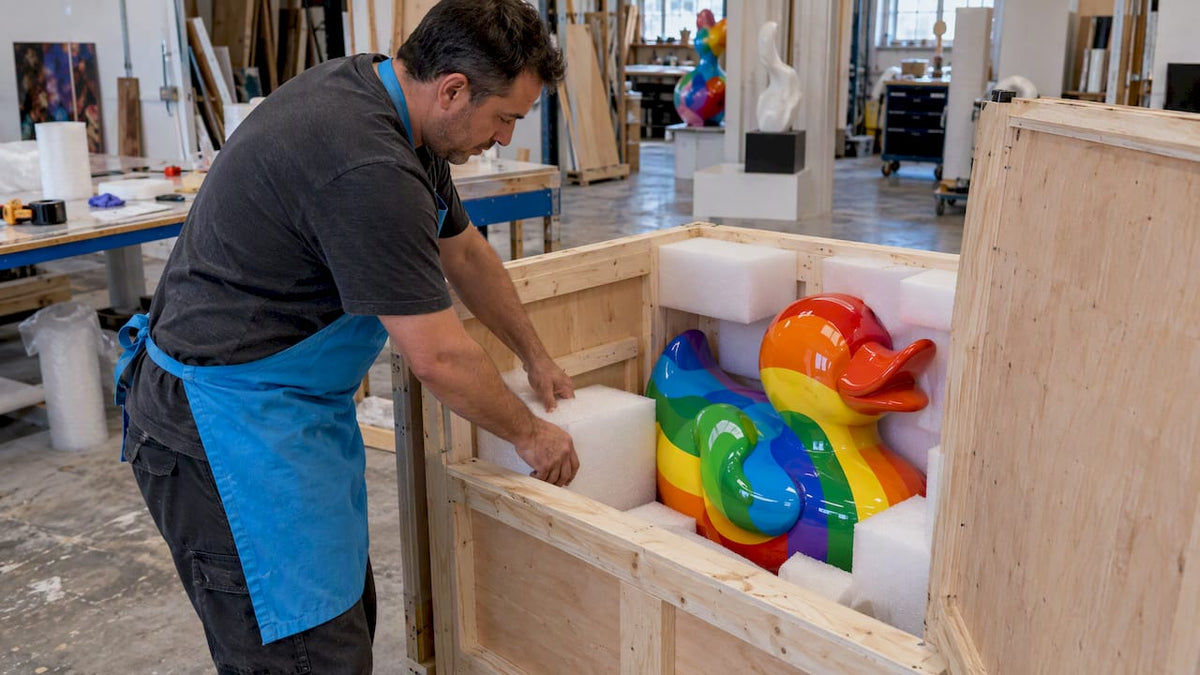
- Carve layered foam cavities that cradle the object’s actual contours rather than a generic rectangular slot.
- Line each cavity with tissue to prevent direct foam contact with painted or finished surfaces.
- Number the foam layers during fabrication so the crate can be repacked correctly at the destination without guesswork.
Foam selection depends on the object’s weight and surface sensitivity. Dense Ethafoam suits heavier, more robust pieces where load-bearing support matters most, while softer urethane foams protect delicate or finished surfaces that would show compression marks from a denser material. As a rough guide, denser foam needs less thickness to absorb the same shock, while softer foam needs more surface contact area spread across the object to avoid concentrating pressure on any single point.
For sculpture, blocking and bracing has to transfer the object’s load to its strongest structural points, never to a thin edge, protruding element, or decorative surface. Smithsonian Art in Transit research makes a point worth repeating here: adding more foam is not automatically the fix for vibration risk. Mounts and supports engineered around the object’s actual construction matter more than cushioning volume alone.

Pro Tip: Dry-fit the foam cavity before final assembly and photograph each layer; it turns repacking at the destination into a five-minute job instead of a guessing game.
Crate construction: skids, lids, fasteners, and ventilation
A well-built crate is judged by how it survives repeated handling, not by how it looks on day one. Construction choices here determine whether the object inside ever feels an impact at all.
- Base and skids: Build the base on skids sized for forklift tines or sling access, spaced to support the crate’s weight without flexing under load, following the practical base and header principles outlined in institutional crate specification standards-en.pdf).
- Removable lid versus nailed construction: Reserve bolted, removable lids for crates that will be opened and resealed multiple times, such as loan or exhibition crates, and mark the removable panel clearly; a simpler nailed crate suits a one-way shipment.
- Fasteners: Use coated or stainless screws on removable panels so they can be backed out repeatedly without stripping, and mark fastener locations on the exterior for faster, safer opening.
- Rubbing strips and handling features: Add rubbing strips along the base to protect the skids during repeated loading and to keep the crate stable when set down on uneven surfaces.
- Ventilation: Include ventilation baffles so interior air can equalize gradually rather than trapping humidity against the object.
- Vapor barriers: Interior liners of Tyvek or polyethylene can help manage moisture, though sealed plastic against the object itself carries the same mold risk noted earlier, so reserve it for the crate wall rather than the object surface, and add an insulating liner for shipments crossing significant temperature swings.
Chubb’s fine art shipping guidance recommends skids under every crate and secure, checked lids at both dispatch and receipt, a detail worth confirming with whoever builds or inspects your crate.
If your shipment crosses a border, the wood itself has its own rulebook. Under USDA APHIS wood packaging material guidance, any solid wood packaging entering or transiting the country must be debarked and either heat-treated (core temperature of 56°C for 30 minutes) or fumigated, then stamped with the ISPM 15 mark. Noncompliant wood packaging can be refused entry outright, which turns a crate oversight into a shipment delay.
Transport, environmental limits, and handling on arrival
Crate design only works if the vehicle and handling match it. High-value or fragile works call for air-ride suspension, climate control, and a dedicated fine-art carrier rather than a general moving service, a distinction Chubb’s guidance draws explicitly for insured shipments.
Before the crate ever loads:
- Require air-ride suspension and climate control for any piece sensitive to temperature or humidity swings.
- Confirm the vehicle has a lift gate, lockable cargo area, and strap points rated for the crate’s weight.
- Set target environmental ranges for the shipment and include desiccant packs or an insulated liner when conditions are uncertain.
- Place a data logger inside or alongside the crate for any shipment classified as high-value or irreplaceable.
Insurers favor specialized fine-art carriers with air-ride and environmental controls over general household movers for high-value shipments, according to Chubb’s art-moving guidance, which matters when you are deciding what to specify in a shipping contract.
For urgent or unusually high-value pieces, a dedicated or expedited service reduces the number of handoffs and therefore the number of chances for damage.
On arrival, give the crate an acclimatization period before opening it, especially after a shipment with significant temperature change, so condensation does not form on a cold object exposed to a warm room. Open it against the original condition report, photograph the object immediately, and flag any discrepancy before the carrier leaves.
Documentation, labeling, and chain-of-custody procedures
Paperwork is part of the crate, not an afterthought stapled on at pickup. The NPS Museum Handbook treats condition reports, insurance details, and a defined claims process as standard parts of a shipment checklist, not optional extras.
- Pack a copy of the condition report, an inventory of contents, and emergency contact and insurance information inside the crate, with a duplicate set held by the shipper.
- Label the exterior with orientation arrows, discreet handling markings, and a crate ID number, while keeping sensitive value or content details off the outside.
- Record a chain-of-custody at every handoff: who released the crate, who received it, and a signature and timestamp at each transfer point.
- Photograph the sealed crate at dispatch and again at receipt before opening, so any damage claim has a clear before-and-after reference.
- If damage is suspected, isolate the object, photograph it immediately, and notify the insurer and consignee the same day rather than waiting for a full report.
Notes from the studio on mixed-media and glow sculptures
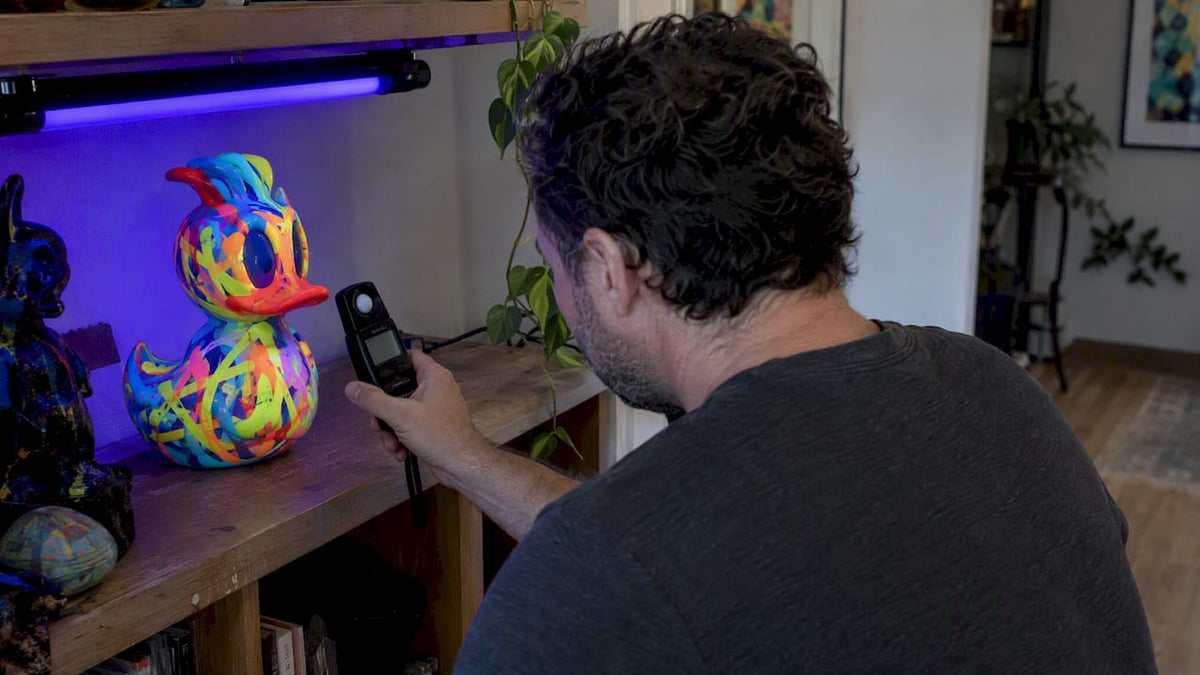
UV-reactive and mixed-media sculptural work add a layer that standard crating guidance does not address directly: pigment and material interactions you cannot always see in daylight. We photograph condition under both standard light and blacklight before any piece leaves the studio, since glow-layer separation or pigment shift will not show up in a normal photo log. Mounts need to isolate vibration at the actual joints between dissimilar materials (resin, wood, metal, paint layers) rather than relying on extra foam around the whole piece, consistent with the object-specific approach Smithsonian’s Art in Transit research recommends. Readers who want shop-level detail can see how this plays out in practice in our sculpture shipping guide.
Why most crating advice undersells the engineering
The biggest gap in most consumer-facing crating advice is treating foam thickness as the whole solution. It is not. A crate with generous padding but no real structural thinking about where the object’s load actually travels will still transmit shock straight into a weak point, whether that is a thin panel edge, a loose sculptural joint, or a pigment layer under stress. The two-inch clearance rule and foam density choices matter, but they are only useful once you have correctly identified the object’s actual load-bearing points, which is exactly what a condition report and a conservator’s eye are for.
What gets overrated: sealed plastic wrap as a catch-all protective layer. What gets underrated: the time spent on the condition report and photo log before any material gets cut. If you only have budget and attention for one part of this process to get exactly right, make it that first assessment. Everything downstream, from foam selection to crate dimensions to insurance terms, depends on what you find there.
— Facundo
A managed option for collectors who would rather not build the crate themselves
Building a museum-grade crate from scratch takes time, tools, and material sourcing most collectors would rather skip, which is why we offer insured shipping on pieces purchased through our studio and publish detailed packing guides for anyone handling their own logistics.

Every original, sculpture, or UV/glow piece we ship travels with condition-report and cavity-packing standards scaled to the surface sensitivity of UV-reactive pigment work specifically. If you are commissioning a custom glow piece or picking up an original and want packing or shipping guidance built around that particular object, reach out through our commissions and shipping page and we will walk through what your piece needs before it ever leaves the studio.
FAQ
What are the four main types of art galleries?
Gallery typologies vary by source, but a common version groups them as commercial galleries, nonprofit or artist-run spaces, museum galleries, and vanity or pay-to-play galleries. None of these categories changes the crating requirements covered above, since condition reporting and cavity packing apply regardless of where the work is headed.
Is FedEx or UPS better for shipping artwork?
Neither general courier is built for fine-art handling the way a dedicated fine-art carrier is, and insurers specifically favor carriers with air-ride suspension and climate control for high-value shipments, according to Chubb’s art-moving guidance. For smaller, lower-value, well-crated pieces, a standard courier can work, but anything irreplaceable or fragile warrants a specialist.
Is art conservation a good career?
Art conservation is a specialized, credential-driven field that blends chemistry, art history, and hands-on treatment skills, and conservators play a direct role in crating decisions for fragile or unstable works. Whether it suits you as a career depends on training path and job market factors outside the scope of a crating guide.
What do criteria mean in art?
In an art context, criteria generally refer to the standards used to judge or evaluate a work, such as technique, originality, or conceptual strength. In a crating and shipping context, the relevant criteria are physical and practical: condition, material stability, and fragility, which determine how the object needs to be packed and handled.
Sources
- NPS Museum Handbook: Packing and Shipping guidance
- USDA APHIS — Wood packaging material (WPM) guidance
- Chubb: Protect your fine arts (handling and shipping guidance)
- Art in Transit (Smithsonian-led research)