Light Budget for Collectors: Why UV Artwork Fades (BWS 1–2)
Yes, UV-reactive artwork fades, and that fading is predictable rather than a flaw. Blacklight pieces rely on fluorescent pigments that are chemically less stable than conventional paint, so collectors should plan a light budget and talk through display limits before buying. At FLY Miami Art, Facundo Yebne and our studio treat each glow piece as a documented, experiential work rather than a permanent fixture.
TL;DR:
- Fluorescent dyes used in UV-reactive artwork degrade faster under light, especially reds and long-wavelength colors, causing uneven fading over time.
- Many daylight fluorescent pigments have low lightfastness ratings, with some showing visible change after limited exposure compared to conventional art materials.
- Fading typically results in dimmer glow, hue shifts, and permanent color changes, which occur gradually rather than suddenly, affecting display longevity.
- Implementing a documented light budget, using timers or rotating displays, can significantly slow fading and extend the piece’s visual lifespan.
- Asking for specific pigment data, a current condition report, and a recommended annual light exposure when commissioning helps set accurate expectations for aging and preservation.
Table of Contents
- What causes fading: the photochemistry of fluorescent pigments
- How long the glow lasts and how fading shows up
- Display and preservation strategies that actually slow fading
- Buying and commissioning checklist: what to ask before you sign
- Conservation and monitoring: how professionals track fading
- Studio perspective: designing for the glow’s natural arc
- Commissioning a glow piece built around a real light budget
- FAQ
- Sources
What causes fading: the photochemistry of fluorescent pigments
Fluorescent dyes work by absorbing light at one wavelength and re-emitting it at another, which is what produces that glow under blacklight. That absorb-and-reemit cycle puts more photochemical stress on the dye molecules than ordinary pigments experience, and the dyes break down faster as a result.
Most UV-reactive paints are not single compounds. They are blends of fluorescent dyes and optical brighteners suspended in a polymer resin, and each dye in that blend degrades at its own rate. This matters because fading in these pieces rarely happens evenly. Research on daylight fluorescent pigments confirms that these colorants are chemically unstable and prone to photochemical degradation under both visible and UV light, not just blacklight exposure.
A few specifics worth knowing before you buy or commission:
- Fluorescent reds and other long-wavelength dyes typically degrade before cooler tones, so the color balance shifts over time rather than just dimming evenly.
- Lab testing on daylight fluorescent watercolors found that blacklight exposure produces fading comparable to simulated daylight, so dimming a piece’s lighting doesn’t fully protect it.
- A handful of pigments briefly intensify under blacklight before their degradation becomes visible, which can mask early damage.
None of this makes the material a poor choice. It means the glow is a finite visual event, and knowing that upfront changes how you plan to display the work.
How long the glow lasts and how fading shows up
Conservators rate light sensitivity using the ISO Blue Wool Standard (BWS), a scale that compares how fast a dye fades relative to reference wool samples. The lower the number, the faster the fade. Many fluorescent colorants test at BWS 1 to 2, among the least light-stable ratings on the scale.
Many daylight fluorescent colorants test at or below ISO Blue Wool Standard 2, meaning they can show visible change after a relatively limited amount of light exposure compared to standard artist pigments.
In practice, fading rarely announces itself as a single event. It shows up as:
- A gradual loss of fluorescent intensity, so the glow looks dimmer under the same blacklight conditions.
- A hue shift as faster-fading dyes drop out first, often leaving a greenish or muddied residue where a brighter color used to be.
- Permanent change once degradation crosses a visible threshold, since these shifts don’t reverse on their own.
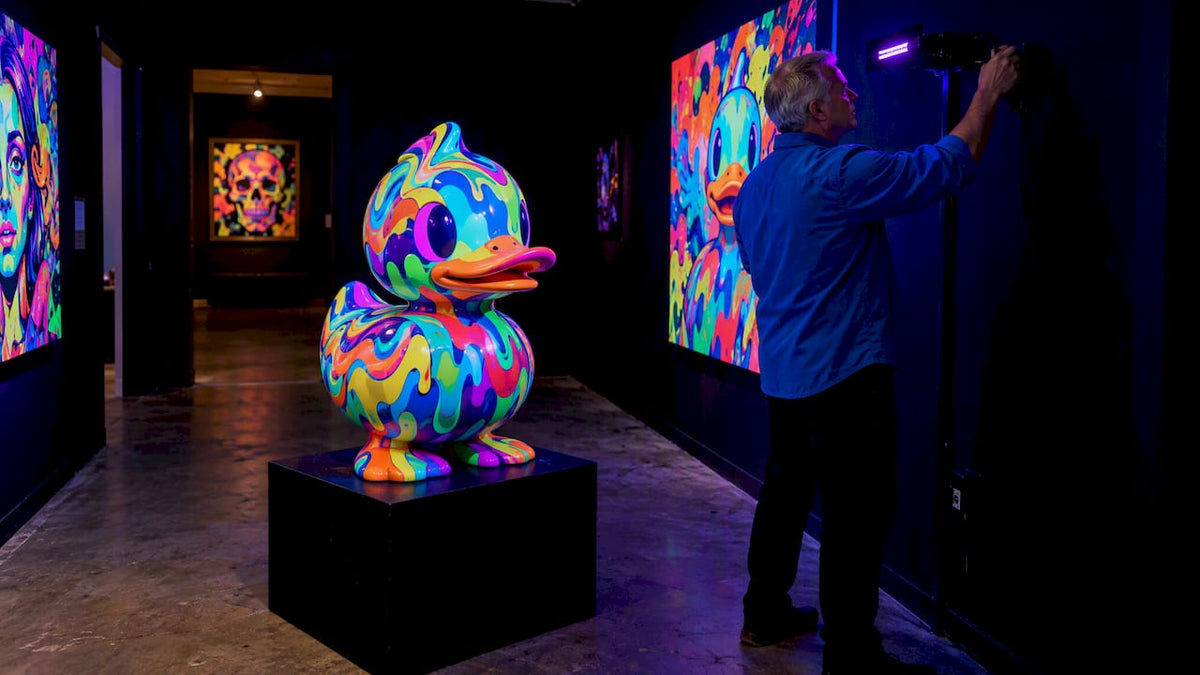
A piece kept under continuous blacklight in a commercial space will show these changes far sooner than one brought out only for occasional events or private viewings. That difference is the entire basis for planning a light budget rather than assuming the work will look the same indefinitely.
Display and preservation strategies that actually slow fading
A light budget is simply an agreed cap on exposure, expressed as hours per year under blacklight or an equivalent lux-hour limit, and it is the single most effective tool a collector has. Recent conservation research on daylight fluorescent paints recommends capping annual exposure and avoiding continuous display precisely because permanent illumination accelerates the degradation these pigments are already prone to.
Beyond setting a budget, a few practical steps make a real difference:
- Run blacklight fixtures on timers or duty cycles instead of leaving them on continuously, and favor filtered or shuttered lighting over bare continuous spotlights.
- Rotate the piece in and out of display rather than treating it as a permanent fixture in a lit space.
- Keep detailed photographic records at set intervals so fading is tracked, not just noticed after the fact.
- Label the piece’s recommended light budget for any future owner, since a resale without that context often leads to overexposure.
Protective coatings are the trickiest tradeoff. Manufacturer guidance from Day-Glo notes that a UV-absorbing varnish or an overcoat can slow visible fading, but it does not guarantee permanence, and it will reduce the fluorescence that makes the piece glow in the first place. For many high-value commissions, a documented display schedule is the better trade, since it protects the intended visual effect instead of muting it.
Pro Tip: Treat your blacklight fixture like stage lighting, not ambient lighting: switch it on for the experience, not as a permanent light source.

For layout and fixture placement specifics, our blacklight room setup guide and interior design notes cover the installation side in more depth.
Buying and commissioning checklist: what to ask before you sign
Before committing to a piece, whether off the shelf or commissioned, get specific answers rather than general assurances. The questions below cover what actually determines how the work will age.
- Ask which pigment brand and formulation were used, and whether any lightfastness or BWS data exists for those specific colors.
- Ask whether a UV-absorbing varnish or glazing was applied, and what tradeoff that creates for glow intensity.
- Ask for a recommended annual display budget in hours, along with storage guidance for when the piece is off exhibit.
- Ask whether the artist or studio offers any post-sale monitoring, such as periodic photographic condition checks.
On the contract side, request a documented condition report at the time of sale, a written light budget, and instructions for who handles inpainting or stabilization if fading becomes visible. If you want the piece looking essentially unchanged in ten years, say so. That usually means choosing a piece built for occasional experiential display rather than one meant to run under blacklight every night in a lobby.
Conservation and monitoring: how professionals track fading
When fading is a concern, conservators lean on noninvasive tools rather than guesswork: standardized photography under consistent lighting, colorimetry to quantify color shifts numerically, and in more advanced cases multimodal imaging or fiber optic spectroscopy to catch early spectral changes before they’re visible to the eye.
- Standardized photography creates a baseline that later images can be compared against directly.
- Colorimetry turns a hue shift into a measurable number, which is useful for insurance records as well as conservation decisions.
- Microfadeometry, used mainly in research settings, tests fading on a microscopic scale without damaging the visible surface.
What conservators cannot do is restore the original fluorescence once the dye itself has broken down. They can document the change, stabilize the substrate, and in some cases apply sympathetic inpainting, but a fully faded fluorescent dye doesn’t come back. Dark storage between exhibitions and a condition check once or twice a year are the simplest ways to extend the piece’s usable life.
Studio perspective: designing for the glow’s natural arc
We don’t treat fading as a defect to hide. We choose materials and finishes with a specific light budget in mind for each commission, then put that budget in writing. Buyers get installation guidance and a condition record at the time of sale, not just a finished object. Choosing a studio that plans for a piece’s full lifespan, glow included, means the care conversation happens before the work ever leaves our hands.
— Facundo
Commissioning a glow piece built around a real light budget
We build every UV-reactive piece knowing it has a defined visual lifespan, so the documentation comes standard, not as an afterthought. Working with us means you get a handmade, original piece with a light budget and installation guidance included from day one.

- Browse finished pieces and originals in our UV/Glow Art collection.
- Start a custom glow piece commission and we’ll walk through display plans before any paint goes on.
- Explore Commissions, FLY Duck tees, and the Pride Collection if you want to see the full range of what we make.
If you already own a fluorescent piece from another source and want framing or protective glazing recommendations, Next Gen Cards has practical guidance on UV-protective sleeves and glazing that applies well beyond trading cards.
FAQ
Is it normal for blacklight artwork to fade over time?
Yes, this is expected rather than a sign of poor quality. Fluorescent pigments are inherently less light-stable than conventional paint, and conservation research confirms they are prone to photochemical degradation under regular light exposure.
Does keeping artwork in the dark prevent fading completely?
Dark storage slows fading significantly but doesn’t stop it outright, since some dyes are sensitive even to brief handling exposure over many years. The safest approach is pairing dark storage between showings with a documented annual light budget.
Will a UV-protective varnish stop the glow from fading?
A UV-absorbing varnish can slow visible fading, but Day-Glo’s own guidance is clear that it doesn’t guarantee permanence and it reduces the fluorescence that creates the glow effect. Many collectors skip the varnish and manage exposure instead, to preserve the full visual intensity.
How long will a UV-reactive sculpture or painting keep glowing?
There’s no single answer since it depends on the specific pigments, the display hours, and whether protective measures were used, but many fluorescent colorants are rated at BWS 1 to 2, among the more light-sensitive ratings on the ISO Blue Wool Standard. A piece displayed occasionally for events will hold its glow far longer than one left under continuous blacklight.
What should I ask an artist before commissioning a glow piece?
Ask about the pigment brand used, any available lightfastness data, the recommended annual display budget, and whether the studio provides a condition report or ongoing monitoring. Getting these in writing at the time of commission avoids disputes later about how the piece was expected to age.
Sources
- Light-induced aging and degradation of daylight fluorescent pigments (PMC article)
- Evaluation of appearance and fading of daylight fluorescent watercolors (JAIC 2005)
- The light aging behavior of daylight fluorescent paints (npj Heritage Science, 2022)
- Day-Glo resources and FAQs