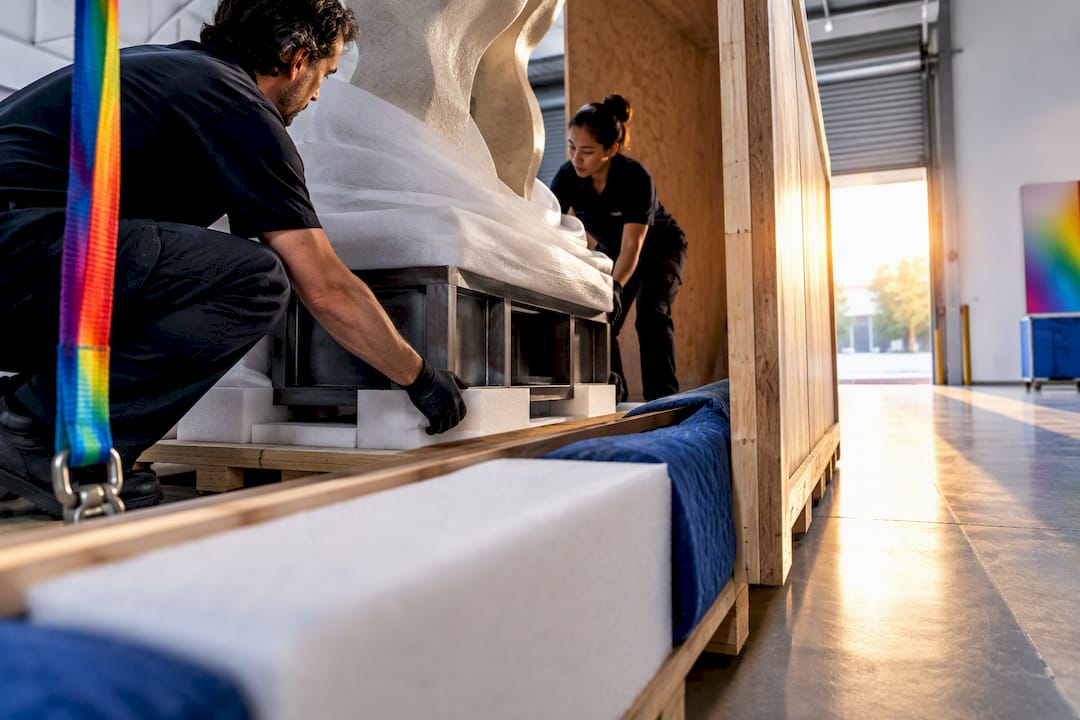
Sculpture Crate Shipping: Vibration, Photo Logs and U.S. Insurance
Most sculptures need a real crate, not a padded box, once they cross state lines or carry meaningful value. For stone, bronze, or anything with a fragile appendage, a custom wood crate with foam bracing is the default; for thin ceramics or mixed media, a suspension (double-shell) crate reduces vibration transmission. The one step that overrides every other decision: get a carrier-built crate with a photo build log, since that paperwork is usually what determines whether Full Value Protection actually pays out. Measure, photograph, and document the piece before you call anyone.
TL;DR:
- Crates with custom foam bracing and clear measurements significantly reduce the risk of damage, especially for fragile or valuable sculptures crossing borders or long distances.
- For sculptures with thin parts, protrusions, or complex shapes, suspension crates are preferred to prevent impact and vibration damage during transit.
- Documenting measurements, weight, and a detailed photo record before crating is essential for claims, with carrier-built crates and photo logs doubling as proof of proper packing.
- International shipments of solid wood crates over 6 millimeters require ISPM 15 compliance, including heat treatment, fumigation, and proper stamps, to avoid customs delays.
- Costs for professional crating range from a few hundred dollars for simple builds to several thousand for specialized suspension or museum-grade crates, with transit time varying based on shipping mode.
Table of Contents
- Do You Actually Need a Crate for Sculpture Shipping?
- How Do You Measure and Document a Sculpture Before Crating?
- Which Crate Type Fits Your Sculpture?
- What Materials and Construction Specs Matter Most?
- How Do You Prevent Vibration Damage Inside the Crate?
- Do You Need ISPM 15 Compliance for Sculpture Shipping?
- What Documentation Protects Your Insurance Claim?
- What Does Crate Sculpture Shipping Cost and How Long Does It Take?
- Should You Build the Crate Yourself or Hire a Professional Shipper?
- Crating for UV-Reactive and Mixed-Media Sculpture: A Studio Perspective
- What Should You Check When a Sculpture Crate Arrives?
- What’s the Safest Way to Load and Unload a Sculpture From Its Crate?
- Why Documented Crating Builds Collector Confidence
- How to Support Your Sculpture From Studio to Delivery
- Sources
- FAQ
Do You Actually Need a Crate for Sculpture Shipping?
Not every sculpture needs a wood crate. A solid granite piece moving across town in a padded van might survive fine in blanket-wrap with corner protection. But once you add distance, carrier transfers, or real dollar value, the calculus changes fast.
Ask these questions before deciding:
- Fragility: Does the piece have thin sections, appendages, or old repairs that flex under pressure?
- Value: Would a chip or crack cost more to fix than a crate costs to build?
- Handling transfers: Will it pass through multiple hands (movers, freight terminals, customs) or go direct?
- Installation complexity: Does it need crane or forklift access at delivery?
- Distance: Local moves tolerate more risk than interstate or international freight.
If you answered yes to two or more, crate it.
How Do You Measure and Document a Sculpture Before Crating?
A crate built without exact measurements almost always fits poorly, and a loose fit is what lets a sculpture shift and crack in transit. Before contacting a crating shop or ordering plywood, work through this sequence:
- Measure all three axes (height, width, depth) including any protrusions like an outstretched arm or base flange.
- Locate the center of gravity by testing where the piece balances when lifted, and mark it.
- Weigh the sculpture on a platform scale, and note where it’s safe to grip or sling.
- Photograph every side and any pre-existing damage, chips, or fragile joints in good light.
- Write a packing spec sheet listing outside crate dimensions, foam clearance around the piece, and lifting points.
That spec sheet becomes your reference for the crate builder and your evidence if a shipper later disputes damage.
Which Crate Type Fits Your Sculpture?
Three crate builds cover almost every sculpture shipping scenario, and picking the wrong one is the most common mistake first-time shippers make.
- Single-shell crate: A single wood box with foam bracing holding the piece rigid inside. Works well for solid, dense material like bronze or granite that doesn’t have delicate protrusions.
- Suspension (double-crate): An inner crate floats inside an outer shell, separated by foam or isolators. This is the standard for fragile appendages, thin ceramic walls, or anything where a direct impact on the outer shell shouldn’t reach the object.
- Triwall or channel crate: Lightweight, triple-wall corrugated construction with softwood framing, often reusable and designed to break down for return shipment. The Canadian Conservation Institute recommends these for controlled networks and repeat exhibition cycles rather than one-way freight.
Pro Tip: If your sculpture has an outstretched limb, a raised head, or any thin connecting point, default to a suspension crate even if the material is otherwise sturdy. Appendages break at the joint, not in the body of the piece.
What Materials and Construction Specs Matter Most?
Panel thickness and framing decide whether a crate survives a forklift drop or a truck’s tailgate. For small to midsize crates, 3/8 to 1/2 inch plywood is standard; larger or heavier pieces need 3/4 inch panels with reinforced cleat framing at every seam. The Canadian Conservation Institute treats 12 mm (roughly half an inch) as a common panel minimum in museum practice, which lines up with what most professional crating shops build for anything over a few hundred pounds.
- Skids: Raise the crate off the ground for forklift access and keep moisture off the base.
- Handles: Position them to reduce drop height during manual lifts, and recess hardware so it doesn’t puncture the interior.
- Barrier lining: Marvelseal or a painted interior surface controls moisture and blocks outgassing that can react with certain finishes.
The Canadian Conservation Institute also recommends 25 to 50 millimeters of cushioning for most shipments, with the higher end reserved for commercial carrier handling rather than controlled art-handler networks.
How Do You Prevent Vibration Damage Inside the Crate?
The core principle behind good internal support is simple: the sculpture and its cushioning need to move as one rigid unit. Any relative motion between the object and its foam bed, even a few millimeters, creates repeated micro-impacts that fatigue material over a long haul.
- Foam density: Denser foam for heavier stone or metal, softer foam for lightweight or painted surfaces that bruise under pressure.
- Clearance: Leave enough foam thickness around every surface, not just the base, so shock has somewhere to absorb before reaching the object.
- Isolation systems: Wire-rope isolators or rubber mounts between an inner and outer shell reduce vibration transmission for three-dimensional objects, according to peer-reviewed transport crate research.
Museum-grade shipments increasingly calculate isolator stiffness against the object’s mass to keep the system’s resonant frequency below typical highway or air-cargo vibration frequencies. That’s engineering-level detail, but the takeaway for a smaller shipment is the same: don’t let the piece float loose in a foam-lined box and call it done.
Pro Tip: Press on the foam around your packed sculpture before closing the crate. If you can feel the object shift more than a millimeter or two, add bracing before you seal it.
Do You Need ISPM 15 Compliance for Sculpture Shipping?
If your crate crosses an international border and uses solid wood over 6 millimeters thick, it almost certainly needs ISPM 15 compliance, meaning heat treatment or fumigation and a visible IPPC stamp. U.S. Customs can destroy or re-export noncompliant wood packaging material at the point of entry, which means your entire shipment gets held up over a stamp that costs almost nothing to get right the first time.
- Get the IPPC mark from your lumber supplier or crating shop before the crate ships internationally.
- Consider alternatives: APHIS lists plywood, plastic, and metal framing as options that sidestep ISPM 15 entirely for some builds.
- Control moisture inside the crate with an interior barrier film and a few desiccant packs, especially for painted or varnished surfaces.
- Let new finishes cure fully before crating. Sealing in fresh paint or varnish traps solvent vapor against the surface.
Domestic shipments generally skip ISPM 15, but the moisture and curing steps still apply regardless of destination.
What Documentation Protects Your Insurance Claim?
Carriers and insurers routinely require a documented build log and photo record before they’ll extend Full Value Protection to a high-value shipment. Skip that paperwork and you’re often left with limited liability coverage that pays a fraction of what the piece is worth.
- Request an in-house crate build from the shipper rather than a generic third-party box, since carrier-built crates are what most FVP policies actually recognize.
- Ask for a photo build log showing the piece being packed, foam placement, and the sealed crate before pickup.
- Get a flat-rate per-piece estimate with the declared value stated in writing, not a rough verbal quote.
- Confirm the carrier’s USDOT authority if you’re using an interstate mover rather than a dedicated art shipper.
- Label the crate clearly with discrete “fragile” and orientation marks, and keep a Bill of Lading checklist handy for inspection at delivery.
What Does Crate Sculpture Shipping Cost and How Long Does It Take?
A basic single-shell crate typically runs in the low hundreds of dollars for materials and labor. A suspension, museum-grade crate with isolators and custom foam climbs into the low thousands, largely because of the extra shell, foam cutting time, and hardware.
- Build lead time: A few days for a simple crate; a week or more for suspension builds or anything requiring custom foam templates.
- Factors that extend timelines: Irregular shapes, multiple appendages, or a shop backlog during peak shipping seasons.
- Shipping mode: Ground freight is slower but cheaper for heavy pieces; air freight cuts transit time but raises cost significantly. For very large or heavy sculptures, sea freight in flat-rack containers is often the only cost-effective option internationally, though it adds weeks to transit.
Should You Build the Crate Yourself or Hire a Professional Shipper?
DIY crating works for lower-value, sturdy pieces where a mistake costs you materials, not the artwork itself. Anything with real value or fragility calls for a professional.
- Ask for references and a sample build log before booking. A shipper who can’t show you a past crate photo record probably isn’t tracking builds carefully.
- Confirm in-house crating rather than a subcontracted box shop, since that’s often what insurance underwriters check for.
- Watch for red flags: vague verbal estimates, no photo documentation offered, or a requirement that you provide “packed by owner” (PBO) crating for a high-value piece, which usually caps your coverage.
- Run the decision flow: low value and sturdy material, consider DIY. High value, fragile, or crossing international borders, hire a specialist.
Crating for UV-Reactive and Mixed-Media Sculpture: A Studio Perspective
UV-reactive pigments and mixed-media surfaces need packing choices that plain stone or bronze don’t. We avoid solvent-based foams and off-gassing materials near painted surfaces, and we let new finishes cure fully before a piece ever touches a crate, a lesson we cover in more detail in our guide to shipping large sculptures. Lightweight attached elements and delicate adhesive joints need their own isolation, separate from the main body’s bracing. For any glow piece, we include reveal instructions so the receiving team inspects it under proper lighting before assuming there’s damage.

What Should You Check When a Sculpture Crate Arrives?
Inspect the crate before it’s even opened. Look for crushed corners, water stains, tilt indicators that have tripped, or a Bill of Lading that’s been altered. Photograph the exterior from all sides before breaking a single seal. If anything looks off, note it on the delivery receipt before signing. A signature without exceptions noted can make a later damage claim much harder to win.

Once the crate is open, work slowly. Remove foam padding in the reverse order it was packed, and photograph each layer as you go. If the sculpture doesn’t lift free easily, stop. Forcing a stuck piece out of foam bracing is how chips happen during unpacking, not during transit.
Check the sculpture itself against your pre-shipment photos, the same ones you took during the measuring and documentation stage. Look specifically at the fragile points you flagged earlier: thin appendages, old repair lines, raised details. Run a hand along surfaces for any grit, moisture, or foam residue that might indicate condensation inside the crate.
If you find damage, document it immediately with photos against a plain background, keep every piece of packing material as evidence, and contact the carrier within whatever window their policy specifies, usually a matter of days. Insurers and carriers often deny claims filed too late, regardless of how clear the damage is. Save the crate itself if you can. An insurance adjuster reviewing a claim will often want to see how the piece was packed, not just the piece.
Finally, give the sculpture 24 to 48 hours to acclimate to room temperature and humidity before final placement, especially if it traveled through significant climate differences. Materials expand and contract, and rushing installation right after unpacking can mask a problem that shows up days later.
What’s the Safest Way to Load and Unload a Sculpture From Its Crate?
Loading starts before the sculpture ever touches the crate. Confirm your lifting points against the spec sheet you created during measurement, and use two people minimum for anything over 50 pounds or with an awkward center of gravity. Never lift a sculpture by an appendage, a raised arm, a tail, a handle, even if it looks structurally solid. Lift from the base or a designated structural point instead.
Lower the piece into the crate slowly, checking foam contact on all sides as it settles. Don’t drop it the last inch and assume the foam will absorb the impact; that’s exactly the kind of relative motion that causes fatigue damage over a long haul. Once it’s seated, press-test the foam around every surface before closing the lid, the same check mentioned earlier for vibration control.
Unloading follows the same logic in reverse, with one added risk: the piece may have shifted slightly in transit even in a well-built crate, so don’t assume it’s sitting exactly where you left it. Open the crate fully before attempting to lift anything out, and clear a stable, padded surface nearby before you start.
For heavier pieces, coordinate crane or forklift access at the delivery site ahead of time. Our guide to displaying large-scale installations covers site prep in more depth, but the short version: know your doorway widths, ceiling heights, and floor load limits before the truck shows up. A sculpture that can’t fit through the delivery entrance turns into an expensive logistics problem fast.
If you’re padding smaller fragile elements separately during load or unload, the same fragile-item packing logic applies as with household goods, covered well in this guide to packing fragile items for a move.
Why Documented Crating Builds Collector Confidence
A carrier build log isn’t paperwork for its own sake. It’s the difference between a claim that gets paid in full and one that gets argued down to a fraction of the piece’s value. When a shipper hands you a photo record before pickup, that’s proof they’ve done this before and expect to be held to it. Always ask for that documentation before you sign anything.
— Facundo
How to Support Your Sculpture From Studio to Delivery
Working with a studio experienced in UV-reactive pigments and mixed media helps ensure sculptures receive appropriate care throughout transit, beyond what generic crating vendors typically provide. Commissioned pieces benefit from thoughtful pigment protection, cure time, and finish handling considerations before crating.

If you’re commissioning a custom glow piece or an original sculpture, we can talk through crating and shipping logistics as part of the process, since we’ve packed and shipped this exact category of work before. Browse the sculpture collection to see the range of pieces we’ve built, or start a conversation about a custom glow commission and we’ll walk you through what shipping your piece will actually involve.
Sources
- Wood packaging material (WPM) | U.S. Customs and Border Protection
- Wood packaging material (WPM) import requirements | USDA APHIS
- Five Steps to Safe Shipment – Canadian Conservation Institute (CCI) Notes
- Protecting three-dimensional museum collections during transport: Engineering and evaluation of transport crates featuring wire-rope isolators
FAQ
How Much Does It Cost to Ship a Sculpture?
Costs depend heavily on crate type, size, and distance, ranging from a few hundred dollars for a basic single-shell crate and short ground freight to several thousand for a suspension crate plus specialized art carrier service. Oversized or international shipments requiring flat-rack ocean freight or crane installation push costs higher still.
How Long Does Crate Shipping Take?
Building the crate itself usually takes a few days for a simple design and a week or more for suspension builds with custom foam. Transit time on top of that depends on shipping mode: ground freight typically takes days, while ocean freight for oversized international shipments can add several weeks.
Is FedEx or UPS Better for Shipping Artwork?
Neither standard carrier is built for custom-crated sculpture, and both generally require carrier-built crates and specific documentation to offer meaningful liability coverage on high-value pieces. For anything beyond a small, sturdy object, a dedicated art shipper with in-house crating and a photo build log is the safer route for Full Value Protection.
How Much Does It Cost to Ship a 24x36 Canvas?
A flat canvas typically ships far more cheaply than a sculpture since it needs only a slim shipping box or soft-crate, often under a few hundred dollars domestically depending on carrier and distance. That said, canvases still benefit from corner protection and moisture barriers, especially for pieces with heavy varnish or mixed media elements.
What Crate Type Should I Use for a Fragile Sculpture?
A suspension, or double-crate, design is the standard choice for fragile appendages, thin sections, or mixed-media pieces, since it isolates the inner shell holding the object from direct impacts on the outer shell. Solid, dense pieces without delicate protrusions can often use a simpler single-shell crate instead.