Marketers: 10 Buildable Brand Art Ideas That Turn Footfall Into Data
This article lists ten art-based activation concepts, backed by real production notes and the KPIs that prove they worked. The throughline: interactive and immersive art installations consistently beat static branded setups on dwell time, social shareability, and earned media, because they give people something to do, not just something to look at. FLY Miami Art, the studio behind these frameworks, has built that logic into commissions for collectors, hotels, and public spaces alike.
TL;DR:
- Projection mapping on building facades is most effective when using night-time, flat surfaces with a 15 to 20-minute loop, measured by dwell time and aerial views.
- Interactive installations like responsive sculptures or participatory art stations generate significantly higher engagement, social sharing, and media impressions compared to static displays.
- Achieving a successful activation requires early planning of permits, power needs, accessibility, and digital integration to avoid costly scope creep and legal complications.
- Using sustainable materials and energy-efficient tech, such as reusable sculptures or LED lighting, can reduce environmental impact without compromising visual impact.
- Prioritizing the hero frame and small participation loops creates more meaningful engagement and social sharing, often outperforming high-budget static setups.
Table of Contents
- Brand Activation Art Ideas Worth Briefing This Quarter
- What Makes These Activations Actually Work
- How to Brief Your Production Partner Without Scope Creep
- A Publisher’s View: Where UV-Reactive Art Fits the Brief
- Blending Digital Layers Into a Physical Art Build
- Permits, Liability, and Venue Realities You Can’t Skip
- Building Art Activations With a Lighter Footprint
- An Editorial Take on What Actually Moves the Needle
- Commission Your Next Activation With FLY Miami Art
- Sources
- FAQ
Brand Activation Art Ideas Worth Briefing This Quarter
Marketers searching for brand activation art ideas usually already know the basics of experiential marketing. What they need is a shortlist specific enough to hand to a producer without needing another round of research. The ten concepts below are ordered roughly by production complexity, not popularity, so you can match ambition to budget before you fall in love with an idea you can’t build in six weeks.
-
Projection mapping on a building facade or hero wall. Turns a static surface into a moving canvas synced to music or a brand story arc. Best on flat, unobstructed facades at night; budgets typically scale with projector lumens and mapping software licensing, and a 15 to 20 minute looped show is plenty. Measure it through drone or aerial footage views and total dwell time under the projection zone.
-
Kinetic sculpture that responds to wind, motion, or touch. A large moving piece reads as “alive” from across a venue and photographs well from multiple angles. Needs structural engineering sign off and a maintenance plan for moving parts; mid-size builds run into real fabrication cost. Track return visits to the piece across a multi-day event.
-
Live mural or wall painting with a visible artist. Watching a piece get made is its own draw, and the finished mural becomes a lasting brand asset. Works in almost any venue with wall access and decent lighting; budget mostly covers artist fees and paint, not fabrication. Time-lapse content from this idea routinely outperforms static photos on social reach.
-
Oversized props or sculptural photo moments. A giant branded object, built at a scale that makes the human body the punchline, is one of the cheapest ways to generate consistent user-generated content. Keep it outdoors or in a tall-ceiling venue and light it for both day and night photography. Success here is measured almost entirely in tagged posts and story shares.
-
Interactive or AI-driven participatory art stations. Guests feed an input, gesture, photo, voice, and the system generates a unique visual output tied to the brand, a format well supported by an AI Content Marketing Platform | Scale Marketing with Artificial Intelligence. Intel’s Encore AI Exhibit paired artist work with live-generated digital content and logged more than 8,500 registrations in a single week, plus millions of PR and social impressions. Budget for both the artistic build and the software layer, and staff a technician on site.
-
Sensory garden pop-up. Scent, sound, and texture zones built around a theme create a slower, more immersive pace than a typical booth. These work well indoors in retail or lobby settings and lean on plant rental, custom scent diffusion, and soft materials rather than heavy fabrication. Dwell time is the primary metric, since sensory spaces are built to be lingered in.
-
Living topiary sculpture. A branded shape rendered in real or preserved greenery reads as premium and eco-conscious at once, and it holds up outdoors for the length of a multi-week campaign. Costs concentrate in the plant structure and irrigation or preservation treatment, not staffing. Track earned media from lifestyle and design press, which tends to cover topiary work more than standard signage.
-
Robotic or automated surprise moments. A small automated element, a hand that pours, a figure that waves, a piece that reacts to proximity, creates a “did you see that” reaction that spreads faster than a passive display. These need power runs and a technician on call for the full activation window. Track dwell time at the trigger zone specifically, not just the general area.
-
Immersive micro-gallery or pop-up exhibition. A compact, curated room of branded art pieces, and this can be scaled from a single storefront window to a multi-room build. A 3,000 square foot immersive build for a SEGA activation produced a 9-minute average dwell time, double typical hall benchmarks, alongside 23 million earned impressions and a measurable sales lift. Even a fraction of that scale can borrow the same room-by-room story structure.
-
Artist-led live workshops and personalization stations. Letting guests customize a small takeaway piece under an artist’s guidance turns spectators into participants and gives everyone a physical reason to talk about the brand afterward. This works in almost any venue and scales from a single table to a full studio setup. Measure it through units personalized per hour and the resale or reshare rate of the finished pieces on social.
What Makes These Activations Actually Work
Every idea above succeeds or fails on three design pillars. The hero frame is the single composition you’d put on a billboard, planned before construction starts, not discovered afterward. The participation loop is the one small action a guest performs, touching, generating, customizing, that turns a spectator into content. The take-away is what leaves with them, a photo, a printed asset, or a physical object stamped with the brand.
Track these KPIs in every brief:
- Average dwell time at the installation, compared against your venue’s typical booth benchmark
- Registrations or opt-ins captured at the activation
- Earned media impressions and press mentions post-event
- Social shares, tagged posts, and hashtag volume
- Demo conversions or measurable sales lift, where the activation ties to a product
Living, evolving installations that change with attendee interaction reliably outperform standard event dwell-time averages. Before fabrication starts, name your three or four hero shots, design every surface for vertical phone framing, and plan creator seeding alongside organic crowd content so the assets keep traveling after teardown.
How to Brief Your Production Partner Without Scope Creep
Match your timeline to your ambition. A small build (photo moment, single mural, small kinetic piece) needs 2 to 4 weeks. A medium build (interactive station, sensory pop-up, micro-gallery) needs 6 to 10 weeks for fabrication, testing, and permitting. A large build (multi-room immersive experience, major kinetic sculpture, full facade projection) needs 12 or more weeks, with budget concentrated in fabrication, technology integration, permits, and on-site staffing, roughly in that order.
Before you sign a producer, get answers to these eight questions:
- What permits or municipal permissions does this location require?
- What power draw and rigging capacity does the piece need?
- What insurance and liability coverage is included versus billed separately?
- How does the design accommodate ADA and general accessibility needs?
- What data is captured from attendees, and how is it stored and consented to?
- Who staffs the activation during operating hours, and what’s the backup plan?
- What content deliverables come with the build, raw footage, edited assets, or neither?
- Who owns the physical and digital assets after the event ends?
Pro Tip: Ask for the technical brief before you ask for the creative concept. A stunning render that skips power and rigging details almost always blows the budget by the time it becomes real.
A Publisher’s View: Where UV-Reactive Art Fits the Brief
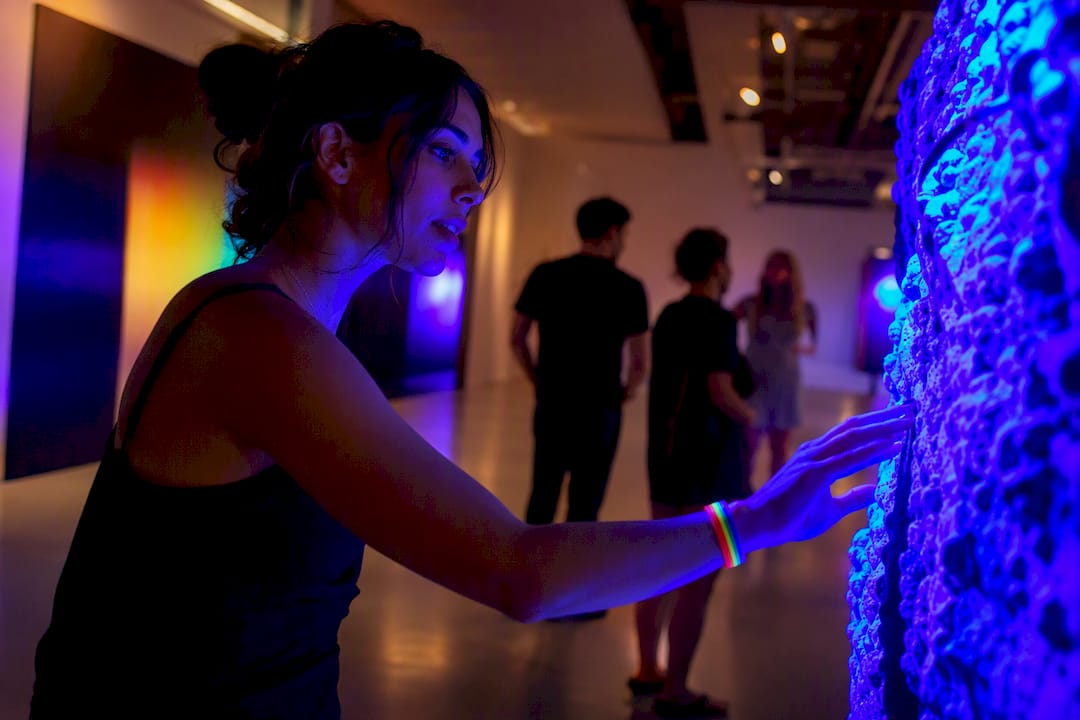
FLY Miami Art, led by artist Facundo Yebne, builds pieces using UV-reactive pigments that reveal hidden patterns and colors under blacklight, work that’s drawn coverage in major exhibitions and appeals to collectors who want something no mass-produced piece can replicate. In an activation context, that same material behaves differently than daytime displays:
- Night activations get a built-in novelty factor since the piece transforms under blacklight
- Sensory contrast between the daylight version and glow version doubles the “reveal” moment for content
- Rigging needs to account for blacklight positioning, pigment behavior at different viewing angles, and glare control on nearby reflective surfaces
A typical case template: place a UV/glow sculpture as the hero frame at a nighttime segment of a multi-day event, let guests photograph the transformation under blacklight, and pair it with a small merchandise moment, apparel or a limited print, tied to the piece’s theme.
Blending Digital Layers Into a Physical Art Build
The strongest activations treat digital and physical elements as one system rather than two separate budgets. A physical sculpture or mural becomes the anchor, and a digital layer, AR filters, a live data feed, generative visuals, extends its reach beyond people physically in the room.

The Intel Encore exhibit shows this pairing at scale: artist work combined with live-generated digital content produced both the in-person spectacle and a wave of shareable digital output that kept circulating after the event closed. You don’t need AI at that level to apply the principle. A simple QR code at your mural that unlocks a time-lapse of its creation, or an AR filter that lets phones “activate” a static sculpture, extends a single physical build into a digital afterlife.
Plan the digital layer at the same time as the physical one, not as an afterthought. If your hero frame is a kinetic sculpture, decide early whether its digital companion is a livestream, a branded filter, or a simple hashtag campaign. Interactive art traditions from artists like Camille Utterback and Daniel Rozin show that responsive, screen-based work has decades of precedent marketers can borrow from rather than invent from scratch. The goal is one coherent story told in two mediums, not a physical build with a digital sticker slapped on top.
Permits, Liability, and Venue Realities You Can’t Skip
Public art activations run into legal friction faster than almost any other marketing format, and most of it is avoidable with early planning. Municipal permits for temporary structures, projections on buildings, or street closures typically require applications weeks or months ahead, and timelines vary significantly by city and by whether the piece sits on public or private property.
Insurance is non-negotiable for anything with moving parts, elevated structures, or crowd interaction. General liability coverage protects against injury claims, but kinetic sculptures, oversized props people climb on, and anything with rigging usually need a rider specific to that risk. Venue owners will ask for a certificate of insurance before signing off, and public spaces often require a bond as well.
Accessibility matters both legally and reputationally. An installation people can’t approach in a wheelchair, or a participation loop that only works for people who can reach a certain height, cuts your potential reach and your earned media angle. Build accessibility into the design brief, not into a fix after complaints.
Venue-specific rules also shape material choices. Historic districts often restrict projection mapping or anything that alters a building’s visible facade, even temporarily. Parks departments frequently cap structure height and require load-in during off-hours. None of this should surprise your producer if the technical brief covers permits and permissions up front, alongside power, rigging, and accessibility.
Building Art Activations With a Lighter Footprint
Sustainability now shapes both the materials brands choose and the story they tell about an activation afterward. A kinetic sculpture built to be disassembled and reused across three cities carries a different environmental footprint than one built once and landfilled after a weekend. Ask your producer directly whether a build is designed for reuse, and factor that answer into your decision alongside cost.
Material choice matters as much as reuse plans. Living topiary sculptures use real or preserved plants that return to soil rather than a dumpster. Sensory garden pop-ups can rent plants instead of buying disposable greenery. Even projection mapping, which uses no physical material at all beyond the projector rig, is one of the lower-impact options on this list simply because it leaves nothing behind.
Energy use deserves a line item too. LED-based kinetic pieces and blacklight installations draw meaningfully less power than older lighting technology, and specifying LED and efficient blacklight fixtures at the brief stage, rather than after fabrication starts, keeps both your carbon footprint and your generator rental costs down. If your activation travels to multiple markets, modular fabrication that ships flat and reassembles on site cuts freight emissions compared to building fresh at every stop.

None of this requires sacrificing the visual impact that makes these activations work. A reused, modular kinetic sculpture photographs exactly as well on its fifth city as its first, and telling that reuse story honestly is itself a piece of content brands increasingly get credit for.
An Editorial Take on What Actually Moves the Needle
Most advice on experiential marketing treats art as decoration, something to make a booth look nicer. That’s backwards, and the data bears it out: the campaigns generating real earned media and dwell time are the ones where the art is the mechanism, not the backdrop. A projection show, a responsive sculpture, or a UV-reactive piece under blacklight gives people a reason to stop that a branded banner never will.
The bigger mistake I see in briefs is skipping the participation loop entirely. Marketers will spend real money on a stunning static sculpture and then wonder why dwell time is short. People don’t linger at things they only look at. They linger at things that respond to them, however small that response is, a color shift, a sound, a personalized takeaway.
Prioritize the hero shot and the participation loop before you touch the budget spreadsheet. Everything else, venue, permits, staffing, follows from those two decisions. Get them right, and even a modest build outperforms an expensive one that gives people nothing to do.
— Facundo
Commission Your Next Activation With FLY Miami Art
Flymiami is a studio offering original, handmade artwork built with UV-reactive pigments that reveal hidden colors and patterns under blacklight, created by an artist with recognized public commissions and media presence. That combination matters most exactly where this article has pointed, night activations, sensory reveal moments, and hero frames that need to photograph like nothing else in the room.
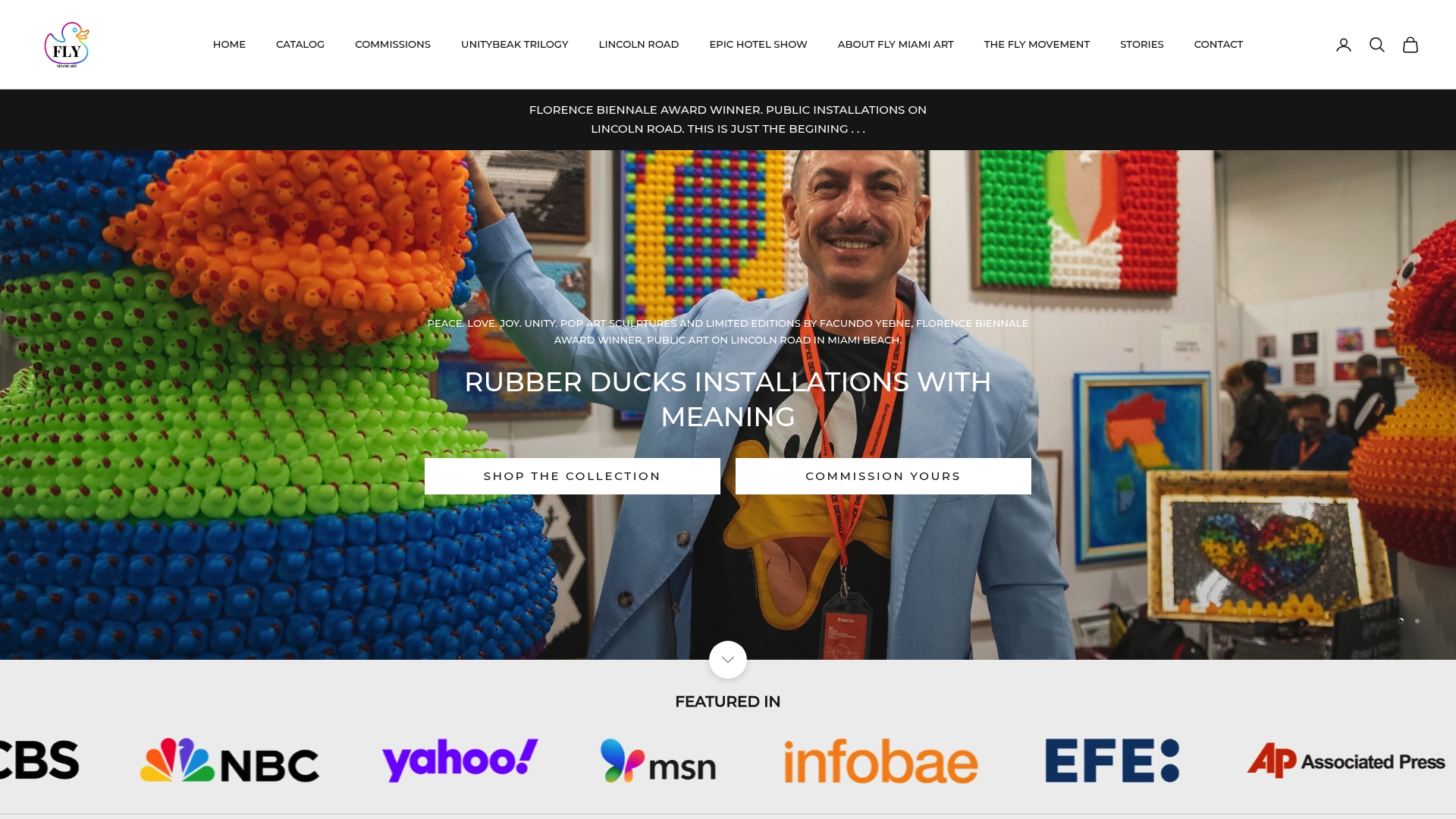
Flymiami works directly with brands, hotels, galleries, and public institutions on commissions, custom glow pieces, and limited-edition sculpture and wall art for permanent or event installations. If you’re scoping a build, start with a brief that covers your venue, timeline, audience size, and whether the piece needs to travel between markets. That’s the same information any producer needs, and it lets Facundo scope a UV-reactive or original piece that fits your hero frame from day one.
Ready to start? Reach out through the primary commission page with your event dates and venue details, and request a quote before your production timeline locks in.
FAQ
What Is the Cheapest Art Activation to Start With?
An oversized photo prop or a live mural costs far less than a kinetic sculpture or projection show, mainly because they skip heavy fabrication and technical rigging. Both still generate strong user-generated content if lit well and placed where foot traffic naturally pauses.
How Long Does It Take to Build an Interactive Art Installation?
Small builds like a single photo moment or mural take 2 to 4 weeks, medium builds like an interactive station or sensory pop-up take 6 to 10 weeks, and large immersive builds need 12 or more weeks. Timeline depends heavily on fabrication complexity and permit lead times.
What KPIs Should I Include in My Activation Brief?
Track average dwell time, registrations or opt-ins, earned media impressions, social shares and hashtag volume, and any measurable sales lift tied to the activation. A comparable large-scale build produced a 9-minute average dwell time, double typical hall benchmarks.
Does FLY Miami Art Do Custom Commissions for Brand Activations?
Yes. FLY Miami Art takes on custom commissions and UV-reactive glow pieces for brands, hotels, galleries, and public institutions, with pricing available upon request based on scale and materials.
How Do I Make an Art Activation Go Viral on Social Media?
Design the piece vertical-first for phone cameras, name your three or four hero shots before construction starts, and seed creator content alongside organic crowd-made posts. Intel’s AI exhibit combined artist work with live digital generation and logged more than 8,500 registrations in one week with millions of resulting impressions.