U.S. Art Donations in 2026: 35% Cap, $5,000 Appraisal Rules
Yes, you can still deduct an art donation in 2026, but three new rules decide how much you actually keep. Non-itemizers can claim a small fixed deduction for cash gifts, itemizers lose the first 0.5% of their adjusted gross income to a new floor, and top-bracket donors face a 35% cap on the deduction’s tax value. Any art gift worth more than $5,000 also triggers appraisal and Form 8283 paperwork that can make or break the claim.
TL;DR:
- The 2026 rules introduce a 0.5% of AGI floor, meaning donors with high income will have a portion of their charitable deductions, including art, disallowed upfront.
- Art donations over $5,000 require a qualified appraisal and timely Form 8283 submission, with appraisal signatures needed within 60 days of transfer.
- Deduction benefits are limited by a 35% cap for top-bracket donors, reducing the effective tax value of large gifts from their full fair market value.
- Donors must verify the donee organization’s use of art to ensure related use and full fair market value deduction rather than basis-only treatment.
- Proper documentation, including provenance, photographs, and independent appraisals, is essential to safeguard deductions and withstand IRS scrutiny.
Table of Contents
- 2026 Tax Law Changes That Affect Your Art Donation Deduction
- Valuation Rules and Form 8283 Appraisal Requirements
- Related-Use Rules: Why the Donee You Choose Changes Your Deduction
- Documentation Every Art Donor Needs Before Filing
- IRS Audit Risk and How to Protect Your Deduction
- Donating Art You Already Own vs. Buying Art to Donate
- Fractional Interest Donations: Special Rules for Partial Gifts
- Sample Deduction Calculations Under 2026 Rules
- The Practical Timeline for Donating Art to a Qualified Organization
- How the 2026 Rules Change Art Donation Value Compared to Prior Years
- Determining Fair Market Value for a Donated Artwork
- Give the Artwork You Love, Not Just What’s Convenient
- Prefer to Sell or Commission Instead of Donate?
- Sources
- FAQ
2026 Tax Law Changes That Affect Your Art Donation Deduction
The One Big Beautiful Bill Act rewrote several pieces of the charitable deduction puzzle for 2026, and art donors feel the impact more than most because their gifts tend to be large, noncash, and heavily scrutinized.
Start with the good news for people who don’t itemize. Beginning in tax year 2026, non-itemizers may deduct up to $1,000 if single or $2,000 if married filing jointly for cash contributions to qualifying organizations. That deduction does not apply to art, since it’s cash-only, and it excludes gifts routed through donor-advised funds. If your only charitable act this year is writing a check to your local museum’s annual fund, this helps. If you’re donating a painting, it does nothing for you directly, but it matters for the household tax picture around your art gift.
For itemizers, the bigger change is a new 0.5% of AGI floor. Practically, this means the first half a percent of your adjusted gross income in charitable giving doesn’t count toward your deduction at all. A donor with $500,000 in AGI loses the first portion of any charitable claim equal to 0.5% of their AGI, art included, before the deduction even starts calculating.
Then there’s the cap that hits collectors hardest: a 35% ceiling on the tax value of deductions for taxpayers in the top bracket. Someone in the 37% bracket doesn’t get a 37-cent-per-dollar benefit anymore. The value of their deduction is capped at 35 cents per dollar, regardless of bracket.
A few things are worth tracking before you give:
- The 2026 standard deduction sets the bar you must clear before itemizing makes sense at all, so smaller art gifts sometimes produce no incremental benefit.
- The 0.5% AGI floor applies before any percentage-of-AGI ceiling calculations under Publication 526.
- The 35% cap is separate from, and applied after, the standard AGI percentage limits for capital gain property.
None of this makes art donation a bad idea. It does mean the math changed enough that a gift planned under old assumptions could land differently on your 2026 return.
Valuation Rules and Form 8283 Appraisal Requirements
Art donations live and die on paperwork, and the IRS has built a tiered system based on dollar value.
The threshold that matters first is $500. Cross it, and Form 8283 becomes mandatory for any noncash contribution. Below that, a receipt usually suffices.
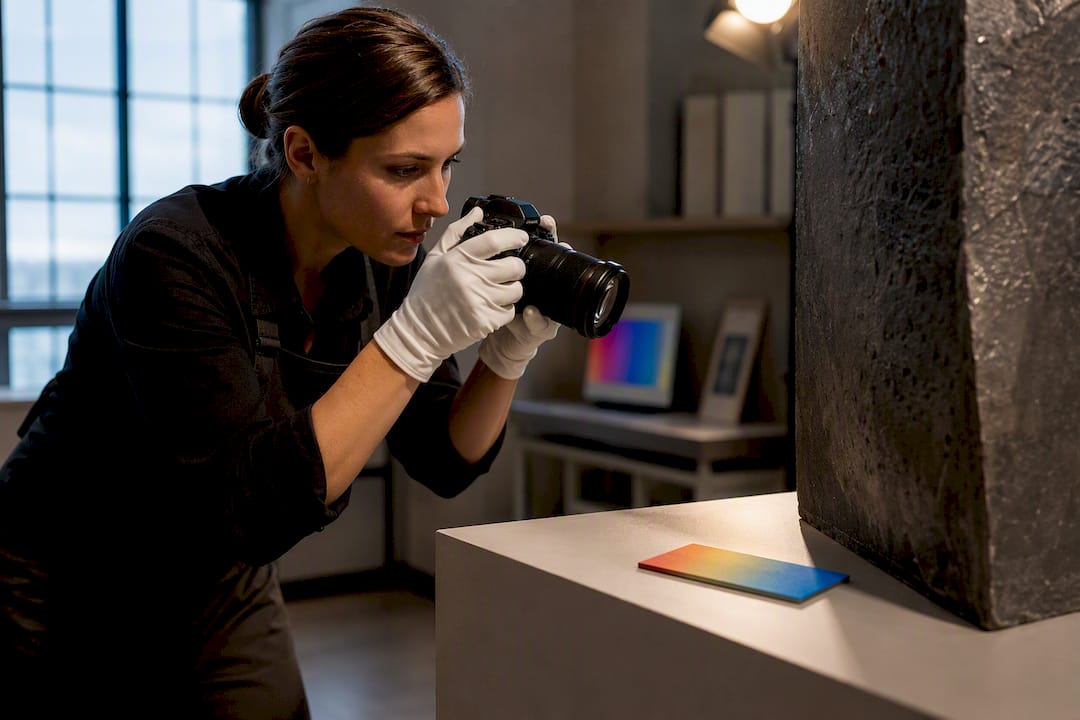
Pro Tip: Photograph the artwork from multiple angles, front and back, before it leaves your hands. Appraisers, and later the IRS, both want to see condition at the moment of transfer, not a memory of it.
Here’s how the filing requirements escalate as value climbs:
- Over $500: File Form 8283, Section A. Basic description, donee name, and estimated value required.
- Over $5,000: Section B applies. You now need a qualified appraisal completed by someone who meets IRS appraiser standards.
- At $20,000 or more: A signed copy of the full appraisal report must be physically attached to your tax return, not just kept on file.
- Over $500,000: Additional disclosure requirements apply, and the appraisal itself may need to be attached along with more detailed qualification statements from the appraiser.
The appraisal timing rule trips up more donors than any other piece of this. The appraisal must be signed no earlier than 60 days before the donation date, and you need it in hand before you file the return claiming the deduction. An appraisal obtained after filing, or dated too far in advance, can invalidate the entire claim.
Qualified appraisers also need to follow the Uniform Standards of Professional Appraisal Practice and meet the requirements laid out in Treasury Regulation 1.170A-17. This isn’t a formality. The IRS uses appraiser qualifications as a first checkpoint when a return gets flagged, and an appraiser who can’t demonstrate USPAP conformity gives an examiner an easy reason to challenge the entire valuation.
Build your file in this order: qualified appraisal, high-resolution photographs, provenance documentation, and a record of your original purchase price or cost basis. That last item matters more than most donors expect, since basis becomes the deduction amount whenever the related-use rule doesn’t favor you.
Related-Use Rules: Why the Donee You Choose Changes Your Deduction
The related-use rule decides whether you deduct fair market value or get stuck deducting your original cost basis, and it hinges entirely on what the recipient organization does with the piece.
When a museum hangs your painting in a gallery that serves its exempt educational purpose, that’s related use. You claim full fair market value, subject to the AGI percentage limits in Publication 526. When the same painting gets sold at a fundraising auction instead, the charity’s use is unrelated to its mission, even though the sale raises money for a good cause. Deduction drops to your cost basis in that case.
Donee type matters just as much as donee behavior:
- Public charities and museums generally offer the most favorable treatment when they display or otherwise use the art in line with their mission.
- Donor-advised funds routinely sell donated art rather than display it, which typically forces basis-only treatment. This is one of the most overlooked traps in art philanthropy: DAFs often destroy the tax efficiency collectors assume they’re getting.
- Private foundations carry their own basis limitations under separate AGI percentage rules, distinct from public charity treatment.
If tax efficiency drives your decision, ask the recipient directly, in writing, whether the piece will be displayed or sold. A one-paragraph email confirming intended use, kept with your donation file, can matter more than the appraisal itself if the IRS ever asks why you claimed full FMV.
Documentation Every Art Donor Needs Before Filing
Substantiation rules split into two tracks depending on the size and type of your gift, and mixing them up is one of the most common reasons deductions get denied on audit.
For any gift of $250 or more, cash or noncash, you need a contemporaneous written acknowledgment from the charity. This has to exist before you file, not get reconstructed afterward. Bank records alone don’t satisfy this requirement once you cross the $250 line.
For noncash art gifts specifically, your file should include:
- A signed, qualified appraisal meeting USPAP standards
- High-resolution photographs of the piece, front, back, and any signature or maker’s mark
- Provenance records showing chain of ownership
- Purchase documentation or other basis evidence
- The completed Form 8283, signed by the donee for gifts requiring Section B
Pro Tip: Scan every document to PDF the day you finalize the donation, not the week before you file. Appraisers get harder to reach months later, and provenance paperwork has a way of disappearing into storage boxes.
Timing discipline matters here as much as the paperwork itself. The appraisal needs to be in your possession before the return is filed, and for gifts at $20,000 or above, the signed copy attaches directly to that return. If you’re amending a prior-year return to add or correct an art donation, the same appraisal timing rules still apply retroactively to when the original return was due.
IRS Audit Risk and How to Protect Your Deduction
Art donations draw a disproportionate amount of IRS attention relative to other charitable gifts, and the reason is straightforward: valuation is subjective, dollar amounts run high, and promoter-driven overvaluation schemes have become common enough that the IRS actively targets them.
The pattern that draws scrutiny usually looks the same. A promoter helps a donor acquire art at a discount, pairs it with an inflated appraisal from an appraiser tied to that same promoter, and the donor claims a deduction far above what the art would fetch in an open market sale. When these schemes surface in exams, the entire deduction typically gets disallowed, sometimes with penalties layered on top.
Protecting a legitimate donation comes down to a short list of habits:
- Hire your own qualified appraiser, one with no financial relationship to the seller, the donee, or anyone who arranged the acquisition.
- Skip any transaction packaged by a third party promising a specific deduction outcome before you’ve even acquired the art.
- Keep market comparables, auction records, or gallery sale data that support the appraised value independently.
- Get written confirmation from the donee about how the piece will be used or displayed.
Practitioners who work with high-net-worth art donors consistently point to one defense above all others: an independent appraiser who follows USPAP standards, with no connection to how the artwork was sourced. That single choice does more to survive an audit than any amount of paperwork assembled after the fact.
For gifts large enough to justify the cost, requesting an IRS Statement of Value before filing can resolve valuation questions ahead of time rather than after an exam letter arrives. It’s a defensive move advisors raise mainly for major single-piece donations, not routine gifts.
One more trigger to know about: if the donee organization sells or otherwise disposes of your donated art within three years, it must file Form 8282 and send you a copy. The IRS then compares that sale price against your claimed deduction. A wide gap between what you deducted and what the piece actually sold for is one of the most common reasons a prior-year return gets pulled for review.
Donating Art You Already Own vs. Buying Art to Donate
The tax treatment splits sharply depending on whether you’re donating something you’ve held for a while or something you just bought.
Appreciated art you’ve owned for more than a year gets the better deal. As long as the related-use rule works in your favor, you deduct current fair market value, not what you originally paid. A painting bought decades ago for $10,000 that’s now worth $150,000 lets you deduct $150,000, subject to the AGI percentage limits under Publication 526 and the new 35% cap on tax value for top-bracket donors. You never pay capital gains tax on that appreciation either, which is a meaningful piece of the benefit that’s easy to overlook.
Buying art specifically to donate it works very differently, and less favorably. If you purchase a piece and donate it within the same year, or shortly after, you’re generally limited to deducting your cost basis rather than any fair market value that might have already climbed. There’s no appreciation to speak of yet, so the FMV and basis numbers are usually close anyway, but donors sometimes assume they can buy low, get a quick appraisal at a higher number, and deduct the difference. That’s exactly the pattern the IRS treats as a red flag, particularly when the appraisal comes from someone connected to the sale.
The practical takeaway: art donation works best as a strategy for pieces you’ve held and watched appreciate, not as a same-year buy-and-give maneuver. If you’re actively building a collection with philanthropic intent, the tax benefit grows the longer you hold before you give.
Fractional Interest Donations: Special Rules for Partial Gifts
Donating a fractional interest in a piece of art, say 25% ownership of a sculpture, rather than the whole thing, comes with rules strict enough that many advisors steer clients away from the strategy entirely.

The core requirement is that the donor and the charity must actually share use and possession of the artwork in proportion to their ownership stakes.
There’s also a completion deadline. The remaining interest generally needs to be donated within ten years of the initial fractional gift, or before the donor’s death, whichever comes first. Miss that window, and the IRS can recapture the original deduction along with interest.
Valuation for fractional gifts doesn’t work the way many donors expect either. You can’t simply take the full appraised value and multiply by your ownership percentage. If the value of the art changes between the first fractional gift and any additional gifts, the deduction for each subsequent donation gets calculated using the lower of the two valuations. Given the appraisal and Form 8283 requirements already covered above, a fractional gift essentially multiplies the paperwork across multiple tax years.
For most individual donors, fractional interest gifts make more sense as an estate planning tool alongside a family foundation or trust than as a standalone donation strategy. If you’re considering one, this is a case where the compliance requirements are strict enough that professional guidance up front costs far less than a disallowed deduction later.
Sample Deduction Calculations Under 2026 Rules
Numbers make this concrete. Consider a donor with $400,000 in AGI who gives a painting worth $80,000 to a museum that will display it, a clear related-use case.
That leaves $78,000 as the starting deduction base, before AGI percentage ceilings for capital gain property under Publication 526 are applied.
Now compare a donor who gives the same $80,000 painting to a donor-advised fund that plans to sell it. Related use fails immediately. The deduction drops to the donor’s original cost basis, say $15,000 if that’s what they paid years ago, not the $80,000 current value. Same painting, same donor, radically different outcome based entirely on where it went.
A third scenario: a donor buys a piece for $25,000 and donates it to a qualifying museum eight months later, before any meaningful appreciation. The deduction lands close to that $25,000 basis regardless of any appraisal claiming a higher figure, because there’s been no real holding period for value to grow, and a same-year buy-and-donate pattern invites exactly the scrutiny discussed earlier.
Every one of these scenarios assumes the donor cleared the Form 8283 and appraisal requirements. Skip those, and the deduction amount becomes irrelevant, because the IRS can disallow the claim on documentation grounds alone before valuation even enters the conversation.
The Practical Timeline for Donating Art to a Qualified Organization
Donating a piece of art correctly takes weeks, not a single afternoon, and rushing the sequence is how documentation gaps happen.

Start by confirming the recipient qualifies. Not every nonprofit that accepts art donations is a 501©(3) organization eligible to issue a deductible receipt, and not every museum will commit in writing to how they’ll use the piece. Get that confirmation before you finalize anything.
Next comes the appraisal, which needs to be dated no earlier than 60 days before the actual transfer date. Book your appraiser early. Qualified appraisers with real art expertise, not generalists, often have multi-week waiting lists, especially near year-end when donation volume spikes.
Once the appraisal is in hand, coordinate the physical transfer with the receiving institution. This is also the moment to photograph the piece thoroughly and collect the donee’s written acknowledgment, ideally issued at the time of transfer rather than requested later. Museums and larger institutions typically have standard donation agreement templates; smaller organizations may need you to supply language covering intended use, ownership transfer date, and appraised value.
Filing comes last. Complete Form 8283, attach the signed appraisal if the gift is $20,000 or more, and make sure every supporting document, provenance, purchase records, photographs, sits in one file before you submit your return. If your donation happens late in the calendar year, build in extra time; appraisers and museum registrars both slow down in November and December.
How the 2026 Rules Change Art Donation Value Compared to Prior Years
Donors who gave art in 2023 or 2024 are seeing a materially different calculation now, and the gap surprises people who assume the old math still applies.
In prior years, itemizers didn’t lose an automatic slice of their giving before the deduction calculation even started. Now they do, and for donors with high AGI relative to their gift size, that floor can eat a meaningful chunk of a moderate donation.
On an $80,000 deduction, that’s a difference of roughly $1,600 in lost tax value, purely from the bracket cap, before the AGI floor even factors in.
The non-itemizer cash allowance is genuinely new and helps a different group entirely: people who don’t itemize at all. It doesn’t touch art donations directly since it’s cash-only, but it does change the calculus for households deciding whether itemizing makes sense in the first place, which indirectly affects whether an art gift’s deduction gets used at all.
None of this changes the appraisal or Form 8283 mechanics. Those compliance rules are steady from year to year. What changed is the net dollar benefit a donor walks away with, which for many higher-income art donors is smaller in 2026 than it would have been under the prior framework, even for an identical gift.
Determining Fair Market Value for a Donated Artwork
Fair market value for art isn’t a formula. It’s what a willing buyer would pay a willing seller in the piece’s most relevant market, and that market varies enormously depending on the artist, medium, and sales history.
Qualified appraisers typically build FMV from recent comparable sales, auction records for the same artist or a close comparable, gallery pricing history, and any documented exhibition or publication history that affects desirability. A piece with a strong provenance trail and prior gallery representation generally supports a stronger valuation than an unsigned work with no sales history, even if the two look similar to an untrained eye.
Condition matters more than most donors expect. An appraiser will document any restoration, damage, or aging that affects value, which is exactly why photographs taken close to the donation date matter so much. A piece appraised without current condition documentation is easier for an examiner to challenge later.
The appraiser also has to be someone who regularly appraises the type of art in question and meets the qualification standards under Regulation 1.170A-17. A generalist personal property appraiser without specific fine art credentials is a common weak point that surfaces during exams.
For donors building their documentation file, detailed condition assessment alongside sales comparables gives an appraiser the strongest foundation for a defensible number, and gives you the paper trail to back it up if questioned later.
Give the Artwork You Love, Not Just What’s Convenient
The tax rules matter, but they shouldn’t be the only thing driving where a piece ends up. Pick the institution first, based on where the work will actually be seen and cared for, then work backward to the tax mechanics.
Studios that handle condition reporting and high-resolution photography as part of normal practice, which is standard for any working artist managing a body of work, understand how much that documentation matters later when an appraiser or an examiner asks for proof of what the piece looked like at the moment it changed hands. That habit, built for entirely different reasons, turns out to be exactly what donation substantiation requires.
None of this replaces a tax professional. Any gift large enough to trigger Form 8283 deserves a conversation with an accountant who has handled art donations before, not a generic tax preparer working from a template.
— Facundo
Prefer to Sell or Commission Instead of Donate?
Not every valuable piece belongs in a donation file. If you’re weighing a gift against selling, consigning, or commissioning something new entirely, Flymiami’s studio built its process around the same documentation collectors need either way: condition reporting, high-resolution photography, and provenance records that hold up whether a piece is headed to a museum wall or a private collection.

We work directly with collectors preparing artwork for transfer, whether that’s a donation, a sale, or a new commission entirely. If you’re building a collection rather than giving one away, browse the current Originals or explore a custom glow piece commission built specifically for your space. For pieces you already own and want professionally documented before any transfer decision, reach out through Flymiami to start that conversation.
This article is not tax advice. Talk to a qualified tax professional before finalizing any donation strategy that affects your return.
This article is general information, not a substitute for advice from a qualified financial advisor. Consult a qualified financial professional about your own circumstances before acting on anything here.
Sources
- Instructions for Form 8283 (Rev. December 2025)
- The Tax Benefits of Charitable Contributions of Artwork (Northern Trust Institute)
FAQ
Can I Deduct Charity Donations Without Itemizing in 2026?
Yes, but only for cash gifts. Non-itemizers can deduct up to $1,000 (single) or $2,000 (married filing jointly) in cash contributions to qualifying charities, though donor-advised fund gifts don’t count and this doesn’t apply to donated art.
What Is the New $2,000 Charitable Deduction?
It’s the 2026 non-itemizer cash deduction cap for married couples filing jointly, set at $1,000 for single filers. It applies to cash gifts only and excludes contributions to donor-advised funds.
Do I Have to Prove to the IRS How Much I Donated?
Yes. Any gift of $250 or more needs a contemporaneous written acknowledgment from the charity, and noncash art gifts over $500 require Form 8283 with a qualified appraisal for anything above $5,000.
How Does the New $1,000/$2,000 Deduction Actually Work?
It lets non-itemizing taxpayers claim a fixed cash charitable deduction directly against income without itemizing other expenses. The amount is $1,000 for single filers and $2,000 for joint filers, and it sits separately from the itemized deduction rules that govern art donations.
Does Flymiami Help With Documentation for a Planned Art Donation?
Flymiami’s studio process includes condition reporting and high-resolution photography that collectors can use as part of their own donation documentation file. Current pricing and commission details are available at Flymiami.