Art Commission Agreements for Developers: Essential Guide
Before any artist touches a material, get a short, signed commission agreement that locks in scope, IP ownership, payment schedule, and termination terms. That single step prevents the disputes that derail projects and budgets.
Here is what to do right now:
- Define deliverables precisely. Dimensions, materials, finish specifications, and site conditions (structural supports, power, lighting) go in writing before concept sketches begin.
- Set deposit and milestone payments. A deposit is customary; tie subsequent payments to fabrication start, delivery, and signed acceptance, not to calendar dates.
- State the IP outcome. Decide whether you need a full copyright assignment, a broad perpetual license, or a limited-use license, and put that choice in the contract. Under U.S. copyright law, the artist retains copyright by default unless a written agreement says otherwise.
- Set approval gates and change-order fees. Define how many revision rounds are included (two is common), what triggers a change order, and the rate for additional work.
- Require insurance certificates before fabrication starts. Commercial general liability and property-in-transit coverage protect both sides.
- Choose dispute resolution and governing law. Name the U.S. state and specify mediation before arbitration or litigation.
The Urban Land Institute (ULI) recommends formal selection processes and intermediaries for developer-artist collaborations. Flymiami (FLY Miami Art), led by artist Facundo Yebne, is one studio that structures commissions with these elements built in from the first conversation.
Pro Tip: Draft a one-page letter of agreement during the proposal phase, before full contract negotiation. It confirms budget range, general scope, and IP intent, and prevents misaligned expectations from compounding into a contract dispute.
Table of Contents
- What clauses does every commission agreement need?
- How should you price a commission and structure payments?
- How should developers run an RFQ or RFP for art commissions?
- How do you manage approvals and revisions without scope creep?
- Who owns the copyright in a commissioned artwork under U.S. law?
- What insurance and warranties should a commission contract require?
- How do you negotiate with artists without damaging the relationship?
- How does FLY Miami Art structure a commission?
- Sample contract checklist and clause bank you can copy
- Key Takeaways
- Procurement rigor and creative flexibility are not opposites
- Flymiami offers end-to-end commissions for developers and venues
- Useful sources and further reading
What clauses does every commission agreement need?
A commission contract is not a standard vendor agreement with the word “art” swapped in. Artists are not commodity suppliers, and procurement-style boilerplate routinely misses the clauses that actually protect both sides. Here is what belongs in every developer art agreement.
Scope of work
Describe the deliverable with enough specificity that a stranger could fabricate it correctly: dimensions (height, width, depth, weight), materials, fabrication method, surface finish, color palette, and any site-specific dependencies such as structural anchors, electrical connections, or lighting requirements. Include acceptance criteria so “done” is objective, not a feeling.

Schedule and milestones
List calendar dates for concept submission, design approval, pre-fabrication signoff, production completion, delivery, installation, and final handoff. Define what constitutes a delay, what notice is required, and what remedies apply (schedule extension, fee adjustment, or termination). Add a force majeure clause covering supply-chain disruptions and material shortages.
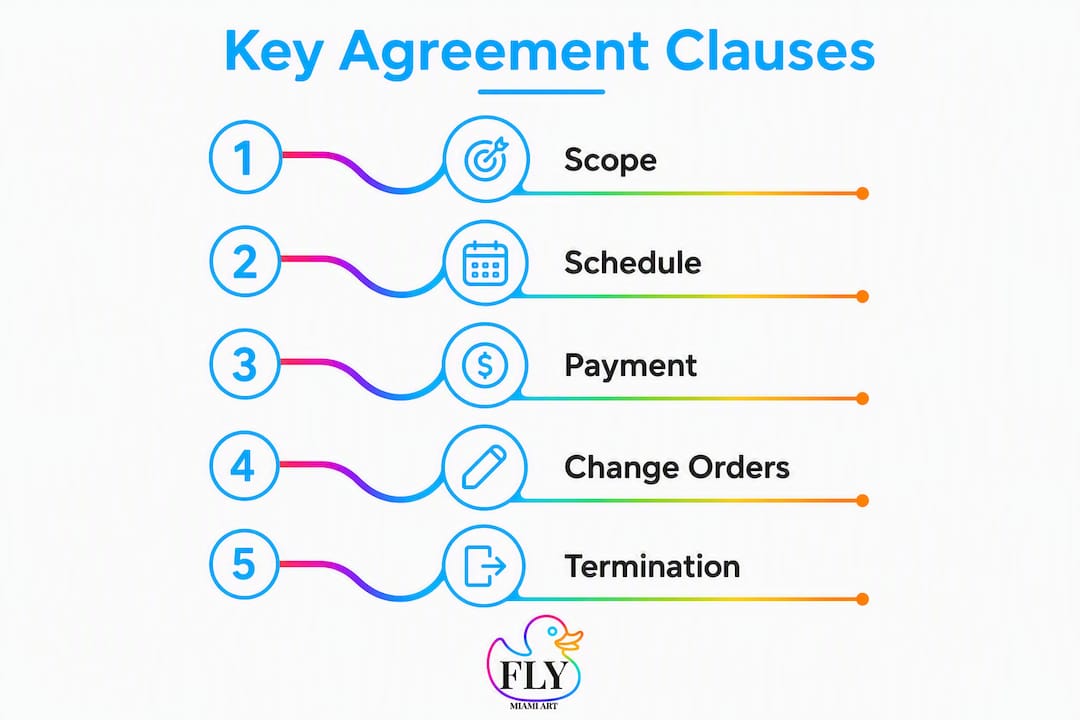
Payment terms
Tie every payment to a deliverable or a signed acceptance, never to a calendar date alone. Specify invoicing requirements, expense reimbursement procedures, and whether sales tax applies. Final payment should release only after written acceptance of the installed work.
Approvals and review process
State the number of included review rounds, the format of deliverables at each round (sketches, scaled drawings, physical samples, digital mockups), and the developer’s response window. Silence is not approval; set a default outcome if the developer misses a response deadline.
“Design the approval process like a design project phase rather than a subjective ‘taste’ review — define non-negotiables versus flexible areas to avoid costly misunderstandings.” — The Art Fair Guy
Change orders and scope creep
Every scope change requires a written change order signed by both parties before work proceeds. Include the rate for additional work (hourly or fixed), the lead time required to price and schedule changes, and language stating that unauthorized scope changes void the original timeline and budget.

Termination
Cover two scenarios: termination for convenience (either party can exit with notice) and termination for cause (material breach). Include a refund formula that accounts for work completed, materials purchased, and reasonable overhead. Specify how partially completed work is valued and who retains it.
Representations and warranties
The artist warrants that the work is original, does not infringe third-party rights, and complies with applicable laws (materials safety, public-art permitting, ADA requirements for public installations). The developer warrants that site conditions meet the specifications provided.
Confidentiality and publicity
Seasoned professionals include clauses controlling the timing of public announcements and promotional rights. Developers typically want to control the reveal until project launch; artists need portfolio rights. A balanced clause defines permitted uses, embargo periods, and attribution requirements for both sides.
Dispute resolution and governing law
Specify mediation as the first step, followed by binding arbitration or litigation in a named U.S. state. Arbitration is faster and cheaper for most commission disputes; litigation is appropriate for large public-art contracts where precedent matters.
Logistics and installation
State who hires installers, who pays for crating and shipping, who obtains permits, and who signs off on structural engineering. Specify what happens if site conditions differ from the specifications provided, and who bears the cost of rework.
Pro Tip: Ask the artist to provide a fabrication and installation plan as part of the contract exhibits. A studio that cannot produce one is a risk signal.
How should you price a commission and structure payments?
Pricing a commission is not like pricing a product. The variables are real: material costs fluctuate, fabrication complexity varies by scale, and installation logistics can double the budget on a large site-specific piece. Here is how to structure it so neither side gets burned.
Common pricing models
- Fixed fee: The most common model for defined-scope commissions. The artist quotes a total price covering design, materials, fabrication, and installation. Works well when scope is fully defined upfront.
- Cost-plus: The developer pays actual costs plus a markup or fee. Useful for large, complex projects where material costs are genuinely uncertain, but requires a cap to prevent open-ended exposure.
- Staged milestone billing: Payments release as phases complete. Reduces risk for both sides on long-timeline projects.
- Production-cost pass-throughs: Materials, permits, and shipping billed at cost with supporting receipts, separate from the artist’s fee.
Deposit and milestone splits
Artwork Archive notes that many studio commissions commonly use an upfront deposit and final payment structure split evenly (50%/50%). For larger or more complex developer projects, a three-stage structure is more protective: 30–50% deposit on contract signing (covers materials and initial design work), 25–30% on fabrication start or midpoint, and 20–25% on delivery and installation, released after signed acceptance.
Favor higher deposits when the artist is sourcing specialty materials, fabricating off-site, or working with subcontractors. A studio that refuses any deposit is a red flag; a studio demanding 100% upfront is equally concerning.
Royalties and reproduction fees
For public art and hospitality projects, developers sometimes negotiate a limited reproduction license for marketing use (website, brochures, social media) as part of the commission fee. If the developer wants to reproduce the work on merchandise or in advertising beyond the original site, a separate royalty or one-time reproduction fee is appropriate. Limit these rights to specific uses and a defined term; “unlimited, perpetual, worldwide” language is rarely necessary and often overpriced.
Expense handling
Specify in the contract who pays for materials, shipping, fabrication subcontractors, permits, and installation equipment. Reimbursable expenses should require receipts and pre-approval above a stated threshold. Tax treatment of reimbursements varies; consult a tax advisor for large public commissions.
Pricing red flags
- Open-ended cost reimbursement with no cap
- Milestone definitions tied to subjective approval (“client is satisfied”) rather than objective deliverables
- No payment timeline linked to acceptance, leaving the artist waiting indefinitely for final payment
Pro Tip: For hospitality and venue projects, ask the artist for a detailed budget breakdown at proposal stage, not just a total number. It reveals fabrication capacity, subcontractor relationships, and whether the quote is realistic.
How should developers run an RFQ or RFP for art commissions?
Informal selection, where a developer calls one artist they know, is the fastest path to a misaligned project. ULI’s best practices recommend formal, transparent selection processes that widen the talent pool, create objective documentation, and build trust with stakeholders and community groups.
Why a formal process matters
A documented RFQ or RFP process protects the developer in procurement audits, demonstrates due diligence to investors and public stakeholders, and consistently surfaces better-fit artists than word-of-mouth alone. It also gives artists a fair shot, which matters for community-facing projects.
What to include in an RFQ or RFP
- Project brief: Site description, dimensions, thematic intent, audience, and any technical constraints (structural limits, material restrictions, ADA requirements).
- Budget range: State a realistic range. Hiding the budget wastes everyone’s time and attracts proposals that miss the mark entirely.
- Timeline: Key dates for submission, selection, design development, fabrication, and installation.
- Submission requirements: Portfolio (relevant past work), references, a preliminary concept or approach statement, and a budget breakdown.
- Evaluation criteria: Publish the scoring weights upfront so artists know how they will be judged.
- Draft contract terms: Include key contract terms in the RFP so artists can flag concerns before selection, not after.
Sample scoring rubric
| Criterion | Weight |
|---|---|
| Technical and fabrication capacity | 25% |
| Budget realism and transparency | 20% |
| Community and brand alignment | 10% |
| References and track record | 10% |
Procurement pitfalls to avoid
- Vague briefs: An artist cannot price or propose accurately without dimensions, site conditions, and a budget range.
- Hidden budget expectations: Artists who discover the real budget after submission feel misled, and the relationship starts badly.
- Skipping insurance verification: Confirm the artist carries commercial general liability coverage before award. Discovering a gap after contract signing creates delays.
- No fabrication capacity check: Ask for examples of comparable-scale work. A studio that has never fabricated a piece above a certain scale is a production risk on a large public commission.
ULI also recommends using an art advisory panel or creative placemaking intermediary for complex projects, particularly those with community engagement components. An intermediary reduces the developer’s coordination burden and improves the quality of the selection process.
How do you manage approvals and revisions without scope creep?
Scope creep on art commissions usually starts at the approval stage, not the contract stage. A contract that defines revision rounds but not what counts as a revision is almost as bad as no contract at all.
Define approval gates clearly
Set four gates: concept approval, detailed design approval, pre-fabrication signoff, and post-installation acceptance. Each gate requires specific deliverables:
- Concept: Sketches, mood board, material palette
- Detailed design: Scaled drawings, material samples, structural specifications
- Pre-fabrication: Final drawings, confirmed materials, fabrication schedule
- Post-installation: Physical inspection against acceptance criteria
Set response windows and default outcomes
Give the developer a defined window to respond at each gate (10 business days is common). State explicitly that silence does not constitute approval. If the developer misses the window, the contract should specify a default outcome, typically that the artist may proceed to the next phase after written notice.
Limit revision rounds
Two included revision rounds per gate is a reasonable standard. Additional rounds are change orders, billed at the agreed rate. The contract should define what a “revision” is: a change to dimensions, materials, or structural design is a revision; a minor color adjustment within an agreed palette is not.
Experienced art consultants recommend treating approval like a design project phase, clearly splitting non-negotiable project requirements from flexible aesthetic choices. This framing prevents the most common source of costly rework: a developer who approves a concept and then changes the non-negotiables at the detailed design stage.
Use objective acceptance criteria
Acceptance criteria should reference dimensions, materials, safety specifications, and structural performance, not aesthetic preference. “The sculpture matches the approved drawings within a 2% dimensional tolerance and uses the specified UV-reactive coating” is enforceable. “The client is satisfied with the result” is not.
Pro Tip: Require all approvals in writing, even if the conversation happens verbally. A follow-up email confirming “we approved the concept as discussed on [date]” is sufficient and creates a paper trail that protects both sides.
- Link payment releases to signed acceptance forms at each gate, not to verbal confirmation.
- Keep a shared log of all review comments, responses, and approvals throughout the project.
- Pre-construction visualization tools can help align developer and artist expectations before fabrication begins; CGI for developers is one resource worth reviewing for complex site-specific projects.
Who owns the copyright in a commissioned artwork under U.S. law?
This is the clause most developers get wrong, and the consequences can surface years later when they want to reproduce the work in marketing materials or adapt it for a new location.
The legal baseline
Under U.S. copyright law, the artist retains copyright in a commissioned work by default. The developer pays for the physical object; they do not automatically acquire the right to reproduce, adapt, or display the work in derivative contexts. A written assignment or a valid work-made-for-hire agreement is required to transfer copyright.
“Work-made-for-hire” is widely misunderstood. For an independent artist, it applies only to works that fall within specific statutory categories (contributions to collective works, parts of motion pictures, compilations, and a few others) AND only when there is a signed written agreement designating the work as such. A sculpture commissioned for a hotel lobby does not qualify as work-made-for-hire under the statute simply because the developer paid for it.
Options developers can negotiate
- Exclusive copyright assignment: The artist transfers all rights to the developer in writing. The developer controls reproduction, adaptation, and display. Appropriate for large public commissions where the developer needs full control. Typically commands a higher fee.
- Broad perpetual exclusive license: The developer receives an exclusive license to reproduce and display the work for commercial purposes, but the artist retains underlying copyright. Practical for most hospitality and venue projects.
- Limited-purpose license: The developer may display the work at the specified site and use images for marketing for a defined term. The artist retains all other rights. Common for smaller commissions and gallery placements.
Sample clause language
(a) Limited installation and marketing license: “Artist grants Developer a non-exclusive, perpetual license to display the Work at [Site Address] and to reproduce images of the Work solely for Developer’s marketing and promotional materials related to [Project Name].”
(b) Exclusive assignment with moral-rights waiver: “Artist hereby assigns to Developer all copyright in the Work, including rights of reproduction, adaptation, distribution, and display, in exchange for the compensation set forth herein. To the extent permitted by law, Artist waives any moral rights in the Work.”
© Portfolio carve-out for the artist: “Notwithstanding the foregoing, Artist retains the right to display images of the Work in Artist’s portfolio and to reference the commission in Artist’s professional biography.”
VARA and moral rights
The Visual Artists Rights Act (VARA) gives U.S. artists of works of “recognized stature” the right to prevent destruction or modification of their work, even after sale. For site-specific installations, this matters: if the developer later wants to remove or alter the work, VARA may require the artist’s consent or written waiver. Get a VARA waiver in writing for any permanent installation.
Artwork Archive’s guidance on commission contracts reinforces that formal written agreements protect both artists and commissioners, particularly on IP and termination terms.
Documenting transfers
Any copyright assignment must be in writing and signed by the artist to be enforceable under U.S. law. Attach a clear description of the transferred rights (reproduction, adaptation, display, derivative works) and tie the transfer to a specific payment milestone so the developer does not receive the assignment before paying for it.
What insurance and warranties should a commission contract require?
A sculpture that falls during installation, a mural that fades within two years, or a fabricator who damages a lobby floor: these are not hypothetical risks. The contract needs to allocate them before they happen.
Insurance requirements
| Coverage Type | Minimum Recommended | Notes |
|---|---|---|
| Commercial general liability | commercial general liability and property-in-transit coverage | Developer listed as additional insured |
| Professional liability (errors & omissions) | $500,000 | Covers design errors and specification failures |
| Property in transit | Full replacement value of the work | Active from fabrication through installation |
| Workers’ compensation | Statutory limits | Required if artist employs installers |
Require certificates of insurance before fabrication begins, not before installation. A studio that cannot provide certificates promptly is a procurement risk.
Warranty and maintenance
A standard workmanship warranty covers defects in materials and fabrication for one to two years after installation. For UV-reactive and specialty-material works, specify the expected performance period for the coating or reactive element separately, since material warranties from the manufacturer may differ from the artist’s workmanship warranty.
Clarify who is responsible for routine maintenance (cleaning, touch-ups, UV bulb replacement for blacklight-activated works) and at what cost. Some studios offer maintenance contracts; others provide a maintenance guide and leave it to the developer.
Installation responsibilities
- Who hires and supervises installers (artist, developer, or shared)
- Who obtains installation permits
- Who pays for structural engineering sign-off (required for most permanent public sculptures; see structural engineering for public sculpture for technical considerations)
- Who bears the cost of rework if site conditions differ from specifications
- Who is responsible for crating, shipping, and customs (for international studios)
Indemnities and liability caps
Standard practice is to cap each party’s liability at a multiple of the contract value (1x to 2x is common for art commissions). Exclude consequential damages (lost revenue, reputational harm) from the cap. Each party indemnifies the other for claims arising from its own negligence or breach.
Pro Tip: For large public installations, require the artist to name the developer, the property owner, and the general contractor as additional insureds. A single certificate that covers all three eliminates gaps.
How do you negotiate with artists without damaging the relationship?
Procurement-style bargaining, where the developer treats the artist as a commodity vendor and drives price down through competitive pressure, is the fastest way to get a technically compliant piece that nobody loves. Art commissions require a different posture.
What works
- Be transparent about budget and constraints upfront. Artists price more accurately when they know the real number. Hiding the budget to negotiate later wastes design time and creates resentment.
- Frame approval needs as design phases. “We need a concept review, a detailed design review, and a pre-fabrication signoff” lands better than “we need to approve everything before you proceed.”
- Offer limited portfolio rights as part of the deal. Allowing the artist to show the work in their portfolio costs the developer nothing and matters enormously to the artist.
- Use an intermediary for complex projects. ULI’s research consistently shows that a bridge person or creative placemaking intermediary reduces misunderstandings about schedule, scope, and technical constraints. The intermediary translates developer requirements into artist-facing briefs and manages milestones without the developer needing to speak “artist” fluently.
- Acknowledge the artist’s creative investment. A concept proposal takes real time. If you reject it, say why specifically, not just “it’s not what we envisioned.”
What to avoid
- Changing scope without a written change order, even informally
- Demanding unlimited copyright assignment without fair additional compensation
- Sending procurement-style vendor questionnaires that treat the artist like a materials supplier
- Making subjective taste comments at the acceptance stage after approving the design at every prior gate
When to bring legal counsel
IP assignments, large public-art commissions, and any project involving third-party fabrication or rights licensing warrant legal review. A one-page letter of agreement for a small interior commission can be handled without a lawyer; a $500,000 public sculpture with VARA implications cannot.
Pro Tip: Appoint a single point of contact on the developer’s side for all artist communication. Multiple stakeholders sending conflicting feedback is one of the most common causes of scope creep and relationship breakdown on art commissions.
How does FLY Miami Art structure a commission?
Flymiami (FLY Miami Art), led by artist Facundo Yebne, runs commissions for hospitality venues, public spaces, private collectors, and commercial developers. The studio’s process is a practical model for developers who want to see how a professional studio handles the steps described above.
The studio process
- Initial brief and concept (2–4 weeks): The developer submits a project brief covering site dimensions, thematic intent, budget range, and timeline. Flymiami responds with a concept proposal, including preliminary sketches and a material palette.
- Paid design development: Once the concept is approved and a deposit received, the studio moves into detailed design: scaled drawings, material samples, and mockups. This phase is paid, not speculative.
- Fabrication: Timeline varies by scale and complexity. UV-reactive sculptures and large-format installations require additional lead time for specialty materials and coating application.
- Delivery and installation: The studio coordinates crating, shipping, and on-site installation, with contractor coordination for structural anchoring and electrical connections where required.
- Final acceptance: The developer signs an acceptance form after physical inspection against the agreed specifications. Final payment releases on signing.
Typical pricing structure
Flymiami uses a deposit-and-milestone model: 30–50% deposit on contract signing, 25–30% at a mid-fabrication milestone, and 20–25% final payment on signed acceptance. This structure aligns with Artwork Archive’s guidance on protecting both parties through staged payments.
“Every commission starts with a clear brief and a signed agreement. The creative process works best when the boundaries are defined — scope, timeline, and IP — so the art can do what it’s supposed to do: surprise you within those boundaries.” — Facundo Yebne, FLY Miami Art
Contract highlights the studio uses
- Scope defined with materials, finish specifications, and site conditions
- Limited commercial license for the developer (display at site, marketing use) plus a portfolio carve-out for the artist
- Installation responsibilities defined with contractor coordination details
- VARA waiver included for permanent installations
- Change-order clause with a stated rate for additional work
For developers commissioning hotel lobbies, themed venues, or public plazas, the studio’s UV-reactive and large-format capabilities scale from wall art to multi-piece installations. The commissioning process, timeline, and pricing details are documented on the studio’s blog for developers doing early-stage due diligence.
Developers adapting these clauses for larger public projects should add VARA language, public-art permitting requirements, community engagement provisions, and ADA compliance clauses. The core structure remains the same; the scope of each clause expands.
Sample contract checklist and clause bank you can copy
Use this as a first-draft starting point. Send it to legal for refinement before signing anything above a small interior commission.
One-page checklist
- [ ] Scope of work: dimensions, materials, finish, site conditions, acceptance criteria
- [ ] Schedule: concept, design approval, pre-fabrication signoff, delivery, installation, final acceptance
- [ ] Payment: deposit amount, milestone triggers, invoicing requirements, final payment release
- [ ] IP: license or assignment, scope of rights, VARA waiver, portfolio carve-out
- [ ] Approvals: number of included rounds, response windows, default outcomes, change-order triggers
- [ ] Insurance: coverage types, minimum limits, additional insured requirements, certificate timing
- [ ] Installation: who hires installers, permits, structural sign-off, shipping, rework responsibility
- [ ] Warranties: workmanship period, material performance, maintenance responsibility
- [ ] Termination: conditions, notice period, refund formula, ownership of partial work
- [ ] Dispute resolution: mediation first, then arbitration or litigation, governing state law
- [ ] Confidentiality and publicity: embargo period, permitted uses, attribution requirements
Short clause bank
Scope of work: “Artist shall create [description of work], measuring approximately [dimensions], fabricated from [materials] with [finish specifications], for installation at [site address]. Acceptance criteria are set forth in Exhibit A.”
Payment schedule: “Developer shall pay: (i) [X]% of the total fee upon execution of this Agreement; (ii) [X]% upon commencement of fabrication; (iii) [X]% upon delivery and installation, conditioned on Developer’s written acceptance.”
Approval rounds: “Developer is entitled to two (2) rounds of revisions per design phase at no additional charge. Additional revision rounds shall be billed as change orders at Artist’s then-current hourly rate of $[rate].”
Basic license: “Artist grants Developer a non-exclusive, perpetual, royalty-free license to display the Work at [site] and to reproduce images of the Work in Developer’s marketing materials related to [project].”
Change order: “No change to the scope, schedule, or budget of this Agreement shall be effective unless documented in a written change order signed by both parties prior to commencement of the changed work.”
Insurance requirement: “Prior to commencing fabrication, Artist shall provide Developer with certificates of insurance evidencing: (i) commercial general liability coverage of not less than $1,000,000 per occurrence; (ii) property-in-transit coverage at full replacement value of the Work.”
Notes on redlining
Lawyers typically reopen three areas: IP scope (how broadly “marketing use” is defined), liability caps (the multiple of contract value), and moral rights (whether the VARA waiver is enforceable for the specific work type). Flag these for legal review on any commission above a small interior piece.
For small commissions, this clause bank works as a short-form letter of agreement. For large public installations, expand each clause with legal review and add public-art permitting, community engagement, and ADA compliance provisions.
| Clause | Small interior commission | Large public installation |
|---|---|---|
| IP | Limited license | Full assignment or broad exclusive license |
| Insurance | $1M GL + transit | $2M GL + professional liability + workers’ comp |
| Approvals | 2 rounds per phase | Formal gate process with panel sign-off |
| VARA | Waiver recommended | Waiver required; consult counsel |
| Dispute resolution | Mediation + arbitration | Mediation + litigation (public contracts) |
Key Takeaways
A signed commission agreement that fixes scope, IP, payment milestones, and approval gates before work begins is the single most effective way to protect a developer art project from cost overruns and disputes.
| Point | Details |
|---|---|
| Lock scope before work starts | Define dimensions, materials, and acceptance criteria in writing; vague scope is the root cause of most commission disputes. |
| Structure payments to milestones | Use a typical split of 30–50% deposit on contract signing, 25–30% at fabrication start or midpoint, and 20–25% on delivery and installation with final payment tied to signed acceptance, not calendar dates. |
| Assign or license IP explicitly | U.S. copyright defaults to the artist; get a written assignment or license that matches your actual use needs before fabrication begins. |
| Set approval gates with revision limits | Two included revision rounds per phase is standard; additional rounds are change orders billed at an agreed rate. |
| Flymiami as a commissioning partner | Flymiami structures commissions with milestone billing, defined IP options, and installation coordination built in from the first brief. |
Procurement rigor and creative flexibility are not opposites
The most persistent mistake I see in developer-artist contracting is treating the two as a trade-off. Procurement teams want predictable outcomes, documented decisions, and clear deliverables. Artists need creative space, fair IP recognition, and a client who understands that the best work happens when the boundaries are clear but the creative process within them is respected.
These goals are compatible, but only if the contract and the relationship are structured correctly from the start. A formal RFQ process does not prevent a great creative outcome; it creates the conditions for one by attracting the right artists and setting honest expectations. A detailed approval process does not stifle creativity; it protects the artist from a developer who approves a concept and then changes the non-negotiables at fabrication stage.
The place where I see this break down most often is the IP clause. Developers sometimes demand full copyright assignment as a default, without understanding that it is not necessary for most use cases and that it signals to the artist that their creative contribution is being treated as a commodity. A well-drafted limited license gives the developer everything they actually need: the right to display the work, use it in marketing, and reference it in investor materials. The artist keeps the copyright, which costs the developer nothing in practice and preserves the relationship.
The other underrated tool is the intermediary. A creative placemaking partner or experienced art consultant who has worked on both sides of the table can translate developer requirements into artist-facing briefs, manage milestone reviews without the developer needing to speak “artist,” and catch scope creep before it becomes a contract dispute. For large public commissions, the intermediary’s fee is almost always recovered in avoided rework and schedule delays.
Treat artists as creative partners. The contract enforces the boundaries; the relationship determines the quality of what happens inside them.
Flymiami offers end-to-end commissions for developers and venues
Developers commissioning art for hotel lobbies, public plazas, themed venues, or private collections face the same challenge: finding a studio that can handle design, fabrication, installation, and the contract structure that protects everyone. Flymiami does all of it.
Flymiami’s commissions cover the full process: initial brief, concept development, paid design phases, specialty fabrication (including UV-reactive and large-format works), shipping, and on-site installation. Milestone billing and IP license options are built into every commission agreement, so developers are not starting from a blank contract. The studio’s statement pieces and large-scale sculptures are designed specifically for high-impact spaces where the art needs to hold its own against architecture.
For developers who need wall art for interiors, the wall art collection includes original and limited-edition works available for immediate purchase or custom commission. For three-dimensional focal pieces, the sculpture collection covers everything from gallery-scale works to lobby installations.
To start a commission inquiry or review the studio’s portfolio, visit the commission page or contact the studio directly through the installations page.
Useful sources and further reading
These are the primary sources developers and their legal teams should consult when drafting or reviewing art commission agreements.
- 7 Best Practices in Artist/Developer Collaboration, Urban Land Institute: The most authoritative U.S. source on procurement best practices for developer-artist collaborations, including RFQ/RFP guidance, intermediary use, and selection criteria. Directly supports the procurement and negotiation sections of this guide.
- Art Business Essentials: Commission Contracts for Artists, Artwork Archive: Practical guidance on commission contract structure, deposit splits, and IP terms. Useful for both artists and developers drafting first agreements.
- Hotel Art Commissions: How to Work with Artists, The Art Fair Guy: Hospitality-focused guidance on approval workflows, budget transparency, and installation planning. Directly applicable to hotel and venue developer projects.
- Artist Contracts and Stonemaier Games: A practical example of how to balance publicity rights, portfolio carve-outs, and announcement timing in a commission contract.
- ARTS NOW Art Policy Developer Guidelines: Policy-level guidance on developer art programs, including marketing/image use permissions and letter-of-agreement best practices.
- New York Foundation for the Arts (NYFA): Resources for artists and commissioners on contracts, rights, and professional practice in the U.S.
- Volunteer Lawyers for the Arts (VLA): Legal resources and referrals for art-related contract and IP questions in the U.S.
- Creative Capital: Resources on artist professional development and commissioning practices, with a U.S. focus.
For any commission involving copyright assignment, VARA waivers, or large public-art contracts, consult a U.S. attorney with intellectual property or arts law experience before signing. The clause examples in this guide are starting points, not legal advice.
For Flymiami’s commission process, portfolio, and contact details, visit the studio installations page.