Examples of Interactive Civic Art Installations for Collectors
Interactive civic art installations are large-scale, participatory works that turn anonymous strangers into active contributors — through touch, motion, light, or shared making. If you’re a collector or commissioning client evaluating this format, the short answer is: it works when scale, low-friction interaction, and site specificity align. Flymiami’s UV-reactive pop art approach fits squarely in this space, and the NYC Department of Cultural Affairs (DCLA) has formalized exactly this model through its Public Art as Community Engagement (PACE) pilot. Budget a year or more for a community co-creation commission. Done right, these projects drive foot traffic, press coverage, and genuine neighborhood buy-in.
Table of Contents
- What do examples of interactive civic art installations actually look like?
- What design principles actually make these installations work?
- What materials and technical specs do UV-reactive installations need?
- How do you commission an interactive civic installation in the US?
- How do you measure impact and prove community buy-in?
- FLY Miami Art: how the studio approaches UV-reactive civic work
- Key Takeaways
- Why co-creation is the part most commissioners underestimate
- Commission a UV-reactive civic installation with Flymiami
- Useful sources and further reading
What do examples of interactive civic art installations actually look like?
Eight types dominate the field. Each translates differently to UV-reactive pop art.
1. Large inflatable spectacle sculpture. Jen Catron and Paul Outlaw’s 65-foot hot dog in Times Square rises daily and showers visitors with confetti. Scale and absurdist humor generate press without requiring any visitor action beyond showing up. For UV-reactive commissions, a large inflatable with embedded blacklight strips creates a dayparting effect: ordinary by day, glowing spectacle after dark. Permitting for temporary inflatables in high-traffic plazas typically requires a special event permit plus liability insurance.
2. Interactive LED/blacklight mural. Embedded LED panels or UV-reactive paint on a large wall surface respond to motion sensors or simply glow under installed blacklights. Projects that integrate LEDs into architectural-grade panels rather than fragile temporary rigs hold up far better in public settings. Budget for weatherproof enclosures and a maintenance contract from day one.
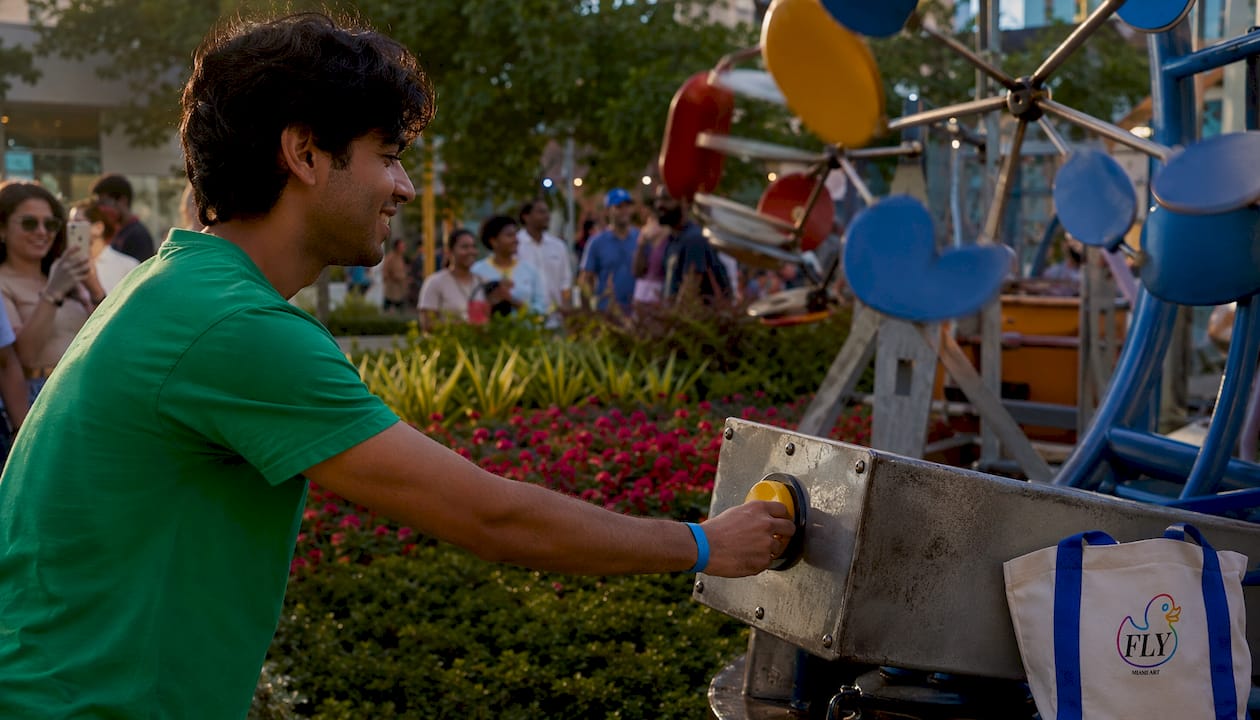
3. Button-triggered mechanized sculpture. A push-button activates movement, sound, or a light sequence. The interaction is anonymous and immediate — no app, no sign-in. Research confirms that participation drops sharply when installations require identification; a single button is the gold standard for public engagement.
4. Co-created community mural. The Mosaicos de la Comunidad project documented by MDPI used iterative workshops and a public unveiling attended by civic leaders, producing a mural with genuine local ownership. For UV-reactive versions, workshops where participants paint blacklight-reactive sections under portable UV lamps create a memorable co-creation moment and strong social media content.
5. Multi-site scavenger-hunt inflatables. Van Alen Institute’s Friends from the Canal placed three illuminated inflatable creatures at multiple Gowanus locations, paired with a neighborhood scavenger hunt and ceramic tile “easter eggs” hidden around the district. The multi-site format multiplies press placements and extends dwell time across a whole neighborhood.
6. Motion-triggered illuminated walkway. Pressure sensors or PIR motion detectors trigger UV-reactive panels underfoot or along a path. Effective in parks, underpasses, and transit corridors. Key commissioning note: coordinate with the facilities manager on power access and ADA compliance before design begins.
7. Projection-mapped interactive facade. A building face becomes a canvas that responds to crowd movement or sound input. High setup cost but strong press return. UV-reactive surface coatings can amplify projection contrast after dark, a technique worth specifying in the brief.
8. Tactile shadow/silhouette installation. Visitors create shadow figures on a UV-reactive or phosphorescent surface. Simple, zero-tech, and universally accessible. The Boston Public Library’s LEXICON installation shows how a civic institution can host large-scale participatory work without requiring visitors to do anything complicated.
“The best civic installations hold the public’s cultural climate up to the light — using humor, scale, and provocation to make people stop, look, and argue.” — Anna Starling, Times Square Arts
What design principles actually make these installations work?
Scale plus low-friction interaction plus site specificity equals higher engagement. That formula sounds obvious, but most failed civic installations miss at least one leg.
Low-barrier participation is the non-negotiable. Anonymous, playful interactions — shadows, push-buttons, tactile surfaces — consistently outperform anything requiring a phone, an app, or an account. The moment you add a sign-in step, you lose the casual passerby, who is often your most valuable audience member.
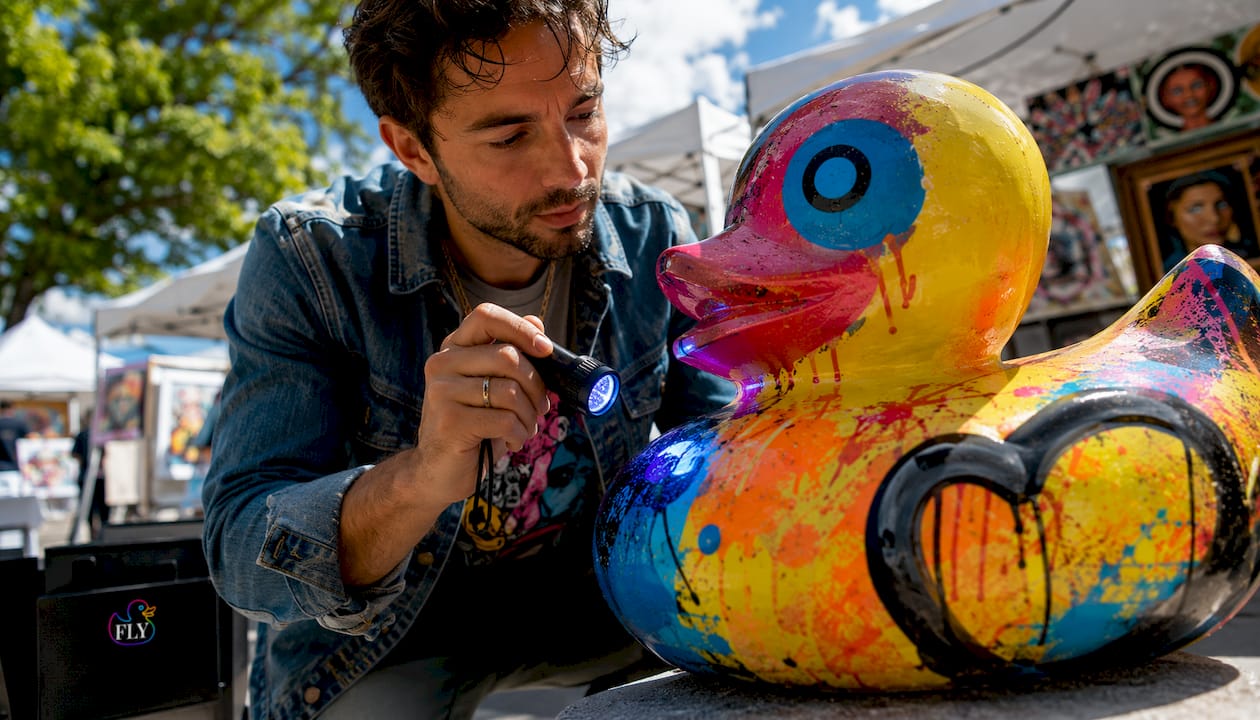
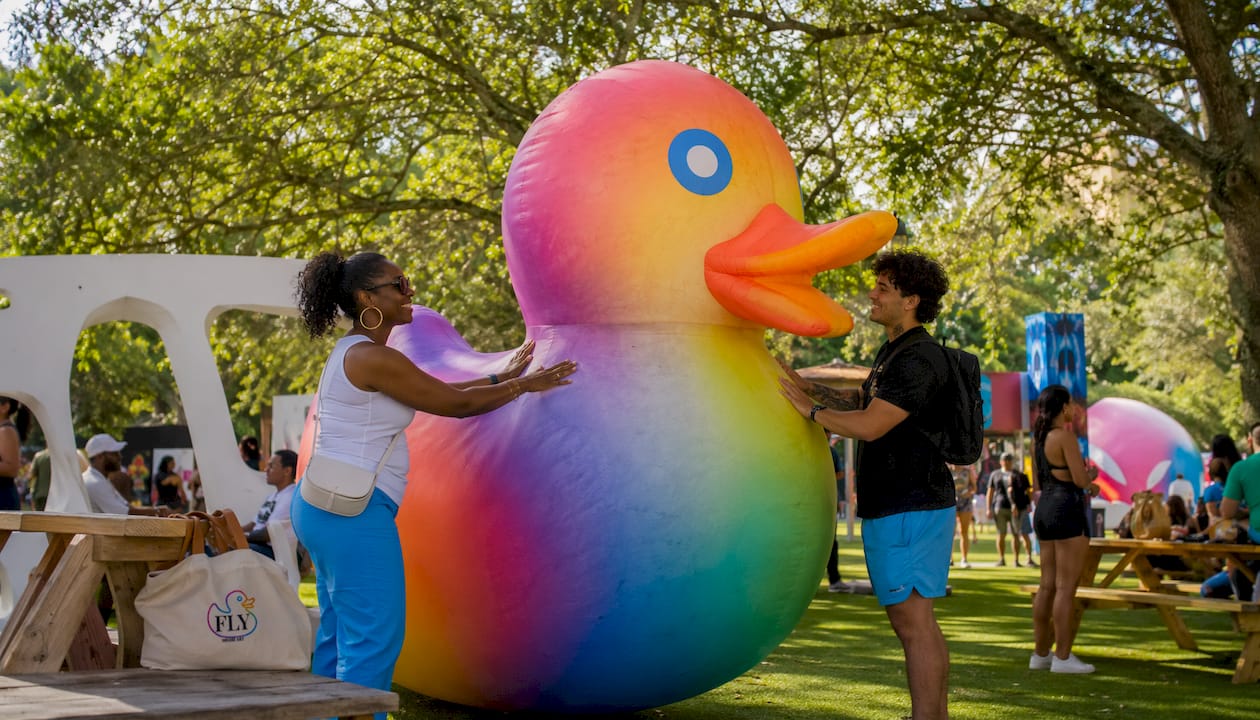
Humor and provocation are tools, not accidents. The hot dog in Times Square works because it is absurd at civic scale. Anna Starling of Times Square Arts frames it precisely: effective installations hold the public’s cultural climate up to the light. UV-reactive pop art carries the same potential — a rubber duck the size of a car, glowing electric under blacklight, stops people and makes them take photos. That photograph is the press placement.
Pro Tip: Before finalizing a provocative concept, run it by the site’s stakeholder group and your insurance broker simultaneously. A concept that generates debate is an asset; one that generates formal complaints can trigger permit revocation. Document community input sessions as part of your project deliverables.
NYC DCLA’s PACE model recommends artist-led temporary interventions and community convenings before any permanent commission. That sequence protects the artist, the institution, and the budget. A temporary pop-up tests the concept in the actual site conditions — light levels, foot traffic patterns, weather — before you commit to fabrication at full scale. For urban placemaking projects specifically, this pilot phase often produces the community relationships that make a permanent installation sustainable long-term.
“When community members actively participate in the creation process, public artworks act as catalysts for social bonding and urban sustainability.” — MDPI research on community-engaged mural projects
What materials and technical specs do UV-reactive installations need?
| Material | Application | Durability Note |
|---|---|---|
| Architectural LED panels | Embedded wall/floor arrays | IP65-rated for outdoor; plan maintainable wiring runs |
| Marine-grade fiberglass | Sculptural forms, inflatables | UV-stable gel coat; resists salt air and humidity |
| Powder-coated steel | Armatures, frames, mounting hardware | Hot-dip galvanize before powder coat for outdoor longevity |
| UV-reactive acrylic paint | Surface finish on any substrate | Reapplication cycle every 3–5 years depending on sun exposure |
| UV-reactive resin | Cast elements, detail work | Yellowing risk without UV-stabilizer additive; specify it |
Technical priorities for any UV-reactive public installation:
- Power and ballast sizing: UV/blacklight fixtures draw more current than standard LEDs; size circuits with a 20% headroom buffer and use dedicated breakers.
- Wiring concealment: Exposed conduit invites vandalism and weather damage; route through sealed channels within the substrate.
- IP ratings: Outdoor fixtures and control boxes should meet IP65 minimum; IP67 for ground-level or splash-zone placements.
- Vandal resistance: Polycarbonate lens covers over UV tubes; anti-graffiti coating on painted surfaces.
- Maintenance access: Design removable panels at every fixture point. A studio process that documents access points at fabrication saves significant cost at the first service interval.
Flymiami’s UV art in public spaces guide covers visibility thresholds, power planning, and conservation considerations specific to blacklight work — worth sharing with your site engineer before the design is finalized.
Safety checklist: UV-B and UV-C emission must stay within ACGIH occupational exposure limits; most commercial UV-A blacklight fixtures are safe at normal viewing distances, but specify UV-A-only sources in the brief. Electrical grounding for all metal elements is non-negotiable. Large inflatables and freestanding sculptures need engineered anchorage calculations stamped by a licensed structural engineer.
How do you commission an interactive civic installation in the US?
Commissioning checklist:
- Select and survey the site (ownership, utilities, ADA access, permit jurisdiction).
- Map stakeholders: property owner, city agency, neighborhood associations, adjacent businesses.
- Issue an artist/studio RFQ or direct-commission brief with site photos, budget band, and target dates.
- Run a community co-creation phase: workshops, convenings, design feedback sessions.
- Finalize design and obtain permits (special event, building, electrical as applicable).
- Execute fabrication with milestone reviews and a full-scale blacklight mockup.
- Install with a licensed electrician and structural rigger on-site.
- Hand over a maintenance manual and schedule the first service visit.
| Phase | Typical Duration |
|---|---|
| Community co-creation | 6–12 months |
| Design and fabrication | 3 months |
| Permitting | 1–4 months |
| Total | 12–18 months |
US budget bands vary significantly by scope. Temporary large-scale UV-reactive installations typically run from the low five figures to the low six figures. Permanent integrated pieces with electronics, engineered anchorage, and multi-site components start in the mid-six figures. Factors that push cost up: multi-site logistics, interactive electronics, rigging complexity, and insurance riders for high-traffic public spaces.
Questions to ask any studio or vendor: What is the materials warranty period? Who holds the electrical specs and as-built drawings? What is the maintenance commitment and at what cost? What are the insurance limits and who is named as additional insured? What IP rights does the artist retain for reproduction?
A commissioning timeline of 12–18 months is standard when community co-creation is included — and the pre-installation process is where much of the project’s long-term value is actually created.
How do you measure impact and prove community buy-in?
Metrics worth tracking from day one:
- Foot traffic counts: baseline vs. post-install, measured at consistent time windows.
- Dwell time: how long visitors stay near the work (simple timed observation or sensor data).
- Social media impressions and sentiment: track the installation’s hashtag and location tag weekly.
- Quick-intercept surveys: anonymous, three-question paper or QR surveys on-site during peak hours.
- Local business lift: ask adjacent retailers to share foot traffic or sales data for the installation period.
- Press placements: count unique outlets and note audience reach.
- Repeat visitation: track whether the same visitors return, especially for time-limited or evolving works.
Capture baseline data before installation begins. Run observation windows at the same times each week. Hold a post-install community convening at the 30-day and 90-day marks to gather qualitative feedback and document co-creation contributions as formal project deliverables. Temporary interventions are particularly useful here: community-engaged mural research shows that iterative, workshop-based projects produce stronger local resonance and longer-term sustainability than one-shot installations.
For ticketed or timed-entry activations, immersive experience booking tools can automate visitor flow data collection and provide attendance reports that feed directly into your impact documentation.
FLY Miami Art: how the studio approaches UV-reactive civic work
Flymiami, led by artist Facundo Yebne, specializes in UV-reactive pop art sculptures and installations that reveal hidden patterns and colors under blacklight. The studio’s process runs from briefing through community input (when applicable), full-scale blacklight prototyping, engineering for outdoor durability, and installation with a maintenance handover.
Proof points collectors and institutions should request from any studio include: fabrication documentation, in-studio QA records, exhibition history, and a clear maintenance schedule. Flymiami’s studio process page covers fabrication steps and materials in detail.
For civic commissions, the studio’s large-scale installation experience spans hospitality, gallery, and public contexts. Signature works like Nocturnal Ascension and Glowing with Pride demonstrate how UV-reactive rubber duck motifs carry civic themes — visibility, joy, community identity — at a scale that reads across a plaza.
To start a commissioning conversation, include in your brief:
- Site photos and dimensions.
- Target installation and removal dates.
- Available budget band (even a rough range).
- Key community stakeholders and any permit constraints already identified.
- Intended audience and any thematic direction.
Key Takeaways
The most effective interactive civic installations combine low-barrier participation, site-specific scale, and UV-reactive spectacle — with a 12–18 month timeline built around community co-creation.
| Point | Details |
|---|---|
| Prioritize low-barrier interaction | Anonymous, touch-or-motion interactions consistently outperform app-based or identity-required systems. |
| Budget and timeline realistically | US temporary UV-reactive installations often require significant investment; full commissions with co-creation generally span over a year. |
| Test before you commit | Temporary interventions validate concept, community response, and site conditions before permanent fabrication. |
| Document co-creation as a deliverable | Workshop records and community feedback sessions are project assets, not just process steps. |
| Flymiami for UV-reactive civic work | Facundo Yebne’s studio delivers engineered, blacklight-reactive sculptures with full fabrication documentation and installation support. |
Why co-creation is the part most commissioners underestimate
Most commissioning conversations start with the object: what will it look like, how big, what colors. The harder question is who helped make it and whether the neighborhood actually wanted it there. Spectacle without community input produces installations that photograph well and feel hollow in person. The most durable civic works I’ve seen — durable in the sense that people still care about them two years after the ribbon cutting — are the ones where the community had a real hand in the concept, not just a courtesy consultation.
UV-reactive work adds a layer that most civic art misses: it behaves differently at different times of day. That dayparting quality creates a reason to return, which is exactly what drives repeat visitation metrics and long-term press. The trade-off is technical complexity. Power, weatherproofing, and UV source selection require engineering discipline that not every studio brings to civic scale. Balancing spectacle with that kind of durability is where the real craft lives.
Commission a UV-reactive civic installation with Flymiami
Flymiami offers custom UV-reactive pop art installations built for public and commercial settings, from single gallery-scale sculptures to multi-site civic commissions. Every piece is handcrafted with engineered durability in mind: marine-grade substrates, IP-rated lighting, and a full maintenance handover at installation.
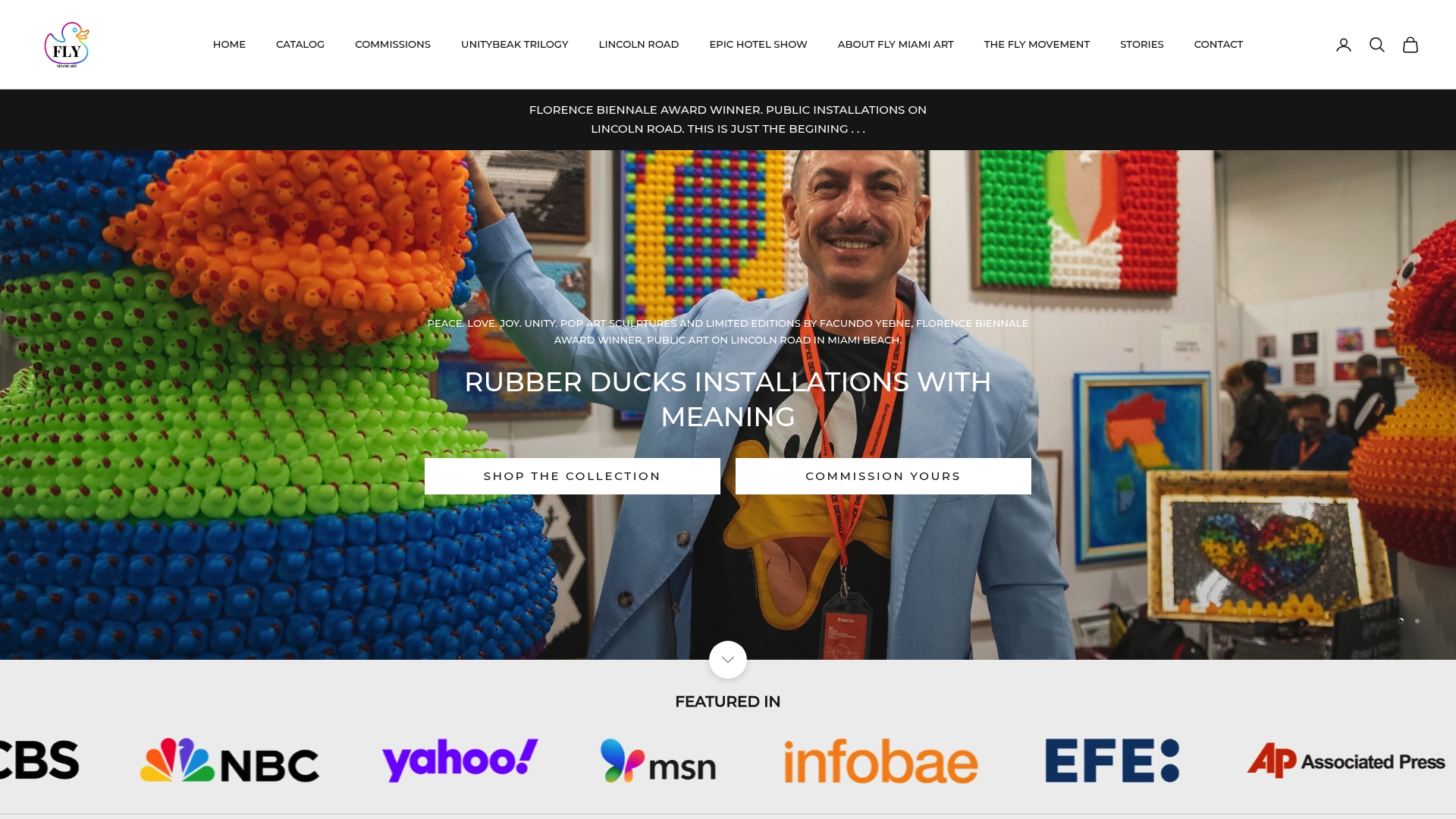
The first conversation is straightforward: share your site, your budget window, your timeline, and any community context. From there, the studio can scope a concept, recommend a prototyping approach, and outline permit requirements for your jurisdiction. Browse the UV glow art collection and the sculpture collection to see the range of finishes and scales available, then reach out directly to begin your commissioning brief.
Useful sources and further reading
- NYC DCLA — Public Art as Community Engagement (PACE): Best for policy guidance on temporary interventions and community co-creation frameworks.
- Times Square Arts — Hot Dog: The Second Serving: Project documentation for a high-visibility spectacle installation; useful for press and programming benchmarks.
- The Art Newspaper — Jen Catron and Paul Outlaw, Times Square: Press coverage model for large-scale civic humor and provocation.
- MDPI — Community Engagement via Mural Art: Research on co-creation methods, social bonding outcomes, and sustainability of community murals.
- MDPI — Mosaicos de la Comunidad: Detailed case study of a participatory mural workshop model with civic unveiling.
- Van Alen Institute — Friends from the Canal: Multi-site inflatable installation with scavenger hunt; strong model for neighborhood-scale engagement.
- Boston.gov — LEXICON at Boston Public Library: Example of a civic institution hosting large-scale participatory fabrication work.
- Flymiami — Why UV Art Works in Public Spaces: Technical and aesthetic guidance specific to blacklight installations in public settings.
- Flymiami — Studio Process: Fabrication documentation and QA practices for evaluating studio capability.