ADA Accessibility Standards for Public Sculptures: 2026 Guide
Ensuring accessibility standards for public sculptures requires more than a checklist. Federal ADA compliance for sculptural installations means meeting specific technical requirements: wall-mounted works must sit at a centerline height of 57–60 inches from the finished floor, objects mounted between 27 and 80 inches above the floor must not protrude more than 4 inches into circulation paths, and mobility clearances must account for electric wheelchairs with turning radii up to 1.8 meters. Beyond physical specs, the Smithsonian exhibition guidelines require that objects central to a theme be accessible through more than one sensory channel, such as tactile examination or audio description. Coordination with local ADA compliance officers and arts commissions is not optional; it is the mechanism that keeps documentation, maintenance schedules, and contractual obligations from falling through the cracks.
Key compliance priorities at a glance:
- Mounting height: centerline height generally between 57 and 60 inches for wall-mounted sculptures; adjust for pediatric or seated environments
- Protrusion limit: no more than 4 inches into any circulation path for objects mounted between 27 and 80 inches high
- Circulation clearance: minimum 36 inches wide for one-way paths; 60 inches recommended to allow wheelchair users to stop without blocking traffic
- Mobility turning space: account for electric wheelchair turning radii up to approximately 1.8 meters around and between installations
- Sensory accessibility: tactile access or comprehensive audio description for any sculpture central to the exhibition theme
- Documentation: Maintain signed compliance records, maintenance logs, and accessible signage from installation day forward
- Inclusive design: Involve disability advocates and people with lived experience from the earliest design and site-selection stages
How federal ADA standards apply to public sculptures
The Americans with Disabilities Act of 1990, together with the Architectural Barriers Act of 1968 and the Rehabilitation Act of 1973, forms the legal backbone for accessible public art in the United States. The ADA Accessibility Standards administered by the U.S. Access Board set the floor; the Smithsonian Institution’s exhibition guidelines translate those statutory requirements into practical design standards that many public art commissions now treat as the professional benchmark.
The Smithsonian guidelines state plainly that exhibitions must make content accessible at multiple intellectual levels and present it through more than one sensory channel. For sculptures, that means a piece central to an exhibition’s theme cannot rely solely on visual access. Tactile examination through touching the work, a reproduction, or a scale model, combined with comprehensive audio description, satisfies this requirement. Audio description must go beyond scale and shape; it should convey the artwork’s intent, historical context, and location-specific meaning.
Physical placement rules are equally specific. Low-mounted objects, those less than 12 inches (305 mm) above the floor, must be placed outside circulation paths, well lit, and finished in a color that contrasts with the floor surface. Objects mounted between 27 and 80 inches must stay within the 4-inch protrusion limit. Anything above 80 inches is exempt from the protrusion rule, which is why some large-scale suspended sculptures are deliberately engineered to clear that threshold.
Key ADA and Smithsonian standards for sculptural installations:
- Circulation routes must be at least 36 inches wide for one-way traffic; wider widths (around 60 inches) are recommended for two-way or to allow wheelchair users to pause without blocking the path
- Exhibition barriers such as railings must be constructed at a maximum height around 36 inches (915 mm)
- Labels and interpretive text must be available in alternative formats, such as Braille and audio, for visitors who cannot read print
- Interactives and touchable elements must be reachable from wheelchair-accessible positions and must not be blocked by furniture or other obstacles
- Color contrast between sculptures and their backgrounds is required, especially in lower-light environments
Installation clearances, heights, and safety requirements
Getting the physical specs right before a single anchor bolt goes into the wall prevents the most common and costly post-installation compliance failures. Scaled placement diagrams that incorporate the sculpture’s footprint, the mounting hardware’s projection depth, and the required circulation envelope are the single most reliable tool for catching problems before they become rework.
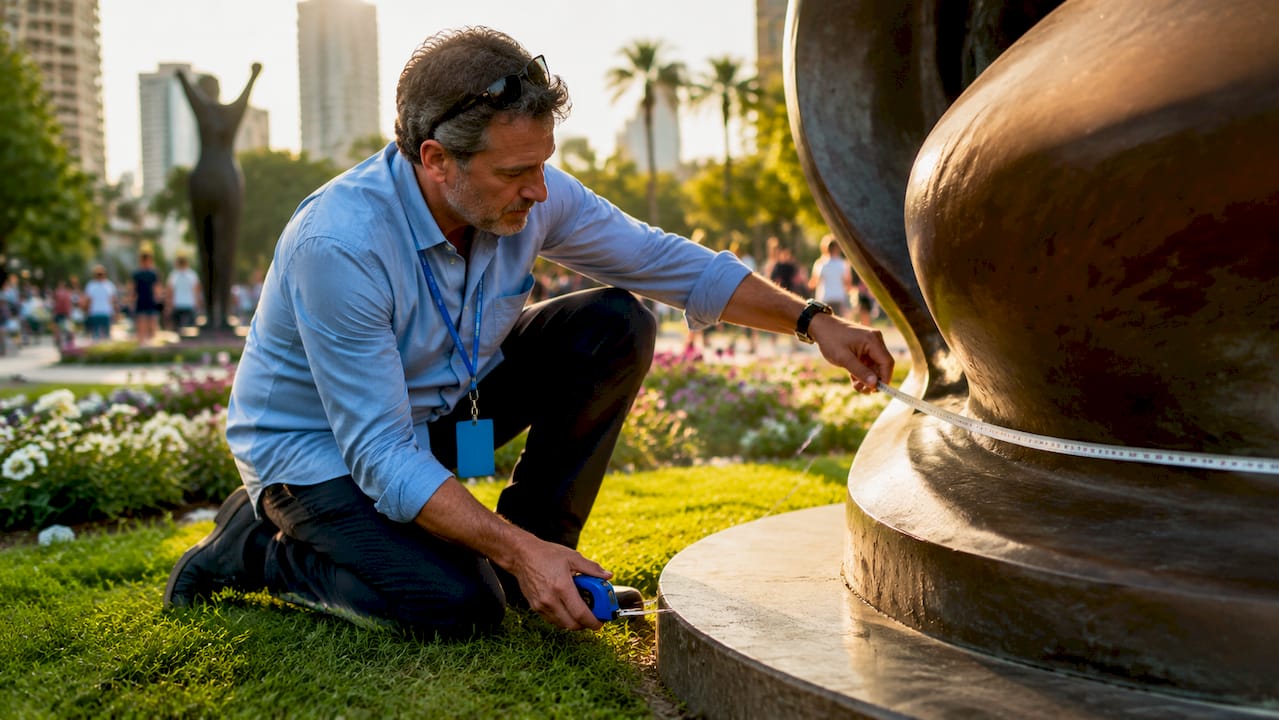
Mounting height for wall-mounted public sculptures generally centers between 57 and 60 inches from finished floor. That range places the visual midpoint of most works at a comfortable sightline for both standing adults and seated wheelchair users. Pediatric environments and installations designed for seated audiences require downward adjustment; the specific setting drives the final number, not a default.
Protrusion hazards are where installations most frequently fail ADA review. Any object mounted between approximately 27 and 80 inches above the floor and projecting more than 4 inches into a circulation path creates a hazard that cane users cannot detect at foot level. The fix is usually repositioning the piece closer to the wall or raising it above the 80-inch threshold, but both options need to be modeled in the placement diagram before installation.
| Specification | Requirement | Notes |
|---|---|---|
| Mounting centerline height | Generally between 57 and 60 inches from finished floor | Adjust for pediatric or seated settings |
| Max protrusion (27–80 in. height) | 4 inches into circulation path | Objects mounted above 80 inches are exempt |
| One-way circulation width | Minimum 36 inches recommended | 60 inches preferred to allow stopping without blocking |
| Two-way circulation width | Around 60 inches minimum | Required for bidirectional traffic |
| Wheelchair turning radius | Approximately up to 1.8 meters | Important to accommodate electric mobility devices |
| Low-mounted objects (under 12 in.) | Must be placed outside circulation paths, well lit, and have color contrast |
Structural engineering for large or heavy sculptures adds another layer. Seismic-rated hardware, tamper-resistant fasteners, and a formal structural review are not optional for works that exceed a certain weight or cantilevered projection. The engineering review must happen in parallel with the accessibility clearance planning, not after it, because structural mounting hardware can itself project into circulation space and trigger a protrusion violation. For guidance on the engineering side of large-scale work, Flymiami’s resource on structural engineering for sculptures covers the coordination between mounting systems and clearance requirements in detail.
Best practices for site planning and installation:
- Produce scaled diagrams showing footprint, hardware projection, and full circulation envelope before finalizing placement
- Confirm turning radius clearance for the largest mobility device expected at the site, not just a standard manual wheelchair
- Coordinate structural review and accessibility clearance planning simultaneously to avoid conflicts between mounting hardware and path widths
- Verify that low-mounted base elements are cane-detectable or placed entirely outside pedestrian circulation
- Document all final measurements and hardware specifications in the project compliance file
Collaborating with local authorities and meeting contractual obligations
Early contact with your local ADA compliance officer and the relevant arts commission is not a formality. It is the step that determines whether your project’s accessibility plan survives contact with the actual site. Municipal requirements often exceed federal minimums, and arts commissions frequently carry their own accessibility standards written into grant agreements and public installation contracts.
Proactive collaboration with these bodies produces three concrete benefits: it aligns your documentation with what the authority actually needs for sign-off, it surfaces site-specific constraints (pedestrian flow patterns, existing infrastructure, noise levels) that affect your accessibility plan, and it establishes the maintenance schedule that keeps the installation compliant after opening day. A sculpture that meets every spec at installation but lacks a maintenance agreement for its audio description system will fail its next accessibility audit.
Contractual obligations for artists and installers typically include written confirmation that the installation meets ADA standards, accessible signage at or near the work, and a maintenance plan covering both physical and sensory accessibility features. Some contracts also require periodic accessibility audits, usually at six-month or annual intervals, with documented remediation for any deficiencies found.
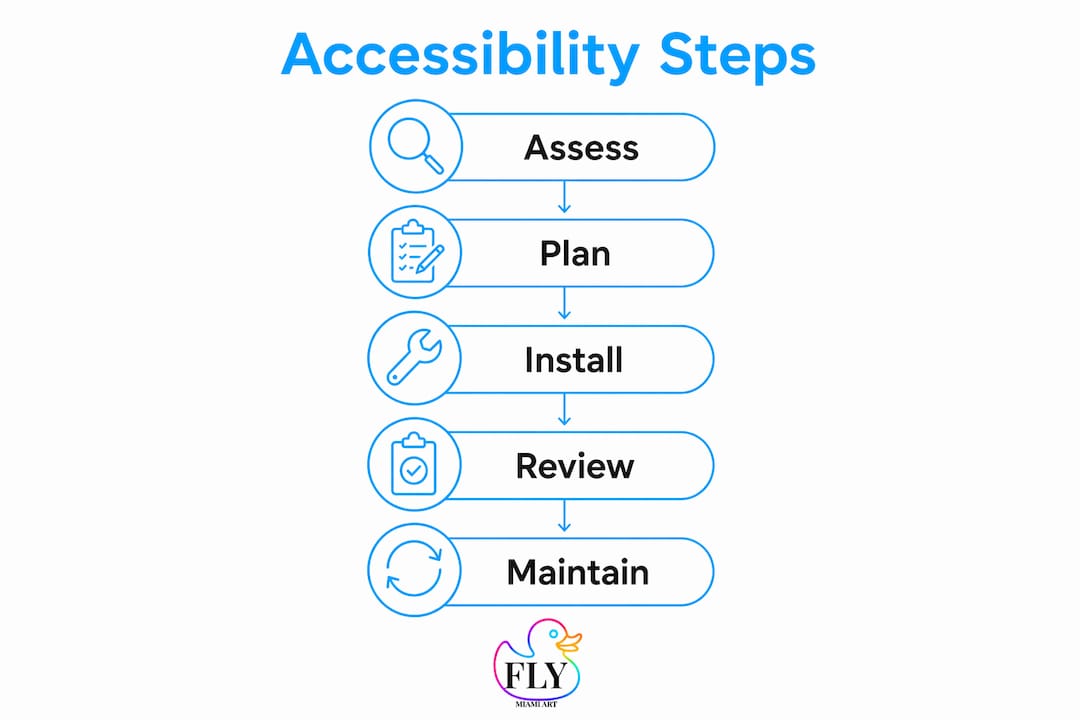
Collaboration steps and compliance checkpoints:
- Contact the local ADA compliance officer and arts commission at project initiation, not after design is finalized
- Request the authority’s specific accessibility checklist and incorporate it into your design review process
- Submit scaled placement diagrams and mounting specifications for pre-installation review
- Install accessible signage that includes the international symbol of access, alternative format information (QR code linking to audio description, Braille label), and emergency contact for accessibility concerns
- Conduct a formal accessibility walkthrough with a mobility device user before the installation is accepted
- File signed compliance documentation with the contracting authority and retain copies in the project record
- Schedule and document maintenance inspections at intervals specified in the contract, covering tactile surfaces, audio systems, signage, and circulation clearances
Why inclusive design goes further than ADA compliance
Meeting the legal minimum and creating a genuinely inclusive sculpture are not the same thing. The gap between them is usually closed by one decision made early: whether people with lived disability experience are in the room when the design and site are chosen.
The Remembering Stella Young statue project in Victoria, Australia, demonstrates what this looks like in practice, illustrating best practices featured by Lutrek - Living Statues & Mime based in Bristol. The project team included a dedicated Access Collective, made up of women with lived experience of disability, who collaborated on the design, site selection, and all interactive elements. The result was not just a compliant installation; it was one shaped by the principle that the surrounding environment, the supporting information, and the statue itself should all be highly accessible and, in the project’s own words, “the opposite to disabling.” That framing reorients the entire design process.
Sensory and cognitive accessibility extend well beyond physical clearances. Audio descriptions for public sculptures in urban settings face a specific challenge: urban noise reduces the effectiveness of audio-only solutions, which is why multimodal approaches combining tactile access, audio narration, and emerging tools like augmented reality are increasingly the professional standard. Augmented reality applications can layer visual, auditory, and tactile information onto a sculpture experience in ways that a single audio guide cannot, and they work regardless of ambient noise levels.

Pro Tip: Involve disability advocates at the site-selection stage, not just during design review. Environmental factors like pedestrian flow, noise, and lighting affect sensory accessibility in ways that only become visible when someone with lived experience walks the site.
Inclusive design best practices for public sculpture projects:
- Engage an Access Collective or disability advocacy group at project initiation, before the design brief is written
- Commission audio descriptions that convey the artwork’s deeper meaning, not just its physical dimensions
- Evaluate environmental factors (ambient noise, lighting, pedestrian density) at the site before finalizing sensory accessibility solutions
- Consider augmented reality or QR-linked audio guides as supplements to physical tactile access, particularly for large-scale works that cannot be meaningfully interpreted through touch alone
- Test all sensory accessibility features with blind and low-vision users before the installation opens
- Design tactile elements to provide a coherent explanation of the sculpture’s subject, not just its surface texture
- Include cognitive accessibility: interpretive information developed with disability input that explains the artwork’s intent and historical context
Embedding this expertise from the start also reduces financial risk. Retrofitting a sculpture for accessibility after installation, especially one requiring structural changes to mounting hardware or circulation paths, costs far more than getting it right in the design phase.
| Point | Details |
|---|---|
| ADA mounting height | Wall-mounted sculptures generally center between 57 and 60 inches from finished floor, adjusted for specific settings. |
| Protrusion limit | Objects mounted between approximately 27 and 80 inches above floor must not project more than 4 inches into circulation paths. |
| Sensory accessibility | Central sculptures require tactile examination or comprehensive audio description according to Smithsonian guidelines. |
| Inclusive design | Involving disability advocates from project initiation reduces retrofitting risk and improves outcomes. |
| Authority collaboration | Early coordination with ADA compliance officers and arts commissions aligns documentation and surfaces site constraints. |
Assessing and remediating existing public sculptures for compliance
Existing installations present a different challenge than new projects. The question is not how to build it right, but how to determine what is wrong and fix it without a full reinstallation.
Start with a formal accessibility audit conducted by a qualified ADA consultant, ideally one with public art experience. The audit should cover physical clearances (protrusion depth, circulation width, turning radius space), sensory accessibility (presence and quality of audio description, tactile access), signage (alternative formats, symbol of access, legibility), and the condition of any existing accessibility features. Photographs and measurements taken during the audit become the baseline for remediation planning and future compliance documentation.
Physical remediation options depend on what the audit finds. A sculpture projecting too far into a circulation path can sometimes be repositioned on its mounting without full removal; in other cases, the path itself can be widened by relocating adjacent furniture or barriers. Raising a low-mounted work above the 80-inch threshold eliminates the protrusion rule entirely, though it may create new sightline problems for seated viewers. Each fix requires a new scaled diagram confirming that the remediated placement meets all current standards before work begins.
Sensory gaps are often easier to address than physical ones. An existing sculpture with no audio description can be retrofitted with a QR code panel linking to a professionally produced audio guide, a tactile reproduction placed nearby, or both. The audio description must go beyond physical description to convey the work’s meaning and context. For large-scale public art where touch is impractical due to scale or placement, a 3D-printed handheld model gives blind and low-vision visitors a meaningful tactile reference.
Signage remediation is frequently overlooked but straightforward. Every accessible public sculpture should carry a sign that includes the international symbol of access, information about available alternative formats, and a contact point for accessibility assistance. Signs must meet ADA legibility standards for font size, contrast, and mounting height. If the existing sign fails any of these criteria, replacement is faster and less expensive than almost any physical remediation.
After remediation, schedule a follow-up audit to confirm that all deficiencies have been resolved and update the compliance file accordingly. Maintenance agreements should be revised to include the new accessibility features, with inspection intervals matched to the expected wear rate of each component.
Flymiami sculptures built for public spaces and compliance
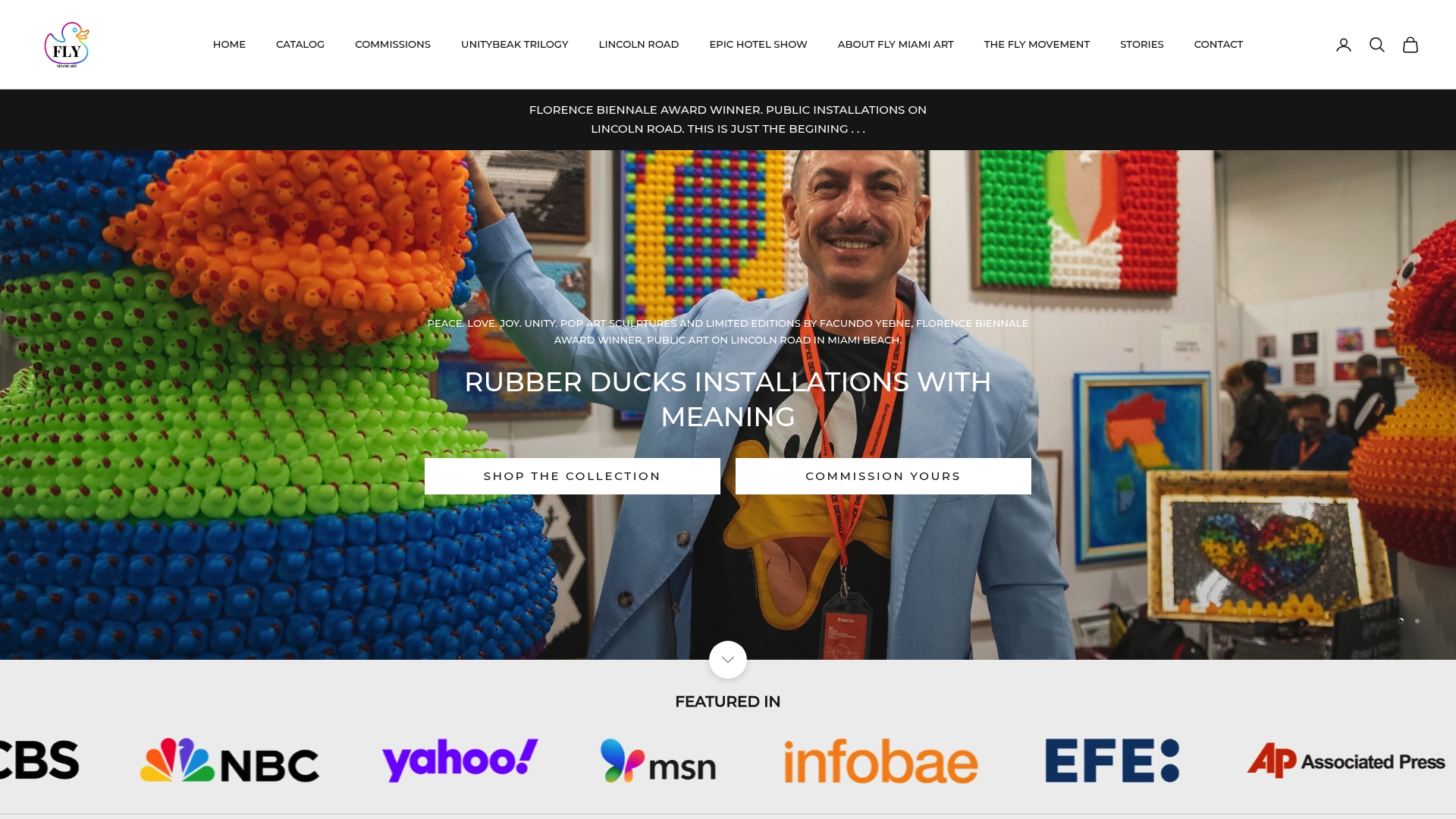
Flymiami’s sculptures, created by award-winning artist Facundo Yebne, are designed from the ground up for public installation. The UV-reactive materials and handcrafted construction make each piece visually striking under both natural and blacklight conditions, and the studio’s process accounts for the physical and sensory accessibility requirements that public placement demands. Whether you are planning a hotel lobby installation, an outdoor plaza commission, or an entertainment venue feature, Flymiami’s sculpture collection includes works sized and engineered for compliant public display.
For professionals sourcing art that meets both aesthetic and regulatory standards, Flymiami’s wall art collection offers mounting-ready pieces with specifications that align with ADA height and protrusion requirements. Every installation comes with the documentation support your compliance file needs.
Key Takeaways
Ensuring accessibility compliance for public sculptures requires integrating ADA technical standards, sensory accessibility, and disability expertise from the earliest design stage through ongoing maintenance.
| Point | Details |
|---|---|
| ADA mounting height | Wall-mounted sculptures generally center between 57 and 60 inches from finished floor, adjusted for specific settings. |
| Protrusion limit | Objects mounted between approximately 27 and 80 inches above floor must not project more than 4 inches into circulation paths. |
| Sensory accessibility | Central sculptures require tactile examination or comprehensive audio description according to Smithsonian guidelines. |
| Inclusive design | Involving disability advocates from project initiation reduces retrofitting risk and improves outcomes. |
| Authority collaboration | Early coordination with ADA compliance officers and arts commissions aligns documentation and surfaces site constraints. |