350+ U.S. Percent for Art Programs: How Artists Win Commissions
Percent-for-art programs set aside a fixed slice of public construction budgets, commonly around 1%, to commission permanent artwork for civic buildings, parks, and infrastructure. Since Philadelphia launched the first ordinance in 1959, the model has spread to more than 350 state, county, and municipal programs across the country. State arts agencies, city cultural affairs departments, and the federal General Services Administration each administer their own version, with percentages typically ranging within typical statutory ranges from about 0.25% to a bit above 1%.
TL;DR:
- Percent-for-art programs typically allocate around 1% of construction budgets for public art, with thresholds usually set at a minimum project cost to trigger funding.
- The most common projects include new construction and major renovations of public buildings, parks, and transit facilities, excluding interior remodels and mechanical upgrades.
- Successful proposals must respond to the site, ensure material durability, incorporate maintenance planning, and meet accessibility standards, often requiring detailed technical documentation.
- Ownership transfers to the public agency after installation, shifting long-term maintenance obligations onto government bodies, which may include conservation, vandalism repairs, and deaccessioning procedures.
- Policy trade-offs involve balancing higher percentages that enable ambitious art commitments against budget scrutiny, with exemptions for small projects and options for pooled or site-specific funding.
Table of Contents
- What Percent-for-Art Funding Actually Pays For
- From Philadelphia to 350-Plus Programs
- How the Formula, Triggers, and Caps Work
- Who Runs These Programs and How Artists Get Selected
- Where to Find State and City Programs
- Preparing a Competitive Proposal
- Who Owns the Work, and Who Pays to Keep It Standing
- Setting the Percentage Right: Policy Trade-Offs
- A Practitioner’s View on What Actually Matters
- Bringing Durable Public Art to Life With Flymiami
- Sources
What Percent-for-Art Funding Actually Pays For
Percent-for-art dollars fund a specific chain of activities: commissioning new work, purchasing existing pieces for public sites, engineering the installation, and later conserving or restoring the piece as it ages outdoors. The money comes out of the same capital budget that pays for a new courthouse, library, transit station, or fire hall, so it moves through government finance offices, not a separate charity fund.
The public-value case behind these programs rests on a few recurring goals:
- Access — putting original art in front of people who would never walk into a gallery.
- Placemaking — giving a plaza, transit stop, or municipal building a visual identity tied to its neighborhood.
- Civic design — treating art as part of the architecture brief, not an afterthought bolted on after construction.
That last point separates percent-for-art from other public funding streams. A program like the NEA’s Grants for Arts Projects awards money competitively to organizations and individual proposals. Percent-for-art is different: it’s a mandatory line item triggered automatically whenever a qualifying capital project gets built, which is why it has grown into such a reliable funding source over six decades.
From Philadelphia to 350-Plus Programs
Philadelphia’s Fairmount Park Art Association pushed through the country’s first percent-for-art ordinance in 1959, tying public art spending to municipal redevelopment for the first time. The idea caught on slowly through the 1960s and 1970s as cities and states adopted their own versions, then accelerated as arts agencies built out professional administrative capacity.
Today, a large number of such programs operate at the municipal, county, and state level, most still built around an approximate 1% allocation. New York City’s program, run by the Department of Cultural Affairs, became one of the most influential city-level models. The federal government took a parallel but separate path: the GSA’s Art in Architecture program predates most municipal ordinances and operates under federal procurement rules rather than state or city statute, historically dedicating around 0.5% of federal building budgets to fine art.
How the Formula, Triggers, and Caps Work
The mechanics vary more than most people expect. Here’s what typically determines whether a project owes money to public art, and how much:
- The percentage itself ranges from 0.25% to 2% of eligible construction costs, with 1% acting as the most common baseline nationally. Lower percentages tend to apply to larger, more expensive projects where 1% would generate an outsized art budget; higher percentages sometimes apply to smaller renovation work where a flat 1% wouldn’t fund a meaningful piece.
- Trigger thresholds set a minimum project cost before the requirement kicks in at all. Many jurisdictions exempt routine maintenance, road resurfacing, or projects below a set dollar floor, so a small parking lot repair usually doesn’t generate an art allocation.
- Qualifying project types usually include new construction and major renovation of public buildings, parks, and transit facilities. Interior remodels or purely mechanical upgrades are often excluded.
- Caps and fee deductions limit how much a single mega-project has to contribute. A billion-dollar transit expansion at a flat 1% would generate an enormous art budget, so many statutes cap total art spending per project regardless of size. Administrative fees, often a modest portion of the allocation, get carved out first to fund the agency running the selection process.
- Private development rules differ sharply from public-project rules. Some cities require private developers to contribute directly, others offer a pay-in-lieu option where developers fund a general public art pool instead of commissioning site-specific work, and some negotiate contributions in exchange for density or height bonuses.
Who Runs These Programs and How Artists Get Selected
Administration falls to whichever government body controls the capital budget in question. State arts agencies run state-level programs, municipal arts commissions or cultural affairs departments run city programs, and the GSA handles federal buildings directly through its own procurement office.
Selection follows a fairly consistent pattern across jurisdictions:
- A request for proposals (RFP) or request for qualifications goes out publicly, often through the administering agency’s website or an existing artist roster.
- A shortlist gets built from submitted qualifications, sometimes narrowed further through interviews or maquette review.
- A peer-review or citizen selection committee, usually mixing artists, architects, and community members, makes the final recommendation.
- The agency finalizes a commission contract that includes fabrication, insurance, and installation terms.
Administrative budgets fund the staff running this process, and a portion of most allocations gets set aside specifically for long-term maintenance rather than spent entirely on the initial commission.
Pro Tip: Ask the commissioning agency directly whether a maintenance reserve exists before you finalize material choices. If there’s no dedicated upkeep budget, your material selection needs to survive decades with zero intervention, which changes the entire engineering conversation.
Where to Find State and City Programs
The most efficient starting point for anyone researching a specific jurisdiction is NASAA’s state-by-state summary, which documents active percent-for-art programs across 27 states and territories along with their statutory triggers and administering agencies. It functions as a central index rather than a single program, which makes it the fastest way to find the actual statute language for a given state.
Beyond the state index, three references cover most of what a researcher needs:
- The GSA Art in Architecture program page details federal practice for anyone working on or bidding into government construction projects.
- New York City’s Department of Cultural Affairs publishes its Percent for Art rules directly, including how the 1% requirement applies to City-funded construction and how commissions get managed.
- Americans for the Arts’ NAAPPD database collects sample municipal ordinances showing how different cities structure their requirements, including private-development provisions.
Names vary by jurisdiction even when the mechanism is nearly identical. “Percent for Art,” “Art in Public Places,” and “Art-in-Architecture” all describe the same basic capital-budget-percentage model under different local branding, so a search for the wrong term can send you looking in the wrong place entirely.
Preparing a Competitive Proposal
Finding the opportunity is the easy part. NASAA’s index, individual city arts agency websites, and the GSA’s own opportunities listings cover most open calls. Winning the commission requires a different kind of preparation than gallery work does.
Selection panels evaluate proposals against a specific set of concerns:
- Site-specific thinking — does the proposal respond to the actual location, or could it be dropped anywhere?
- Durability — will the materials hold up to weather, foot traffic, and decades of exposure without constant intervention?
- Maintenance planning — has the artist thought through what upkeep the piece will need, and who pays for it?
- Accessibility compliance — does the installation meet ADA requirements for placement, clearance, and sightlines?
A strong submission package typically includes scaled drawings, a written installation plan, engineering notes for anything structural, conservation guidance for the specific materials used, proof of insurance, and a realistic fabrication timeline. Multi-stage selection is normal. Expect a qualifications round, a shortlist interview or maquette presentation, and a final contract negotiation, often stretching six months to well over a year from RFP to installation.
Pro Tip: Build your engineering and conservation notes before you submit, not after you’re shortlisted. Panels increasingly weight technical readiness as heavily as concept, especially for outdoor sculpture facing wind load, UV exposure, or high-traffic public handling.
Who Owns the Work, and Who Pays to Keep It Standing
Ownership almost always transfers to the commissioning public agency once installation is complete and accepted. That transfer matters because it also shifts long-term liability and maintenance obligation onto the government body, not the artist.
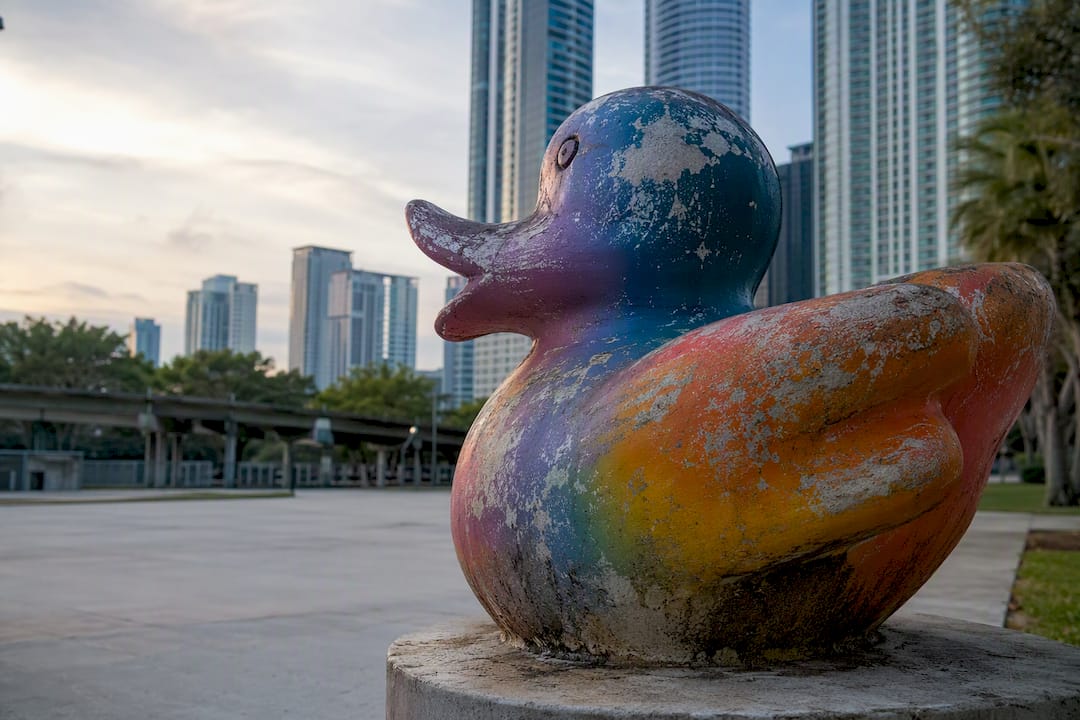
Maintenance funding models vary widely. Some programs build a dedicated reserve into the original appropriation; others fund upkeep out of general operating budgets year to year, which tends to underfund conservation over time. Costs that catch agencies off guard include periodic professional conservation, vandalism repair, and relocation when a building gets renovated or demolished. Well-designed policies build a deaccessioning process into the original ordinance, so there’s a clear legal path for retiring or relocating a piece rather than leaving it in limbo.
Setting the Percentage Right: Policy Trade-Offs
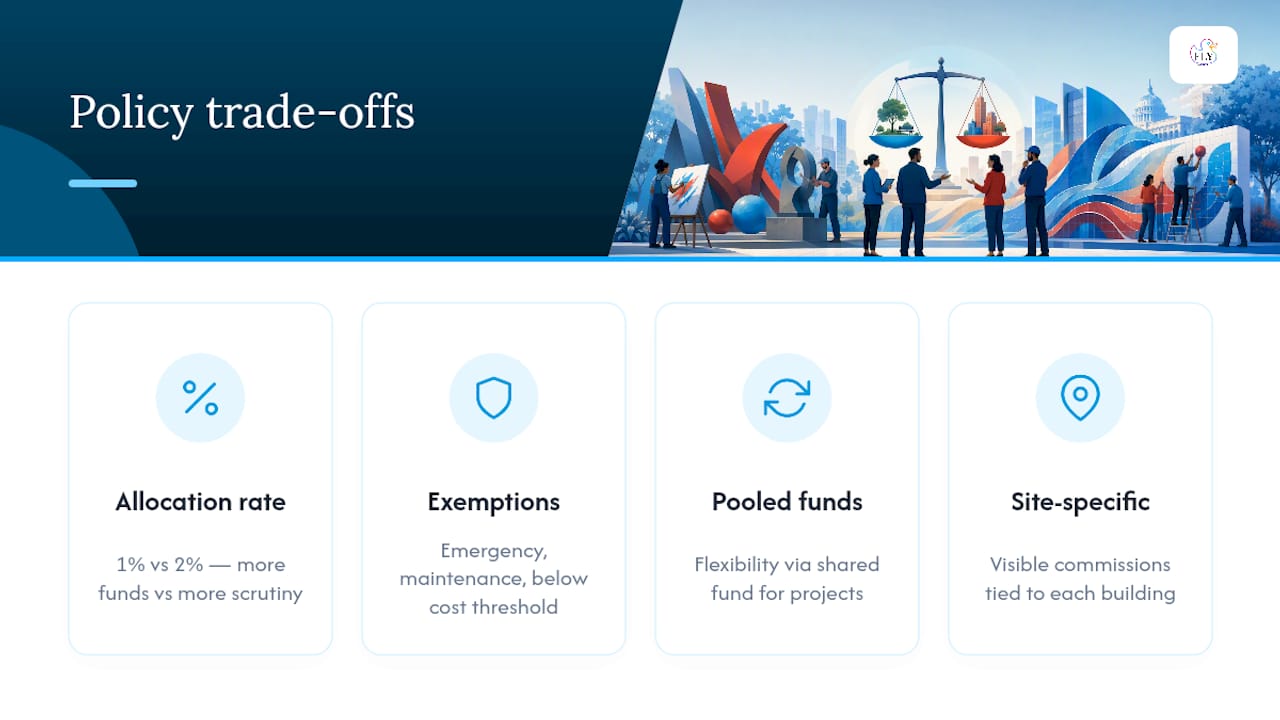
Choosing between a 1% and a 2% allocation isn’t a purely aesthetic decision. Higher percentages fund more ambitious commissions but draw more scrutiny during tight budget years, and some agencies find pooled funds easier to defend politically than a mandatory line item on every single project.
Common exemptions cover emergency repairs, routine infrastructure maintenance, and projects below a minimum cost threshold, all designed to keep the requirement from applying to work where it wouldn’t make practical sense. Administrators also choose between pooling contributions from many small projects into a shared fund versus requiring site-specific commissions on each qualifying project. Pooled funds offer flexibility; site-specific commissions guarantee visible results tied directly to the building that generated the money. Private-developer mechanisms add another layer, with mandatory contribution, pay-in-lieu, and negotiated design-integration options each shifting cost and creative control differently between developer and artist.
A Practitioner’s View on What Actually Matters
Facundo Yebne, the artist behind Flymiami, has spent years designing large-scale sculptural work meant to hold up outdoors and engage the public directly, the same fundamentals that make or break a percent-for-art commission. Public work isn’t gallery work. A piece has to survive weather, vandalism, and decades of foot traffic while still landing visually with people who never chose to see it. That distinction should shape every proposal an artist submits, and it’s worth building into any commission conversation from the first sketch.
— Facundo
Bringing Durable Public Art to Life With Flymiami
If a percent-for-art allocation, private developer requirement, or civic redevelopment budget has landed on your desk, Flymiami builds the kind of engineered, site-ready sculptural work that survives outdoor installation and still stops people in their tracks. Unlike a standard fabrication shop, Flymiami’s UV-reactive pop art sculptures create a piece that reads one way in daylight and reveals an entirely different layer after dark, which gives a plaza, lobby, or public plaza two distinct visual identities from a single commission.
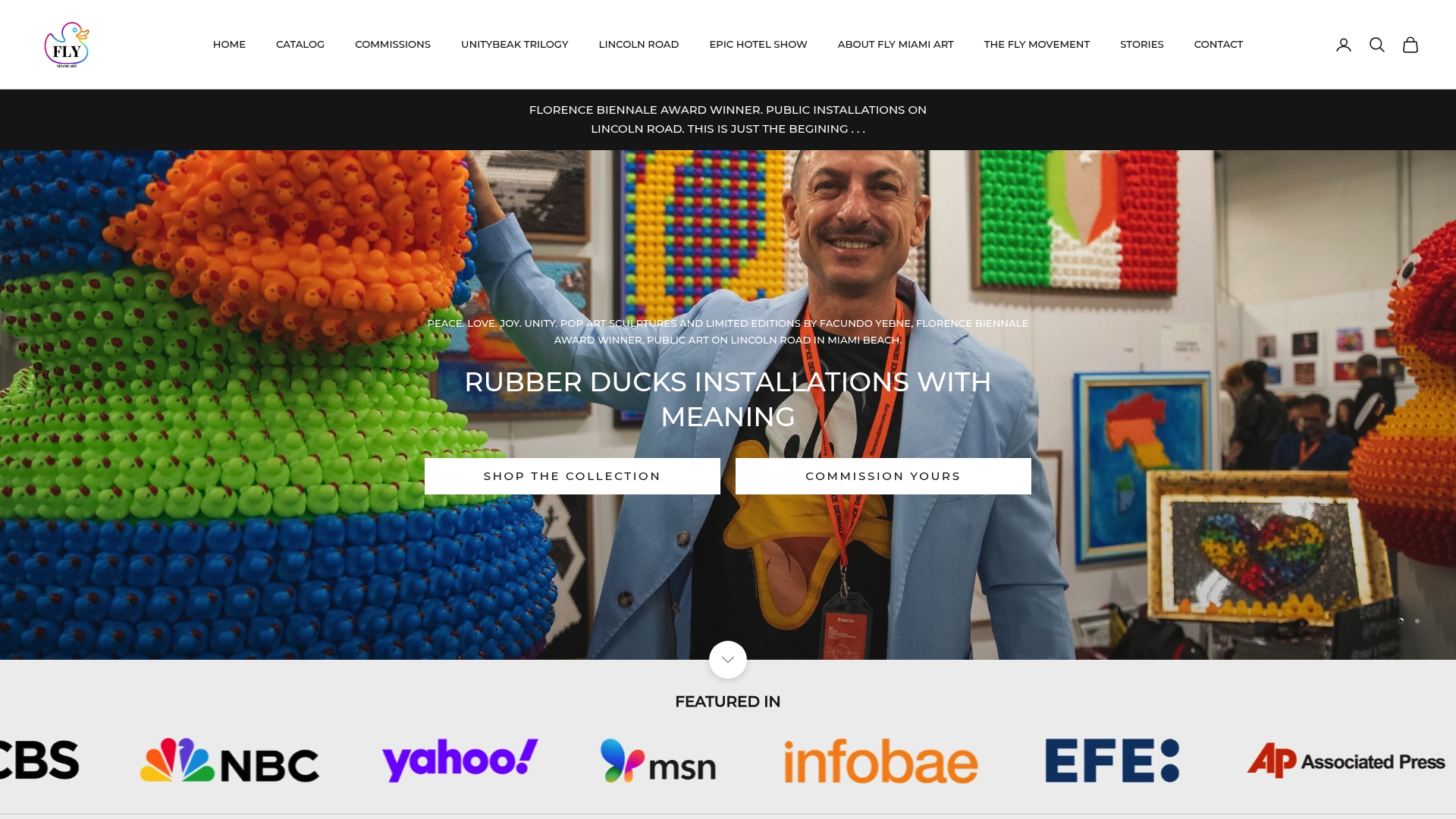
Facundo Yebne’s studio has handled commissions for hotels, brands, and private collectors that require the same durability and installation planning a public-art committee expects: engineering sign-off, conservation-ready materials, and a fabrication timeline built around real-world deadlines. Browse the sculpture collection to see the scale and material range available, or reach out directly to discuss a custom public commission and get a quote built around your project’s timeline and budget.
Sources
- Percent for Art (Arts & Planning Toolkit)
- GSA Art in Architecture
- Percent for Art Ordinances (Americans for the Arts NAAPPD)