For Commissioners: Site Specific Sculpture, UV Materials and 5 Steps
A site-specific sculpture is a work made for one location, where the setting is part of the meaning rather than a backdrop for it. Move the piece, and you lose something the artist built into it on purpose. Robert Smithson’s Spiral Jetty and Richard Serra’s Tilted Arc are the two examples most often cited to explain the idea. What follows covers the movement’s history, its materials, how commissions actually get built, and what happens to a work’s meaning when institutions try to move it.
TL;DR:
- Moving a site-specific sculpture destroys its meaning because its form, concept, and scale are directly tied to the original location.
- Properly designed outdoor site-specific works must consider climate, site conditions, and maintenance needs; materials like fused glass or stainless steel offer long-lasting durability.
- Public commissions require thorough site analysis, stakeholder approval, and structural engineering, with many works built specifically for their context before installation.
- Relocating a site-specific sculpture often damages its conceptual and aesthetic essence, though documentation can help preserve its intent if movement is unavoidable.
- Artists integrate sculptures into a site through visual harmony, conceptual relevance, and lighting, tailoring form and meaning to the unique history and environment of the location.
Table of Contents
- What Defines a Site-Specific Sculpture?
- Where Did Site-Specific Sculpture Come From?
- Four Case Studies That Define the Movement
- What Materials Hold Up Best for Outdoor Sculpture?
- How Does a Site-Specific Sculpture Commission Actually Work?
- What Happens to a Sculpture’s Meaning When It’s Moved?
- Legal and Ethical Considerations in Site-Specific Sculpture
- Site-Specific vs. Site-Responsive Sculpture: What’s the Difference?
- How Do Artists Integrate Sculpture Into a Site?
- A Practitioner’s View From FLY Miami Art’s Studio
- Why Site-Specific Thinking Still Matters for Public Space
- Commission a Sculpture Built for Its Site
- Sources
What Defines a Site-Specific Sculpture?
The core test is simple: does the sculpture’s meaning depend on where it stands? The Getty Museum’s education curriculum defines it plainly. A site-specific sculpture is created with a specific location in mind, and removing it strips away a substantial part, or all, of what it communicates. The Tate uses nearly identical language in its own glossary, which tells you this isn’t a fringe interpretation. It’s the working consensus among major art institutions.
A few features tend to show up across genuinely site-specific works:
- Scale determined by the site. The sculpture’s size answers to the landscape, room, or plaza it occupies, not a gallery-standard footprint.
- Environmental interaction. Weather, tide, sunlight angle, or foot traffic patterns become part of how the piece reads.
- A fixed relationship with the audience. Viewers approach the work the way the location dictates, not however a curator arranges a room.
- Conceptual dependency. The work often comments on the history, function, or politics of the ground it occupies.
Carsten Höller’s Test Site at Tate Modern shows this well. He built the piece around the specific volume and industrial history of the Turbine Hall itself, not a generic large room.
Where Did Site-Specific Sculpture Come From?
The term took shape in the late 1960s and 1970s, when a cluster of American and European artists pushed back against the idea that art had to be a portable object you could sell, ship, and hang anywhere. National Galleries Scotland’s glossary frames this as an explicit critique of commodification: if a sculpture can’t be separated from its ground, it can’t be flipped like a painting at auction.
The shift happened in a few overlapping moves:
- Land and earthworks. Artists moved into deserts, lakebeds, and quarries, building work directly from the material of the site.
- Institutional critique. Others turned the gallery itself into the subject, using architecture, lighting, and circulation as raw material.
- Terminology consolidation. Through the 1970s, critics and practitioners refined “site-specific” into the term now used by museums and universities, as documented in general reference histories of the movement.
Robert Smithson and Richard Serra became the two names most associated with pushing this idea into public consciousness, largely because both artists were willing to fight, publicly, over what happened when their work was threatened or removed.
Four Case Studies That Define the Movement
Some works explain the concept faster than any definition. These four keep showing up in academic and museum discussions for good reason.
- Spiral Jetty (1970). Robert Smithson built a large coil of black basalt rock and earth into the Great Salt Lake in Utah. The site’s mineral content turns the water pink under certain conditions, and the jetty submerges and resurfaces depending on lake levels. Move this sculpture and you don’t have a Smithson anymore. You have a pile of rock.
- Tilted Arc (1981). Richard Serra installed a tall curved steel wall across Federal Plaza in New York. It split the plaza and forced pedestrians to walk around it, which was the entire point: making people physically feel the government presence in the space. Public backlash led to its removal in 1989, over Serra’s objection.
- Test Site (2006). Carsten Höller filled Tate Modern’s Turbine Hall with five slides descending through the building’s full height, turning an exhibition hall into something between a playground and an architectural experiment.
- 6 TIMES (2010). Antony Gormley placed six identical cast iron body forms along the Water of Leith in Edinburgh, from the harbor mouth inland into the city. The same figure repeated across a coastal to urban gradient picks up different meaning at each stop, from tidal exposure to street-level anonymity.
Pro Tip: When researching a case study, always ask what specifically would be lost if the piece were relocated. That question separates genuine site-specificity from a sculpture that merely happens to sit outdoors.
What Materials Hold Up Best for Outdoor Sculpture?
Material choice in outdoor sculpture is a trade-off between how long a color lasts and how much upkeep a studio and client are willing to commit to over decades. A useful way to think about it: match exposure level, desired color permanence, structural load, and maintenance budget before picking a material, rather than picking a material and hoping it fits the site.
- Stainless steel resists corrosion well and needs little maintenance, but its palette leans toward brushed metallics rather than saturated color.
- Bronze ages into a patina that many clients want, though achieving a specific color requires ongoing chemical treatment.
- Fused glass and porcelain enamel hold saturated color far longer outdoors than paint or vinyl graphics, since the pigment is fired into the surface rather than applied on top of it, according to a fabrication materials guide from Winsor Fire Form.
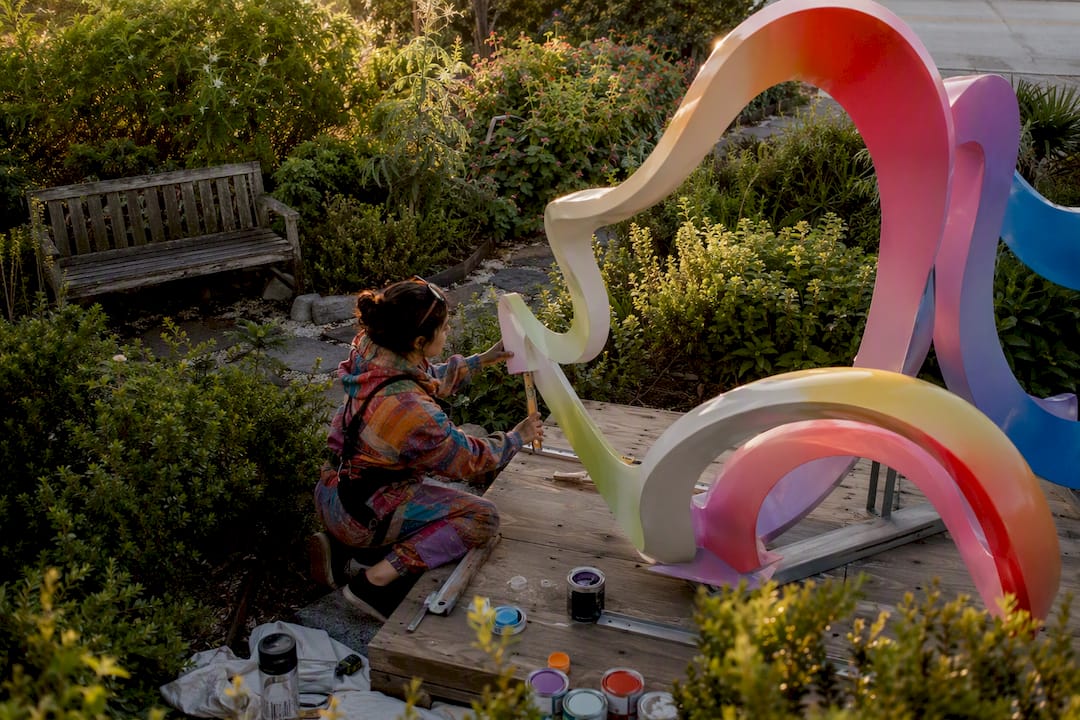
- Fiber-reinforced polymer (FRP) is lightweight and good for complex shapes, but it needs UV-stable coatings to avoid fading.
- Concrete handles structural load well and suits large-scale forms, at the cost of a limited color range without added treatments.
Pro Tip: If the design calls for bold, saturated color that has to survive years of direct sun and salt air, budget for fused architectural systems rather than paint. It costs more upfront and saves the client a repaint cycle every few seasons.
How Does a Site-Specific Sculpture Commission Actually Work?
Turning a concept into an installed piece follows a fairly consistent sequence, even though every site brings its own complications.
- Site analysis. Study access routes, sightlines, sun and wind exposure, soil or foundation conditions, and how the microclimate might affect material choice.
- Stakeholder mapping. Identify the landowner, permitting authority, funding body, and the surrounding community, since public commissions especially need buy-in from all of these before fabrication starts.
- Design development. Build maquettes and full-scale mockups to test proportion and material against the actual site conditions.
- Engineering sign-off. Get structural review for load, wind resistance, and foundation requirements before anything ships.
- Installation planning. Document rigging, access logistics, and a maintenance schedule so the piece survives contact with its environment.
What Happens to a Sculpture’s Meaning When It’s Moved?
Richard Serra argued directly that removing a site-specific work can destroy the piece entirely, a position he defended through years of litigation over Tilted Arc. His argument wasn’t sentimental. The sculpture was engineered for one plaza’s dimensions and foot traffic, and no other location reproduces that relationship.
When physical relocation is unavoidable, some institutions treat the original installation as a score, a documented set of choreography, sightlines, and technical parameters that a future team can use to restage the work with fidelity, an approach detailed by the Art Institute of Chicago. It’s an imperfect substitute for the original site, but it preserves intent better than simply hauling the object somewhere new and calling it the same piece.
Legal and Ethical Considerations in Site-Specific Sculpture
Tilted Arc’s removal remains the reference case for a reason: it exposed a real conflict between an artist’s authorial rights and a public body’s authority over its own property. Serra had a federal commission and a signed contract, yet the General Services Administration removed the work anyway after years of public complaint. Courts sided with the government, ruling that federal ownership of the site overrode Serra’s objections.
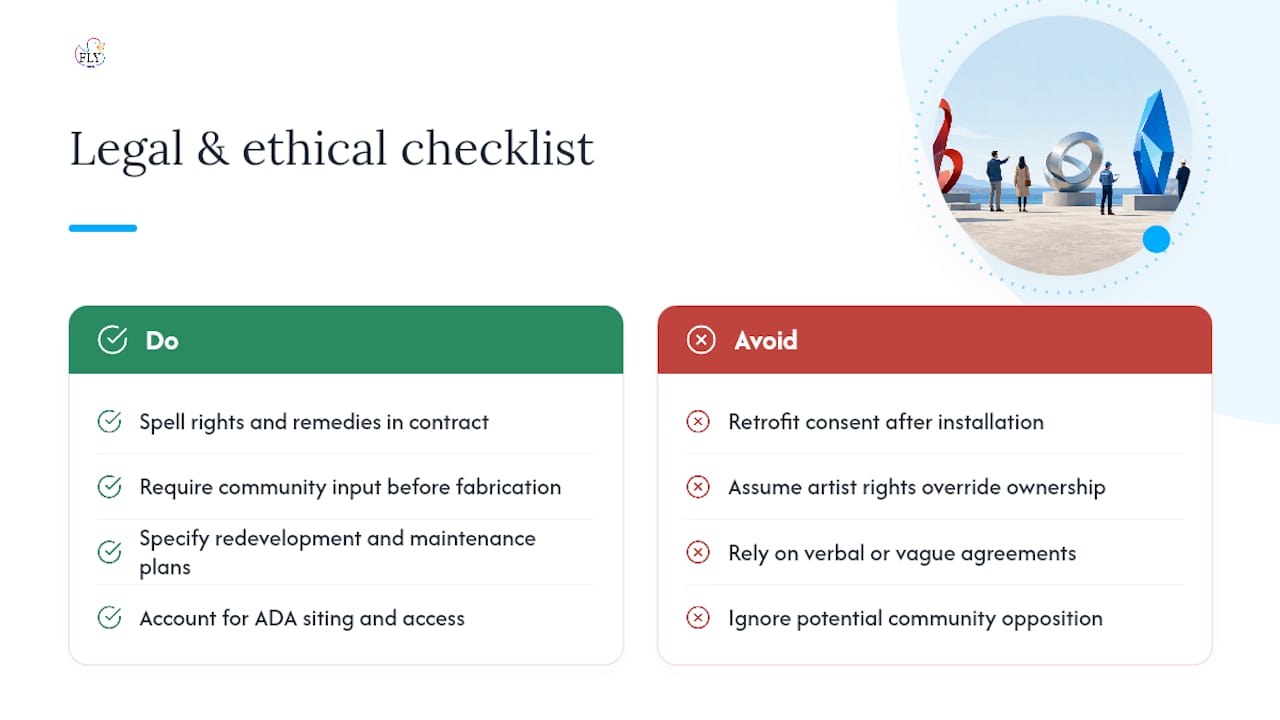
That tension shows up in nearly every serious public commission. A landowner or municipality typically retains legal ownership of the physical object, even when the artist retains moral rights over how it’s presented or altered. Contracts should spell out what happens if a site is redeveloped, if maintenance lapses, or if community opposition mounts after installation, since these disputes rarely get resolved cleanly once they start.
There’s also an ethical dimension tied to the community itself. A sculpture installed in a public plaza, waterfront, or neighborhood square affects people who never asked to live with it. Responsible commissioning processes build in community input before fabrication, not after installation, precisely because retrofitting consent after the fact tends to produce the kind of standoff that ended with Tilted Arc in a scrapyard. Accessibility law adds another layer: public sculptures in the United States generally need to account for ADA compliance in how they’re sited and approached, which shapes everything from base height to surrounding pathway width.
Site-Specific vs. Site-Responsive Sculpture: What’s the Difference?
The two terms get used interchangeably more often than they should, and the distinction matters for how a piece is designed and how it survives relocation.
A site-specific sculpture is conceived for one location and, per both the Getty and Tate definitions, loses much of its meaning if moved. Spiral Jetty can’t exist anywhere but the Great Salt Lake. The work’s form, material, and concept all derive from that exact ground.
A site-responsive sculpture, by contrast, is designed with enough flexibility to adapt its presentation to different environments while keeping its core concept intact. The underlying idea travels, even when the physical execution shifts to suit a new plaza, park, or building. A studio might design a modular piece that reads differently in a coastal setting than in an urban courtyard, adjusting scale or orientation each time, without the work losing its identity.
The practical difference shows up at the commissioning stage. Site-specific work demands exhaustive site research before design even starts, since the site is the design brief. Site-responsive work allows more standardized fabrication with site-tailored installation details layered on afterward. Neither approach is inherently better. They solve different problems: one prioritizes irreplaceable connection to a single place, the other prioritizes adaptability across a portfolio of locations. Knowing which category a commission falls into early prevents a lot of wasted design work later.
How Do Artists Integrate Sculpture Into a Site?
Integration happens on two levels: what the eye sees and what the mind understands, and strong site-specific work handles both at once.
Visually, artists read the site’s existing geometry first. A plaza with strong sightlines toward a building entrance might call for a piece that frames or redirects that view rather than blocking it. A coastal site invites forms that echo tidal rhythm or wind exposure, the way Gormley’s 6 TIMES used repetition along a shoreline to register that gradual shift from harbor to city street. Height and scale get calibrated to the sightline distance a viewer will actually experience, not an abstract “large” or “small.”
Conceptually, the strongest integrations respond to a site’s history or function rather than merely occupying its footprint. Serra’s Tilted Arc worked because it commented on the plaza’s role as a government thoroughfare, forcing a physical negotiation with authority that most people walk past without noticing. A sculpture installed in a hotel lobby, a waterfront park, or a corporate courtyard each calls for a different conceptual anchor: hospitality and welcome in one setting, ecological rhythm in another, civic identity in a third.
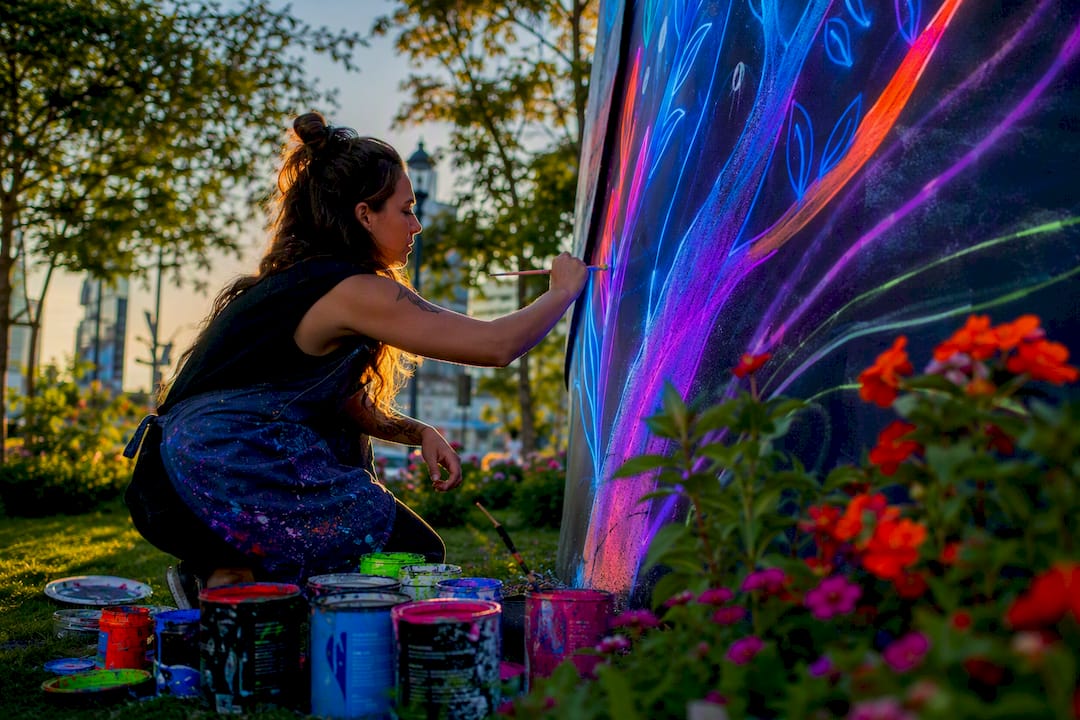
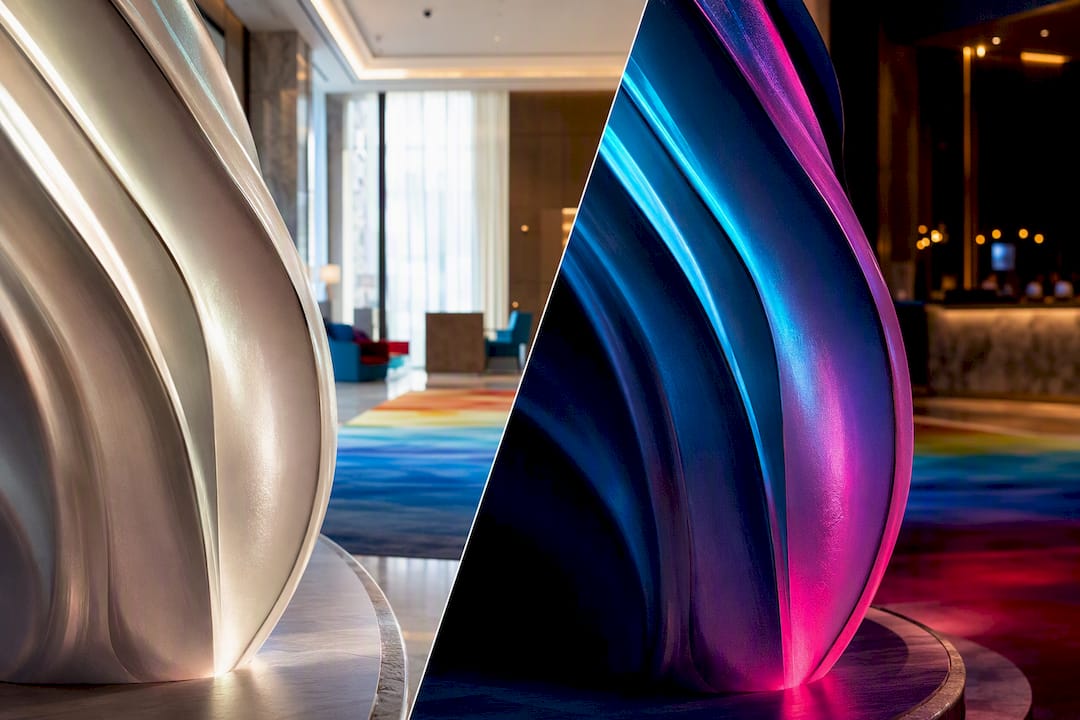
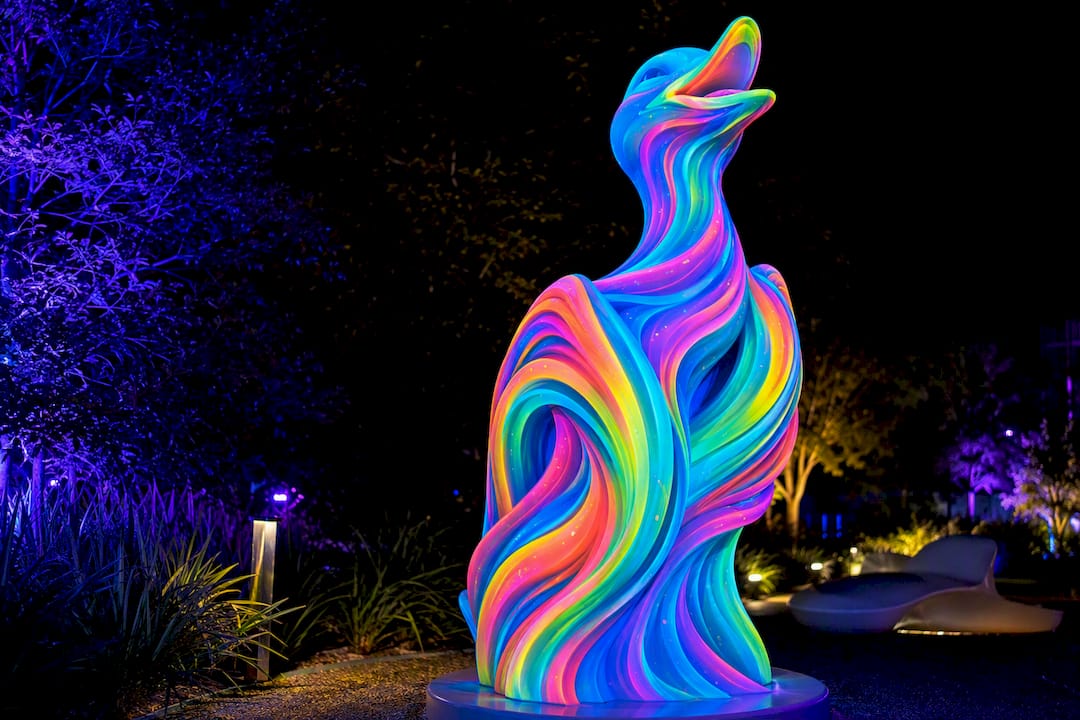
Lighting plays a bigger role in this integration than most people expect. Outdoor art lighting design determines whether a piece reads as a daytime object only or continues to function after dark, and public art lighting design increasingly incorporates programmable or reactive elements that change the work’s presence by time of day. Materials that respond to UV light extend that idea further, giving a sculpture a second visual identity under blacklight or ambient UV exposure that daytime viewing never reveals.
A Practitioner’s View From FLY Miami Art’s Studio
At Flymiami, translating site research into a finished piece starts with the same fundamentals covered above: understanding light exposure, sightlines, and how people will actually move around the work.
- Site visits and maquette development precede any material commitment.
- Materials testing includes trials with UV-reactive pigments to see how a piece performs under both daylight and blacklight conditions.
- Every commission balances structural permanence against how much the audience gets to physically or visually interact with the piece.
- The studio’s documented fabrication process keeps the client’s original brief intact from maquette through final installation.
Why Site-Specific Thinking Still Matters for Public Space
Placemaking succeeds when a sculpture makes people notice where they’re standing, not just what they’re looking at. That’s the whole inheritance from Smithson and Serra, and it still shapes how a good commission gets designed today. Readers looking for a deeper practitioner angle on this can check Flymiami’s writing on placemaking practice.
— Facundo
Commission a Sculpture Built for Its Site
Flymiami designs sculptures around the exact space they’ll occupy, pairing UV-reactive materials with durable outdoor fabrication so a piece reads one way in daylight and reveals something entirely different under blacklight after dark. That dual identity gives collectors, hotels, and public art clients a piece that keeps rewarding attention long after installation day.
Every commission starts with a site consultation covering exposure, sightlines, and structural needs, the same process outlined above, before any material gets fabricated. Facundo Yebne’s studio has built pieces for private collectors, commercial spaces, and public installations, each one calibrated to the light, foot traffic, and story of its specific location. Browse the current sculpture collection to see available pieces, or reach out to start a commission built around your site from the ground up.
Sources
- Getty: Sculpture background (site-specific definition)
- Tate: Site-specific
- Art21: Site-Specific
- Art Institute of Chicago: Staging site-specific installation art in a museum context