U.S. Collectors: What to Document for Sculpture Insurance Appraisals
Get a USPAP-compliant replacement-value insurance appraisal with professional photos and a signed report. This is what establishes the coverage amount your insurer will honor and what speeds up a claim if a piece is damaged, lost, or stolen. For sculptures valued near or above $50,000, an on-site inspection and closer attention to IRS substantiation standards matter more than for smaller pieces.
TL;DR:
- Replacement-value appraisals for sculptures over $50,000 require on-site inspection and detailed documentation to meet IRS and insurer standards.
- USPAP compliance is essential, with appraisers usually affiliated with recognized organizations like the Appraisers Association of America or the International Society of Appraisers.
- An appraisal involves inspection, research of comparable sales, and a signed report that includes detailed descriptions, condition notes, provenance, and photographs.
- Costs typically range from flat fees to hourly rates, with in-person appraisals costing more due to travel and detailed inspections, and online options offering faster, lower-cost estimates.
- High-value sculptures need thorough provenance and materials documentation, especially for mixed-media or UV-reactive pieces, including photos under normal and blacklight conditions.
Table of Contents
- What an insurance appraisal is and how it differs from fair market value
- Why insurers require documented appraisals
- Who is qualified to appraise a sculpture and which standards matter
- How the appraisal process works for sculpture
- Typical costs and timing for sculpture insurance appraisals
- How to find and vet an appraiser for your sculpture
- Documenting UV-reactive and mixed-media sculpture for an appraisal
- Where FLY Miami fits into your appraisal documentation
- Primary sources and official guidance worth consulting
- Sources
- FAQ
What an insurance appraisal is and how it differs from fair market value
An insurance appraisal estimates what it would cost to replace your sculpture with a comparable piece at current retail or gallery prices. Appraisers call this replacement value, and it is almost always higher than what the piece would sell for on the open market, because retail replacement accounts for dealer markups, sourcing time, and the difficulty of finding an equivalent work.
Fair market value (FMV) is a different number entirely. FMV reflects what a willing buyer would pay a willing seller in an arm’s length transaction, and it is the figure used for estate planning, charitable donation deductions, and divorce settlements. Insurers do not use FMV to set coverage, so a report prepared for tax purposes usually will not satisfy an underwriter.
Collectors sometimes need both reports for the same piece:
- A donated or inherited sculpture may require an FMV appraisal for the IRS and a separate replacement-value appraisal for the policy that covers it in the meantime.
- A commissioned piece purchased directly from an artist or studio may only need replacement value, since there is no prior sale to benchmark against.
- A piece acquired at auction can sometimes use the hammer price as a starting point, but insurers still prefer a current replacement-value opinion rather than a historical sale figure.
Ask any appraiser you hire which valuation standard they are using before the engagement begins, and make sure it matches what your insurer or your tax advisor actually requested.
Why insurers require documented appraisals
Insurance carriers want a defensible record of what a sculpture is, what condition it was in, and what it would cost to replace. Without that record, a claim adjuster has nothing to compare against after a loss, which slows settlement and invites disputes over value.
Appraisals create a record insurers can act on fast. Chubb’s guidance on insuring fine and decorative art states that appraisals establish a defensible record of existence and condition, which lets insurers settle claims more quickly when something goes wrong.
Carriers generally weigh a few things when they review a submitted appraisal:
- Whether the report documents pre-loss condition in enough detail to compare against post-loss damage.
- Whether the valuation methodology relies on real comparable sales rather than guesswork.
- Whether the appraiser is independent and has no financial stake in the sculpture’s final value.
Chubb also notes that not every policy requires a formal appraisal for lower-value pieces, but higher-value or individually scheduled items typically do. A photo-documented, signed report gives the adjuster a baseline to work from the moment a claim is filed, which is often the difference between a settlement in weeks versus one that drags on for months.
Who is qualified to appraise a sculpture and which standards matter
Not every appraiser is equipped to value sculpture, and not every valuation will satisfy an insurer. The standard that matters most is USPAP, the Uniform Standards of Professional Appraisal Practice, which governs how appraisers research, document, and report value across the United States. An insurer reviewing a claim will almost always expect a USPAP-compliant report, because it follows a consistent methodology that can be defended if challenged.
Membership in a recognized professional body is a practical signal that an appraiser meets those standards. Look for:
- The Appraisers Association of America, which maintains a directory of specialists and promotes USPAP compliance among its members.
- The International Society of Appraisers (ISA), which certifies appraisers across personal property categories including sculpture and mixed media.
- The Appraisal Foundation, which authors and updates USPAP itself.
For sculptures valued at $50,000 or more, the IRS Art Appraisal Services (AAS) and Revenue Procedure 96-15 become relevant even outside a tax context, because they define the level of detail and substantiation that a formal appraisal review expects. Insurers covering high-value pieces often look for reports that would also pass IRS scrutiny, since the documentation standard is effectively the same.
Pro Tip: Ask any prospective appraiser for their USPAP certification date and a sample report before you hire them, not after.
How the appraisal process works for sculpture
A proper appraisal engagement starts with scope, not with a number. The appraiser should put the intended use in writing, insurance scheduling, FMV for tax purposes, or something else, since that choice shapes the entire report.
- Scope and engagement letter. The appraiser defines intended use, fee structure, and timeline before any inspection happens.
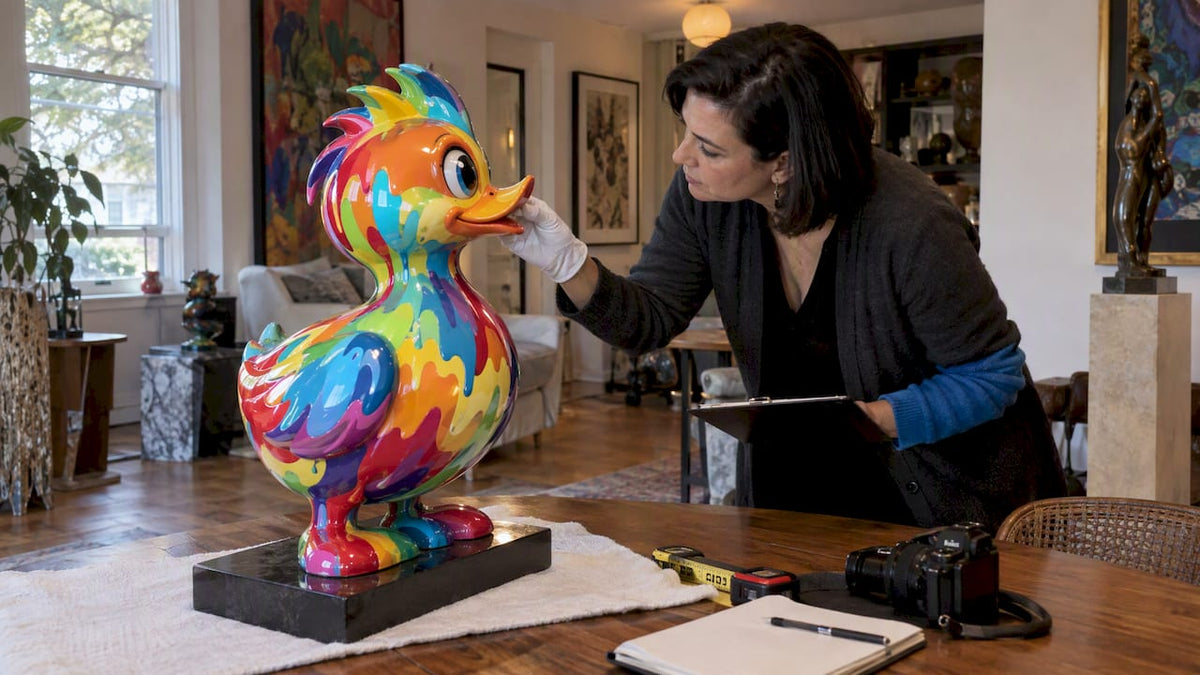
- Inspection. Three-dimensional works with multiple sides, mixed materials, or moving parts generally need an on-site inspection rather than a photo-only review, especially for larger or structurally complex pieces.
- Research. The appraiser pulls comparable sales, exhibition history, and the artist’s market standing to support the value conclusion.
- Report drafting. Dimensions, materials, condition, provenance, methodology, and comparables all get documented in a single itemized report.
- Delivery. The final report includes a signed USPAP statement and is formatted for direct submission to your insurer.
A photo-based appraisal can work for smaller or lower-value sculptures when the appraiser has enough reference images to judge materials and condition accurately. IRS guidance under Publication 5497 outlines the photographic standard that serious appraisals should meet: multiple angles, close-ups of any signature or maker’s mark, and clear shots of any damage or repair.
A complete insurer-ready report typically includes:
| Report element | What it covers |
|---|---|
| Item description | Title, artist, medium, edition number if applicable |
| Dimensions and materials | Height, width, depth, base materials, any mixed media |
| Condition notes | Current state, prior repairs, structural concerns |
| Provenance | Purchase records, prior ownership, exhibition history |
| Methodology and comps | Comparable sales data and how value was derived |
| Signed USPAP statement | Appraiser’s certification of compliance |
| Photographs | Multiple angles, signature, any damage or wear |
Typical costs and timing for sculpture insurance appraisals
Appraisal fees usually follow one of two models: a flat fee per item or an hourly rate, with hourly work more common for complex, multi-piece collections. Flat fees tend to run higher for sculpture than for flat works like paintings or prints, since three-dimensional pieces often take longer to inspect and photograph from every angle.
Avoid any appraiser who charges a percentage of the appraised value. That fee structure creates an incentive to inflate the number and violates the conflict-of-interest guidance built into USPAP.
A few cost and timing factors worth knowing before you book an appraisal:
- Photo-based appraisals for mid-value sculptures are generally faster and cheaper than full on-site reports.
- On-site comprehensive appraisals cost more because they include travel, inspection time, and often more extensive comparable research.
- Multiple pieces appraised in a single engagement usually cost less per item than single, standalone appraisals.
Online platforms such as Mearto often promise turnaround within 48 hours for straightforward sculpture valuations, while comprehensive in-person reports from independent appraisers can take anywhere from one to six weeks depending on research complexity and the appraiser’s schedule.
How to find and vet an appraiser for your sculpture
Start with the Appraisers Association of America directory if you want a vetted, credentialed appraiser with sculpture experience. Auction houses often have in-house specialists who can also perform or refer appraisals, and some insurers maintain their own referral lists of appraisers they already trust. Online platforms like Mearto offer a faster, lower-cost path for mid-value pieces, though a high-value sculpture scheduled on a policy usually still needs a signed, USPAP-compliant report rather than a quick online estimate.
Before hiring anyone, ask these questions:
- Are you USPAP-compliant, and can you show a current certification?
- Do you have specific experience appraising sculpture or mixed-media work?
- Can I see a sample report with the sections you typically include?
- Have insurers accepted your reports before, and which carriers?
- What is your fee structure, and is travel included for on-site inspection?
- What is your typical turnaround time from inspection to final report?
Red flags to walk away from include a fee tied to a percentage of value, no written engagement letter, no sample report available, and an inability to explain how comparable sales were chosen. A reputable appraiser will welcome every one of these questions.
Pro Tip: Build your documentation packet, photos, provenance, purchase records, before you contact an appraiser. It shortens the engagement and often lowers the fee.
Documenting UV-reactive and mixed-media sculpture for an appraisal
Sculptures built from mixed media or UV-reactive materials need documentation that general appraisal guides rarely mention. A piece that uses blacklight-reactive pigments looks completely different under standard gallery lighting than it does under UV, and an appraiser who only sees one version of the work is missing half the story.

A complete materials list matters here more than with traditional sculpture: resin types, pigment categories, any embedded lighting components, and how the piece is meant to be displayed. Condition notes should cover both states, how the surface holds up under normal light and whether the UV-reactive elements still glow as intended, since pigment degradation over time is a real condition issue specific to this medium.
Photographing glow and UV-reactive work for an appraisal means shooting it twice: once under neutral white light for accurate color and surface detail, and once under blacklight to document the reactive effect itself. Our guide to sculpture lighting covers the angles and color rendering that produce usable appraisal photos rather than snapshots. For commissioned or exhibited contemporary sculpture, provenance records, exhibition history, and any conservator notes carry more weight than they would for an older, more established work, since there is less of a public sales record to draw on. Our piece on what makes pop sculpture valuable walks through how that history gets built and used.
— Facundo
Where FLY Miami fits into your appraisal documentation
If you own or are considering a pop art sculpture with UV-reactive features, provenance records, purchase documentation, and high-resolution photography can help an appraiser produce a clean insurance report. Artwork authenticity and related documentation matter as much as the artwork itself.

Collectors commissioning custom glow pieces can obtain documentation detailing materials, UV pigment specifications, and photos under both standard and blacklight conditions, providing useful detail for appraisals of mixed-media work. If you already own a piece and need supplementary photos or records for an appraisal in progress, reach out through our commission page and we will put together what you need. Browse the current sculpture collection if you are considering adding a documented, insurable piece to your collection, or start a custom glow piece built with your appraisal needs in mind from day one.
Primary sources and official guidance worth consulting
For tax substantiation on sculptures valued at $50,000 or more, go directly to the IRS Art Appraisal Services page and Revenue Procedure 96-15. For appraiser standards and directories, the Appraisers Association of America is the most direct resource. For insurer expectations, Chubb’s fine art guide lays out what carriers look for in practical terms. For fast, lower-cost valuations on mid-value sculpture, Mearto offers an online alternative, though high-value scheduled pieces still benefit from a full USPAP-compliant report. Collectors handling their own sale documentation can also review Noirci Studio’s artist terms for how provenance and seller records are typically structured.
Sources
- Mearto — Sculpture appraisal
- Art appraisal services | Internal Revenue Service
- Chubb Guide to insuring your fine and decorative art
- Appraisers Association of America — About us
FAQ
How much does an art appraisal typically cost?
Costs vary by appraiser and whether the engagement is flat fee or hourly, with sculpture generally costing more than flat work due to multi-angle inspection and photography. Avoid any appraiser who charges based on a percentage of the appraised value, since that structure creates a direct conflict of interest.
How do you determine the insurance value of artwork?
Insurance value, or replacement value, is determined by a qualified appraiser researching comparable sales and current retail or gallery prices for equivalent work. This figure is typically higher than fair market value because it accounts for the real cost of sourcing a replacement piece.
How does an insurance appraisal work?
An appraiser inspects the sculpture on-site or reviews detailed photographs, researches comparable sales and the artist’s market standing, then delivers a signed, USPAP-compliant report with dimensions, condition notes, and a replacement-value conclusion. Insurers use that report setting the coverage amount on your policy and as a reference point if you ever file a claim.
How do I find out how much my artwork is worth?
Start with a qualified appraiser from a directory like the Appraisers Association of America, or use a reputable online platform such as Mearto for a faster estimate on mid-value pieces. For insurance purposes, insist on a signed, USPAP-compliant report rather than an informal estimate, especially for higher-value sculpture.