Pop Art Cultural Commentary Pieces: Collector's Guide
From Andy Warhol’s Campbell’s Soup Cans to Claes Oldenburg’s monumental soft sculptures, the most compelling examples of pop art cultural commentary pieces use everyday imagery to expose how consumer culture shapes identity, desire, and value. Contemporary studios like Flymiami extend that tradition with UV-reactive sculptures that literally change under light, adding a performative dimension earlier Pop artists could only suggest.
Standout examples at a glance:
- Andy Warhol, Campbell’s Soup Cans (1962) — a series of hand-painted canvases displayed on gallery shelves like grocery products; critiques mass consumption and the fine-art/commodity boundary
- Roy Lichtenstein, Masterpiece (1962) — comic-book speech balloon satirizes how publicity manufactures artistic value
- Roy Lichtenstein, Whaam! (1963) — diptych re-presenting combat as comic-book spectacle; questions media desensitization to violence. The Tate purchased it in the 1960s after trustee deliberation over whether it qualified as fine art.
- Claes Oldenburg, The Store (1961) — storefront selling plaster-covered muslin sculptures; blurs the gallery/shop line
- James Rosenquist, F-111 (1964–65) — monumental canvas juxtaposing military hardware with consumer goods
- Robert Rauschenberg, assemblage works (1950s–60s) — cultural patchwork combining found objects and mass-media imagery
- Melesio Casas, Humanscape 62 (1970) — confronts racist advertising mascots and media stereotyping of Chicano identity
- Flymiami / Facundo Yebne, UV-reactive rubber duck series — Pop iconography that reveals hidden patterns under blacklight, extending commentary on joy, peace, and consumer symbolism
“Pop artists oscillated between celebrating consumer abundance and critiquing the dehumanizing effects of media-saturated capitalism; they functioned as nuanced commentators rather than single-minded celebrators or detractors.” — TheCollector
Table of Contents
- Canonical Pop Art works and what each specifically comments on
- How Pop Art actually works as cultural commentary
- Sculptures and interactive works that force you to engage
- What collectors should evaluate before buying Pop Art sculptures
- FLY Miami Art and Facundo Yebne: UV-reactive Pop Art in practice
- Key Takeaways
- Why UV light changes what Pop Art can say
- Acquire a UV-reactive Pop Art sculpture from Flymiami
- Useful sources and further reading
Canonical Pop Art works and what each specifically comments on
These case studies cover the cultural critiques embedded in major works, with exhibition context collectors can verify.
-
Andy Warhol, Campbell’s Soup Cans (1962), oil and graphite on canvas. First exhibited at the Ferus Gallery in Los Angeles, the 32 canvases were displayed on shelves like grocery products. Warhol said he ate the same soup for lunch for many years. That repetition is the point: the paintings stress uniformity and pervasiveness while challenging painting’s claim to originality. His Green Coca-Cola Bottles (1962, Whitney Museum) pushed further, replacing his own signature with the Coca-Cola logo at the canvas bottom.
-
Roy Lichtenstein, Masterpiece (1962), oil on canvas. A woman tells a man his painting is a masterpiece. Scholarship reads the speech balloon as a diagram of how circulation and promotional language confer value, not the work itself. It is media reflexivity compressed into a single panel.
-
Roy Lichtenstein, Whaam! (1963), acrylic and oil on canvas, Tate Modern. Sourced from a DC Comics panel, the diptych re-presents aerial combat in flat primary colors and Ben-Day dots. The graphic flattening prompts debate: is this anti-war parody or desensitization? The Tate purchased it in the 1960s after trustee deliberation over whether it qualified as fine art.
-
Claes Oldenburg, The Store (1961), plaster-covered muslin sculptures. Oldenburg opened a storefront on East 2nd Street, New York, selling sculptural replicas of consumer goods complete with business cards and posters. The Store deliberately commercialized the artwork to question where the gallery ends and the shop begins.
-
James Rosenquist, F-111 (1964–65), oil on canvas with aluminum, MoMA. Trained as a billboard painter, Rosenquist produced a 10-by-86-foot canvas combining a fighter jet with a girl under a hairdryer, spaghetti, and a nuclear umbrella. The juxtaposition of military hardware and consumer goods implicates everyday spending in the military-industrial complex.
-
Robert Rauschenberg, assemblage works (1950s–60s). Rauschenberg’s “Combines” layered newspaper clippings, photographs, and found objects onto painted surfaces, treating mass-media imagery as raw material. His Satellite (1955, Whitney Museum) is an early example of cultural patchwork that predates Pop’s commercial peak.
-
Melesio Casas, Humanscape 62 (1970), oil on canvas, Smithsonian American Art Museum. Casas depicts the Frito Bandito — a racist cartoon mascot Frito-Lay was phasing out under Chicano activist pressure — as a Mesoamerican jade pendant. The painting documents the character’s existence while confronting mass media’s power to shape cultural stereotypes. It is one of the sharpest examples of Pop Art as direct political critique.
| Work | Date | Medium | Core Commentary |
|---|---|---|---|
| Campbell’s Soup Cans | 1962 | Oil on canvas | Commodity vs. fine art |
| Masterpiece | 1962 | Oil on canvas | Media manufactures value |
| Whaam! | 1963 | Acrylic/oil on canvas | War as spectacle |
| The Store | 1961 | Plaster/muslin sculpture | Gallery vs. commerce |
| F-111 | 1964–65 | Oil on canvas/aluminum | Consumer-military complicity |
| Humanscape 62 | 1970 | Oil on canvas | Racist advertising stereotypes |
How Pop Art actually works as cultural commentary
Pop Art’s power comes from specific techniques, not just subject matter. Understanding the mechanisms helps collectors read any work more accurately.
- Appropriation and quotation: Taking a Brillo box or a comic panel and placing it in a gallery forces the viewer to ask why one context confers value and another does not.
- Ben-Day dots and mechanical aesthetics: Lichtenstein’s canvases look mass-produced. Analysis documents graphite underdrawing and hand-painted dots beneath the mechanical surface, creating a tension between the appearance of industrial reproduction and actual hand labor.
- Repetition and branding: Warhol’s grid of Coca-Cola bottles evokes the assembly line. Each bottle is slightly different, which makes the uniformity feel uncanny rather than reassuring.
- Scale changes: Monumentalizing a clothespin or a hamburger forces viewers to reckon with objects they normally ignore. Scale is a rhetorical device.
- Placement and context: The 1964 exhibition The American Supermarket converted a gallery into a retail space filled with Pop artworks, blurring the line between trading and collecting.
- Material play: Tate documents how artists used inflatables, plastics, and industrial finishes to create unsettling, human-associated forms — a precedent for today’s UV-reactive surfaces.
“Pop Art’s relationship to consumerism is intentionally ambivalent — artists both appropriated and critiqued mass-market imagery.” — TheCollector
The cultural relevance of Pop Art persists precisely because that ambivalence was never resolved. Works that celebrate and critique simultaneously stay open to new readings.
Sculptures and interactive works that force you to engage
Pop Art’s sculptural tradition is where the movement gets physical. These works don’t hang quietly on a wall.
-
Claes Oldenburg’s soft sculptures — Oldenburg made vinyl and canvas versions of hard objects (typewriters, toilets, light switches). Art historian Emily Carter notes that Pop Art sculptures intentionally engage public spaces, transforming familiar objects into monumental statements that change how viewers relate to everyday commodities.
-
Oldenburg’s monumental public works — Clothespin (1976, Philadelphia) and Spoonbridge and Cherry (1988, Minneapolis) place domestic objects at civic scale. The role of sculpture in urban placemaking is exactly what Oldenburg theorized: familiar objects become strange, then meaningful.
-
Jeff Koons, Balloon Dog series (1994–2000) — Stainless steel mirror-polished to look like a party balloon. The work reflects the viewer back at themselves inside a consumer celebration, which is either joyful or unsettling depending on your reading.
-
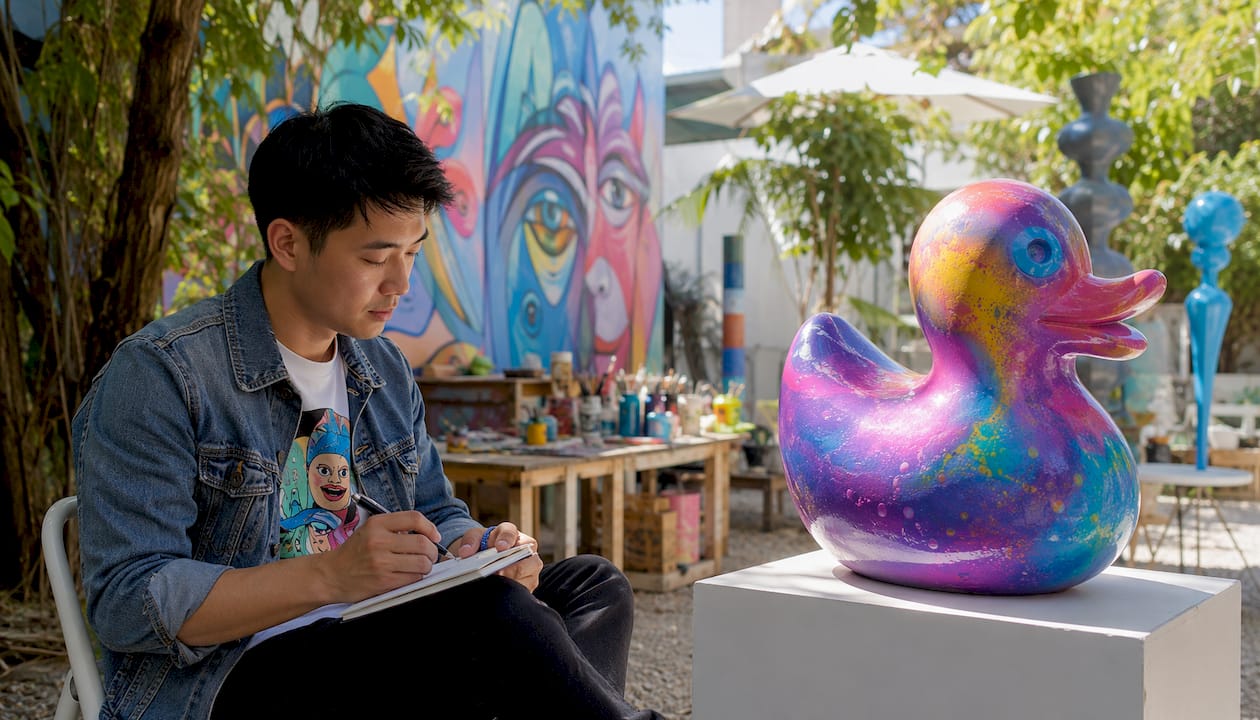
Flymiami UV-reactive sculptures — Facundo Yebne’s rubber duck series and Exploding Love Neon reveal hidden patterns under blacklight. Tate’s documentation of mid-century material experiments explains the lineage: plastics and industrial finishes established the precedent for reactive media that adds temporal, performative dimensions.
Pro Tip: When evaluating any interactive or light-reactive sculpture, ask the studio for a lighting rider specifying blacklight wavelength (typically 365nm UVA), recommended fixture distance, and maximum daily exposure hours. Some UV pigments degrade under continuous exposure and require controlled light cycles.
What collectors should evaluate before buying Pop Art sculptures
Provenance and condition matter more in Pop Art than in almost any other category, because the medium is often the message.
-
Provenance and exhibition history — Request a full ownership chain and any exhibition citations. Works shown at institutions like MoMA, the Whitney, or Tate carry verifiable provenance that supports both authenticity and resale value.
-
Authenticity documentation — For contemporary works, request a certificate of authenticity signed by the artist or studio, plus studio process notes describing materials used.
-
Surface condition — Collectors should inspect hand-applied surface techniques even when a work mimics mechanical reproduction. Visible inconsistencies in Ben-Day dots or underdrawing are often authentic markers of conceptual labor, not defects.
-
Technical rider for UV/interactive works — Request lighting specifications: blacklight wavelength, fixture type, recommended installation distance, and daily light cycle. Some UV pigments degrade under continuous exposure.
-
Conservation plan — Tate’s material research confirms that plastics and industrial finishes require specific environmental controls. Ask for written conservation guidelines covering humidity, temperature, and UV exposure limits.
-
Insurance and display — Large-format or interactive sculptures often require specialized fine-art insurance riders. Confirm installation requirements (wall anchoring, electrical, lighting rigs) before finalizing a purchase.
| Evaluation Point | What to Request |
|---|---|
| Provenance | Ownership chain, exhibition citations |
| Authenticity | Signed certificate, studio process notes |
| Surface condition | Inspection report, underdrawing documentation |
| UV/lighting specs | Wavelength, fixture distance, daily cycle limits |
| Conservation | Written guidelines for humidity, temperature, light |
| Insurance | Fine-art rider, installation requirements |
Pro Tip: For UV-reactive works, request pigment specifications in writing before purchase. Ask specifically whether the pigments are solvent-based or water-based, as each has different longevity and conservation requirements under gallery or domestic lighting conditions.
FLY Miami Art and Facundo Yebne: UV-reactive Pop Art in practice
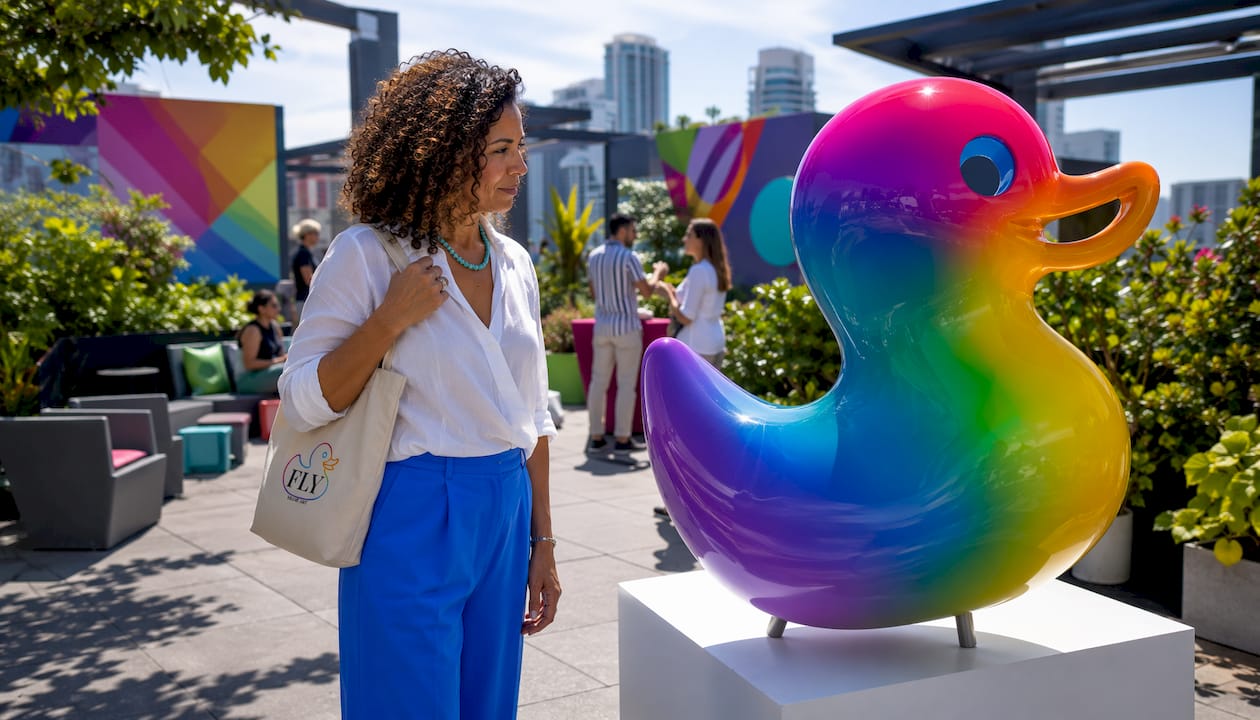
Flymiami, led by artist Facundo Yebne, extends Pop Art’s commentary tradition through handcrafted UV-reactive sculptures that shift appearance under blacklight, adding a performative layer to familiar Pop iconography.
- UV-reactive rubber duck series — The AMOR, LOVE, and Smiley Black Glow sculptures use the rubber duck, one of the most universally recognized consumer objects, as a vehicle for commentary on joy, peace, and mass-produced symbolism. Under blacklight, hidden patterns and colors emerge, changing the work’s meaning in real time.
- Exploding Love Neon — The Exploding Love Neon combines neon and UV-reactive surfaces to create a statement piece that reads differently under ambient and blacklight conditions.
- Studio process — Yebne applies UV pigments by hand over sculpted forms, documenting each layer. Collectors should request the studio’s care instructions, lighting specs, and certificate of authenticity, all of which Flymiami provides with each work.
Pro Tip: Ask the studio for a studio process overview before commissioning. A credible studio will document material sourcing, pigment type, application method, and expected longevity under specified lighting conditions.
Key Takeaways
Pop Art’s most enduring cultural commentary pieces work because they refuse to settle the question of whether consumer culture deserves celebration or critique, and contemporary UV-reactive sculptures extend that productive ambiguity into new perceptual territory.
| Point | Details |
|---|---|
| Ambivalence is the mechanism | Pop Art’s power comes from oscillating between celebration and critique, not choosing one side. |
| Sculpture forces engagement | Scale, material, and placement transform familiar objects into civic or domestic provocations. |
| UV-reactive works add time | Blacklight-reactive surfaces give sculptures a second reading, deepening commentary beyond static imagery. |
| Collectors must verify materials | Request pigment specs, lighting riders, and conservation plans before acquiring any interactive or UV work. |
| Flymiami extends the tradition | Facundo Yebne’s UV-reactive rubber duck sculptures apply Pop Art’s consumer-object commentary with handcrafted, light-reactive techniques. |
Why UV light changes what Pop Art can say
The conventional view is that Pop Art’s commentary lives in the image: the soup can, the comic panel, the inflatable. That reading is incomplete. The most interesting Pop works have always used material as argument. Warhol’s hand-stamped Coca-Cola bottles look mechanical but aren’t. Lichtenstein’s dots look printed but are painted by hand. The gap between appearance and reality is where the critique lives.
UV-reactive sculpture takes that gap further. A piece that looks one way under gallery lighting and reveals hidden imagery under blacklight is not just a visual trick. It stages the same question Pop Art always asked: what are you actually looking at, and what are you missing? The rubber duck is a universally legible consumer object. Under blacklight, it becomes something else. That shift is the commentary.
Collectors who want works that hold that tension, pieces that keep asking questions rather than settling them, should look at studios willing to document their material choices in full. Process transparency is not just a conservation concern. It is evidence that the artist understands what they are making and why.
Acquire a UV-reactive Pop Art sculpture from Flymiami
Flymiami offers collectors a direct path to handcrafted, UV-reactive Pop Art sculptures that carry documented provenance and full material specifications from day one.
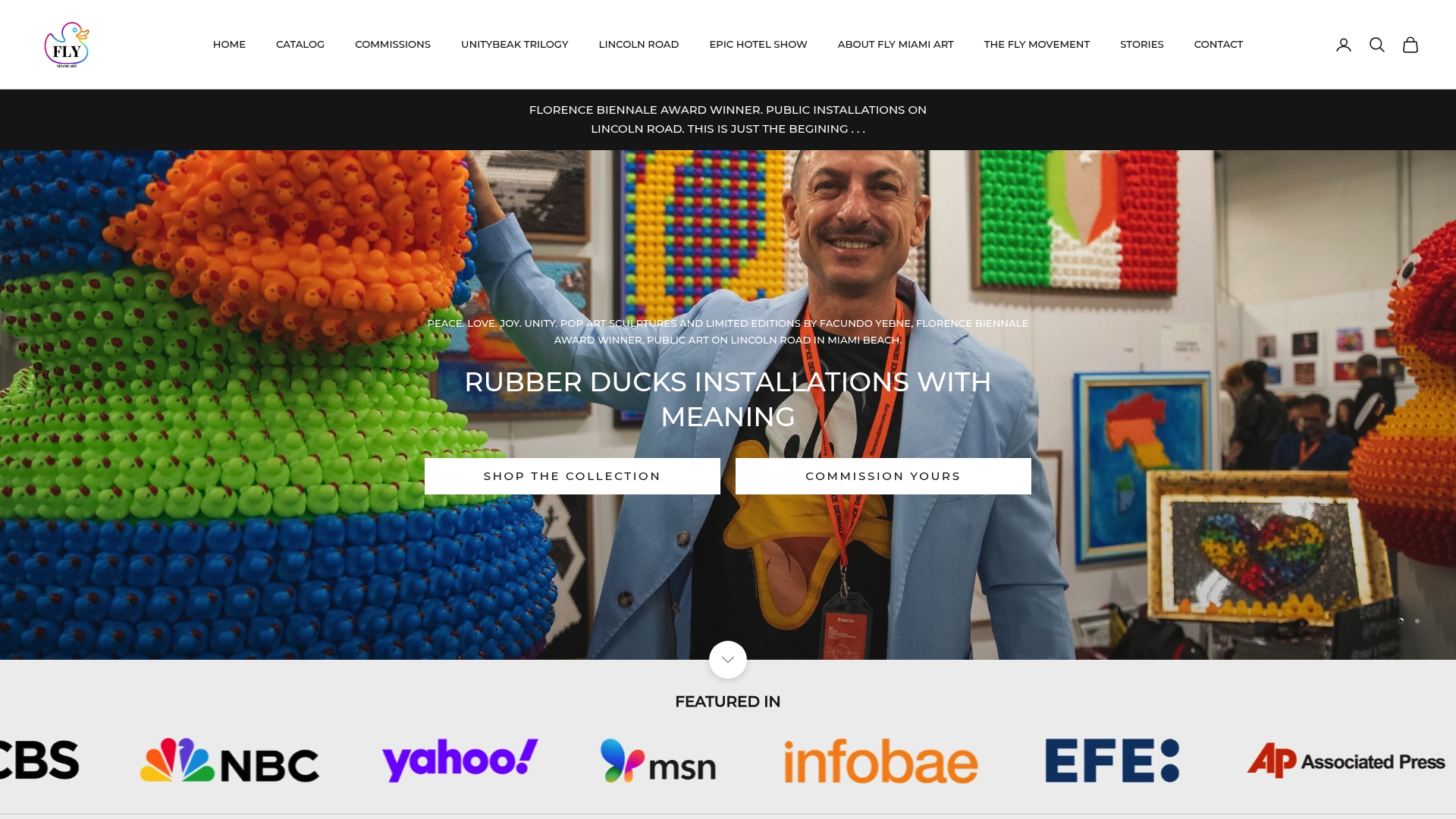
The UV Glow Art collection and the sculpture collection are the starting points. Each work ships with a certificate of authenticity, lighting rider, and conservation guidelines.
Commissioning steps:
- Browse the collection or contact the studio with your space dimensions and lighting setup.
- Request pigment specifications, lighting rider, and installation requirements.
- Agree on the technical rider and confirm deposit terms.
- Fabrication and quality review (timeline varies by piece complexity).
- Delivery and lighting installation coordination.
For collectors ready to acquire now, the AMOR rubber duck sculpture and Exploding Love Neon are available for immediate purchase. Custom commissions are accepted with an initial inquiry and studio consultation.
Useful sources and further reading
These sources support the claims, provenance notes, and exhibition histories in this article.
| Source | What it provides |
|---|---|
| TheCollector — Consumerism in Pop Art | Analysis of Pop Art’s ambivalence toward consumerism; covers The American Supermarket (1964) and The Store |
| Painting-Meanings — Masterpiece by Lichtenstein | Scholarly reading of Masterpiece (1962) as media reflexivity and value-manufacturing |
| MoMA — Campbell’s Soup Cans | Primary exhibition record and process notes for Warhol’s 1962 series |
| MyArtbroker — Lichtenstein’s Whaam! | Technical analysis of Ben-Day dot technique and hand-labor beneath mechanical aesthetics |
| Tate — Political Pop Introduction | Material history of industrial finishes, plastics, and the precedent for UV-reactive works |
| Art-Guides — Claes Oldenburg | Emily Carter’s commentary on Pop Art sculptures in public space |
| Smithsonian — Humanscape 62 | Provenance and exhibition notes for Casas’s Chicano Pop critique |
| Whitney — Green Coca-Cola Bottles | Exhibition and process notes for Warhol’s 1962 silkscreen series |
- For Pop Art’s defining examples across fine art and popular culture, Flymiami’s editorial archive is a practical starting point.
- For collectors interested in UV art in public and private spaces, Flymiami’s guide covers installation, conservation, and display considerations in detail.
- For gallery and exhibition experiences in the arts and culture space, Art in Devon’s 2026 gallery guide covers regional venues worth visiting.