Why UV Innovation Updates Pop Art's Mass-Media Tradition
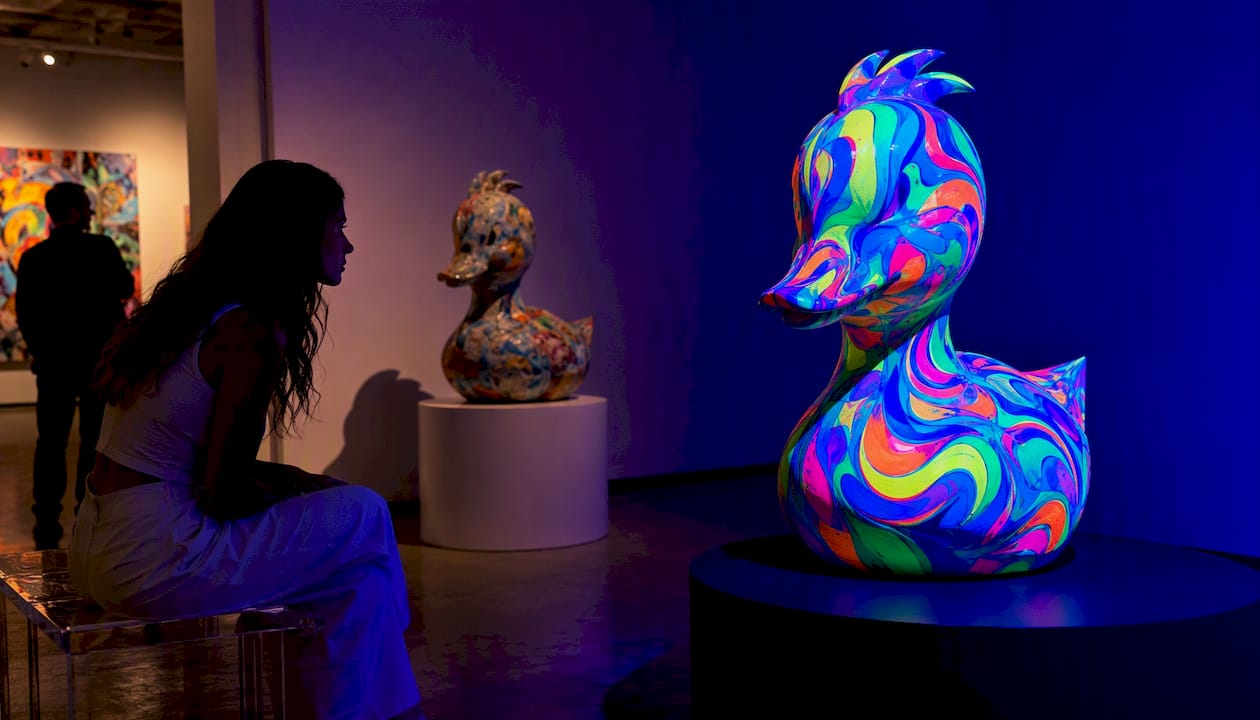
UV technology updates Pop Art by converting its old trick, mechanical reproducibility, into something light-activated and alive in the room. A silkscreen print stayed the same under any bulb. A UV-reactive sculpture does not: switch the lights and the piece reveals a second image, a hidden palette, a different mood entirely.
That shift rests on three things: fluorescent pigments that respond to specific wavelengths, blacklight and UV LED systems that trigger them, and museums rethinking how they light historic work now that fluorescent pigments turn up in analyses of original Pop Art pieces. The result isn’t a gimmick bolted onto an old movement.
- Fluorescent pigments and UV-reactive inks replace static color with light-dependent color
- Blacklight and UV LED rigs let a single object hold two visual identities
- Museum lighting upgrades now factor in how UV exposure changes what visitors see
It extends Pop Art’s original argument (that art could be manufactured, repeated, and staged like mass media) into a version that unfolds in real time, under specific light.
Key Takeaways
UV innovation updates Pop Art by turning its mechanical, mass-media logic into a light-activated experience that changes with the room it’s shown in.
| Point | Details |
|---|---|
| UV extends, doesn’t replace | Fluorescent pigments and blacklight add a light-dependent layer to Pop Art’s original reproducibility. |
| Materials matter | Rhodamine-class dyes and UV LEDs create emission effects impossible with traditional reflective pigment. |
| Lighting changes the art | Museum retrofits can cut UV exposure by around 60% while altering how fluorescence appears. |
| Conservation needs new tools | Non-invasive UV-fluorescence imaging tracks pigment health without damaging the surface. |
| Flymiami applies this directly | The studio designs UV Pop sculptures and wall art for dual states, daylight and blacklight, from the first sketch. |
Table of Contents
- Why UV Innovation Updates Pop Art’s Original Challenge to Fine Art
- What Are UV-Reactive Materials and Lighting Technologies?
- How UV Technology Extends Pop Art’s Mechanical Logic
- Real Examples of UV Innovation in Pop Art Today
- Display and Conservation: What Changes When Art Glows
- Does UV Turn Pop Art Into Critique or Spectacle?
- See UV Pop Art in Person or Commission Your Own
- Sources
Why UV Innovation Updates Pop Art’s Original Challenge to Fine Art
Pop Art’s whole premise was a dare: take a soup can, a comic panel, a movie star’s face, and put it in a museum next to things people had been taught to call “high art.” The movement, which took root in the UK’s Independent Group in the 1950s and hit full stride in the American 1960s through artists like Warhol, Lichtenstein, and Rosenquist, rejected the emotional seriousness of Abstract Expressionism in favor of something flatter, funnier, and instantly recognizable.
The tactics mattered as much as the subject matter. Pop artists leaned on:
- Appropriation of advertising, packaging, and comic-strip imagery
- Silkscreen printing and Ben-Day dots, mechanical processes that mimicked commercial print production
- A deliberate collapse of the line between “fine art” and mass culture, as Tate’s own framing of the movement makes clear
None of that was decorative. It was an argument about who gets to make meaning and how. UV innovation picks up that argument rather than abandoning it.
What Are UV-Reactive Materials and Lighting Technologies?
Fluorescent pigments and dyes absorb ultraviolet light and re-emit it as visible color, which is a different mechanism than a normal paint reflecting ambient light back at your eye. That’s why a UV-reactive surface can look muted under a gallery’s white lights and then ignite under a blacklight, sometimes revealing an image that wasn’t visible a second earlier.
The toolkit behind that effect includes a handful of specific technologies:
- Fluorescent and phosphorescent pigments, including rhodamine-class xanthene dyes, identified in analytical studies of highly fluorescent areas in Pop-era works
- Blacklight fluorescent tubes, the classic UV-A source used in nightlife and gallery installations
- UV LEDs, which run cooler and more efficiently than fluorescent tubes and give artists finer control over intensity
- UV-safe projection mapping, which layers moving light onto a static surface without degrading the pigment
- UV-reactive print inks, used for flat and sculptural work alike
The visible color you see in daylight and the color that appears under UV are often two different design decisions layered into one object. Rhodamine 6G, for instance, emits near 604 nanometers, a specific, intense red-orange that ordinary pigment can’t replicate.
Pro Tip: If you’re commissioning or buying UV-reactive art, ask what light source it was designed under. A piece tuned for fluorescent blacklight can look flat under a narrow-spectrum UV LED, and vice versa. Matching the artist’s intended emission spectrum to your actual lighting setup is the difference between a piece that glows and one that just kind of does.
How UV Technology Extends Pop Art’s Mechanical Logic
Pop Art’s power came from mechanical reproduction: the same silkscreened Marilyn, over and over, draining the image of its uniqueness on purpose. UV innovation doesn’t undo that logic. It adds a variable Pop Art never had access to: time and light as part of the artwork’s actual content.
- Editions and reproducibility still define the medium, but now each piece can hold multiple visual states depending on illumination
- A UV Pop sculpture isn’t “finished” the way a print is; its appearance shifts with the room it’s in
- That variability turns passive viewing into something closer to an event, especially when a blacklight reveal happens in front of a crowd
Christie’s has described Pop Art’s mechanical reproduction as a jab at the sanctity of the unique original. UV materials replicate that jab in a new register.
A static image becomes an event that depends on the technological conditions around it, not just the object itself.
That’s the real update: Pop Art already treated the artwork as something manufactured and repeatable. UV technology makes the viewing experience itself manufacturable and repeatable too, staged, timed, switchable. Whether that deepens the original critique of mass culture or just gives it better production value is a real question, and worth sitting with rather than answering too quickly.
Real Examples of UV Innovation in Pop Art Today
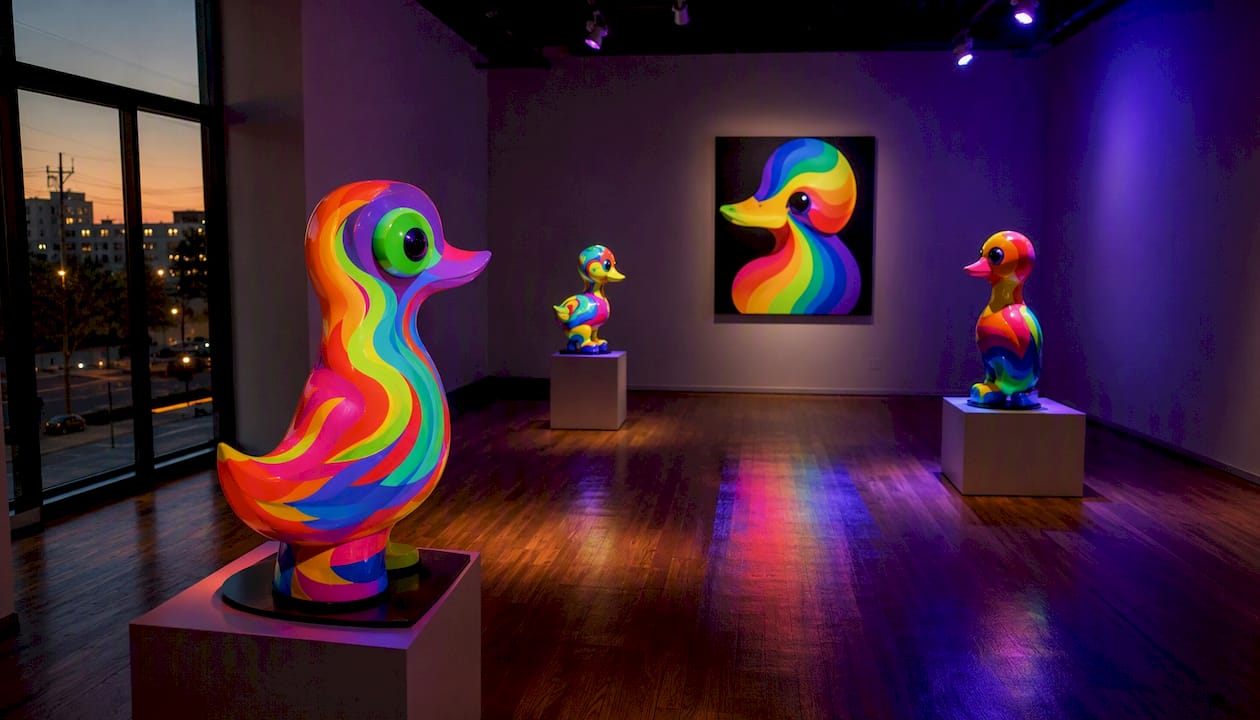
Museum lighting practice offers the clearest technical proof of how much UV changes the viewing equation. The Tacoma Art Museum’s lighting retrofit cut UV exposure by roughly 60% while actually increasing perceived brightness, a trade-off that matters enormously for any UV-dependent artwork hanging nearby. Less UV bleed means less pigment degradation, but curators now have to think about spectral output, not just lumens.
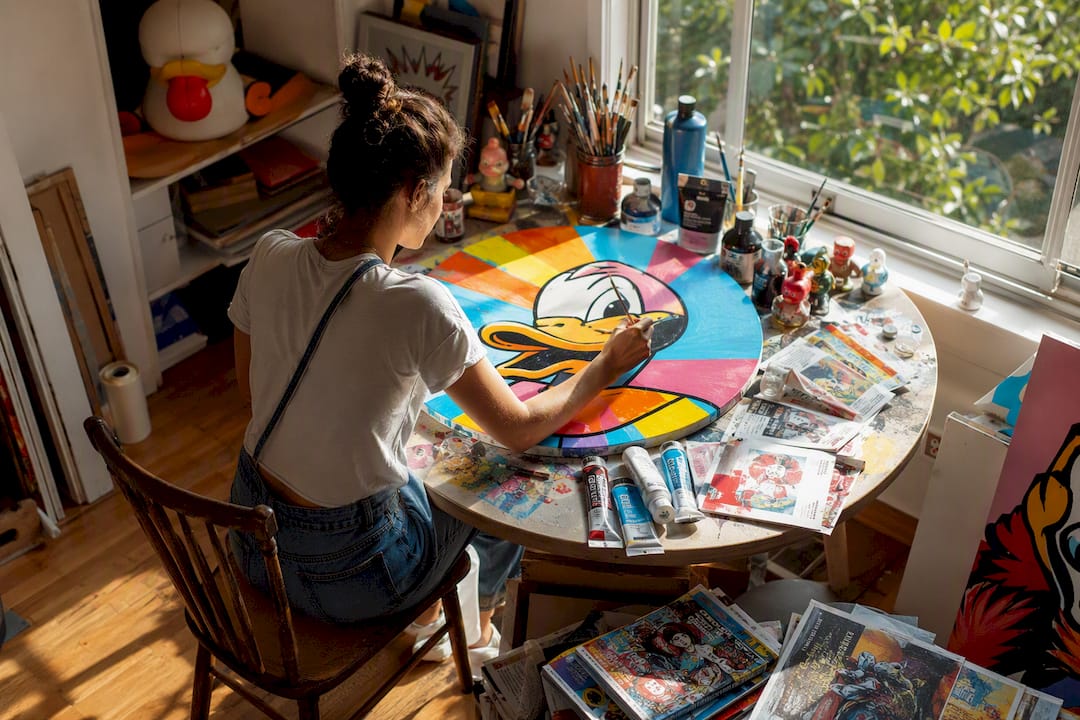
Flymiami’s own studio process, highlighted in Jonathan Adler’s New Art Collection that bursts with summer colour, builds around that same dual-state logic from the start. A sculpture gets designed to hold one identity in daylight, rooted in the bold color-blocking strategy common to UV Pop work, and a second, hidden identity that only surfaces under blacklight. Collectors commissioning a piece are asked upfront about the room it will live in: gallery white walls, a hotel lobby, a nightlife venue with a dedicated blacklight rig.
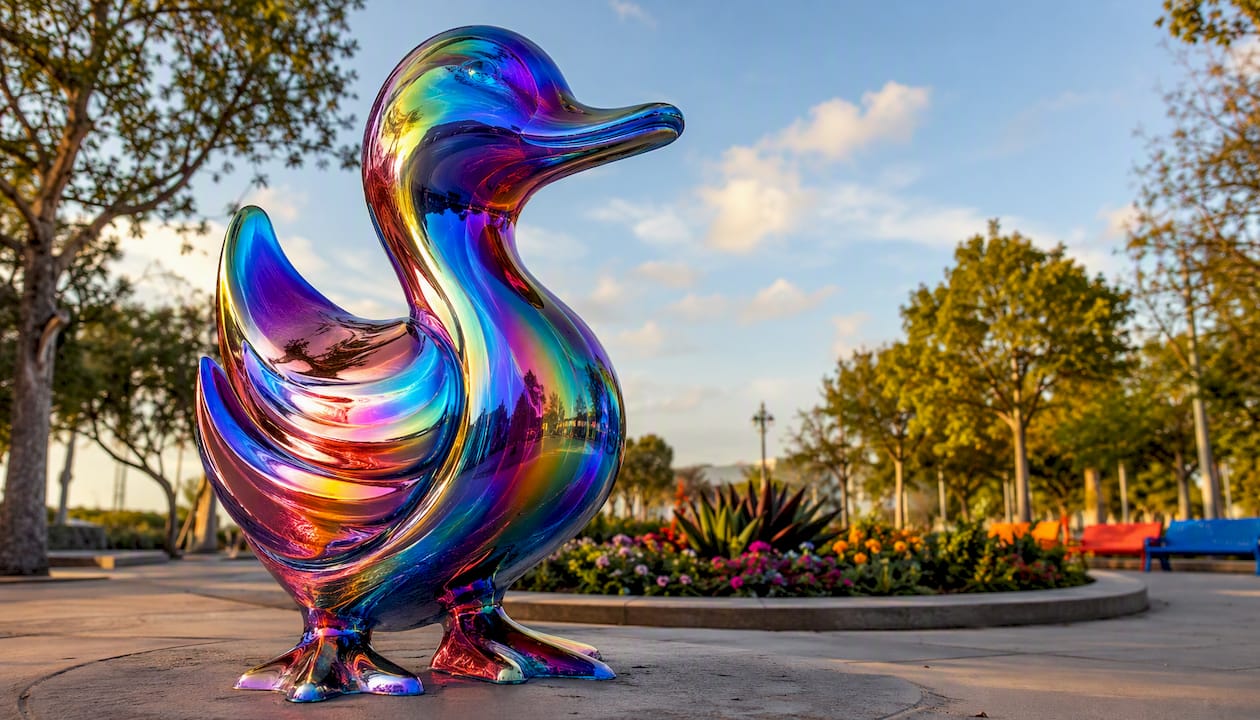
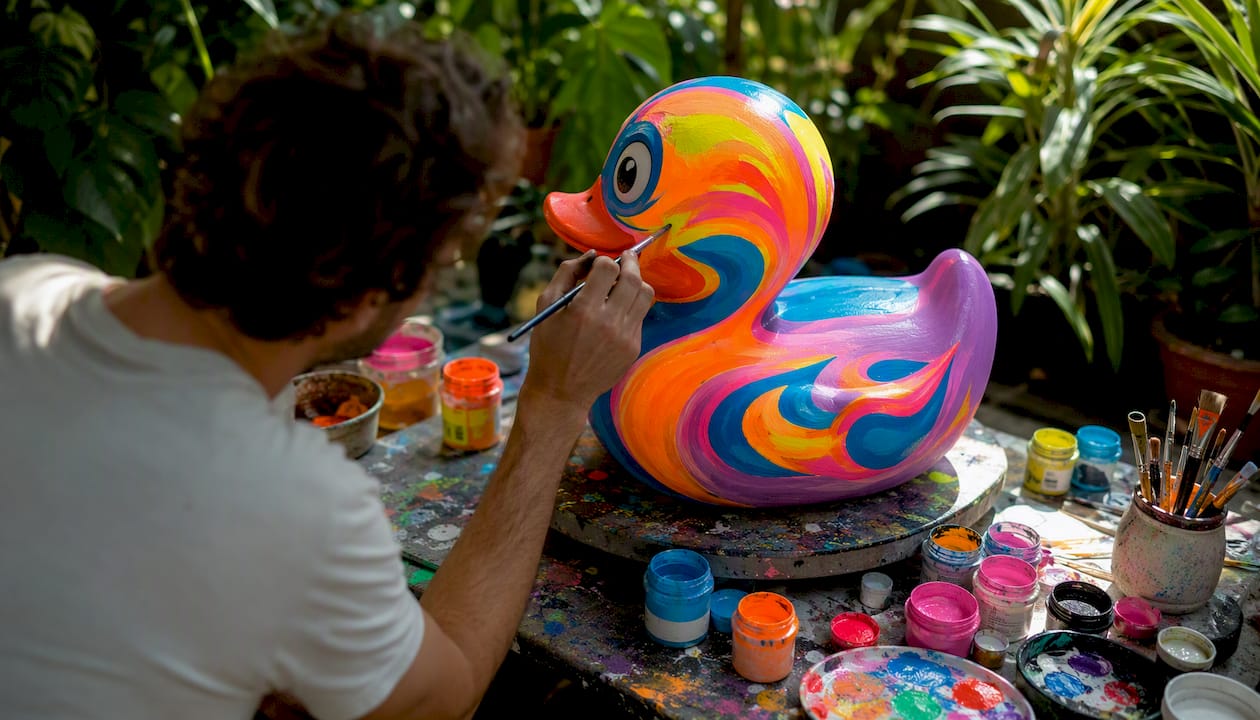
The same duck-shaped sculpture can read as playful pastel decor at 2 p.m. and as a glowing, pattern-revealing centerpiece at a blacklight event that night.
That range, quiet by day, activated by night, is precisely what separates UV Pop from a silkscreen print bolted to a wall forever.
Display and Conservation: What Changes When Art Glows
Fluorescent pigments don’t age like traditional oil or acrylic. Conservation researchers have flagged that these materials often degrade on a different timeline than the binders around them, which means a UV-reactive piece can lose its glow long before the underlying paint layer shows visible wear.
That creates a genuinely different conservation job:
- Non-invasive imaging, including UV-induced fluorescence photography, lets conservators track pigment condition without touching the surface
- LED retrofits reduce damaging UV exposure but can mute a piece’s intended glow if the spectral output isn’t tuned to match the original pigment
- Controlled viewing events, rather than constant blacklight exposure, extend a fluorescent work’s lifespan
Pro Tip: If you own a UV-reactive piece, don’t leave it under constant blacklight for the sake of atmosphere. Save full UV exposure for viewing events and keep the piece under standard, low-UV gallery lighting the rest of the time. It’s the single easiest way to protect the fluorescence you paid for.
Does UV Turn Pop Art Into Critique or Spectacle?
Here’s the honest tension: UV can push a piece toward commodity glitz, or it can sharpen Pop Art’s original ironic distance from mass culture. Context decides which one wins.
- A UV piece framed inside a curated exhibition, with wall text and conceptual intent, tends to read as extended critique
- The same piece in a nightclub or hotel lobby, switched on for effect, tends to read as spectacle first and commentary second
- Mechanical process plus time-dependent material also complicates authorship: is the “finished” work the daylight state, the blacklight state, or both together?
A Note From the Studio
I build every UV piece assuming it will live two lives: one in daylight, one under blacklight, and I want both to say something on their own. That means designing for a gallery wall and a collector’s private lighting setup at the same time, because that’s the reality of how people actually display this work now.
See UV Pop Art in Person or Commission Your Own
Flymiami is where this whole explanation stops being theory and starts being an actual object you can own. Every piece in the studio’s UV glow art collection is built around that daylight-to-blacklight transformation, hand-finished with fluorescent pigments chosen for a specific emission response, not a generic glow-in-the-dark effect.

If you collect wall pieces, browse the wall art collection for pieces sized for gallery and home walls alike, or look at sculpture if you want something three-dimensional that reveals a hidden pattern from every angle. The studio’s UV-reactive rubber duck series is a good entry point if you want to see the dual-state effect in a single, signature motif before committing to a larger commission. Galleries, hotels, and collectors working on a specific installation can start a commission conversation directly through the studio to match pigment and lighting to the exact room the piece will hang in.
Sources
- Everything you need to know about Pop Art | Christie’s
- Heritage 2021 (materials/techniques investigation of Pop Art works) | University of Milan repository
- Heritage (MDPI): Non-invasive investigation of Italian Pop Art (2021) | MDPI
- Pop art | Tate