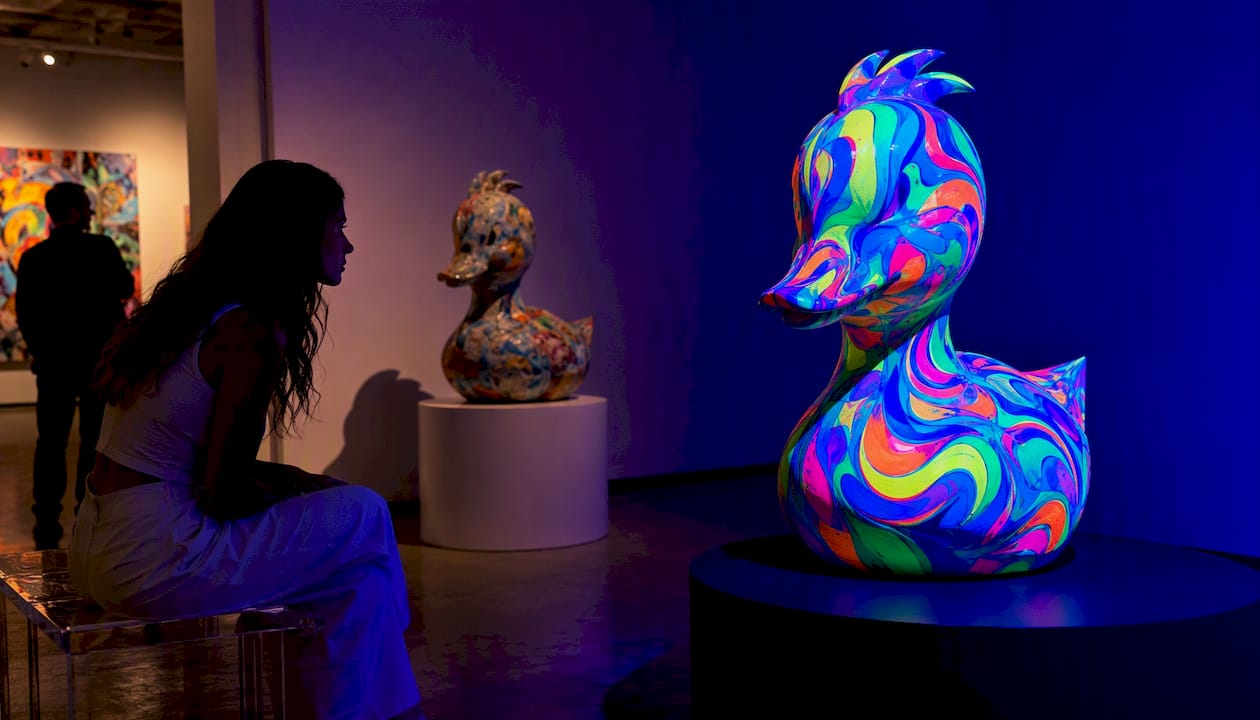
How Mass Culture Shaped Pop Art's Themes and Methods
Pop Art turned advertising, comic strips, packaging, and celebrity photography into both its subject matter and its production method, treating commercial imagery as fine-art material worthy of the museum wall. That single move, borrowing what mass media already put in front of millions of eyes, defines the role of mass culture in Pop Art more than any single artist’s biography. A few examples make the point concrete:
- Andy Warhol repainted a Campbell’s soup can label as a grid of 32 near-identical canvases.
- Roy Lichtenstein blew up a single comic-book panel to mural scale, dots and all.
- Claes Oldenburg cast ordinary consumer goods, hamburgers, typewriters, clothespins, at absurd size.
- Richard Hamilton assembled a collage of magazine cutouts to ask what actually made 1950s homes so appealing.
Pro Tip: When you’re asked to analyze a Pop work cold, start by naming its source image before you say anything about “meaning.” The source tells you almost everything about the artist’s intent. The rest of this guide walks through the postwar conditions that made mass imagery usable, the specific techniques artists borrowed from commercial production, close readings of the movement’s landmark works, and a practical toolkit for essays and classroom discussion.
Key Takeaways
Pop Art turned advertising, comics, packaging, and celebrity images into fine-art subjects by borrowing the reproduction methods, not just the pictures, of mass media.
| Point | Details |
|---|---|
| Mass culture supplied raw material | Postwar advertising, TV, and consumer packaging gave artists their subject matter after the 1950s consumer boom. |
| Method mattered as much as image | Silkscreening, Ben-Day dots, and serial repetition mimicked commercial production to reinforce each work’s meaning. |
| Celebration and critique coexist | Warhol’s glamorous portraits and his Death and Disaster series show Pop Art pulling in both directions at once. |
| British and American Pop diverged | The Independent Group analyzed mass media from a distance; New York artists worked from inside the same culture. |
| Contemporary studios extend the strategy | Flymiami’s UV-reactive sculptures and wall art apply Pop’s appropriation and spectacle tactics using current materials. |
Table of Contents
- Why Postwar Consumer Culture Made Pop Art Possible
- How Did Mass Culture Supply Pop Art’s Methods?
- What Do the Canonical Pop Art Works Actually Show?
- How Did British and American Pop Art Differ?
- Did Pop Art Celebrate or Critique Consumer Culture?
- Why Does Pop Art’s Mass-Culture Strategy Still Matter?
- How Should Students Analyze a Pop Art Work?
- What Pop Art’s Techniques Mean for Working Artists Today
- See Pop Art’s Strategies at Work in a Contemporary Studio
- Frequently Asked Questions
- Sources
Why Postwar Consumer Culture Made Pop Art Possible
Pop Art couldn’t have happened in 1935. It needed a very particular set of postwar conditions: full employment, suburban expansion, television in nearly every living room, and advertising budgets large enough to blanket that television with jingles and slogans. By the mid to late 1950s, artists in London and New York were surrounded by an unprecedented volume of mass-produced imagery, and Pop Art responded directly to that saturation, using soup cans, comic strips, and celebrity photographs to challenge the assumption that fine art had to rise above the everyday, as Wikipedia’s overview of the movement documents.
MoMA’s curatorial materials trace this shift to a specific set of forces: suburban consumer spending, television’s sudden dominance of daily life, and advertising’s growing sophistication at turning products into images worth remembering. Artists didn’t just notice this environment. They started borrowing its production tools, adopting techniques like silkscreening and multiples that let art mimic the repetition of a factory line.
A short timeline helps here:
- Early 1950s: The Independent Group forms in London, debating advertising and science fiction as legitimate cultural material.
- Mid 1950s: Suburban consumer culture and television advertising expand rapidly across the US and UK.
- Late 1950s to early 1960s: Warhol, Lichtenstein, and Oldenburg begin translating commercial imagery into gallery-scale work.
The takeaway for students: Pop Art’s timing isn’t incidental. Mass culture had to become inescapable before artists could treat it as raw material rather than background noise.
How Did Mass Culture Supply Pop Art’s Methods?
Mass culture gave Pop artists more than pictures. It handed them a production toolkit. Appropriation, the direct lifting of existing commercial images, became the movement’s baseline technique, but the specific methods artists used to reproduce those images mattered just as much as the images themselves.
Warhol’s shift from hand painting to silkscreening is the clearest case. He deliberately chose a mechanical, repeatable process over the visible brushstroke, which let him produce serial, commodity-like images that questioned the very idea of a unique, hand-touched artwork, a strategy Wikipedia’s Pop Art entry frames as a calculated statement about authorship, not a shortcut. Lichtenstein went a different route: he hand-painted Ben-Day dots, the mechanical printing pattern used in cheap newsprint comics, at a scale no printing press could achieve. The techniques Pop artists pulled from commercial production include:
- Appropriation of existing advertising and comic-book images rather than inventing new compositions.
- Silkscreen printing, borrowed from commercial signage and packaging production.
- Serial repetition, mimicking factory output and product-line uniformity.
- Isolation of a single image or panel, stripped of narrative context.
- High-contrast, primary-color palettes inspired by billboards and comic-book printing, chosen for immediate visual recognition, as noted in Wikipedia’s discussion of the movement’s visual language.
Pro Tip: A quick visual test: if an image reads as flat, cropped tight, and stripped of any surrounding scene, it likely started life as an advertisement or comic panel rather than an observed subject. That flatness is the fingerprint of appropriation. Comparing a Warhol silkscreen to a Lichtenstein comic painting side by side shows two different relationships to the same borrowed logic. One replicates mechanical reproduction exactly; the other performs it by hand, which raises its own question about whether painstaking labor undercuts or reinforces a joke about mass production. Readers curious about how this plays out formally against other contemporary movements can see the contrast laid out in Pop Art vs Street Art: What Sets Them Apart.
What Do the Canonical Pop Art Works Actually Show?
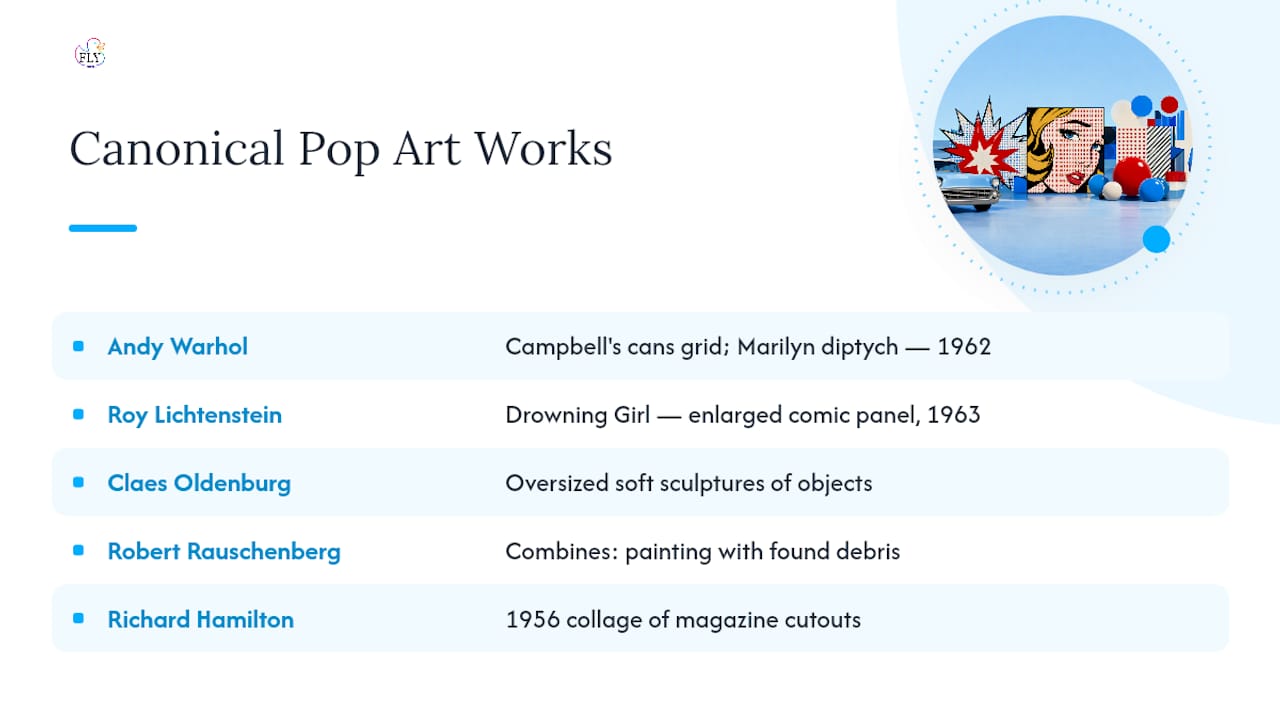
Five artists and their signature works carry most of the weight in any Pop Art syllabus, and each demonstrates a distinct relationship to mass-produced imagery.
Andy Warhol’s Campbell’s Soup Cans (1962) presented 32 canvases, representing a range of soup varieties by the company, arranged in a grid that mimicked supermarket shelving. His Marilyn Diptych (1962), made months after Marilyn Monroe’s death, repeated a single publicity photograph in fading, garish color, turning a mourning image into something closer to product branding. Roy Lichtenstein scaled up comic-strip panels, complete with hand-painted Ben-Day dots and speech balloons, in works like Drowning Girl (1963), lifting his source almost directly from a DC romance comic. Claes Oldenburg built oversized soft sculptures of hamburgers, ice cream cones, and clothespins, rendering the throwaway object monumental and slightly absurd. Robert Rauschenberg’s combines, assemblages that fused painting with newspaper clippings, tires, and found photographs, blurred the line between artwork and collage of daily debris. Across the Atlantic, Eduardo Paolozzi and Richard Hamilton got there first: Hamilton’s 1956 collage Just What Is It That Makes Today’s Homes So Appealing? assembled magazine cutouts of appliances, bodybuilders, and a Tootsie Pop into a single satirical domestic scene, often cited as an early landmark of the movement.
Museum-level writing consistently frames these works as reflecting and interrogating the visual language of advertising and celebrity at once, not simply borrowing it. That double function, mirror and question mark, is what separates Pop Art from illustration.
Each work rewards a caption built around three facts: the exact source image, the reproduction method, and the year, details that also anchor the close analyses collected in Pop Art Crossing Fine Art: 9 Defining Examples.
How Did British and American Pop Art Differ?
The Independent Group in London got to mass culture before New York did, but their approach looked almost academic by comparison. Formed in the early 1950s, the IG treated advertising, science fiction, and industrial design as objects of analysis, dissecting American mass media the way an anthropologist might study an unfamiliar culture. Critic Lawrence Alloway, working within the group, helped coin the term “pop art” itself.
American Pop artists, working inside the culture they were depicting rather than observing it from across an ocean, produced something more visceral and representational. The contrast plays out in paired examples:
- Richard Hamilton’s collage dissects the idea of American domestic consumerism from a British vantage point.
- Warhol’s soup cans present that consumerism flatly, without the ironic distance of an outside observer.
- Paolozzi’s early collage experiments treat pulp imagery as evidence to be examined.
- Lichtenstein’s comic paintings simply inhabit the comic-book style at full scale.
That distance shapes interpretation: British Pop reads more analytically, American Pop more like a native speaker’s dialect.
Did Pop Art Celebrate or Critique Consumer Culture?
Pop Art never fully resolved this question, and that’s precisely why it’s still debated in seminar rooms. Adorno and Horkheimer’s “culture industry” critique, developed decades before Pop Art existed, argued that mass-produced culture standardizes thought and turns art into just another commodity, a warning laid out in their chapter on the culture industry. Pop artists knew this critique, or absorbed its cultural moment, and responded by doing something trickier than agreeing or disagreeing: they adopted commercial techniques as a deliberate conceptual statement, using the culture industry’s own methods to comment on it.
Warhol’s glossy celebrity portraits often read as celebratory, glamorizing fame the way a magazine cover does. His Death and Disaster series, silkscreened car crashes and electric chairs repeated in grid formation, reads as something closer to critique, numbing repetition standing in for media desensitization.
The Art Story’s analysis of the movement notes that Pop artists sometimes turned the culture-industry critique on its head, using commercial production not despite the Frankfurt School’s warnings but through them, as an explicit part of the artwork’s argument.
Scholars studying mass culture as a sociological category point out that standardized cultural products shape identity while still leaving room for resistance, a tension that runs through nearly every major Pop work.
Why Does Pop Art’s Mass-Culture Strategy Still Matter?
Pop Art’s core move, treating mass-produced imagery as legitimate art material, didn’t end when the movement’s first generation retired. Neo-Pop artists in the 1980s and 1990s pushed appropriation further, and branding-as-art has become its own recognizable genre, a lineage explored in Why Pop Art Remains Culturally Relevant Today.
Social media runs on the same logic Pop Art pioneered: isolate a single image, strip its context, repeat it until it becomes instantly recognizable. A meme format is functionally a Ben-Day dot pattern, a compressed visual shorthand built for mass repetition rather than individual expression.
For a quick classroom exercise, pair Warhol’s Marilyn Diptych with a viral celebrity meme and ask students to identify what changed and what didn’t. Both isolate a face, repeat it, and drain it of original context, and how contemporary media phenomena sustain that same visual grip offers a useful modern parallel for discussion.
How Should Students Analyze a Pop Art Work?
Four steps cover most essay assignments and classroom discussions:
- Identify the source image: is it advertising, a comic panel, a product label, or a press photo?
- Note the reproduction method: hand-painted, silkscreened, cast, or collaged, and what that method signals about intent.
- Ask whether the work celebrates, critiques, or simply neutralizes its source material, and look for evidence on both sides.
- Consider audience and context: who saw this work first, and what did that audience already believe about the source image?
Two sentence starters worth stealing for a body paragraph: “By reproducing [image] through [method], the artist transforms a disposable commercial object into…” or “The tension between celebration and critique in [work] becomes visible when…” A simple in-class activity, build a small Pop-style image using only found packaging or magazine clippings under a strict two-color limit, forces students to feel the appropriation process rather than just read about it, an approach echoed in What Pop Art Teaches Children About Culture.
What Pop Art’s Techniques Mean for Working Artists Today
Studios still reach for the same strategies Pop artists pioneered: familiar consumer motifs, mechanical or repeatable production processes, and a scale built for immediate recognition rather than quiet contemplation. That’s not nostalgia. It’s a working method that still produces results when the goal is instant visual impact tied to a recognizable object.
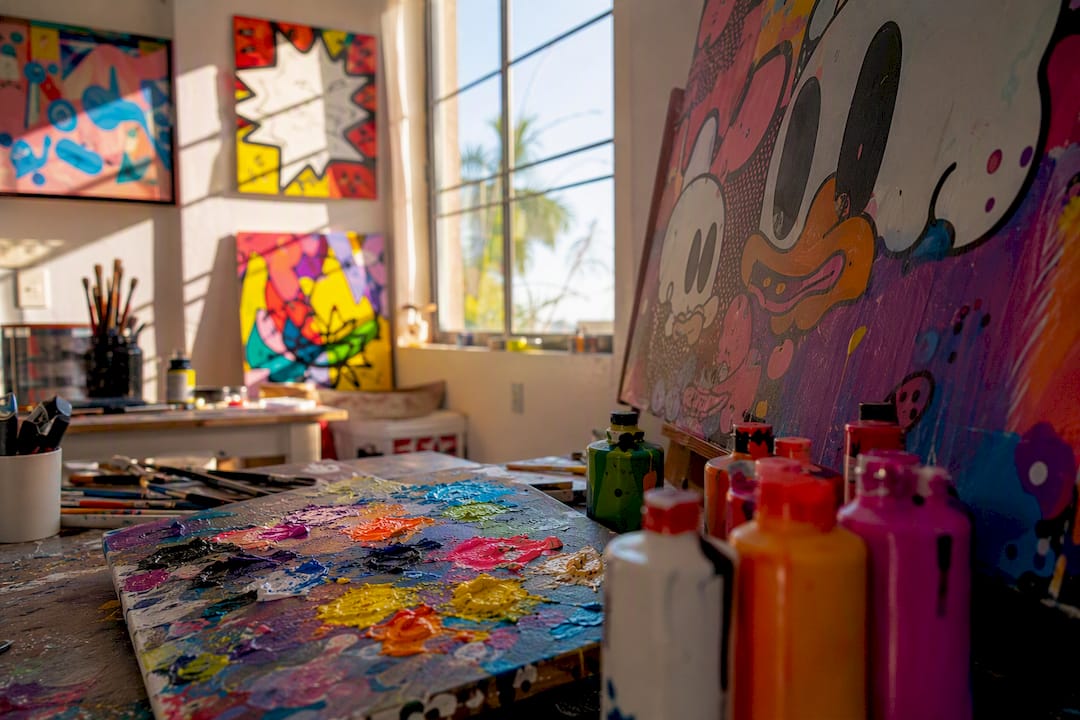
This educational content stands apart from any commercial offering. A studio can respect Pop Art’s history and still sell art without pretending the two are the same conversation. For readers who want to see how a contemporary artist applies these ideas, the Pop Culture Series shows the through line from comic panels to current studio work.
See Pop Art’s Strategies at Work in a Contemporary Studio
Everything covered above, appropriation, repetition, bold color, instant recognition, still drives how contemporary Pop-influenced work gets made, and Flymiami’s collections put those same strategies into physical, three-dimensional form rather than leaving them as classroom theory.

Where Warhol used silkscreen to give commercial images a repeatable, mechanical surface, Flymiami uses UV-reactive pigments that shift a piece’s entire meaning under blacklight, a material update on Pop’s original interest in spectacle and immediate visual grab. The UV Glow Art collection and the Sculpture collection, which includes consumer-object motifs in the spirit of Oldenburg’s oversized everyday goods, both extend that lineage into pieces you can actually hang or place in a room. If you’re a collector, gallery owner, or designer curious how these historical strategies translate into a piece for your own space, browse the Wall Art collection or start a commission inquiry directly through Flymiami’s studio page.
Frequently Asked Questions
What is the role of mass culture in Pop Art? Mass culture supplied both the imagery, advertising, comics, celebrity photos, product packaging, and the production techniques, silkscreening, serial repetition, mechanical reproduction, that Pop artists used to challenge the boundary between fine art and commercial visual culture.
Why did Pop artists use comic strips and advertisements as subjects? These images were already familiar to mass audiences, which let artists question art’s traditional focus on originality and high subject matter by elevating something everyone already recognized.
Is Pop Art a celebration of consumerism or a critique of it? Both readings hold up depending on the work. Glossy celebrity portraits tend to read as celebratory, while repetitive, media-saturated pieces like Warhol’s Death and Disaster series read closer to critique of mass-media desensitization.
How did British Pop Art differ from American Pop Art? The Independent Group in London approached mass media analytically, almost academically, while American artists worked more directly within the consumer culture they depicted, producing a more representational style.
What techniques did Pop artists borrow from mass media? Appropriation of existing images, silkscreen printing, serial repetition, Ben-Day dot patterns from comic printing, and high-contrast advertising-style color palettes all came directly from commercial production methods.
Sources
For images and primary context, MoMA’s collection essay and Tate’s art term entry are the strongest starting points, both museum-vetted and citation-ready. For critical theory background, look up Adorno and Horkheimer’s culture industry chapter directly rather than relying on secondhand summaries. For classroom planning, the Yale-New Haven Teachers Institute unit offers ready-made activity structures, and The Art Story’s movement overview works well as a broader entry point before narrowing to a specific artist. Wikipedia remains a reasonable first stop for dates and artist lists, but cite the museum sources for anything going into a formal essay.