


What Is an Art Certificate of Authenticity, and What Must It Include?
An art certificate of authenticity (COA) is a signed document that identifies a specific artwork and formally attests to who made it. The single most important requirement: it must tie the exact work to an accountable issuer, through a legible signature and enough metadata that no one could mix it up with another piece. If you’re issuing one for the first time, the fastest path is simple.
- Start from a template, not a blank page
- Sign it in wet ink or with a verified digital signature
- Keep an archival copy before the original ever leaves your studio
Key Takeaways
A trustworthy certificate of authenticity works only when it locks a specific artwork to an accountable, verifiable issuer through matching identifiers, a signature, and an archived record.
| Point | Details |
|---|---|
| Identity plus accountability | Every COA needs the work’s exact details and a named, reachable issuer who signed it. |
| Legal exposure is real | Under the UCC, inaccurate COA statements can create an express warranty a seller must honor. |
| Serials beat design | A matching label and unique serial number matter more than how polished the certificate looks. |
| Archive before it ships | Keep a scanned copy, a photo of the matching label, and buyer contact details on file. |
| Studio-tested example | Flymiami issues a unique inventory ID and matching label for every sculpture before it leaves the studio. |
Table of Contents
- Why a Certificate of Authenticity Matters More Than Most Artists Think
- The Complete Checklist: Fields Every Professional COA Needs
- How to Make a Certificate Verifiable and Hard to Forge
- COA Templates: One-Page Fillable Versus Full Archival Versions
- Step-by-Step: Creating, Signing, and Archiving a COA
- Provenance Basics: Where the COA Fits in the Bigger Picture
- Red Flags That Undermine a COA’s Credibility
- How Flymiami Documents and Certifies Its Sculptures
- What Actually Matters Once You Cut the Noise
- See How Flymiami Documents Every Piece It Sells
- Sources
Why a Certificate of Authenticity Matters More Than Most Artists Think
A COA does three jobs at once: it seeds provenance, reassures the buyer, and creates a paper trail for resale and insurance. Without one, a buyer has almost nothing to show an appraiser, an insurer, or a future auction house beyond a receipt and a memory.
The legal side surprises a lot of artists. Under the Uniform Commercial Code, a COA that describes the goods can function as an express warranty, meaning the seller is on the hook if the artwork doesn’t match what the certificate claims. Write “hand-signed original” on a piece that’s actually a print, and you’ve created legal exposure, not just an awkward conversation.
Museums lean on this same logic when researching acquisitions. Provenance teams work backward through ownership history, and a COA issued at the point of sale often becomes the earliest link in that chain, according to Yale University Art Gallery’s provenance research guidance. A COA also supports appraisal work, though it never replaces a formal appraisal report.
The Complete Checklist: Fields Every Professional COA Needs
Skip a field on this list and you’ve handed a buyer a document that raises more questions than it answers. Galleries and serious collectors read COAs the way lawyers read contracts. Missing information reads as a shortcut, and shortcuts erode trust fast.
Here’s the full field list, drawn from how professional COAs are actually structured, per Jackson’s Art Blog:
- Artist’s full legal name (not a studio name or nickname alone)
- Title of the work
- Year of completion
- Medium (oil on canvas, resin sculpture, archival pigment print, etc.)
- Dimensions, including depth for sculptural or mixed-media pieces
- Edition number and total edition size, for prints or multiples (e.g., “14/50”)
- A unique serial or inventory ID, distinct from the edition number
- A clear statement of authenticity, in plain language that leaves no ambiguity
- Issuer information: full name, role (artist, gallery, or estate representative), and contact details
- Signature and date of issue
Beyond those ten required fields, a few optional additions push a COA from adequate to genuinely archival: a photograph of the finished piece, provenance notes documenting prior ownership, storage or care instructions, and copyright or reproduction terms if you want to retain those rights.
Pro Tip: Write your authenticity statement once, save it as a locked text block in your template, and reuse the exact wording every time. Consistency across your COAs is itself a credibility signal. A gallery that sees the same precise language across ten pieces trusts issuer number eleven faster than one with a different phrasing every time.

How to Make a Certificate Verifiable and Hard to Forge
A wet-ink signature still carries the most weight for original paintings and sculptures sold in person; buyers can compare it against other signed works if a dispute ever arises. Digitally signed PDFs work fine for prints, digital editions, or when you’re shipping work internationally and need documentation to arrive before or with the piece.
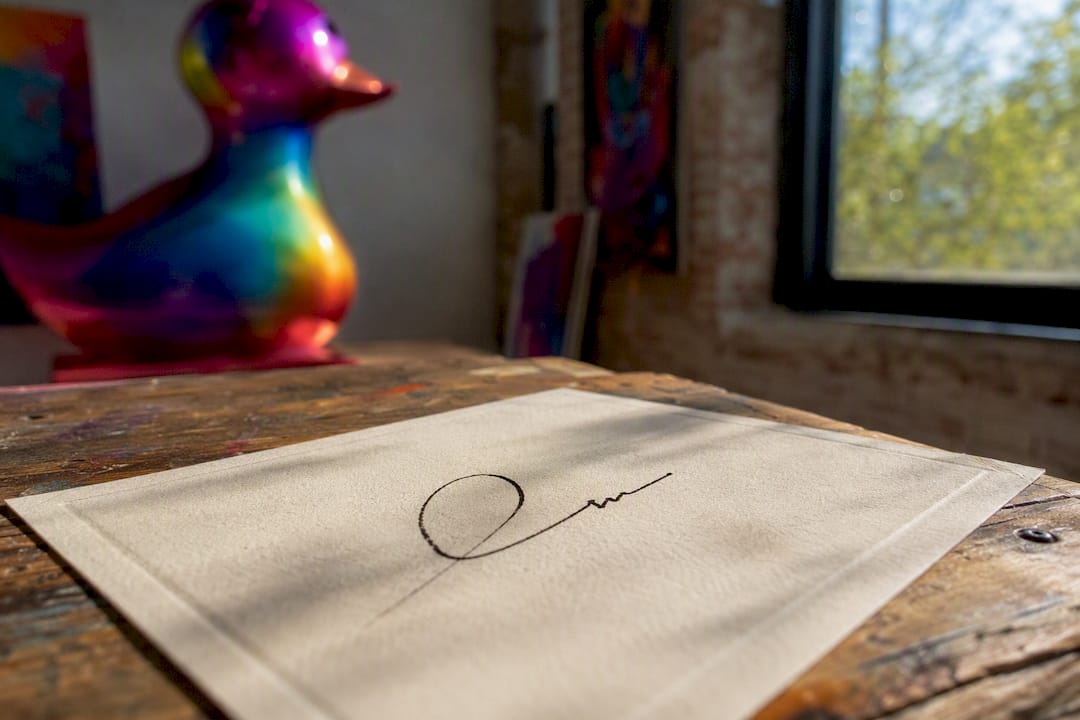
The anti-forgery layer is where most self-taught issuers fall short. Matching labels, serial numbers, and even holograms on the physical work, cross-referenced against the same identifiers on the COA, are what separate a professional practice from a printed sheet of paper. Jackson’s Art Blog notes this matching-label approach makes later verification dramatically easier for anyone down the ownership chain.
A basic buyer verification checklist should include:
- Contact the issuer directly using details on the COA, not a number found elsewhere
- Confirm the serial number matches an entry in the issuer’s own records
- Compare the signature against other verified examples of the artist’s hand
- Ask whether an online or database record exists for cross-reference
COA Templates: One-Page Fillable Versus Full Archival Versions
Two template formats cover almost every situation. A one-page fillable COA handles the essentials: artist name, title, year, medium, dimensions, edition info, serial number, statement of authenticity, signature, and date. It’s what you hand a buyer at a fair or pop-up sale.
An archival COA adds provenance notes, a photograph, storage instructions, and sometimes a short artist statement about the piece’s concept. This is the version worth keeping in your permanent studio files, separate from the copy you hand over.
For the authenticity statement itself, language like this works: “I, [artist name], certify that this work titled ‘[title]’ is an original piece created by me in [year], using [medium], and is identified by inventory number [ID].” For editioned prints, state it plainly: “This is print number 14 of a limited edition of 50.”
Several artists and galleries publish free fillable COA templates as a starting point, though customizing the serial numbering and adding your own archival system is what actually prevents duplication down the line. Artwork management platforms also let you generate COAs directly from piece records, which saves time once you’re issuing more than a handful a year.
- PDF fillable format for email delivery and instant download
- Printed cardstock for in-person handoff at galleries or fairs
- Online record links for buyers who want a permanent, checkable reference
| Format | Best Use Case |
|---|---|
| One-page fillable PDF | Fast sales, fairs, pop-ups |
| Archival COA with photo | Gallery sales, high-value originals |
| Printed cardstock | In-person handoff with framed work |
| Online database record | Cross-reference for future buyers |
Step-by-Step: Creating, Signing, and Archiving a COA
Issue the COA at completion if the work is a one-off, or at the point of sale if you’re producing an edition and want the serial locked to a specific buyer. Either way, never let the artwork leave your possession without a signed COA attached.
- Draft the COA using your saved template, filling in every required field before printing or exporting
- Apply a matching label or serial directly to the artwork, whether that’s a small sticker on the back of a canvas or an engraved code on a sculpture base
- Sign and date the COA, in wet ink for physical handoff or with a verified digital signature for PDF delivery
- Deliver it with the work, in a protective sleeve for in-person sales or as a password-protected PDF for shipped pieces
- Archive your own copy, including a scan of the signed COA, a photo of the matching label in place, and the buyer’s contact information
That last step gets skipped constantly, and it’s the one that matters most five years later when a buyer wants to resell, insure, or simply confirm the piece is what they think it is.
Provenance Basics: Where the COA Fits in the Bigger Picture
Provenance is the documented ownership history of an artwork, essentially its biography from the studio to wherever it sits today. The Getty Research Institute frames early documentation like a COA as the first chapter in that biography, the entry everything else eventually gets checked against.
Structuring provenance notes is straightforward: list the date of creation, the first sale with buyer name (or “private collection” if anonymity is requested), and any subsequent exhibition or resale entries as they occur.
- Add a new entry any time the work changes hands or appears in a show
- Note gallery representation changes if they happen mid-ownership
- Seek a catalogue raisonné entry or conservation report for historically significant pieces, since a COA alone won’t satisfy that level of scrutiny
Red Flags That Undermine a COA’s Credibility
Vague language, a missing issuer signature, or a reused template with no unique serial number are the most common ways artists accidentally weaken their own documentation.
Buyers should watch for a matching set of warning signs: an issuer who can’t be reached or verified independently, a serial number that doesn’t match anything on the physical piece, and low-quality printing on what’s supposed to be a professional document. If something feels off, contact the named issuer directly and ask them to confirm the piece and serial number before completing a purchase.
How Flymiami Documents and Certifies Its Sculptures
Award-winning artist Facundo Yebne built Flymiami’s documentation process around the same principle that governs any credible COA: every piece needs a traceable identity from the moment it’s finished.
Each sculpture gets a unique inventory ID before it leaves the studio, photographed from multiple angles, with a matching label applied to the piece and archived alongside the signed certificate.
For UV-reactive sculptures specifically, the studio’s documented process adds installation notes and light-sensitivity guidance to the standard COA fields, since these works behave differently under blacklight than in ambient lighting and buyers need that context recorded, not just implied.
What Actually Matters Once You Cut the Noise
Most advice on this topic focuses on the wrong layer. Artists worry about design, whether the COA looks polished enough, when the real vulnerability sits in the metadata: a missing serial number, an issuer who can’t be reached, a signature no one can compare against anything else. A beautifully designed COA with none of that is worse than a plain one that has all of it, because it looks credible while offering none of the protection credibility implies.
The UCC angle gets ignored almost entirely in casual advice, and it shouldn’t. Every word you write on that certificate is a claim you’re legally standing behind. If you call something “one of one” and it later turns out to be one of three, that’s not a wording slip, it’s a warranty problem.
My honest priority order for any artist starting from zero: lock a template with every required field, build a serial system before your next sale, and only then worry about whether the layout looks good. Design is the last 10 percent. The metadata is the whole foundation.
— Facundo
See How Flymiami Documents Every Piece It Sells
Every sculpture and wall piece Flymiami sells ships with a certificate built the way this article describes: unique inventory ID, matching label, signed statement, and an archival record kept on file long after the piece leaves the studio. If you want to see what that looks like on finished work rather than in the abstract, browse the wall art collection or the sculpture collection, where UV-reactive pieces carry the added installation and care notes their materials demand.
Curious how the documentation process actually runs studio-side, from inventory ID to archival storage? The studio process page walks through it step by step. If a piece from the UV glow art collection catches your eye, each listing links back to the same certification standard covered here, and you can check availability directly on the product page before it’s gone.
Sources
For the legal mechanics behind COA warranty exposure, the William & Mary Law Review analysis of UCC express warranties lays out seller liability in detail. Yale University Art Gallery’s provenance research guide shows how institutions build ownership trails from early documents like COAs. For a practical field-by-field breakdown, Jackson’s Art Blog and its authentication-adjacent counterpart, Next Gen Cards’ collector’s guide to authentication, cover verification practices worth adapting for fine art.
- William & Mary Law Review (UCC and goods description / express warranty discussion)
- Certificate of Authenticity: How it works and legal weight - LegalClarity
- What is art provenance? — Getty Research Institute case study (via Smarthistory)

%20is%20a%20signed%20document%20that%20identifies%20a%20specific%20artwork%20and%20formally%20attests%20to%20who%20made%20it.%20The%20single%20most%20important%20requirement:%20it%20must%20tie%20the%20exact%20...)