Commercial Lease Art Restrictions: What to Check First
In a commercial lease, art is almost never governed by one clause. It falls under the signage clause, the alterations clause, the fixtures clause and, at move-out, the restoration and abandonment clauses. Before you hang, install or rotate anything, read all four, because the rule that stops you is rarely the one titled “art.” If you plan a sculpture, a glow installation or a seasonal display, settle consent, mounting method, visibility from outside and removal in writing before the piece arrives.
This guide is for collectors, designers, gallery owners, developers and city staff who place art in space someone else owns or manages. It is general information, not legal advice. For a lease you are about to sign, have a commercial real estate attorney review the clauses described below.
TL;DR
- Art is controlled by the signage, alterations, fixtures and move-out clauses together. Check all four.
- Anything visible from outside, or anything fixed into walls, ceilings or floors, usually needs prior written landlord consent. Standard leases say it cannot be unreasonably withheld.
- Settle the removal and restoration terms when you get approval, not at move-out.
- For a rotating program, write down the term length, set-up and removal windows, who installs, and who insures.
- Federal law (VARA) can protect art that becomes part of a building. Use a signed written agreement before installing permanent or irremovable work.
Table of Contents
- Which lease clauses actually govern art
- When you need landlord approval
- Art visible from the street
- Building a seasonal art rotation policy
- Damage, insurance and art left behind at move-out
- When art becomes part of the building: VARA
- Local rules that sit on top of the lease
- A pre-signing checklist for art in leased space
- Commissioning art that fits your lease
- Our view: plan the paperwork with the art
- FAQ
- Sources
Which lease clauses actually govern art
SEC-filed commercial leases show the pattern. One shopping-center lease requires the landlord’s prior written consent, not unreasonably withheld, before a tenant installs exterior lighting, decorations or paintings, or erects signs, window lettering, placards or advertising visible from the outside. The only carve-out is dignified displays of customary type in display windows. All signage must follow criteria the landlord sets for construction, attachment, size, height, lighting and color.
Another SEC-filed lease bars any sign, fixture, advertisement or notice, inside or outside, without written consent. It requires the landlord’s specified color, size, style and material, and conformity with sign ordinances. A separate alterations section bars painting, decorating, partitions or boring into ceilings, walls or floors without consent, with plans and specifications supplied.
In practice, one art project can trigger several clauses:
| Clause | What it usually controls | Art example |
|---|---|---|
| Signage / advertising | Anything displayed inside or outside that others can see | A glowing sculpture in a storefront window |
| Alterations | Painting, drilling, wall or floor work | Anchoring a wall piece or a heavy base |
| Fixtures / tenant property | What you may install and must remove | A freestanding installation |
| Rules and regulations | Common areas, lobbies, display cases | A piece in a shared lobby |
| Insurance and indemnity | Who pays if something is damaged | A fragile piece in a high-traffic corridor |
Some leases add a dedicated art section. A Vornado-related office lease has a “Visual Art” provision that lets the landlord include the cost of fine art it installs, and its upkeep in common areas, in operating expenses where required. If you are a tenant, that means art in the lobby can show up in your share of costs.
When you need landlord approval
The SEC-filed leases above converge on one rule: you need prior written consent, not unreasonably withheld or delayed, to affix anything to the premises or to make alterations. Two details help you plan.
First, small cosmetic work may need no consent at all. A Boston office lease defines “cosmetic alterations,” including hanging pictures. They need no consent if they are not visible from the exterior, do not affect the building, require no work inside walls, below floors or above ceilings, and cost no more than $10,000 per alteration or series of related alterations. Structural additions are prohibited outright.
Second, approval is a document, not a conversation. A worked example: you want to mount a 6-foot wall sculpture in a leased showroom. The wall mount drills into drywall and studs, so the alterations clause applies. Send the landlord a short package: the piece’s dimensions and weight, the mounting method, who will install it, and your insurance certificate. Ask for a written reply that also states whether removal and wall patching will be required at move-out. That last line is the one most tenants forget.
If the landlord’s consent is silent on restoration, you have no answer yet. In the alterations section of that lease, alterations become the landlord’s property unless the landlord requests restoration, and that request must be made together with its written approval. Not every lease works that way, so read yours.
Art visible from the street
Window and exterior display is where restrictions are tightest. Landlords care about the look of the whole building and the neighboring tenants. A glowing piece in a storefront counts as a display, a sign, or both, depending on the lease.
Two New York cases show how much weight the wording carries:
- In 31 W. 47th St., LLC v. Nelly’s Fine Jewelry, Inc., the lease gave the landlord exclusive and final control over displays in the arcade. The rules let it prohibit advertising that in its opinion harmed the building’s reputation.
- In FAMO, Inc. v. Green 521 Fifth Ave., LLC, an art-gallery tenant objected to a floating wall that greatly reduced the gallery’s visibility from the lobby. The court denied a preliminary injunction because a right to an unobstructed view was not clearly established in the lease.
The lesson for gallery owners and designers is that visibility has to be written into the lease. Do not assume it. Sign rules are also layered on top of the lease: sign rights are generally subject to zoning, sign codes and historic-district restrictions, and tenants are typically responsible for permits. Ask for the landlord’s signage criteria before you sign, so you can see what fonts, colors, illumination and mounting methods are allowed.
If your piece lights up, tell the landlord that early. Illumination is a named category in the sign criteria above, and glow or blacklight effects can fall into it. Our guide to lighting art in galleries and hotels covers how light changes a room, which helps when you describe the effect in your approval request.
Building a seasonal art rotation policy
If you manage a lobby, a retail center or a public building, a rotation policy turns a vague lease permission into a repeatable schedule. Public programs show what to include.
The City of Golden Valley, Minnesota, publishes a Request for Artists that works as a model. Art is displayed in three-month terms, such as summer and fall. The call goes out in spring, with a submission deadline, committee selection, and artist notification weeks later. Each term has fixed set-up and removal windows, and the artist is responsible in writing for coordinating installation and removal on those dates. Dates change each year, so check the city’s page for the current cycle.
San Francisco’s Guidelines for Temporary Public Art add two items worth copying: a full timeline covering installation and de-installation, and a written maintenance plan naming who is responsible while the work is on display.
Smaller venues use simpler versions. The Goshen Public Library exhibit application uses monthly slots, with installation on the first and removal on the last day. The artist meets staff to confirm dates after approval, and no labels or adhesives go on walls or cases without approval of the item and the adhesive. The Gleason Library policy has curators supervise set-up and removal. It makes insurance the exhibitor’s responsibility and says artwork left more than 30 days becomes library property.
A workable rotation policy has six lines:
- Term length and the dates of set-up and removal windows.
- Who approves selections, named by role or committee.
- Who installs and removes, and who pays.
- Approved mounting methods, including adhesives and anchors.
- Insurance: who carries it, and who is named as additional insured.
- What happens to work left behind after a stated number of days.
If the lease limits temporary displays, ask for a clause that names seasonal or event-specific displays, the maximum duration and the locations. Standard practice favors a not-unreasonably-withheld approval standard for temporary, non-illuminated items. Our modular sculpture installation guide covers access, logistics and planning for pieces that need to go in and out on a schedule.
Damage, insurance and art left behind at move-out
Move-out is where small lease phrases become invoices. The SEC-filed leases show the typical terms:
- The tenant repairs at its own cost any damage caused by removing its property and fixtures, and the landlord can bill reasonable costs if the tenant does not.
- Items left after the last day rent is paid are deemed abandoned, and the tenant reimburses reasonable removal and disposal costs.
- The tenant must carry property damage insurance for its equipment and above-standard improvements, naming the landlord as additional insured, with certificates delivered before installation begins.
- Under the Boston lease, a use that raises the building’s insurance premium must be reimbursed within 30 days of written demand, treated as additional rent.
On restoration, an SEC-filed lease limits the landlord’s right to demand removal of specialty alterations. The landlord must say which ones require removal within 10 business days, or the right is waived. Troutman Pepper Locke’s New York City lease guidance notes that landlords typically require removal of alterations at term end unless they give written notice at least 20 days before termination. The advice there is to decide removal at approval time or limit restoration to specialty alterations.
Practical steps: photograph the walls and floors before install, keep the approval letter with the lease, and ask that the mounting hardware be listed as removable. For heavy or glowing sculpture, a pre-install checklist saves rework; ours is in Gallery Installation Requirements.
When art becomes part of the building: VARA

The Visual Artists Rights Act (VARA) is a federal law that gives certain artists the right to prevent intentional destruction or modification of their work, even after it is sold or installed. It protects a narrow class of work: paintings, drawings, prints, sculptures and photographs made for exhibition in a single copy or an edition of 200 or fewer, as the Second Circuit described in Carter v. Helmsley-Spear.
For owners and tenants, the rule depends on whether the piece can come off the wall without harm:
- Removable work, no written waiver: for work installed after December 1, 1990, the owner must diligently try to find the artist and then give 90 days’ notice to remove it or pay for its removal.
- Work that removal would destroy: the artist’s rights can be waived only by a written instrument signed by both artist and building owner, acknowledging that removal may damage the work.
- Damages: statutory damages run $750 to $30,000 per work, up to $150,000 if willful, as applied in the 2020 Castillo v. G&M Realty decision. The analysis there points to signed contracts up front as the safeguard for irremovable work.
If you are a developer or city employee commissioning a mural or built-in sculpture, put the waiver or acknowledgment in the commission agreement and the lease. If you are a collector installing something permanent in leased space, the landlord will want the same document. For commissioning terms on outdoor pieces, see 4 contract terms for weatherproof glow art and, for public sites, vandal-resistant sculpture.
Local rules that sit on top of the lease
Local law can add restrictions the lease never mentions.
- Landmarked buildings in New York City. Under 63 RCNY § 10-03, a nonresidential lease signed after December 13, 1996 for landmarked property must carry a highlighted notice that construction, alteration or minor work, including interior work affecting architectural features, needs prior written Landmarks Preservation Commission approval.
- Murals in Portland, Oregon. The city’s mural code, amended effective January 1, 2025, requires permitted original art murals to stay in place unaltered for two years and bars them on certain historic sites.
- Public accessibility. Sculpture in public space may also raise accessibility questions; our ADA guide for public sculptures walks through them.
Check your city’s sign and mural rules and, for older buildings, historic-district rules before you promise a date to a client.
A pre-signing checklist for art in leased space
- Find every clause that mentions signs, displays, decorations, paintings, alterations, fixtures and rules and regulations.
- Ask for the landlord’s sign and display criteria in writing.
- Add an exhibit listing art you plan to install, with sizes and mounting methods, as pre-approved.
- Define “cosmetic alterations” so that hanging art needs no consent below a dollar threshold.
- Decide at approval whether removal and restoration are required, and in what form.
- Add language allowing seasonal or temporary displays, with duration and location.
- Confirm insurance requirements and get the certificate ready before installation.
- For permanent or built-in work, sign a VARA acknowledgment with the artist.
Commissioning art that fits your lease
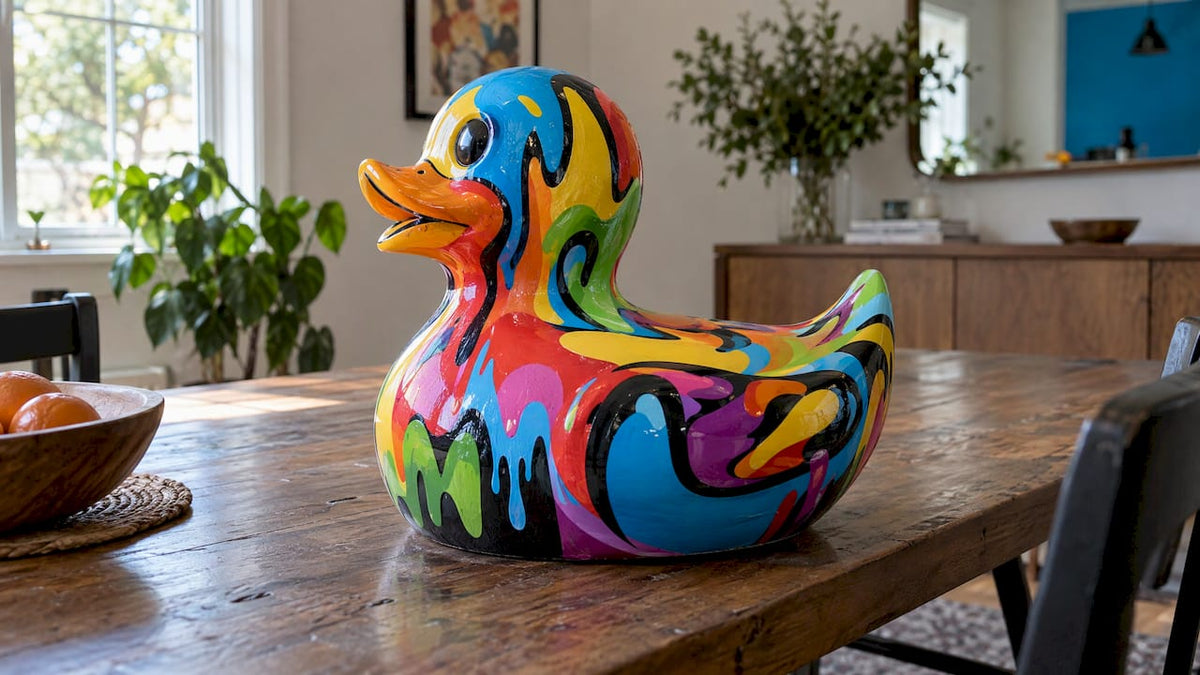
We create handmade, original pop art sculptures, wall art and installations with UV-reactive pigments that glow under blacklight. If your lease or rotation program needs a specific size, mounting approach or theme, a custom glow piece is made for your space, and commissions are open to private collectors, galleries, commercial spaces and public clients. You can also browse sculpture, wall art and UV/glow art that is already made.

Send us your landlord’s display criteria and we can talk through what works for your site.
Our view: plan the paperwork with the art
Facundo Yebne’s work is handmade, and every piece carries UV-reactive pigments, so the way it looks changes with the light around it. That is part of why we think the lease conversation belongs at the start of a project, not the end.
When a collector, hotel or city office commissions a piece from us, the best results come from knowing the site’s rules while the piece is still being designed. Size, mounting and visibility are design decisions, and a lease clause can be a design brief.
Our work has appeared in public exhibitions and received international media coverage, and we make pieces meant to celebrate peace and unity. Art like that deserves a clear written home. Get the approval, the removal terms and any artist agreement on paper, and the piece can simply do its job.
Facundo
FAQ
Can a landlord refuse to let me hang art in my commercial space?
Often the lease says consent cannot be unreasonably withheld, but that applies only to what the lease covers. Art that is fixed to walls or visible from outside usually needs written approval. Hanging pictures inside may need none under a cosmetic alterations clause, up to a stated dollar limit. Read your own lease, and ask an attorney about any dispute.
Do I have to remove art and patch the walls when I leave?
It depends on the lease. Many require repair of damage from removal, and items left behind may be treated as abandoned at your cost. Ask for the landlord’s decision on restoration in the same letter that approves the installation.
How should a seasonal art rotation policy work?
Fix the term length, set-up and removal windows, the approving body and who installs and insures. Public programs, such as a city’s Request for Artists, publish all of these in advance. Add a rule for work left past the removal window.
Does VARA apply to art in a leased commercial building?
It can, if the work qualifies and is incorporated into the building. If it can be removed safely, the owner must try to reach the artist and give 90 days’ notice. If removal would destroy it, a signed written waiver from both artist and building owner is required.
Sources
- Shopping-center lease filed with the SEC
- SEC-filed lease, signage, alterations and fixtures clauses
- Boston office lease filed with the SEC
- Vornado-related office lease, Visual Art section
- SEC-filed lease EX-10.24, specialty alterations
- 31 W. 47th St., LLC v. Nelly’s Fine Jewelry, Inc.
- FAMO, Inc. v. Green 521 Fifth Ave., LLC
- A Tenant’s Guide to Negotiating Sign Rights in a Commercial Lease
- City of Golden Valley, Request for Artists
- SF.gov, Guidelines for Temporary Public Art
- Goshen Public Library exhibit application
- Art at the Gleason policy and contract
- Troutman Pepper Locke, Considerations for New York City Commercial Leases
- Carter v. Helmsley-Spear, Inc., 71 F.3d 77 (2d Cir. 1995)
- Oregon Volunteer Lawyers for the Arts, The Visual Artists Rights Act
- Fordham IP Institute, Second Circuit on 5Pointz damages
- 63 RCNY § 10-03, Landmarks lease notice
- Portland.gov, Title 4 Original Art Murals