Cut Rework Costs: Commission UV Reactive Immersive Art for Hotels
Commission immersive, site-specific art the way you would commission any architectural element: as a managed project with early coordination between design, safety and facilities teams. UV-reactive, two-state sculptural work is one of the most cost-effective ways to make a lobby or bar memorable, since it delivers a completely different look under ambient light and blacklight. Studios that specialize in UV-reactive sculptural work often build this kind of art, but the priorities below apply no matter who you hire: contracts, safety and a realistic timeline.
TL;DR:
- UV-reactive sculptures should be specified with fixtures that support both daytime and blacklight states, including UL/ETL listing, correct IP ratings, and DMX control compatibility.
- A two-stage contract process, with separate design development and fabrication phases, minimizes change orders and clarifies scope, cost, and maintenance responsibilities.
- Installation requires early coordination with code officials, certified riggers, structural calculations, and safety assessments for electrical and UV sources to ensure compliance and safety.
- Budget planning must account for design, materials, engineering, hardware, transport, permits, contingency, and staged payments aligned with project milestones.
- Successful hotel immersive art projects rely on thorough early collaboration, detailed maintenance documentation, and structured contracts, avoiding costly retrofit issues post-installation.
Table of Contents
- Why immersive, site-specific art belongs in lobbies and guest spaces
- Types, materials and lighting to specify for UV-reactive art
- How to plan and procure an immersive art commission
- Installation, safety and compliance checklist
- Budget and realistic timelines
- How to evaluate and select an artist or studio
- Guest experience and engagement with immersive art in hotels
- Integration of immersive art with hotel branding and interior design
- Maintenance and upkeep specific to immersive art installations
- Technology options for immersive art (interactive elements, projection mapping)
- Case studies of successful immersive art projects in hotels
- How Fly Miami Art runs hotel commissions
- Start a commission with Fly Miami Art
- Sources
- FAQ
Why immersive, site-specific art belongs in lobbies and guest spaces
A generic sculpture or print gets noticed once, on arrival, and then fades into the background. Site-specific immersive art keeps working because it’s built for the room: the sightlines, the light, the path guests walk. The strongest hospitality art briefs start with a question about feeling rather than appearance, since work scoped only for opening-day photos tends to lose relevance once the novelty of the space wears off.
Done well, this kind of commission changes how guests experience the property, not just how it looks in marketing shots. It gives staff a reason to talk about the space, gives guests a reason to photograph it, and gives the brand a visual signature that off-the-shelf decor cannot replicate.
Immersive art tends to earn its budget fastest in a few specific zones:
- The entry sequence, where first impressions form in seconds.
- The arrival lobby, where guests wait and look around.
- The bar, where dwell time is longest and lighting is already dramatic.
- Corridors and elevator landings, where repetition can be turned into a visual rhythm instead of dead space.
Types, materials and lighting to specify for UV-reactive art
Immersive hotel commissions generally fall into a few material categories: sculptural pop art, UV-reactive pigment work, digital or projected light elements, and kinetic pieces with moving parts. Each carries different engineering and maintenance implications, so the category should be locked down before fabrication drawings start.
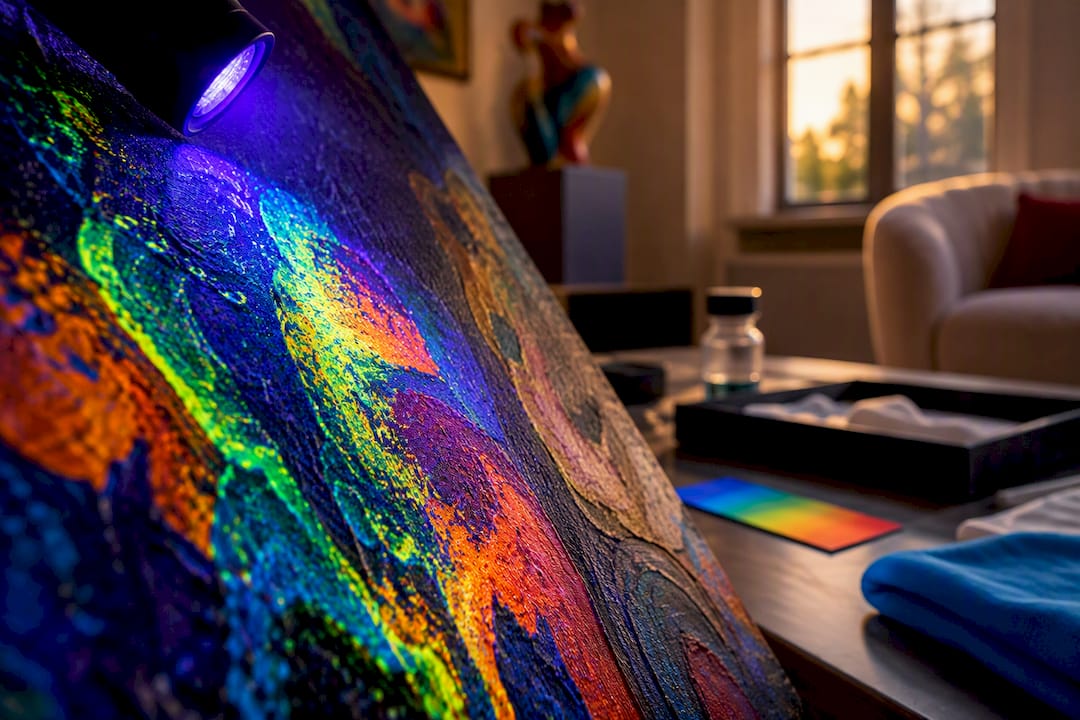
The defining feature of UV-reactive work is that it performs in two lighting states: a daytime or ambient-light appearance, and a blacklight state that reveals hidden pigments and patterns. Specify both states in the design brief and request a walkthrough of each before signing off, since a piece that looks flat under one light setting can undercut the whole install.
On fixtures, ask for documentation, not adjectives. A UV fixture like the Rosco Image Spot UV is a useful reference point: it runs a 365nm LED array, carries an IP65 rating, and supports DMX512 control, which is the kind of spec sheet procurement should request from any lighting vendor on the project.
- Require UL or ETL listings on every fixture used in guest-facing areas.
- Confirm IP ratings match the installation environment, especially near bars or outdoor terraces.
- Ask whether the piece uses DMX control and how that integrates with existing building systems.
- Request finish and coating information so facilities can plan cleaning without damaging UV pigments.
Pro Tip: Ask the studio to demonstrate the artwork under both lighting states on-site before final acceptance, not just in a portfolio video.
Designers specifying lobby sculpture should also review dedicated guidance on requiring two lighting states before finalizing the brief, since the wrong fixture choice at this stage is expensive to correct later.
How to plan and procure an immersive art commission
A two-stage contract structure protects both sides of the deal. The first stage covers design development: concept sketches, material samples, mock-ups and site visits. The second stage covers fabrication, transport and installation, and only gets signed once the concept is locked. Rushing both stages into a single agreement is a common source of change orders and misaligned expectations.
Contract essentials worth writing into either stage:
- A clear scope of work describing what’s being delivered, in what form, and by when.
- A payment schedule tied to milestones rather than calendar dates.
- Intellectual property and reproduction rights, spelled out for both marketing use and any future replication.
- A warranty or defect period covering materials and workmanship after installation.
- As-built documentation and maintenance instructions delivered at handover.
The Erin Hutton Projects guidance on hospitality art contracts lists scope, payment schedule, IP and moral rights, warranty of originality, and maintenance documentation as standard clauses, and recommends getting all of it signed before work begins. The College Art Association’s guidelines for guest artists add that roles, fees, insurance and copyright should be defined in writing from the outset, a practice that also shows up in how federal Art in Architecture procurement structures site visits, final concept approval and maintenance planning around staged, fixed-price contracts.
On the workflow side, map your stakeholders early: the owner, the lead designer or architect and engineer team, facilities management and the artist all need defined approval points. Coordinating with the lead design team during early development avoids the costliest kind of rework, structural or sightline problems discovered after fabrication starts. At handover, require engineering sign-offs, a maintenance schedule, a spare parts list and an operations manual, not just the finished piece.
Installation, safety and compliance checklist
Bring code officials and the authority having jurisdiction into the conversation before fabrication locks in, not after. Any large-scale artwork in a public hotel space needs to respect egress paths and exit visibility, and the NFPA 101 Life Safety Code sets the baseline for exit marking and life-safety features that apply to new and existing buildings alike.
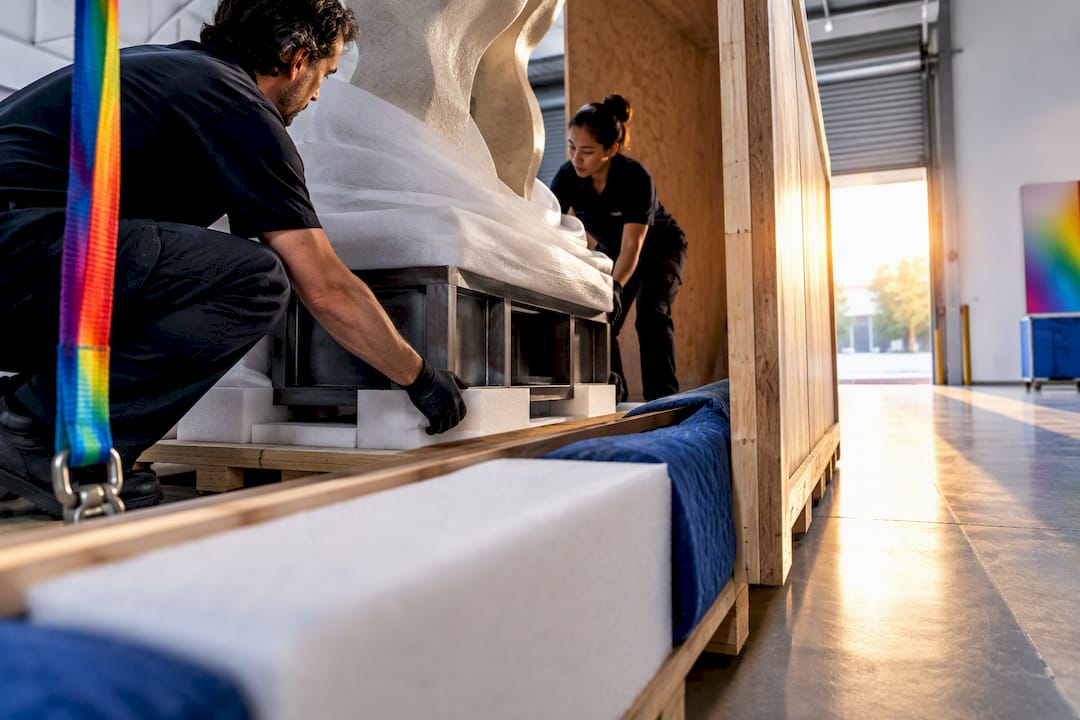
Rigging and structural safety. Any suspended or wall-mounted piece over a certain weight needs structural calculations, certified riggers and, ideally, a third-party inspection before it opens to guests.
Electrical and UV safety. Every fixture should carry UL or ETL listing, UV sources should go through a photobiological risk assessment, and DMX control wiring should be integrated by a licensed electrician, not bundled in as an afterthought.
- Confirm structural calculations exist for any suspended or heavy wall-mounted element.
- Verify certified riggers handle installation, with third-party inspection for larger pieces.
- Require photobiological risk assessment for any UV or blacklight source.
- Collect proof of insurance from the artist or studio before installation begins.
- Run a formal site acceptance test and sign-off before the space reopens to guests.
Kinetic and light-driven installations require compliance across rigging, mechanical safety, electrical standards and documentation, and third-party inspection is a commonly recommended step before these pieces go live in a public space.
Budget and realistic timelines
Budgets for immersive commissions break down into a handful of predictable line items: design fees, materials and fabrication, structural engineering, lighting and control hardware, transport and installation, permits and inspection fees, plus contingency and insurance. Skipping the contingency line is the fastest way to blow a budget once a site condition or fixture substitution comes up mid-project.
Timelines are driven less by the art itself and more by the process around it: site visits and measurement, engineering review and sign-off, fabrication lead times for custom materials, and inspection or insurance windows before opening day. Rather than pinning a project to exact months, phase the schedule around these milestones and build buffer into each one.
- Separate design fees from fabrication costs in the initial proposal.
- Include structural engineering and permitting as distinct budget lines, not bundled into fabrication.
- Build in a contingency percentage acknowledged by both parties before work starts.
- Stage payments to match design development and fabrication/installation phases separately.
How to evaluate and select an artist or studio
Look for hospitality or large-scale installation experience first. A studio that’s only shown work in galleries may not understand egress codes, rigging loads or facilities handover, all of which matter more in a hotel than in a white-cube gallery.
Beyond that, prioritize documented two-state lighting projects, in-house or vetted fabrication capacity, clear insurance and warranty practices, and a track record of delivering maintenance documentation, not just a finished object.
Questions worth asking in an RFQ or interview:
- Can you walk us through a past project’s two-state lighting design, day and blacklight?
- What maintenance and handover documents do you provide at project close?
- Who fabricates the work, in-house staff or subcontractors, and how is quality controlled?
- What insurance coverage do you carry, and what are the limits?
- How do you handle structural engineering for suspended or heavy pieces?
- What’s your standard contract structure, single-stage or two-stage?
- How do you coordinate with our lead designer and architect during design development?
- What’s the expected fabrication lead time for the proposed materials?
- What warranty or defect period do you offer after installation?
- How do you handle on-site changes discovered during install?
- Can you provide references from a comparable hospitality project?
Pro Tip: Treat a missing maintenance plan or reluctance to coordinate with your architect and engineer as a red flag, not a detail to resolve later.
Guest experience and engagement with immersive art in hotels
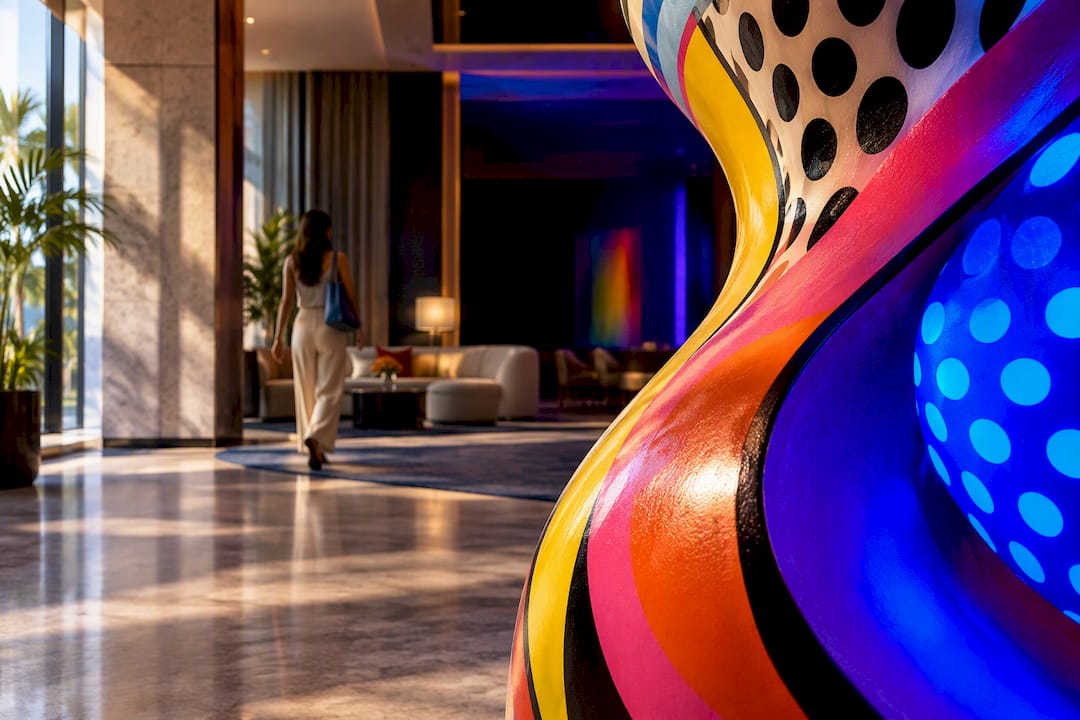
The value of immersive art shows up in how guests move through and linger in a space, not just in what they photograph on arrival. A UV-reactive sculpture that reveals a hidden pattern at night gives returning guests something new to notice, which is a different kind of engagement than a static piece that reads the same every time.
That’s the practical case for scoping art around a feeling over time rather than a single visual moment. Guest experience frameworks in hospitality generally treat every touchpoint, art included, as part of a continuous experience rather than a one-off impression, and a two-state artwork is built to support exactly that kind of repeat engagement.
Bars and lounges tend to get the most out of this dynamic, since guests spend real time in one place and the lighting is already set up to shift through the evening. Lobbies benefit differently: most guests pass through quickly, so the piece needs to register fast and reward a second look on the way out. Corridors and elevator landings, often treated as pure circulation space, can become a quiet, ongoing part of the guest experience if the art is scaled and lit for a shorter dwell time.
None of this requires interactive technology to work. A well-placed sculptural piece with a strong day state and a distinct blacklight reveal already gives staff something to point out and guests something to remember, which is often enough to shift how a space gets talked about.
Integration of immersive art with hotel branding and interior design
Art that’s added after the interior design is finished tends to look added on. The stronger approach treats the artwork as an architectural element from the start, coordinated with the lead designer during early development rather than dropped into a finished room.
That coordination protects two things: the artwork’s fit with the space, and the interior design’s cohesion with the art. A UV-reactive piece needs a lighting plan that accounts for both its day state and its blacklight state, which means the electrical and lighting design has to be worked out alongside the interior scheme, not after it. Waiting until the space is complete to bring in an artist usually means retrofitting fixtures, rethinking sightlines, or accepting a compromise on placement.
Branding fits into this the same way. A hotel’s color palette, materials and overall tone give a commissioned piece its starting brief, and a site-specific commission can pick up motifs, palettes or themes that a stock art purchase never will. This is where the case for commissioning over off-the-shelf decor is strongest: a custom piece can be built around the property’s actual identity instead of a generic aesthetic chosen to offend no one.
Practical coordination points worth locking in early: confirm the artwork’s placement against structural and mechanical drawings, align the piece’s color and material palette with the interior design package, and involve the lighting designer in both the daytime and blacklight lighting plan rather than treating the UV element as an afterthought.

Maintenance and upkeep specific to immersive art installations
UV-reactive and kinetic pieces carry maintenance needs that standard decor doesn’t. Pigments used in blacklight-reactive work can shift in appearance over years of UV exposure, moving parts in kinetic pieces need periodic mechanical checks, and any DMX-controlled lighting needs the same firmware and bulb-life attention as the rest of the building’s lighting systems.
This is why maintenance instructions and as-built documentation matter as much as the artwork itself. A studio should hand over a maintenance schedule, a spare parts list and clear guidance on safe cleaning methods, since the wrong cleaning product on a UV-reactive coating can dull or strip the effect entirely.
Facilities teams should build the artwork into their existing preventive maintenance rotation rather than treating it as a one-time install. That means periodic checks on fixture output, a visual inspection of structural mounting points, and a documented process for who to call if something needs repair. Studios that specialize in immersive exhibition work often publish checklists covering exactly this kind of upkeep, which is worth requesting as part of the handover package rather than assembling from scratch after the fact.
Skipping this step is the most common way a strong opening-day installation degrades within a year or two: fixtures dim, pigments fade unevenly, or a mechanical part sticks, and nobody on staff was ever told how to fix it.
Technology options for immersive art (interactive elements, projection mapping)
Not every immersive commission needs technology beyond lighting, and UV-reactive sculptural work proves that: the two-state lighting effect alone creates a strong sense of transformation without any interactive hardware. That said, some hotels want to go further, and it’s worth knowing the options and their tradeoffs.
Projection mapping adds a layer of moving imagery calibrated to a physical surface, which can make a static sculpture or wall feel animated at set times of day or evening. It requires ongoing content management and a projector maintenance plan, which adds a layer of technical upkeep beyond what a sculptural piece needs.
Interactive elements, motion sensors that trigger a lighting change, or touch points that shift a piece’s appearance, can deepen guest engagement but also add points of mechanical or electronic failure. Any interactive element should go through the same electrical and safety review as the base installation, with clear documentation on how to reset or service it.
For most hospitality settings, the practical answer is to start with a strong two-state UV-reactive piece and treat projection mapping or interactivity as an optional layer to add once the core installation is proven, rather than building complexity in from day one. Simpler systems fail less often and are easier for facilities teams to maintain long after the opening event has passed.
Case studies of successful immersive art projects in hotels
The best-documented public examples of structured art commissioning come from institutional programs rather than hotels specifically, but the underlying process transfers directly. Federal art procurement guidelines describe a structured approach built around artist coordination with architecture and engineering teams, mandatory site visits, detailed final concept submissions and maintenance documentation, all delivered through fixed-price, staged contracts, which is close to the model recommended throughout this guide.
Public art commissioning frameworks outside the federal system follow a similar shape. Guidance from Public Art Online’s commissioning resources recommends a bespoke Art Plan covering vision, site description, selection criteria, management structure, maintenance arrangements and a timetable, essentially the same checklist a hotel procurement team should build before issuing an RFP.
What separates a successful hospitality installation from a disappointing one usually comes down to the fundamentals covered above: early coordination between artist and designer, a two-stage contract that separates concept approval from fabrication, and maintenance documentation delivered at handover rather than requested after something breaks. Properties that skip any of these three steps tend to end up with either a piece that clashes with the finished interior or a piece nobody on staff knows how to maintain once the installing studio has moved on.
How Fly Miami Art runs hotel commissions
Certain artist studios build UV-reactive pop art sculptures designed around two lighting states, the same standard this guide recommends specifying for any hotel commission. The studio’s process follows the procurement steps above: early coordination with the lead design team, a two-stage contract separating concept from fabrication, and maintenance and lighting-state documentation delivered at handover. Readers planning a lobby or bar installation can find more detail in the studio’s hotel art procurement guidance.
— Facundo
Start a commission with Fly Miami Art
If you’re ready to move from planning to procurement, a strong first brief saves everyone time: site photos, the guest experience you’re aiming for, your existing lighting plan, a rough budget range and a target timeline. Some studios work directly from that kind of brief, coordinating with the lead designer from the early concept stage through fabrication and providing maintenance and lighting-state documentation at handover.
- Gather site photos and any existing architectural or lighting drawings before reaching out.
- Note your desired guest experience for the space, entrance, lobby, or bar.
- Share a rough budget and target opening date so the two-stage contract can be scoped realistically.
Browse UV-reactive sculpture examples or start a conversation through the commissions page to request a consultation for your property.
Sources
- Erin Hutton Projects — Art services for hospitality
- GSA — Art in Architecture policies and procedures (Aug 2022)
- Rosco — Image Spot UV datasheet (2024)
- College Art Association — Guidelines for guest artists
FAQ
What makes UV-reactive art a good fit for hotel lobbies?
UV-reactive art shows a completely different image or pattern under blacklight than it does in ambient light, giving one piece two distinct looks. That two-state design rewards repeat viewing, which is useful in spaces guests pass through often, like lobbies and bars.
What should a hotel art contract always include?
At minimum, a scope of work, a milestone-based payment schedule, intellectual property terms, a warranty or defect period and maintenance documentation. Guidance from Erin Hutton Projects and the College Art Association both treat these as standard clauses for hospitality and institutional commissions.
How long does a typical immersive art commission take?
Timelines depend on fabrication complexity, engineering review and inspection scheduling rather than a fixed calendar. A two-stage structure, design development followed by fabrication and installation, helps keep each phase realistic instead of compressing everything into one deadline.
Do hotels need special safety approvals for large art installations?
Yes. Large or suspended pieces need structural calculations and certified rigging, and any installation in a public hotel space should respect the egress and exit-marking requirements in the NFPA 101 Life Safety Code.
Can Fly Miami Art create a custom UV-reactive piece for our property?
Yes, some artist studios offer commissions for site-specific UV-reactive sculpture, working with hotels’ lead designers from concept through installation and handover. Details on the commissioning process are available on the studio’s commissions page.