Protect Large Sculptures Over $5,000: Risk First Shipping for Collectors
Inspect the piece, document every surface and joint with photos, and get an exact weight and footprint before you touch a shipping quote. If the sculpture is insured above $5,000, has glass, thin armatures, or a fixed installation site, hand it to a specialized fine-art shipper instead of a general freight broker. Line up insurance and installation logistics at the same time, not after the truck arrives.
TL;DR:
- For sculptures valued over $5,000, containing glass, thin armatures, or fixed installation sites, specialized fine-art shippers are recommended over general freight brokers.
- Accurate measurements, detailed photos, and notes on disassembly are essential to obtain reliable shipping estimates and avoid damage risks.
- Proper packing varies by material and value, with higher-value or fragile pieces requiring custom foam cradles or wooden crates with internal bracing and moisture barriers.
- International shipments demand precise paperwork, correct HS codes, and experienced customs brokers to prevent delays and ensure proper import-export clearance.
- Using climate-controlled vehicles, detailed condition documentation, and GPS tracking enhances safety, visibility, and claims handling for high-value sculptures during transit.
Table of Contents
- Quick Checklist: Measurements, Photos, and Red Flags Before You Call
- How to Assess the Sculpture: Materials, Structure, and Handling Needs
- Packing and Crating Options: Matching Protection to Risk
- Shipping Modes, Routing, and What Actually Drives Cost
- Insurance and Documentation: How to Avoid Coverage Gaps
- Installation and Final Placement: Coordinating Delivery Day
- How to Get Quotes: The Exact Info and Questions to Request
- Flymiami Studio Perspective: Protecting UV-Reactive Finishes
- Handling and Regulatory Considerations for International Sculpture Shipping
- Customs Clearance and Import/Export Documentation for Artwork
- Best Practices for Tracking Sculptures During Transit
- Environmental and Climate Control During Shipping
- Dealing With Damage or Filing a Claim After Shipping
- The Real Trade-Off: Cost Versus Preservation
- How Flymiami Prepares Every Sculpture for Safe Transit
- Sources
Quick Checklist: Measurements, Photos, and Red Flags Before You Call
Before you request a single quote, gather the facts a shipper will ask for anyway. Skipping this step is the fastest way to get a bad estimate or, worse, a damaged piece.
- Full dimensions: height, width, depth, plus any protrusions like outstretched arms or extended bases.
- A solid weight estimate, even a rough one from the fabricator’s specs or material density.
- Photos from all four sides, plus close-ups of every finish, seam, and attachment point.
- Notes on anything that unbolts, unscrews, or separates into modules.
Certain conditions push a shipment out of DIY territory fast: an insured value over $5,000, glass elements, thin or delicate armatures, or a heavy base integrated into a lighter body. Watch for red flags too. Loose or rattling internal parts, exposed wiring, a center of gravity that sits high and narrow, or bolts anchoring the piece to a specific site all signal you need professional handling before anything moves.
Pro Tip: Shoot a 30-second video walking around the sculpture before it’s touched. It captures scale, existing wear, and attachment points in a way still photos miss, and it becomes your baseline condition record if a claim ever comes up.
How to Assess the Sculpture: Materials, Structure, and Handling Needs
There’s no universal packing method for sculpture, because bronze, resin, welded steel, and mixed-media pieces all fail differently in transit. A universal approach doesn’t exist because material, structural integrity, and weight distribution each dictate a different protection strategy. A solid bronze casting shrugs off vibration but dents on impact. A resin or fiberglass shell cracks under point pressure. Welded steel with thin struts can fatigue at the joints if it’s shipped without internal support.
Finish matters as much as material. UV-reactive coatings and hand-painted surfaces scratch or dull if they touch foam or bubble wrap directly, so a soft-cloth barrier layer between the finish and any packing material is non-negotiable.
Before crating, work through these questions:
- Where is the center of gravity, and does the piece stand safely on its own or need a support jig during handling?
- Which lift points can bear weight without stressing a weld, joint, or thin section?
- Can any component (a base, an arm, a lighting rig) be safely disassembled to reduce bulk and risk?
- Is the weight estimate based on real numbers, or a guess that could be off by hundreds of pounds?
For anything over roughly 300 pounds, or any piece with an unusual weight distribution, bring in a rigger or structural engineer to confirm safe lift points before you schedule a truck. Guessing wrong here is how cranes get overloaded and sculptures get dropped.
Packing and Crating Options: Matching Protection to Risk
Packing tiers scale with value, fragility, and distance. Picking the wrong tier is the single most common way collectors either overpay or under-protect a piece.
- Soft-wrap and inner box. Padded moving blankets or foam sheeting inside a sturdy cardboard box. Fine for small, solid, low-value pieces moving locally, where the ride is short and the handling is controlled.
- Double-box with foam-in-place. An inner box wrapped in soft material, nested inside a larger outer box with expanding foam filling the gap. Reasonable for mid-value, moderately fragile works making a longer domestic trip.
- Carved-foam cradle. A custom-cut foam interior that holds the sculpture in a fixed position with zero shifting room. This is where original, delicate, or higher-value pieces belong, since foam absorbs shock instead of transferring it to the piece.
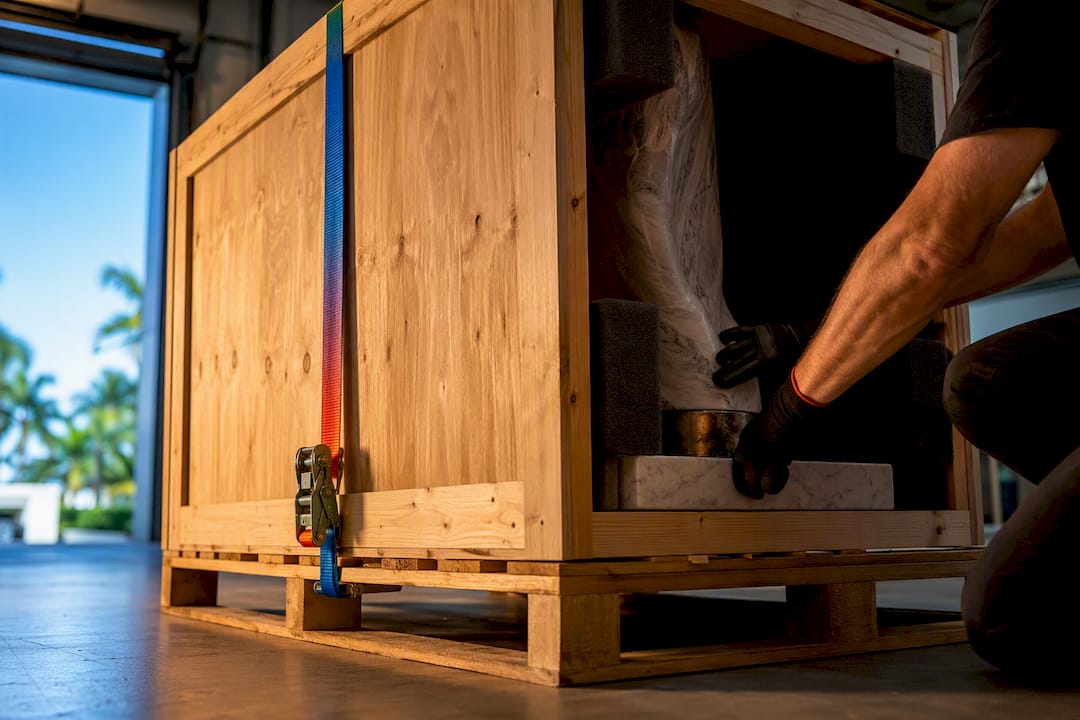
- Custom wooden crate. For international shipments, long-haul freight, or anything genuinely high-value, the industry standard is a crate with a floating platform, bolted closures, a moisture barrier, and tilt indicators that flag mishandling. This construction suspends the sculpture in carved foam rather than letting it bear its own weight against a hard surface.
Whichever tier you land on, the piece needs to be bolted or strapped to a pallet, not just set inside a crate. Add internal bracing so nothing shifts under braking or turbulence, and drop in silica desiccant packs to control humidity inside a sealed wooden crate.
Pro Tip: A crate with a crating warranty is worth paying extra for. It signals the builder stands behind their own joinery, and it usually strengthens your insurance claim if something goes wrong in transit.
Shipping Modes, Routing, and What Actually Drives Cost
The mode you choose depends on size, urgency, and how much handling the piece can tolerate. Four options cover almost every scenario:
- Parcel carriers work for small, crated pieces, but dimensional weight rules (length times width times height divided by a carrier divisor) mean a bulky, lightweight crate can price out far higher than its actual weight suggests.
- Consolidated freight (LTL) with white-glove service is the default for most large domestic sculptures. It typically includes liftgate delivery, in-home or in-gallery placement, and sometimes basic crating.
- Dedicated truck removes the multi-stop handling of LTL, worth the premium for anything fragile or irreplaceable.
- Flat rack or out-of-gauge (OOG) sea freight handles oversize international pieces that won’t fit in a standard container; air freight only makes sense for urgent, high-value, relatively compact works.
Dimensional weight is where budgets get blown. A crate that adds two feet of foam padding on every side can push a shipment into a heavier pricing bracket even though the sculpture itself barely changed weight.
Cost scales with crate volume, distance, and any special equipment required, like a crane or air-ride climate-controlled truck. As a reference point, white-glove service with crating for a large or heavy sculpture can be costly, varying based on service scope and shipment details, while basic consolidated freight without full crating can start lower for shippers who already have their own packing in place.
Insurance and Documentation: How to Avoid Coverage Gaps
Most carriers include some declared-value coverage by default, but it usually comes with tight limits and exclusions that leave real gaps for anything over a few thousand dollars. Third-party fine-art insurers offer broader all-risk coverage and, in most cases, faster claims processing than a carrier’s built-in policy.
Before the piece leaves your hands, assemble a documentation packet:
- A commercial invoice showing declared value.
- A detailed packing list describing the crate and its contents.
- Photos from every angle, taken the day of packing.
- A written condition report, ideally with a matching one done again at delivery.
- A certificate of origin, if the piece is crossing a border.
- The Bill of Lading for freight, or the air waybill for air shipments.
Insurers pay closer attention to how a piece was packed than most collectors expect. A museum-grade crate with a documented condition report and a crating warranty makes a claim far easier to settle than a soft-wrapped box with no paper trail. Skimping on packing to save a few hundred dollars often costs far more if a claim gets denied on the grounds of “inadequate protection.”
Installation and Final Placement: Coordinating Delivery Day
A shipment isn’t finished when the truck pulls away. Delivery includes installation, and skipping that planning step is how pieces sit in a crate for weeks or get damaged during a rushed on-site assembly.
Confirm site readiness before the truck is scheduled:
- Foundation specs and anchor bolt locations, if the piece bolts to a pad or plinth.
- Crane or lift access, including overhead clearance and ground-bearing capacity for heavy equipment.
- Any permitting required for street closures, crane placement, or public-space installation.
Give the rigging crew real lifting specs, not estimates. Exact weight, confirmed lift points, and the sculpture’s center of gravity should reach the crane operator before the day of delivery, not on-site while everyone waits. Once the piece is set, the job still isn’t done. Bolt torque checks, a re-assembly walk-through for any modular components, and a signed post-install condition report close the loop and protect you if a dispute comes up later. For sculptures headed into a gallery or public space, display and installation logistics deserve the same planning attention as the shipping itself.
How to Get Quotes: The Exact Info and Questions to Request
A vague request gets you a vague, unreliable quote. Send shippers a complete packet instead:
- Full dimensions, confirmed weight, and photos of the sculpture from every angle.
- Notes on what disassembles and what doesn’t.
- Photos of the delivery site, including access points and any stairs, narrow doorways, or crane clearance issues.
- Firm dates and exact delivery coordinates.
Then ask direct questions: What crating materials and specs are they using? What does their condition-report process look like, before and after? What insurance options do they offer beyond carrier default coverage? What vehicle type is included, and is it air-ride and climate-controlled? Does the quote include a warranty on the crate itself?
Pro Tip: If a quote comes in noticeably lower than the others, check what’s missing first. Cheap quotes usually skip custom crating, cap insurance at a low default, or leave installation as a separate line item you’ll pay for later.
Flymiami Studio Perspective: Protecting UV-Reactive Finishes
Our studio treats UV-reactive paint as its own category of fragile. A soft-cloth barrier goes between the finish and any packing material, never bubble wrap in direct contact, since the plastic can dull the coating’s glow response over time. Documentation runs deeper too: multi-angle photos, short test videos under blacklight, and, for illuminated pieces, labeled spare parts with wiring notes so an installer isn’t guessing on-site.
Handling and Regulatory Considerations for International Sculpture Shipping
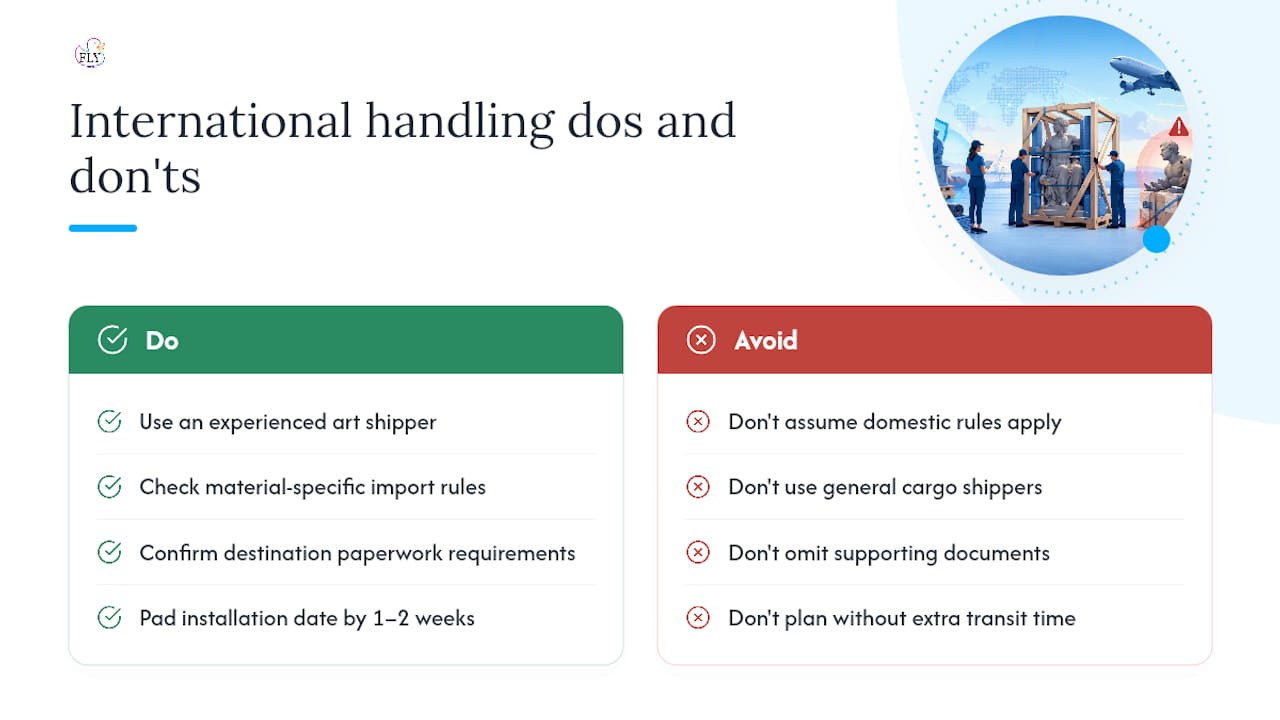
International shipping adds a layer of regulatory exposure that domestic freight simply doesn’t have. Every country sets its own import rules for artwork, and those rules often hinge on the materials used, not just the piece’s value. Sculptures containing certain woods, animal-derived materials, or specific metals can trigger additional inspection or require special permits under wildlife or trade regulations, even when the artwork itself is entirely legal to sell.
Weight and size restrictions also vary by destination port and by carrier. A piece that clears easily through one country’s customs process can sit for extra inspection days in another simply because the paperwork wasn’t formatted to that country’s expectations.
Work with a shipper who has actually handled international art freight before, not just general international cargo. The difference shows up in how they classify the shipment, which affects duty rates, and in whether they know which supporting documents a specific country’s customs office expects to see alongside the standard shipping paperwork.
Build in extra time. International routes involve more handoffs between carriers, freight forwarders, and customs brokers than a domestic shipment does, and each handoff is a point where a sculpture can sit in a warehouse waiting on a signature. Padding your installation date by a week or two against the shipper’s quoted transit time is a reasonable hedge, especially for a first-time international shipment where you don’t yet know how a particular customs office operates.
Customs Clearance and Import/Export Documentation for Artwork
Getting a sculpture through customs cleanly comes down to paperwork accuracy, not luck. A commercial invoice with an accurate declared value is the foundation. Undervaluing a piece to save on duties is a common temptation and a common cause of delay, since customs officers who suspect undervaluation will hold a shipment for review.
Harmonized System (HS) codes classify the artwork for tariff purposes, and getting the code wrong is one of the most frequent triggers for a shipment getting flagged. Missing or incorrect documentation, including HS codes, packing photos, and Bills of Lading, is the leading cause of border delays for large sculpture shipments specifically.
Beyond the commercial invoice, prepare a detailed packing list, the Bill of Lading or air waybill, and, where relevant, a certificate of origin. Original artwork sometimes qualifies for reduced duty treatment in certain countries, but that treatment usually requires supporting documentation proving the piece is an original work by a named artist rather than a mass-produced object. A specialist customs broker who works with fine art specifically, rather than general freight, will know which exemptions apply and how to document them correctly for the destination country.
Best Practices for Tracking Sculptures During Transit
Real-time visibility matters more for a one-of-a-kind sculpture than it does for a standard freight pallet, because there’s no replacement sitting in a warehouse if something goes wrong. Most reputable freight carriers and specialized art shippers now offer GPS tracking on dedicated trucks, giving you location updates throughout the route rather than a single tracking number that updates once a day.
Ask specifically whether the truck itself has GPS, not just the freight company’s dispatch system, since some general carriers only track at the terminal level rather than continuously on the road.
Tilt and shock indicators built into a museum-grade crate serve a tracking function too. They don’t transmit data remotely, but they give you a physical record of whether the crate was tipped or dropped at any point, which is invaluable if you need to compare that record against a condition report at delivery.
For high-value pieces, some fine-art shippers offer scheduled check-in calls at major transit points, particularly for cross-country or international routes with multiple handoffs. It’s worth asking for this explicitly if the shipper doesn’t mention it, since it’s usually not the default service level.
Keep your own paper trail running in parallel. Save every tracking update, every carrier communication, and timestamp your own photos at pickup. If a dispute over timing or handling comes up later, your own records matter as much as the carrier’s.
Environmental and Climate Control During Shipping
Temperature and humidity swings damage sculptures in ways that aren’t always visible right away. Wood bases can warp or crack. Metal surfaces can develop condensation that leads to corrosion. Painted and UV-reactive finishes can experience color shift or surface stress if a sealed crate goes from a cold loading dock into direct summer heat on an open truck bed.
Air-ride, climate-controlled vehicles used by specialized art shippers exist specifically to flatten out these swings, keeping the cargo area within a stable temperature and humidity range regardless of what’s happening outside. That stability matters most on long-haul or multi-day routes where the shipment might pass through several different climate zones.
Inside the crate itself, desiccant packs manage humidity in a sealed environment, absorbing the moisture that would otherwise condense on a metal surface or seep into a wood base. Moisture barriers built into the crate wall add a second layer of protection against humidity swings during transit or while a crate sits in a non-climate-controlled warehouse awaiting the next leg of its journey.
If a sculpture is moving between dramatically different climates (say, a coastal humid region to a dry inland destination) build an acclimation period into your installation timeline. Letting a crated piece sit unopened at the destination for a day before unpacking gives the materials time to adjust gradually rather than being unwrapped straight into a new environment.
Dealing With Damage or Filing a Claim After Shipping
Damage discovered at delivery needs to be documented immediately, before the crate is fully unpacked and definitely before the carrier’s truck leaves. Photograph the crate itself first, noting any external damage, tilt indicator triggers, or signs the crate was dropped or crushed. Then photograph the sculpture as you unpack it, comparing what you see against your pre-shipment condition report.
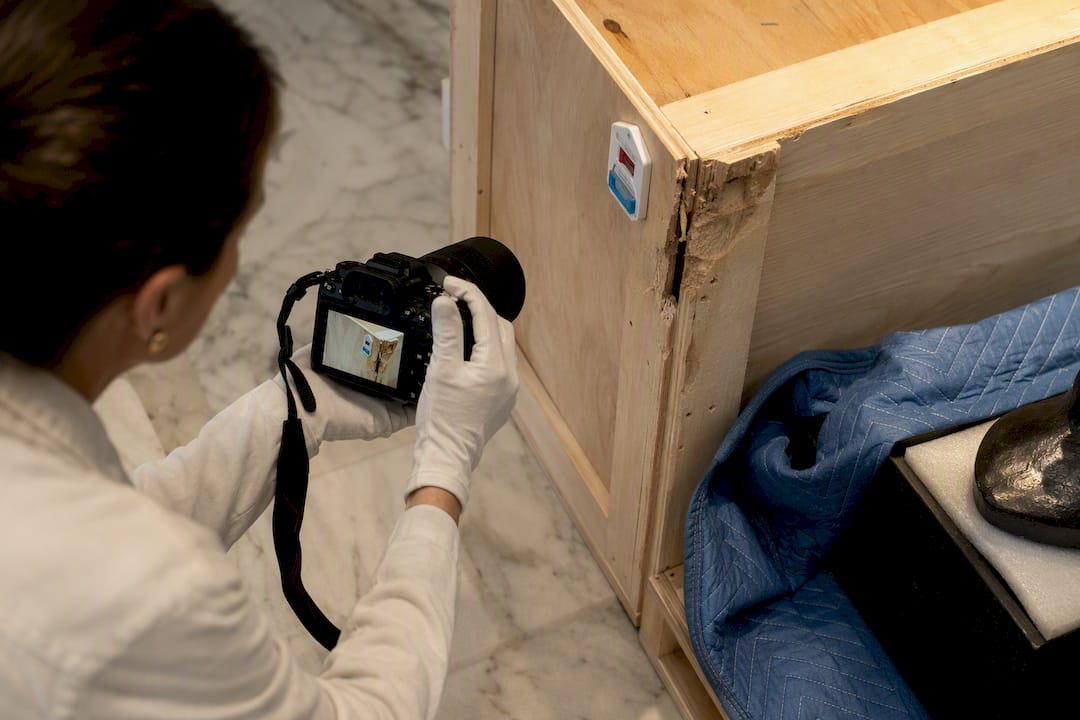
Most claims fail or get delayed not because the damage wasn’t real, but because the paperwork didn’t connect the dots. A condition report from before shipping, matched against clear photos taken at delivery, is the strongest evidence you can hand an insurer or a carrier’s claims department.
Report damage to the carrier and your insurer within the timeframe specified in your policy, which for many carriers is a matter of days, not weeks. Third-party fine-art insurance policies tend to move faster on claims than a carrier’s built-in declared-value coverage, partly because they’re set up to evaluate art-specific damage rather than generic cargo loss.
If the crate itself carried a crating warranty, loop the crate builder into the claim as well. A warrantied crate that failed under normal handling conditions may point to a construction defect, which shifts some liability away from the carrier and toward the packing process itself. Keep every piece of correspondence, every photo, and every report in one file from the moment the sculpture leaves your hands until the claim closes.
The Real Trade-Off: Cost Versus Preservation
Saving a few hundred dollars on packing feels smart until a hairline crack shows up in a base that took three months to cast. The math almost never favors the cheaper option once you account for a piece’s replacement value, and it never accounts for the fact that some sculptures simply can’t be replaced at all. Treat insurance and installation as part of the shipping budget from day one, not as afterthoughts you price out once the truck is already booked. The total cost of moving a sculpture safely includes every stage from crate to final bolt.
— Facundo
How Flymiami Prepares Every Sculpture for Safe Transit
Every Flymiami piece leaves the studio already built for the road ahead. Unlike hiring a separate shipper who’s never seen the work before the pickup date, our team documents condition, packing method, and lifting points during fabrication itself, so the person crating the piece already knows its quirks.
That prep work includes multi-angle photos, test footage under blacklight for UV-reactive finishes, and notes on any component that disassembles for transit, as detailed in this quick setup booth displays checklist relevant for crating and on-site assembly planning. If you’re building a collection or planning an installation, browse the current sculpture collection to see pieces ready to ship, or read through our studio process to understand how a piece is built and documented before it ever reaches a crate. Reach out through the sculpture collection page to request a quote on shipping and installation for a specific piece.
Sources
For deeper technical detail beyond this guide, a few sources are worth bookmarking. Fine Art Shippers’ packing guide breaks down material-specific packing methodology. Sculpture Depot’s crating guide covers museum-grade crate construction in detail. Paragon Logistics explains what a specialist shipper’s condition-report and handling process actually looks like in practice.
- Fine Art Shippers — Best way to ship sculptures internationally: what to consider
- Sculpture Depot — How to pack and ship sculptures safely
- TSI Shipping — How do I ship sculpture?