What Pop Art Teaches Children About Culture
Pop art’s core cultural lessons for children
Pop Art teaches children that culture is everywhere: in a soup can, a comic strip, a celebrity face on a billboard. That’s the movement’s most direct lesson, and it lands with kids in a way that traditional fine art rarely does. By starting with images children already recognize, Pop Art bypasses the intimidation factor that keeps many young people from engaging with art at all.
Here’s what children actually take away from studying Pop Art:
- Visual literacy: They learn to read images the way they read words, asking who made this, why, and what it’s selling them.
- Media critique: Pop Art’s roots in advertising and mass media give children a framework for questioning the commercial images they see every day.
- Cultural identity: Choosing their own icons for art projects teaches children that their personal world, their favorite foods, musicians, and objects, is a legitimate subject for serious creative work.
- High vs. low culture: Pop Art bridges high and low culture, showing children that comic books and Campbell’s Soup cans belong in galleries just as much as oil paintings.
- Empathy and perspective: Encountering art from different cultural backgrounds through the Pop Art lens helps children recognize that other people’s everyday lives are just as rich and worth examining.
- Creative confidence: Making their own Pop Art, rooted in things they care about, builds the kind of self-expression that carries into every subject they study.
Dr. Kerry Freedman of Northern Illinois University puts it plainly: children need to know more about the world than what they can learn through text and numbers alone. Visual arts knowledge helps kids become smart consumers in a world saturated with marketing logos and digital imagery. Pop Art is the most direct path to that knowledge.
What is Pop Art, and why does it work so well with kids?
Pop Art emerged in the mid-20th century in both the United States and the United Kingdom as a deliberate reaction against abstract expressionism. Artists were tired of art that felt remote and inward. They wanted to make work that reflected the actual world around them: television, advertising, supermarkets, celebrities, and mass-produced goods. The result was a movement built on bold colors, repetition, familiar commercial imagery, and a healthy dose of irony.
What makes Pop Art so effective as a teaching tool is precisely what made it controversial when it first appeared. It looks accessible. A child can look at Andy Warhol’s Campbell’s Soup Cans and immediately recognize the subject. That recognition is the entry point. Once a child feels comfortable with the image, the real conversation can begin: Why did the artist choose this? What does it say about what we buy, what we value, and who we are?
Key characteristics that make Pop Art immediately engaging for children:
- Bold, saturated colors that grab attention and invite participation
- Repetition of images, mimicking how advertising works on our brains
- Familiar subjects drawn from comic books, food packaging, celebrities, and everyday objects
- Flat, graphic style that feels approachable rather than technically intimidating
- Commentary on consumerism embedded in images children already see daily
Pop Art’s cultural relevance today is undeniable. The same forces that inspired Warhol and Lichtenstein, mass media saturation, celebrity culture, advertising overload, are more present in children’s lives now than ever. That’s not a problem for teaching Pop Art. It’s an advantage.
Five Pop artists every child should know
Introducing children to the people behind Pop Art transforms it from a style into a story. Each of these artists brought a distinct cultural perspective, and together they show children that art can come from anywhere and anyone.
Andy Warhol
Warhol is the name most people associate with Pop Art, and for good reason. His Campbell’s Soup Cans (1962) and Marilyn Diptych (1962) turned grocery store shelves and celebrity photographs into gallery-worthy subjects. For children, Warhol’s work raises an immediate and genuinely interesting question: if you paint a soup can 32 times, is it art? Warhol’s answer was yes, and his reasoning, that mass production and consumer culture are the defining forces of modern life, gives children a concrete framework for thinking about their own world.
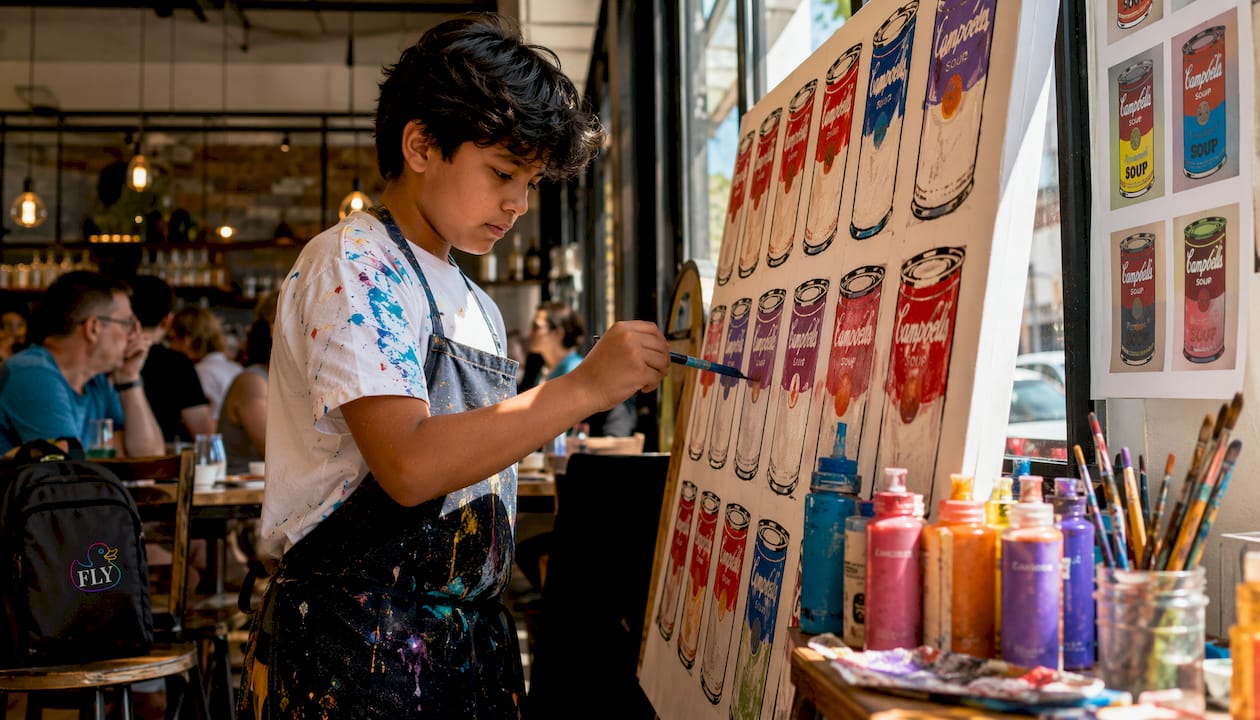
His technique of screen printing, repeating an image in different color combinations, is also one of the most accessible for classroom projects. Children can replicate the effect with stamps, stencils, or even potato prints.
Roy Lichtenstein
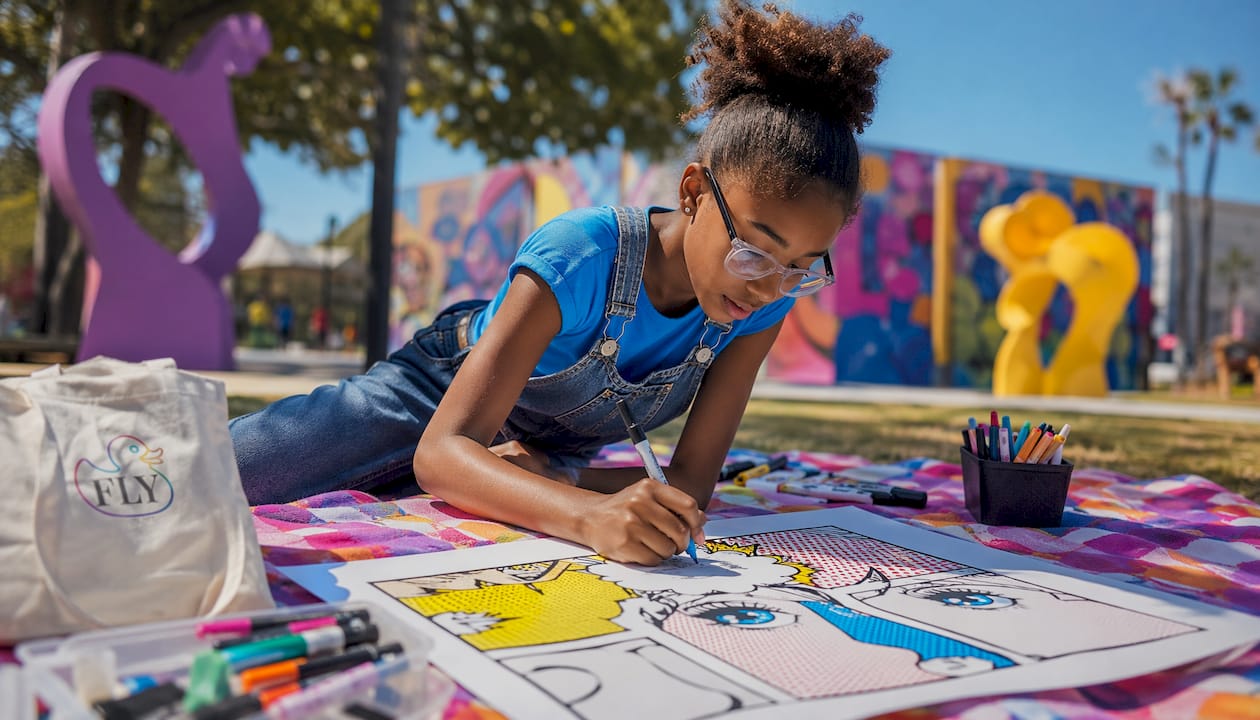
Lichtenstein took comic strips and blew them up to monumental scale, complete with Ben-Day dots, thick black outlines, and speech bubbles. His paintings look like panels from a comic book, but at six feet tall. That scale shift is itself a lesson: when you change the context of something familiar, you change how people think about it.
For children who love comics, Lichtenstein’s work is a revelation. Their hobby isn’t just entertainment. It’s a legitimate art form with a place in major museums. His approach also makes the Ben-Day dot technique one of the most popular Pop Art activities in classrooms, achievable with a pencil eraser dipped in paint.
Yayoi Kusama
Kusama brings a perspective that expands Pop Art’s cultural scope beyond its American and British origins. Her immersive installations and obsessive dot patterns draw from her Japanese heritage and her personal experience with visual hallucinations, which she transformed into art rather than suffering through in silence. For children, Kusama’s work demonstrates that art can come from deeply personal experience and still connect with millions of people across cultures.
Her “Infinity Mirror Rooms” are among the most visited art installations in the world, and children respond to them viscerally. The experience of standing inside a room that appears to extend infinitely in every direction is unforgettable, and it opens conversations about perception, identity, and how different cultures understand space and self.
Keith Haring
Haring started drawing in New York City subway stations in the early 1980s, using chalk on blank advertising panels. His figures, bold, cartoonish, and always in motion, were designed to be read instantly by anyone walking past. That democratic impulse is central to his work: art should be for everyone, not just people who can afford gallery tickets.
His social messages, addressing AIDS awareness, apartheid, drug abuse, and nuclear disarmament, give educators a way to connect Pop Art to real-world issues without losing the visual accessibility that makes his work so appealing to children. Haring’s public art approach also opens a natural conversation about the difference between street art and gallery art, and why that distinction matters less than the message.
Jean-Michel Basquiat
Basquiat’s work is the most complex of the five, and also the most culturally specific. A Haitian-American artist who rose from the streets of Brooklyn to the international art world in the early 1980s, Basquiat used his paintings to confront racism, colonialism, and the erasure of Black history. His canvases are dense with text, symbols, and references to African and Caribbean culture alongside American pop imagery.
For children, Basquiat’s work is a powerful demonstration that art can be a form of protest and self-assertion. His story, a young Black artist who refused to be ignored, resonates with children from marginalized backgrounds and challenges all children to think about whose stories get told and whose get left out.
Pro Tip: When introducing Basquiat to children, start with his SAMO© graffiti tags and ask children to create their own symbol or “tag” that represents something important to their identity. It’s a low-stakes entry point into his much larger cultural conversation.
| Artist | Cultural background | Core lesson for children |
|---|---|---|
| Andy Warhol | American, working class roots | Consumer culture and mass production as art subjects |
| Roy Lichtenstein | American | Mass media and comics as legitimate art forms |
| Yayoi Kusama | Japanese | Personal experience and cultural heritage as creative fuel |
| Keith Haring | American | Art as public communication and social activism |
| Jean-Michel Basquiat | Haitian-American | Art as cultural identity and resistance |
Hands-on Pop Art projects that teach culture through making
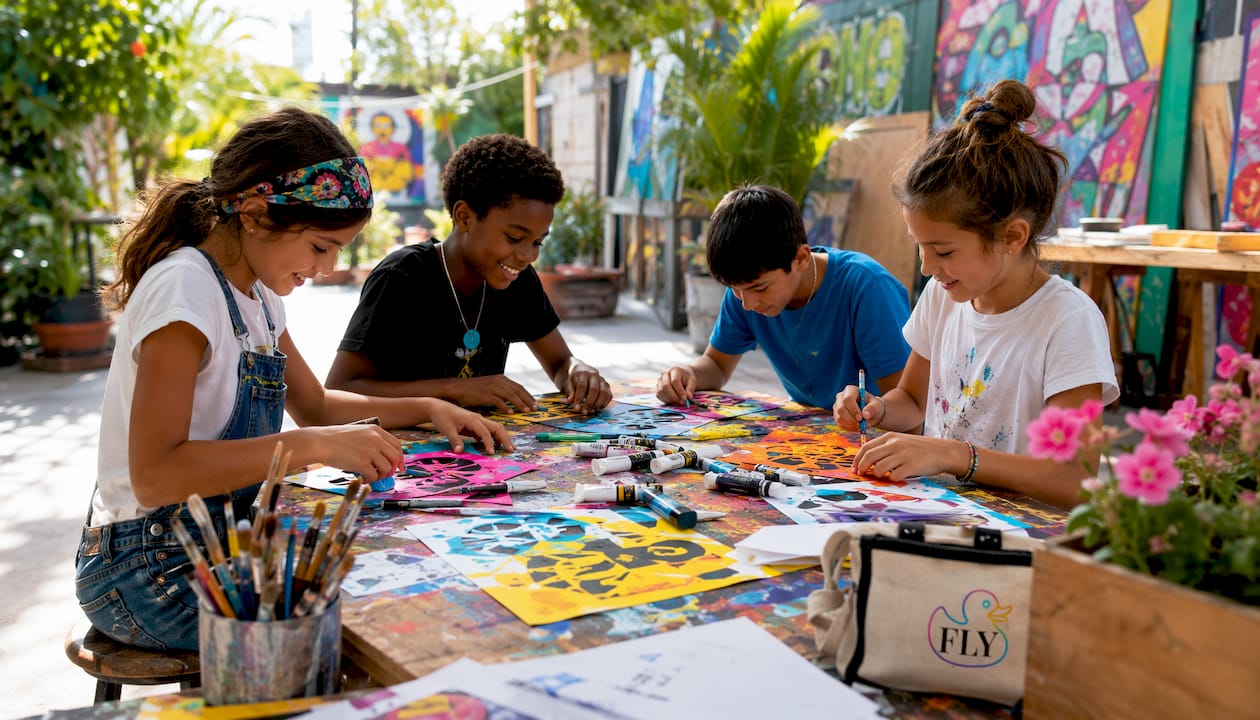
The most effective way to teach cultural understanding through Pop Art is to have children make it. Not copy it. Make their own version, rooted in their own cultural world. The projects below are designed for that purpose.
Pro Tip: Focus on why a child chose their subject, not how technically polished the result looks. The cultural thinking happens in the choosing, not the finishing.
Projects organized by technique
1. Warhol-style repetition prints
Children choose one object from their daily life, a favorite snack, a shoe, a phone, and reproduce it in a grid of four or nine, each in a different color combination. The discussion afterward is where the learning happens: Why did you choose that object? What does it say about your life? How does repeating it change how you feel about it?
2. Lichtenstein comic panels
Children draw a scene from their own life in comic-book style, with Ben-Day dots (pencil eraser dipped in paint), thick outlines, and a speech bubble. The subject should be something culturally specific to them: a family meal, a neighborhood landmark, a conversation in their home language. This grounds the technique in personal cultural experience rather than generic imagery.
3. Haring-inspired public message murals
Working in groups, children design a mural using Haring’s bold figure style to communicate a message they care about. The group process itself teaches cultural dialogue: children have to negotiate whose message gets included and how to represent it visually.
4. Basquiat text-and-symbol collages
Children create a canvas that combines words, symbols, and images that represent their cultural identity. They might include words from a language spoken at home, symbols from their family’s heritage, or images of people and places that matter to them. The result is a personal cultural map in Pop Art form.
5. Kusama dot installations
Give children circular stickers in multiple colors and a large sheet of paper or a section of wall. Ask them to create a pattern that feels like their own visual language. Then display the results together as a group installation. The collective effect, dozens of individual dot patterns forming a larger whole, is a natural metaphor for cultural diversity.
6. Warhol food and consumer goods drawings
Children draw their favorite food or a product from their home, then discuss what that choice reveals about their culture and family. This activity works especially well when children come from different cultural backgrounds, because the variety of objects chosen becomes a conversation starter about how different families live.
7. Class Pop Art exhibition
Children curate and display their work, writing a short statement explaining the cultural choices behind their piece. Process-based curation like this teaches children to articulate their cultural perspective and respect the perspectives of their classmates. It also replicates the real-world experience of an art exhibition, giving children a sense of the cultural weight their work carries.
Additional project ideas worth incorporating:
- Magazine montage collages in the style of Richard Hamilton, using images from current advertising
- Word-as-image paintings where children choose a word with personal cultural significance and render it as a visual object
- Soft sculpture of a personally meaningful object, inspired by Claes Oldenburg’s oversized everyday items
- Advertisement redesign projects where children take a real ad and reinterpret it to say something different about the culture that produced it
Why Pop Art works: what educators and research tell us
Pop Art’s effectiveness as a teaching tool isn’t just intuitive. It’s backed by research on how children learn, how art affects development, and how cultural education actually sticks.
The core reason Pop Art works is that it starts with material children already know. Experts note that beginning with recognizable images lets children bypass the intimidation that surrounds fine art and move directly to forming their own social critiques. That’s a significant pedagogical advantage. Most children shut down when they feel out of their depth. Pop Art keeps them in the conversation.
The research on arts education more broadly supports what Pop Art teachers observe in classrooms. A randomized controlled trial across 42 elementary and middle schools in Houston, Texas found that arts learning reduces disciplinary infractions, improves writing achievement, and increases students’ emotional empathy. Children in elementary schools also showed increases in school engagement and college aspirations. Those aren’t outcomes you’d expect from a subject often treated as supplementary.
Arts engagement also connects directly to self-esteem. A large-scale study analyzing data from 6,209 children found that drawing, painting, or making things was associated with higher self-esteem at age 11, and that this relationship held regardless of the child’s ability level. The engagement itself, not the quality of the output, drove the benefit. That finding directly challenges the instinct to grade children’s Pop Art on technical merit.
Pop Art also teaches children to move past the question “Is this good art?” toward the far more useful question “What does this art say about the culture that made it?” Educators emphasize that this shift from aesthetic judgment to cultural critique is where media literacy actually develops. Children who can ask that question about a Warhol print can ask it about a TikTok video or a fast-food advertisement.
Pro Tip: When children say a Pop Art piece “looks too simple,” turn that observation into a question: “If it’s so simple, why did the artist choose this exact object?” That single question moves the conversation from aesthetics to cultural analysis every time.
One persistent misconception worth addressing directly: Pop Art is not copying. Teachers at the Yale Teachers Institute have long stressed that the biggest teaching challenge is helping children understand that Pop Art artists made deliberate choices about what to depict and why. Warhol didn’t paint soup cans because he couldn’t think of anything else. He painted them because they were the most democratic, universally recognized object in American life. That intentionality is what children need to understand, and it’s what separates a cultural lesson from a craft project.
Media literacy, the ability to decode the cultural messages behind commercial imagery, is increasingly recognized as a core skill for children growing up in a digital world. Pop Art grounds media literacy in something children can see and touch, making abstract concepts like “advertising persuasion” or “cultural representation” concrete and discussable. The same critical thinking that helps a child analyze a Lichtenstein painting helps them question why a social media algorithm keeps showing them certain content. That transfer is the real educational payoff, and it’s why media criticism skills developed through art education matter well beyond the classroom.
Pop Art also opens doors to discussions about cultural diversity that can feel forced or awkward when approached directly. When children examine Basquiat’s references to African and Caribbean history, or Kusama’s Japanese aesthetic sensibility, they encounter cultural difference through the neutral ground of art. The work does the introducing. The teacher facilitates the conversation. That’s a much more natural pathway to cultural understanding than a lecture about diversity.
Key Takeaways
Pop Art teaches children that culture lives in everyday objects, and that learning to read those objects critically is one of the most useful skills they can develop.
| Point | Details |
|---|---|
| Familiar images build confidence | Pop Art starts with objects children already know, removing intimidation and enabling immediate cultural critique. |
| Arts learning improves development | A randomized trial across 42 schools found arts education reduces disciplinary issues and increases emotional empathy. |
| Self-esteem grows through making | Research found that engaging in drawing and making things is linked to higher self-esteem in children around age 11, regardless of ability. |
| Cultural critique beats aesthetic judgment | Shifting children from “Is it good?” to “What does it say about culture?” is where media literacy actually develops. |
| Process matters more than product | Children who explain why they chose their subject develop deeper cultural thinking than those focused on technical finish. |
Bring Pop Art’s cultural energy into your space
Flymiami brings the same cultural energy that makes Pop Art such a powerful teaching tool into handcrafted, UV-reactive sculptures designed to spark conversation and wonder. Artist Facundo Yebne’s work celebrates the everyday icons and vibrant color that define the movement, with an added dimension: hidden patterns and colors that reveal themselves under blacklight, turning each piece into an immersive experience.
Whether you’re looking for a bold wall art piece that anchors a room with cultural meaning, or a sculptural work that children and adults can explore together, Flymiami’s collection brings Pop Art’s lessons off the page and into your home or classroom. Each piece is handcrafted, one of a kind, and built around the same themes that make Pop Art so enduring: identity, popular culture, and the beauty hiding in plain sight.