Commission Nightclub Glow Art for Collectors, 5–14 Week Timeline
Nightclub glow art, meaning UV-reactive pop art that glows under blacklight, is a legitimate gallery-grade investment for collectors, hotels, galleries, and brands, but only when the display site can actually support a blacklight or dual-lighting setup, if your space checks that box, the fastest path forward is a commission brief or a look at FLY Miami Art’s UV/Glow Art collection to see how the effect works at scale before you buy or commission.
TL;DR:
- Custom UV-reactive glow art is most effective when the display space supports both blacklight and ambient lighting, allowing the piece to reveal hidden imagery under specific conditions.
- Commissioning involves a staged process from concept approval to mockup, fabrication, and installation, with site-specific details significantly influencing timelines and costs.
- Material choices like resin castings and layered pigments affect the glow intensity, durability, and conservation needs, requiring specific lighting specifications such as wavelength and lux levels.
- Larger, site-specific glow sculptures are more cost-efficient per square inch, but project complexity and installation considerations can significantly impact overall pricing.
- Accurate preparation, including site photos, measurements, and lighting conditions, reduces revisions and ensures the glow effect works effectively in both daytime and night-time views.
Table of Contents
- When Does UV-Reactive Pop Art Make Sense for Your Space?
- How Does the Commissioning Process Work From Brief to Install?
- What Materials and Lighting Specs Actually Control the Glow?
- What Does Installing and Maintaining Glow Art Actually Involve?
- How Much Should You Budget and How Long Does It Take?
- How to Commission or Buy From FLY Miami Art
- An Artist’s Note on Why This Medium Matters
- Sources
- FAQ
When Does UV-Reactive Pop Art Make Sense for Your Space?
UV-reactive pop art earns its place when a room can hold two identities: one under normal light, one under blacklight. That dual life is the entire point of the medium, and it shows up in a handful of recurring use cases.
- Private focal sculptures. Collectors use a single glow piece as the anchor of a room, often in a media room or hallway where lights can be dimmed on demand.
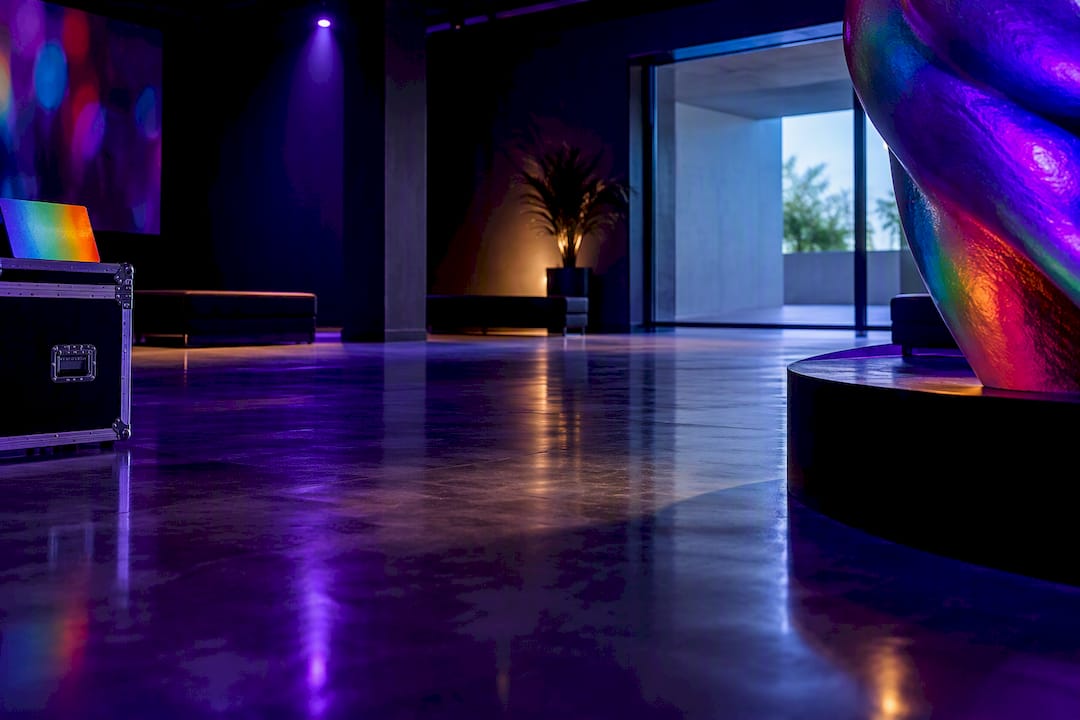
- Lobby and hospitality statements. Hotels install glow sculptures where guests pass through both daylight and evening lighting states.
- Brand activations. Companies commission pieces for launch events or flagship retail spaces where the glow reveal becomes part of the brand story.
- Gallery exhibitions. Curators build entire rooms around the contrast between ambient viewing and blacklight reveal.
- Site-specific public commissions. Institutions place glow work in plazas, museum wings, or civic buildings where nighttime programming matters.
Before committing, walk the room and check sightlines, ambient daylight leakage, viewing distance, and typical footfall patterns. A piece meant to be seen from across a lobby needs different scale and pigment density than one meant for close viewing in a private collection. Glow art also differs from decorative LED strips or neon signage in a fundamental way: decorative lighting illuminates a space, while strategic lighting and display planning for three-dimensional glow artworks reveals hidden imagery baked into the piece itself. That distinction is exactly why a commission adds value over off-the-shelf decor. A commissioned piece is built around your room’s specific light behavior, not a generic glow effect dropped into whatever space happens to buy it.
How Does the Commissioning Process Work From Brief to Install?
Commissioning a custom glow piece follows a predictable arc, and knowing the stages ahead of time keeps budgets and timelines realistic.
- Concept. You share your brief, the studio proposes themes and composition, and you approve a direction before any material is touched.
- Mockup. A visual or small-scale sample shows how the piece behaves under both ambient and blacklight conditions.
- Fabrication. The studio builds the final piece, layering UV-reactive pigments into the substrate according to the approved mockup.
- Installation. The piece ships and mounts on-site, with lighting calibrated to your room’s actual conditions rather than a showroom guess.
Corporate and commercial commissions in particular need airtight paperwork. At minimum, your contract should nail down scope and creative boundaries, timeline with penalty clauses for delays, a payment schedule tied to milestones, insurance covering transit and installation, IP and licensing terms for photographing or reproducing the piece, and who owns ongoing maintenance obligations. Clear scope language prevents the kind of feature creep that blows commercial art budgets, and it’s worth coordinating early with engineers or safety officers on anything large enough to need structural review.
Before your first call with the studio, gather site photos, exact dimensions, a budget range, and your preferred viewing conditions (is this a blacklight-only room, or does it need to read well in daylight too?). Design briefs that include room photos, precise measurements, and a firm installation date consistently produce fewer revision rounds than vague verbal requests.
Pro Tip: Photograph your intended wall or floor space at the exact time of day you expect guests to view the piece. Lighting at 2 p.m. and 9 p.m. can look like two different rooms, and the studio needs to design for both.
What Materials and Lighting Specs Actually Control the Glow?
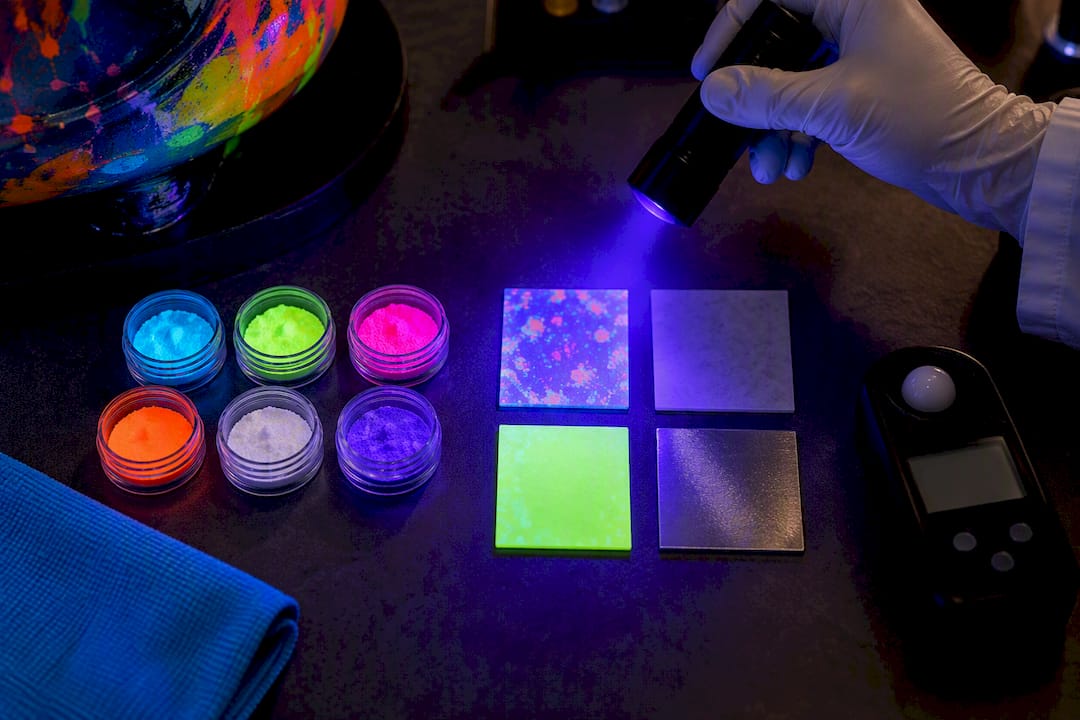
The glow effect comes down to pigment chemistry layered against a substrate, and how that layering is built determines whether your piece looks flat or genuinely dimensional under blacklight. UV-reactive pigments react to specific wavelengths, so pieces built with layered application typically show a stronger day/night contrast than pieces where glow pigment is simply mixed into a single coat. Ask any artist about lightfastness ratings before committing. Pigments that fade under repeated blacklight exposure will lose their punch within a few years of heavy display use.
Substrate choice shapes both appearance and conservation needs:
- Resin castings hold fine detail and glow pigment well but need protection from prolonged direct sun, which can yellow the surface over time.
- Mixed media pieces offer texture variation but require more detailed conservation notes since different materials age differently.
- Painted sculpture gives the most control over color layering but demands periodic inspection of the paint bond.
For lighting, request specifics rather than accepting “blacklight installed.” Ask for the blacklight wavelength used, target lux ranges for both the blacklight state and the ambient viewing state, and the CRI rating for any non-blacklight illumination. Designers commissioning hotel lobby sculpture are increasingly told to require two distinct lighting states, one that keeps the piece legible during the day and one that triggers the glow reveal at night. FLY Miami Art’s own technical guidance points to CRI 90+ and a roughly 30-degree lighting angle as a starting point for accenting sculptural texture without washing out pigment under standard gallery light.
What Does Installing and Maintaining Glow Art Actually Involve?
Large glow sculptures come with the same physical demands as any commercial sculpture, plus a few extras specific to UV-reactive material.
- Weight and mounting. Confirm weight limits for your wall or floor, and use mounting hardware rated for the piece; anything oversized should get a rigging or structural engineer review before installation day.
- Safety checks. Public and hospitality installations need tamper-resistant mounting so guests can’t shift or damage the piece.
- Cleaning. Most UV-reactive surfaces need dry or lightly damp cleaning methods; harsh solvents can strip pigment layers.
- Inspection cadence. Set a recurring check, quarterly for high-traffic commercial sites, to catch pigment fading or mounting wear early.
- UV exposure limits. Continuous blacklight exposure accelerates pigment fatigue, so scheduled “off” periods extend a piece’s usable life.
- Insurance. Commercial and public placements should carry coverage that accounts for both the art’s value and installation liability, following the documentation standards used for sculpture collecting generally.
Hospitality and public sites benefit most from conservation-grade materials and tamper-resistant fixtures specified up front, since retrofitting a fragile mount after installation is far more expensive than building it in from the start.
How Much Should You Budget and How Long Does It Take?
Pricing for custom glow commissions tends to follow the same logic as broader sculpture and commissioned art: larger pieces carry a lower cost per square inch than small ones, because base labor and setup costs get spread across more surface area. Material complexity, layered pigment work, and installation difficulty (rigging, structural review, multi-day setup) all push the number up from there.
- Small commissions (tabletop to wall-mounted pieces) typically move fastest through concept and fabrication.
- Medium commissions (lobby-scale sculpture) commonly run somewhere in the 5 to 14 week range depending on material complexity.
- Large or site-specific commissions need the longest runway, and buyers should build in buffer time for structural review and multi-stage installation.
One procurement note worth flagging: the 15 to 20 percent trade discount that applies to inventory purchases usually does not carry over to bespoke commissions. Negotiate commission pricing on its own terms rather than assuming standard trade rates apply.
How to Commission or Buy From FLY Miami Art
The studio works directly with collectors, galleries, hotels, brands, and public institutions on custom UV-reactive commissions, alongside a standing collection of originals, wall art, and sculpture already built and ready to view. If your space already fits the glow-art profile, browsing the UV/Glow Art collection gives you a real sense of how pigment layering behaves under blacklight before you commit to a custom brief.
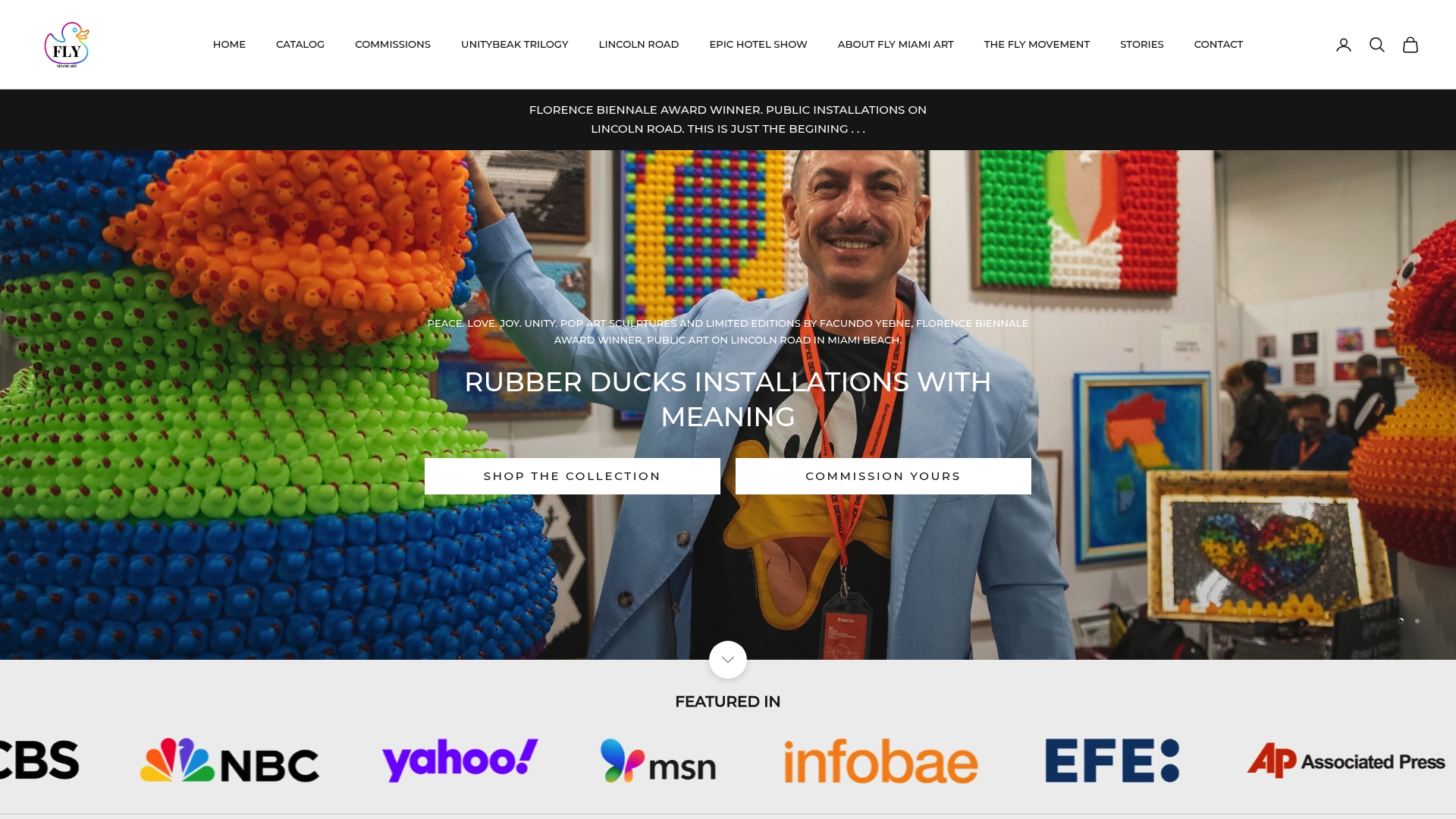
If you’re commissioning instead of buying an existing piece, your brief should include site photos, exact dimensions, your target budget range, and whether the space needs a daytime-legible state alongside the glow reveal. Send that information through Flymiami and the studio will respond with a consultation, a realistic timeline, and a quote scoped to your site conditions rather than a generic price sheet. Buyers looking for a finished, ready-to-ship piece can start directly with the custom glow piece page or browse Originals and Sculpture for work already built to gallery and hospitality standards. Either route puts you in direct contact with the studio behind the piece, not a reseller layer between you and the artist.
An Artist’s Note on Why This Medium Matters
The glow reveal isn’t a gimmick bolted onto a sculpture. It’s built to mirror how peace and unity themes hide in plain sight until the right light draws them out. Media coverage of exhibitions has helped collectors trust that the technique holds up outside the studio, and that credibility is often why institutions commission a custom piece rather than settle for something mass produced.
— Facundo
Sources
For deeper reading beyond this guide, the Artwork Archive sculpture-collecting overview covers documentation and conservation records. The Artfolio corporate commissioning guide breaks down contract scope and insurance. The BertaArt trade guide is useful for briefing checklists and timeline expectations.
- Beyond the frame: how to add contemporary sculpture to your art collection — Artwork Archive
- Corporate art commissions guide 2025 — Artfolio
- Commissioning custom art: a trade guide for designers — BertaArt
- Custom art for commercial real estate in 2026 — TurningArt (blog)
FAQ
What Makes Pop Art “Glow” Under Blacklight?
The piece is built with UV-reactive pigments layered into the substrate, which react to blacklight wavelengths and reveal imagery invisible under normal light. Lightfastness and pigment density determine how strong that contrast stays over years of display.
How Long Does a Custom Glow Commission Take?
Mid-size commissions commonly run 5 to 14 weeks from concept approval to installation, with larger or site-specific pieces needing more buffer time. Sending complete site photos and dimensions at the first call is the biggest factor in keeping that timeline realistic.
Does FLY Miami Art Sell Ready-Made Pieces or Only Commissions?
FLY Miami Art offers both. Collectors can buy directly from the Originals, Wall Art, and UV/Glow Art collections, or start a custom commission through Flymiami.
What Lighting Do I Need to Display Glow Art Properly?
You need a blacklight source at the right wavelength for the piece’s pigments, plus a separate ambient lighting plan, ideally CRI 90+, for daytime viewing. Many designers now specify two distinct lighting states for lobby and public installations so the piece reads well in both conditions.
How Much Does a Custom Glow Sculpture Cost?
Pricing depends on scale, material complexity, and installation needs, and current commission pricing is available directly through FLY Miami Art. Larger commissions typically cost less per square inch than small ones, though standard trade discounts generally don’t apply to bespoke work.