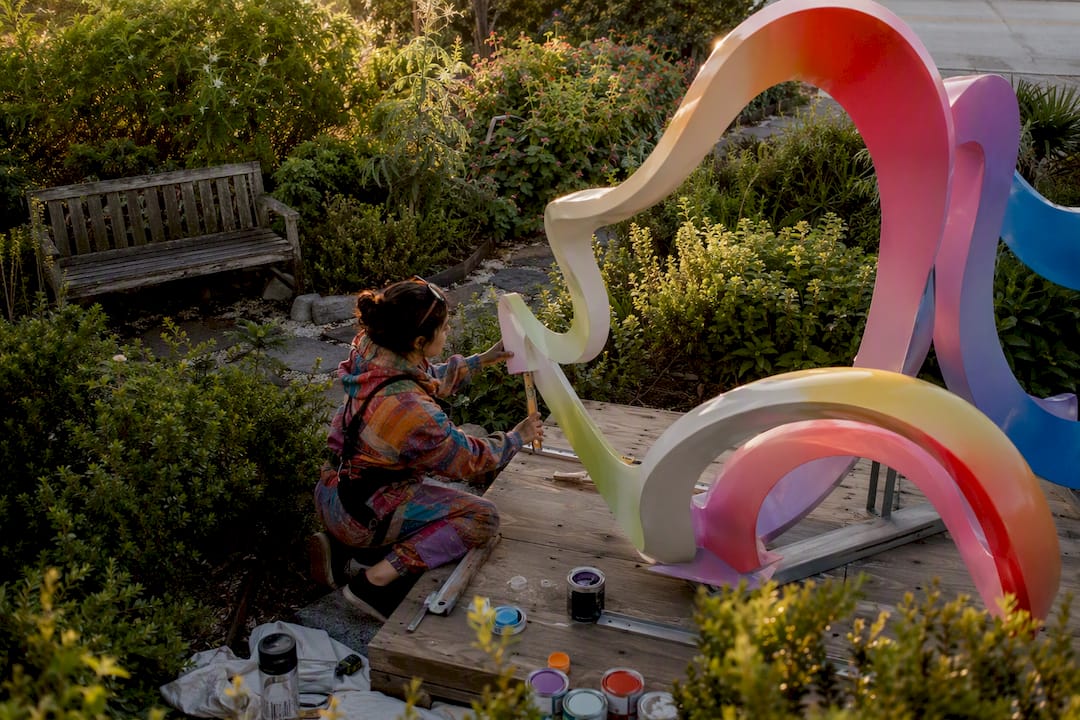
Designers: Require Two Lighting States for Hotel Lobby Sculpture
A hotel lobby sculpture succeeds when it defines the room’s focal zone without slowing anyone down between the door and the desk. That means getting three things right before you sketch a concept: scale that fits the ceiling and floor plate, a finish that survives years of hands and cleaning crews, and an anchoring plan an engineer signs off on. The immediate move is simple. Measure your sightlines and ceiling height, then draft a brief tight enough to hand a fabrication studio for a custom commission.
TL;DR:
- Ensure the sculpture’s height is roughly one third to two thirds of the ceiling height to maintain visual balance without overwhelming the space.
- Choose durable finishes like satin stainless steel or wax-sealed bronze, considering maintenance needs to keep the sculpture looking pristine over years.
- Test sightlines and circulation flow by inspecting the sculpture from key entry points to prevent it from blocking or cluttering guest pathways.
- Coordinate lighting design with material finish, opting for uplighting on matte surfaces and backlighting on translucent acrylic to enhance visual impact.
- Involve engineering from the start to confirm anchoring, load capacity, and safety standards, especially for large or suspended sculptures.
Table of Contents
- Materials and Finishes That Work Reliably in Hotel Lobbies
- Scale, Sightlines, and Placement Rules You Can Test on Site
- Lighting Strategies and Low-Risk Interactivity Patterns
- Engineering, Anchoring, Safety, and Maintenance Checklist
- Brief Template and Commissioning Checklist
- Environmental and Sustainability Considerations in Material and Design Choices
- Design Themes and Styles Common in Hotel Lobby Sculptures
- Cultural and Branding Significance of Sculptures in Hotel Lobbies
- Collaboration Process Between Artists, Designers, and Hotel Management
- Impact on Guest Experience and Ambiance
- Trends and Innovations in Hotel Lobby Sculpture Design
- Studio Perspective: Why Site-Specific Sculpture Matters
- Bring FLY Miami Art Into Your Next Lobby Commission
- Sources
Materials and Finishes That Work Reliably in Hotel Lobbies
Material choice sets the maintenance budget for the next decade, not just the look on opening day. Get this wrong and you’re either replating a scratched finish in year three or explaining water stains to ownership.
Stainless steel in mirror or satin finish remains the default for contemporary lobbies. It reflects surrounding architecture, which makes small lobbies feel larger, and it holds up to daily wiping without degrading. Satin hides fingerprints better than mirror polish, a detail that matters more in high-touch reception areas than most designers expect.
Bronze and patina finishes suit heritage or luxury properties aiming for warmth over shine. Patina ages on its own timeline, sometimes unevenly, so budget for a maintenance plan that includes periodic wax sealing rather than assuming a “set it and forget it” finish.
Acrylic and polycarbonate with embedded LEDs give a piece real presence after dark, especially when brand colors are built into the glow rather than bolted on with external fixtures.
Fiberglass and FRP (fiber-reinforced polymer) handle complex, sculptural forms and suspended modules that would be impossibly heavy in solid metal.
A design guide breakdown of lobby sculpture materials notes that steel’s cleaning ease and durability make it popular for high-traffic public spaces, while bronze demands a tailored care schedule to keep its patina consistent. Whatever you choose, remember the finish is also doing marketing work: it’s the texture guests photograph and post before they’ve even checked in.
Scale, Sightlines, and Placement Rules You Can Test on Site
A sculpture that reads beautifully in a rendering can dominate a real room in a way no one noticed until installation day. Test proportion against the actual space, not the mood board.
- Height. Aim for the sculpture to occupy roughly one third to two thirds of the ceiling height. In a lobby with a high ceiling, the sculpture should occupy roughly one third to two thirds of the ceiling height, depending on how much visual weight the base and surrounding furniture already carry.
- Footprint. Keep the piece’s floor area to no more than a small percentage of the central floor plate that preserves generous circulation space. Anything larger starts eating into the circulation paths guests use to move between entrance, desk, and elevators, according to sculpture guide’s proportion guidance.
- Sightline tests. Stand at the entrance, the reception desk, the lounge seating, and the elevator bank. Confirm the sculpture reads clearly from each point and never forces a guest to walk around it to see the front desk.
- Pinch points. Identify where furniture, columns, and traffic already narrow the path, and keep the sculpture’s base clear of those zones by a meaningful margin, not just code minimums.
- Suspended versus floor-mounted. A hanging piece frees floor area for luggage carts and group check-in but adds structural load to the ceiling grid; a floor-mounted piece is simpler to anchor but competes directly for square footage. Ask your fabricator for sightline sketches from all four vantage points before signing off on either approach.
Lighting Strategies and Low-Risk Interactivity Patterns
Lighting decisions and material decisions are really one decision made twice. A mirror-polished steel form scatters uplighting into sharp, moving highlights; a matte fiberglass surface diffuses the same light into a soft wash. Decide finish and lighting together, not in sequence.
- Uplighting works best on textured or matte pieces where you want shadow depth to read from a distance.
- Backlighting suits translucent acrylic or polycarbonate forms, turning the sculpture into its own light source at night.
- Integrated LEDs embedded in the material itself, rather than mounted externally, give the cleanest daytime silhouette and the most dramatic nighttime transformation.
For interactivity, stick to low-risk, low-maintenance patterns: ambient light sensors that shift a piece’s glow with the time of day, or timed sequences that cycle color slowly enough to feel ambient rather than gimmicky. Interactive or sensor-driven lobby art can meaningfully boost guest engagement, but it has to be engineered for durability in a space nobody supervises, as reporting on interactive installation projects makes clear.
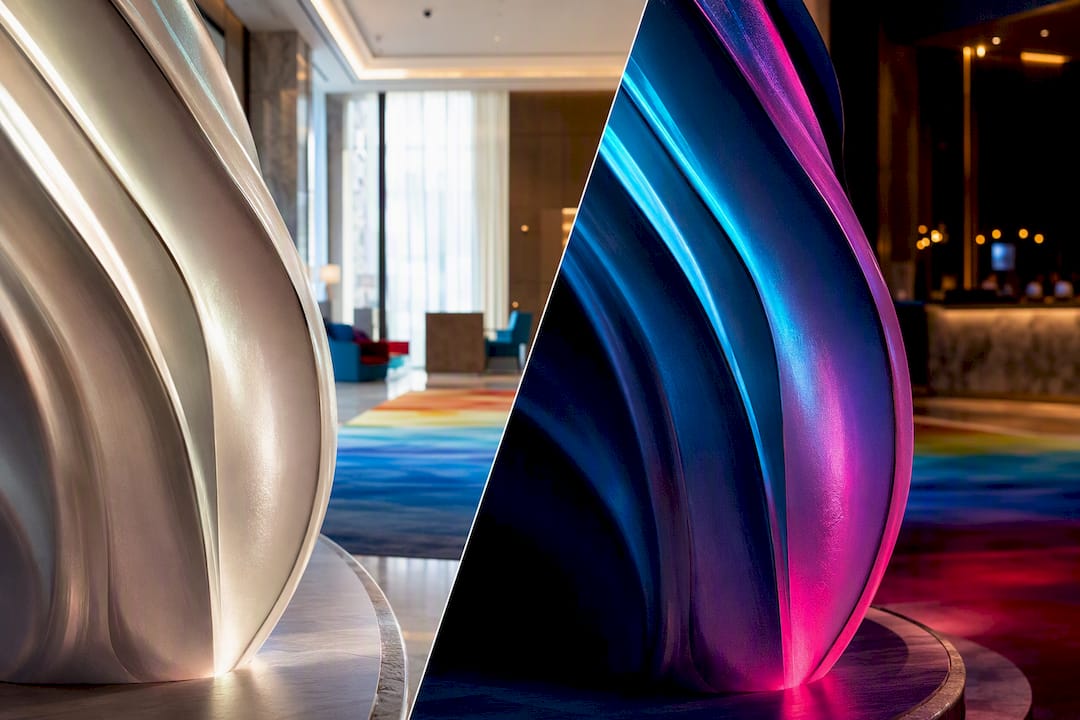
Pro Tip: Design two lighting states into the brief from day one: a daytime mode where the sculpture reads through form and finish alone, and a night mode where the glow becomes the brand statement. Asking for both after fabrication is far more expensive than specifying them up front.
Engineering, Anchoring, Safety, and Maintenance Checklist
The most beautiful concept sketch is worthless if the structural engineer can’t sign off on how it’s held up. Bring engineering into the conversation at concept stage, not after the design is locked.
- Anchoring and load paths. Specify anchor points, load calculations, and seismic or wind considerations (even indoors, tall pieces need lateral bracing) directly to your structural engineer, not just the fabricator.
- Modular sections. Large pieces should ship in sections sized for your service elevator and lobby doors, with on-site assembly drawings included in the deliverables. This matters as much for a rotund bronze form as it does for generative LED installations built in modular components.
- Plinths and protective detailing. A well-designed base protects the finish from luggage carts and vacuum cleaners while also hiding wiring runs.
- Cleaning and inspection schedule. Steel needs routine wiping and occasional polishing; bronze needs wax sealing; anything with embedded electronics needs a documented inspection interval.
- Coordination items. Loop in electrical, fire marshal review, and insurance early, and confirm the piece meets accessibility standards for public sculptures so it never creates a clearance hazard for wheelchair users or service animals.
Before choosing a stainless-steel piece specifically, clarify size, style, color tone, and concept, and measure access points and ceiling height, according to a lobby design guide for stainless steel sculpture.
Brief Template and Commissioning Checklist
A tight brief saves weeks of back and forth with shortlisted studios. Build yours around these steps.
- Define the core brief elements. State the sculpture’s objective (wayfinding anchor, brand statement, photo moment), site constraints, required sightlines, a maintenance budget range, and a realistic budget band.
- Set selection criteria. Weigh technical fabrication capacity, prior hotel or hospitality installation experience, and proof of insurance and warranty terms.
- Understand cost drivers. Material choice, integrated electronics, custom finishes, and site access difficulty all move the price more than raw size does. Lead times from concept to install commonly run several months for a fully custom commission, longer for pieces with embedded lighting systems.
- Ask shortlisted studios direct questions. Request engineering documentation, anchoring details, a maintenance schedule, and on-site assembly drawings as standard deliverables, a practice stainless-steel sculpture guides recommend as baseline procurement protocol. Also ask for approved finish samples and a warranty period on any integrated lighting or electronics, typically 12 to 24 months.
Environmental and Sustainability Considerations in Material and Design Choices
Sustainability in lobby sculpture isn’t a checkbox item anymore. Property developers pursuing LEED or similar certifications increasingly expect art procurement to align with the same standards applied to the building envelope.
Recycled stainless steel and aluminum carry a smaller footprint than virgin metal and perform identically once fabricated. Bronze, largely copper and tin, is highly recyclable at end of life, which matters for properties planning eventual renovation cycles. Fiberglass and resin-based materials are harder to recycle, so ask fabricators about the resin systems they use and whether any bio-based or lower-emission alternatives exist for your project.
LED integration cuts long-term energy use compared to older halogen accent lighting, and it does so while giving designers more creative control over color and timing. Locally sourced materials and regional fabrication reduce shipping emissions, an underrated line item on large-scale metal or stone pieces that often travel internationally.
The most sustainable decision, though, is often the simplest: commission a piece built to last decades rather than a trend-driven installation likely to feel dated in five years. A sculpture engineered for longevity, with replaceable components for anything electronic, keeps materials out of landfills far more effectively than any single material choice on its own.
Design Themes and Styles Common in Hotel Lobby Sculptures
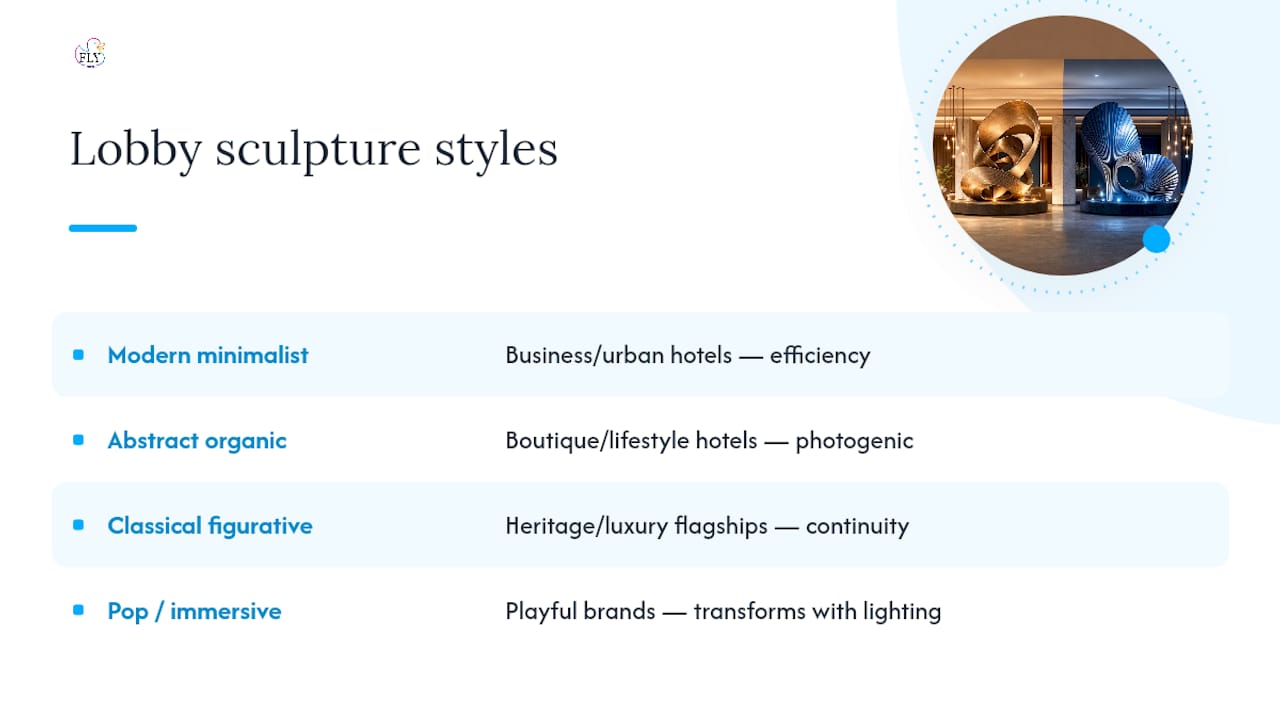
Three broad style families dominate hotel lobby commissions, and each signals something different to arriving guests.
Modern and minimalist forms favor clean geometry, monochrome finishes, and negative space. They suit business hotels and urban properties where the brand message is efficiency and polish rather than spectacle.
Abstract and organic sculpture uses flowing lines, asymmetry, and often mixed materials to create movement without representing anything literal. This category has grown fastest in boutique and lifestyle hotels because it photographs well and gives guests something to interpret rather than simply observe.
Classical and figurative work, drawing on historical or regional motifs, still anchors heritage properties and luxury flagships where continuity with the building’s architecture matters more than novelty.
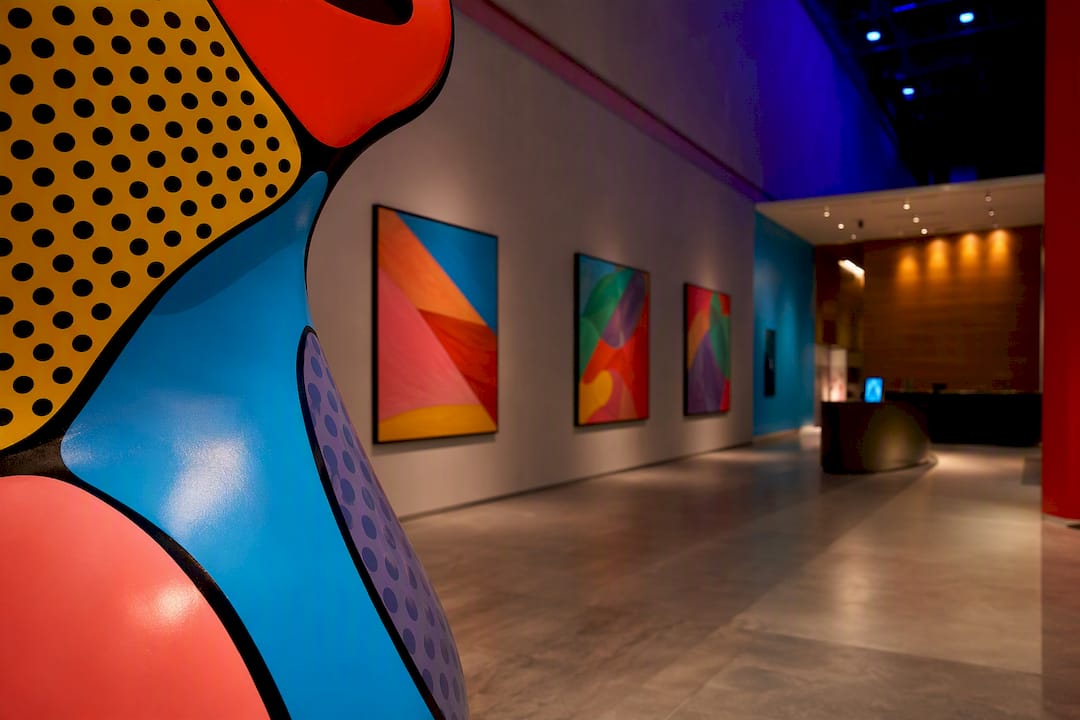
A fourth category worth naming separately: pop art and immersive pieces, often built with UV-reactive or blacklight materials that transform under different lighting conditions. These work particularly well in properties aiming for a playful, memorable brand identity rather than understated elegance, since the piece essentially becomes two different artworks depending on the time of day.
None of these styles is objectively correct. The right choice depends entirely on what the property wants a first-time guest to feel in the first ten seconds after walking through the door, and how that feeling should differ, if at all, between day and night.
Cultural and Branding Significance of Sculptures in Hotel Lobbies
A lobby sculpture is doing brand work whether anyone planned it that way or not. It’s the first three-dimensional object a guest encounters, and it sets an expectation for everything that follows, from room design to restaurant plating.
Material, finish, lighting, and form together create what amounts to a visual signature. Guests form an impression within seconds of entering, and a well-designed piece often performs as an organic marketing asset, generating social media posts and word-of-mouth the marketing department never had to pay for, a dynamic design guides on lobby sculpture describe as a genuine first-impression driver.
Culturally, the sculpture also signals what the property values. A regionally inspired bronze piece tells guests the hotel is rooted in its location. A striking abstract steel form tells them the property sees itself as forward-looking. A vivid, UV-reactive pop art installation tells them not to expect a buttoned-up stay. None of these messages get spoken aloud at check-in, but guests absorb them instantly.
The sculpture should define the space, not overwhelm it. Contrast in surface, scale, or verticality anchors a lobby without competing with the front desk or the concierge for attention, which is the balance every successful commission is really chasing.
Collaboration Process Between Artists, Designers, and Hotel Management
The best lobby sculptures come from a genuine back-and-forth between three parties who rarely speak the same professional language on day one: the artist, the interior designer, and hotel management or ownership.
The process typically starts with a site study, where the artist or studio walks the space, reviews architectural drawings, and understands circulation patterns alongside the interior designer. From there, concept development happens in dialogue rather than in isolation. The designer brings brand guidelines and material palettes already established for the property; the artist brings form language and technical feasibility; ownership brings budget reality and long-term maintenance appetite.
Engineering review follows concept approval, translating an artistic vision into anchor points, load calculations, and shipping logistics. This is where scope sometimes shrinks or shifts, and it’s far better to discover a structural constraint here than during installation week.
Hotel management’s role doesn’t end at sign-off. Someone on staff needs to own the maintenance relationship long after installation, particularly for anything with embedded lighting or moving parts. Clear maintenance ownership, spelled out in the contract rather than assumed, is what separates a sculpture that still looks sharp in year five from one quietly deteriorating in a corner nobody’s responsible for.
Impact on Guest Experience and Ambiance
A well-placed sculpture changes how long guests linger, where they take photos, and what they remember about a stay months later. It’s rarely the reason someone books a room, but it’s often the reason they mention the property to a friend.
Ambiance shifts with the piece’s material and lighting more than most designers initially credit. A cold, mirror-polished steel form in a dim lobby reads austere; the same form under warm uplighting reads sophisticated rather than sterile. Acrylic pieces with embedded color shifting create an entirely different mood at 11 p.m. than they do at check-in time, which matters enormously for properties positioning themselves as nightlife-adjacent or experience-driven.
Integrated lighting and modest interactivity increase how long guests dwell near a piece and how often they photograph it, but that engagement only pays off if someone has clear responsibility for keeping the sensors, LEDs, and finishes working as intended. A stunning installation with a burnt-out light strip six months in does more brand damage than no sculpture at all.
For boutique and lifestyle properties in particular, a sculpture built around vivid color, UV-reactive material, or a playful theme can become the single most photographed corner of the building, generating exposure a static, purely decorative piece never will.
Trends and Innovations in Hotel Lobby Sculpture Design
The clearest shift happening in hotel lobby art right now is the move from static, purely decorative pieces toward sculptures that respond to light, time, or presence in some controlled way.
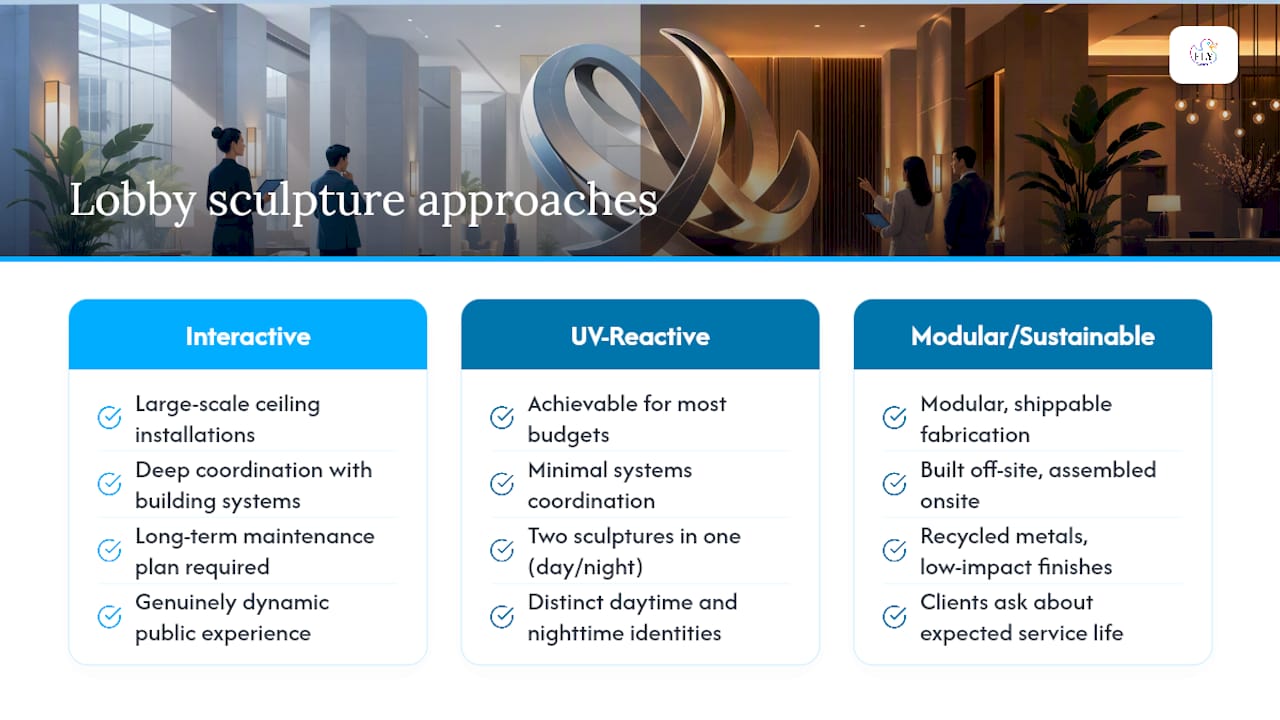
Large-scale interactive ceiling installations, like Pierre Huyghe’s A::Light at One Liberty Plaza, show how media and interactive systems can turn a lobby into a genuinely dynamic public experience. But that ambition comes with a cost: these installations require deep coordination with building systems and a long-term maintenance plan built in from day one, not retrofitted after launch.
At a more achievable scale for most hotel budgets, UV-reactive and blacklight-responsive materials are gaining ground because they essentially give a property two sculptures in one: a distinct daytime presence and a completely different nighttime identity. Modular, shippable fabrication is also becoming standard practice rather than a workaround, letting studios build ambitious forms off-site and assemble them in lobbies with limited access or tight elevator dimensions.
Sustainability is pushing more studios toward recycled metals and lower-impact finishing processes, and clients are asking harder questions about a piece’s expected service life before signing off on budget. The properties getting the most out of these trends aren’t necessarily the ones spending the most. They’re the ones treating the sculpture as an engineered system, lighting, structure, and maintenance included, rather than a static object dropped into a finished room.
Studio Perspective: Why Site-Specific Sculpture Matters
A sculpture built for a specific lobby, its ceiling height, its light, its guest flow, does something a generic piece never can: it becomes part of how people remember the property. At FLY Miami Art, that’s the whole premise behind working in UV-reactive, immersive materials. A piece that shifts under blacklight gives a hotel two distinct identities from one commission. If you’re weighing a custom sculpture for a lobby renovation, a feasibility conversation before you finalize the brief costs nothing and saves real rework later.
— Facundo
Bring FLY Miami Art Into Your Next Lobby Commission
Most hotel sculpture commissions follow a similar path elsewhere: site study, concept development, engineering review, fabrication, and installation, often stretched across separate vendors who’ve never worked together before. Flymiami runs that entire process under one studio, led by Facundo Yebne, which means your engineering questions, finish samples, and lighting integration get answered by the same team that’s fabricating the piece rather than passed between subcontractors.
Where Flymiami distinguishes itself is UV-reactive, blacklight-glow artwork that gives a lobby a genuinely different character after dark without a separate lighting installation. Browse the sculpture collection to see scale and material options, or review the studio’s fabrication process to understand how modular delivery and installation work for hotel properties. If you’re specifying for a hospitality project now, the practical next step is a feasibility consult, bring your ceiling height, floor plan, and budget band, and Flymiami’s team can tell you within one conversation whether a custom piece fits your timeline.
Sources
For deeper technical grounding, review the lobby sculpture proportion and material guide, the stainless-steel specification checklist, and Flymiami’s own hotel installation page for commissioning specifics and prior project context.
- Hotel Lobby Sculpture Guide: First Impressions With Art — Y Sculptures
- Lobby Design Guide: Choosing the Right Stainless Steel Sculpture — MetalsSculpture
- Frankey draws on local legends and childhood memories for Lucky Dragon installation - Architectural Digest