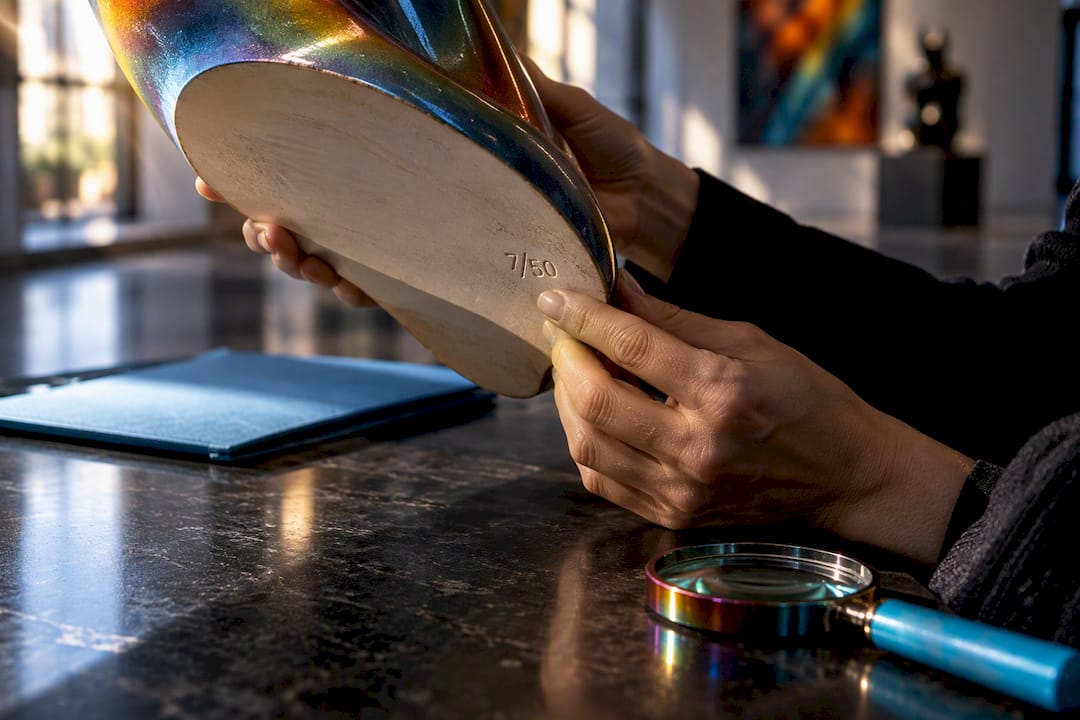
3 Things Collectors Must Verify Before Buying Limited Edition Art
A limited edition is a work released in a fixed, publicly stated quantity, authorized by the artist and never reproduced beyond that number once the run closes. Before buying, check three things: an edition fraction like 24/100 written in pencil, a genuine signature, and a certificate of authenticity that names the issuer. Whether a piece counts as an original edition or a mere reproduction comes down to how it was made and what paperwork backs it up, not the price tag or the framing.
TL;DR:
- Smaller edition sizes, such as 10 or 25, can increase value only if the artist’s reputation and documentation also support scarcity’s importance.
- Certainty about an edition’s legitimacy relies on verified signatures, publisher marks, and confirmation that the matrix was destroyed or cancelled after the run.
- Proofs like artist, printer, or hors de commerce proofs are separate from numbered editions but still count toward the total authorized impressions.
- The total number of physical copies can exceed the numbered edition once proofs and other proof types are included, affecting value and rarity.
- Buyers should request detailed provenance and careful condition checks before purchasing limited editions, especially in print, sculpture, or photographic works.
Table of Contents
- What Is Limited Edition Art, and How Does It Differ From Open Editions?
- How Are Limited Editions Actually Produced?
- How Do You Read Edition Numbers Like 24/100 or AP?
- What Actually Drives the Value of a Limited Edition?
- What Documentation Proves an Edition Is Legitimate?
- What Should You Ask Before Buying a Limited Edition?
- Why We Build Every Edition With Documentation in Mind
- How to Buy or Commission a Piece From FLY Miami Art
- Sources
- FAQ
What Is Limited Edition Art, and How Does It Differ From Open Editions?
A limited edition art piece is produced in a predetermined, capped quantity, then the production tool used to make it is retired or destroyed so no more copies can be issued. An open edition has no such cap. A publisher can print an open-edition poster for as long as demand exists, which is exactly why those pieces rarely command real collector prices.
Think of a limited edition as a contract of scarcity. The artist or publisher promises a specific number, usually a limited number of impressions, and that promise is what collectors are actually paying for on top of the image itself.
Not every “limited” work is an original. A giclée reproduction of a painting, run through an inkjet printer from a digital scan, is a different animal from an original lithograph or screenprint pulled directly from a hand-worked matrix. Sotheby’s guide to edition types treats a limited edition as an original work only when it’s created under the artist’s direct supervision.
Editions show up across more media than most new collectors expect:
-
Fine art prints (lithographs, screenprints, etchings, giclées)
-
Photographs, especially vintage versus later gelatin silver prints
-
Sculptural multiples cast in bronze, resin, or mixed media
-
Textile and tapestry editions
How Are Limited Editions Actually Produced?
Every traditional limited edition starts with a matrix, the physical tool that transfers the image onto paper, canvas, or another surface. In lithography, that’s a stone or aluminum plate. In etching, it’s a copper or zinc plate. In screenprinting, it’s a mesh stencil. In sculpture, it’s the mold.
A master printer or foundry typically does the physical labor, working under the artist’s direction and often with the artist present for proofing and approval. That supervision is part of what separates an authorized edition from a knockoff.
Pro Tip: Ask any seller whether the matrix was destroyed or cancelled after the run closed. If they can’t answer, that’s a real gap in the paperwork, not just an oversight.
Cancellation is the step that actually makes an edition limited rather than theoretically limited. Without it, nothing physically stops a publisher from pulling more impressions later, regardless of what the certificate says. Methods vary by medium:
- Lithographic stones get ground down or resurfaced.
- Intaglio plates get scored, drilled, or defaced across the image.
- Silkscreen stencils get physically destroyed.
- Sculpture molds get broken apart.
A newer wrinkle worth knowing about: timed or demand driven editions, where the final size isn’t fixed in advance but locked once a sales window closes. That flips the traditional model, but the scarcity promise still depends on the artist or publisher actually stopping production when they say they will.
How Do You Read Edition Numbers Like 24/100 or AP?
The fraction written in the margin, something like 24/100, tells you two things: this is the 24th impression officially numbered, out of a total run of 100. It does not tell you this was the 24th one physically printed. Sotheby’s is clear that edition numbers reflect the copy and the edition size, not chronological print order, so number 5 isn’t inherently sharper or more valuable than number 95.
Beyond the numbered run, you’ll run into a handful of proof designations:
- AP (Artist’s Proof): retained by the artist, traditionally a smaller portion of the edition size
- PP (Printer’s Proof): given to the printer or workshop as a courtesy copy
- HC (Hors de Commerce): literally “not for trade,” used for exhibition or display, not sale
- BAT (Bon à Tirer): the single approved proof the printer matches every subsequent impression against
Here’s what trips up newer collectors: proofs sit outside the numbered edition, but they’re still part of the total authorized impressions. An edition marked “100” might actually have more physical pieces in the world once you count APs, PPs, and HCs. Tate’s glossary on editions notes these proofs often represent a meaningful chunk of total output, so factor them in before assuming a “run of 50” means only 50 pieces exist anywhere.
What Actually Drives the Value of a Limited Edition?
Edition size is one input among several, not a standalone formula. A print numbered 10/500 isn’t automatically worth less than one numbered 10/50 unless the other factors line up in the smaller edition’s favor too.
What tends to move price in practice:
- Edition size: smaller runs generally command a premium when demand is equal, since scarcity is baked into the collectibility of the piece.
- Artist reputation and market history: an established name with prior auction results carries more pricing certainty than an unproven one.
- Publisher and material quality: archival inks, quality paper stock, and a respected workshop name all matter to serious buyers.
- Condition: fading, foxing, or handling damage can knock a significant percentage off value regardless of edition size.
- Provenance and exhibition history: a piece with a documented ownership chain or gallery show record tends to outperform an identical piece without one.
Pro Tip: If a seller leans hard on “only 25 made” as the entire pitch, ask what else backs that claim up. Rarity without reputation, condition, or documentation is a thin argument on its own.
A small edition size is not an investment guarantee. Plenty of tightly limited runs from artists whose careers stalled are worth less today than their original sale price, no matter how low that print number was.
What Documentation Proves an Edition Is Legitimate?
A credible certificate of authenticity should specify the artist’s name, the title, the medium, the edition number and total size, the dimensions, and who actually issued the document, ideally the artist, their estate, a recognized publisher, or a gallery with a traceable relationship to the artist. Loose, unsigned, or vaguely worded COAs are a warning sign, not a formality.
Beyond the certificate itself, look for physical markings that corroborate the paper trail:
- A hand signature in pencil or ink, not a printed or stamped signature passed off as original.
- A blindstamp or embossed publisher’s chop mark, often in a corner of the sheet.
- Watermarks in the paper stock, visible when held to light.
- Consistent publisher or workshop marks that match known examples from that edition.
Provenance strengthens all of this. Original invoices, exhibition records, and inclusion in a catalogue raisonné (the official, scholarly inventory of an artist’s complete output) give a piece a documented history that’s much harder to fake than a certificate alone.
Worth knowing: state consumer-protection statutes), starting with laws in California and Georgia dating back to the 1980s, require sellers to disclose edition size and the extent of artist involvement for works above certain value thresholds. If a seller misrepresents those facts, buyers may have legal remedies under those statutes.
What Should You Ask Before Buying a Limited Edition?
Before any purchase, ask the seller directly: what’s the total edition size, who printed or cast it, was the matrix cancelled, and who issued the certificate of authenticity? A dealer who hesitates on any of these questions warrants more scrutiny, not less.
Watch for red flags: a COA with inconsistent or missing details, a signature that looks “tipped in” or printed rather than hand-applied, or a total absence of publisher information anywhere on the piece or its paperwork.
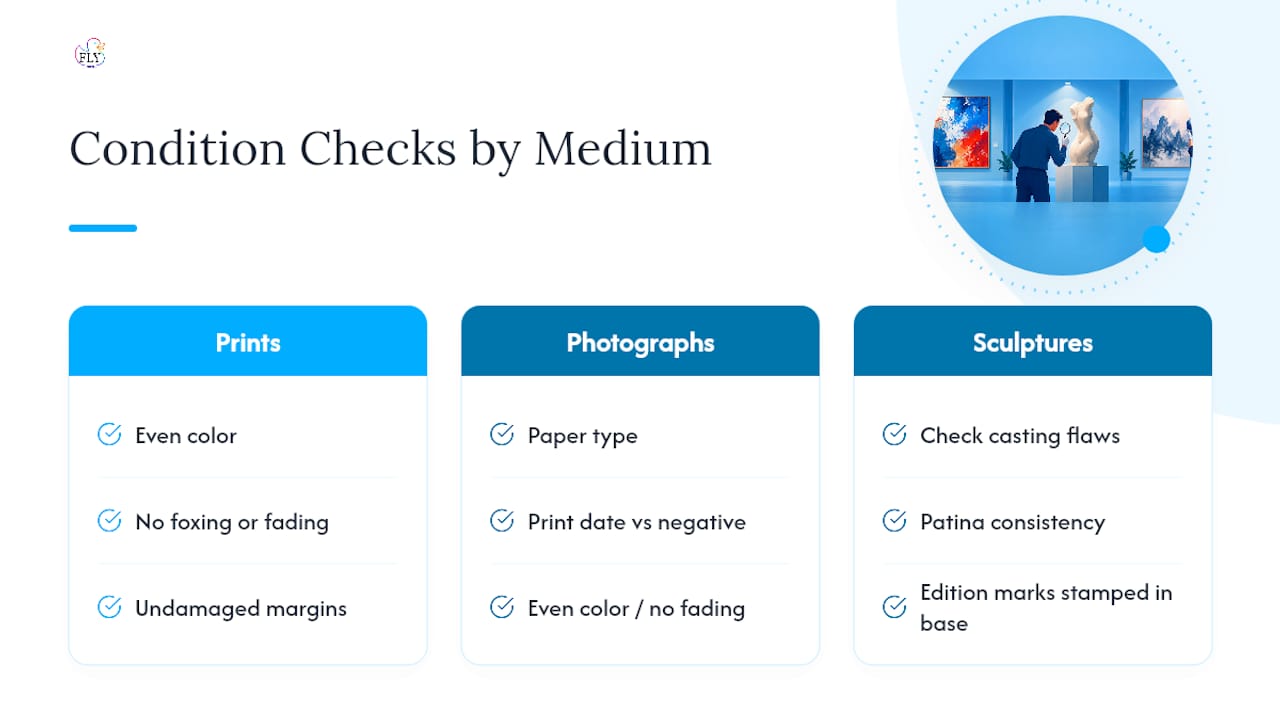
Condition checks differ by medium. Prints need even color, no foxing or fading, and undamaged margins. Photographs need attention to paper type and print date relative to the negative. Sculptural multiples need a check for casting flaws, patina consistency, and edition marks stamped into the base.
Pro Tip: Store prints and photographs away from direct sunlight and humidity swings, and get a professional appraisal before insuring or reselling anything you suspect is significant. A collectible’s condition and grading standards matter across categories, not just fine art.
Why We Build Every Edition With Documentation in Mind
At our studio, every piece starts as a handmade original, so a limited run means a small, fixed group of pieces, each documented and supported by provenance if a collector requests it. If you’re weighing a piece and want to know more about how it was made or where it’s been, reach out. That conversation is part of what buying directly from a working studio should include.
— Facundo
How to Buy or Commission a Piece From FLY Miami Art
This studio offers documented, handmade pieces rather than mass-produced reproductions with vague documentation. Originals and limited editions sold include signature, certificate, and provenance support integrated as part of the sale process.
Start with the Originals collection if you want a true one-off, or browse the UV/Glow Art collection for pieces that reveal hidden patterns under blacklight, a signature feature you won’t find in standard editions. Collectors drawn to sculptural work can look through the Sculpture collection, and anyone considering a custom piece can review the UV-reactive rubber duck commission page to see how a bespoke glow piece comes together from concept to finished work.
Every purchase includes the artist’s signature, a certificate of authenticity, and provenance documentation on request, exactly the trust signals this guide recommends checking for before you buy anything. To start a commission or ask about an available original, visit the FLY Miami Art homepage and reach out directly. That first message is the only step standing between you and a piece built specifically around what you’re looking for.
Sources
- Prints, Photographs, Sculptures, and Multiples: Understanding Edition Types | Sotheby’s
- Edition (printmaking) | Tate
FAQ
What Does “Limited Edition” Mean in Art?
It means the work was produced in a fixed, predetermined quantity, authorized by the artist, with the production matrix retired once the run is complete. The edition size and artist involvement are typically documented on a certificate of authenticity and disclosed under applicable state law.
Are Limited Edition Art Prints Worth Money?
Some are, but edition size alone doesn’t determine value. Price depends on artist reputation, publisher quality, condition, provenance, and market demand working together, not scarcity by itself.
What’s So Special About Limited Editions?
The appeal is verified scarcity paired with direct artist involvement. Once the matrix is cancelled, no more copies can legally enter that edition, which is fundamentally different from an open-edition poster a publisher can keep printing indefinitely.
Which Is Better, Artist Proof or Numbered Edition?
Neither is objectively better; they’re different categories entirely. An Artist’s Proof traditionally sits outside the numbered run and was historically retained by the artist, which some collectors value for that connection, while numbered impressions are the pieces the publisher intended for general sale.
How Do I Know a Limited Edition Isn’t a Fake?
Check for a hand-applied signature, a certificate of authenticity naming a real issuer, and consistent publisher marks or blindstamps. Ask the seller directly whether the matrix was cancelled and request provenance documents like invoices or exhibition records before you commit to a purchase.