Pop Art Crossing Fine Art: 9 Defining Examples
Pop art crossing fine art is defined as the practice of elevating commercial and mass media imagery into gallery-worthy works that challenge the traditional hierarchy between “high” and “low” culture. Emerging in the mid-1950s and peaking in the 1960s, the movement intertwined advertising, comics, and consumer packaging with fine art traditions, ending the dominance of gestural abstraction. Artists like Roy Lichtenstein, Andy Warhol, and Richard Hamilton proved that a soup can, a comic panel, or a celebrity photograph could carry as much cultural weight as any oil painting. The examples explored here show how that collision reshaped what art institutions accept, collect, and celebrate.
1. What are the classic examples of pop art crossing fine art?
The clearest examples of pop art crossing fine art are works that took commercial imagery and placed it at monumental scale inside gallery walls. That act of relocation forced viewers to reconsider what made something “art” in the first place.
Roy Lichtenstein’s “Whaam!” (1963)
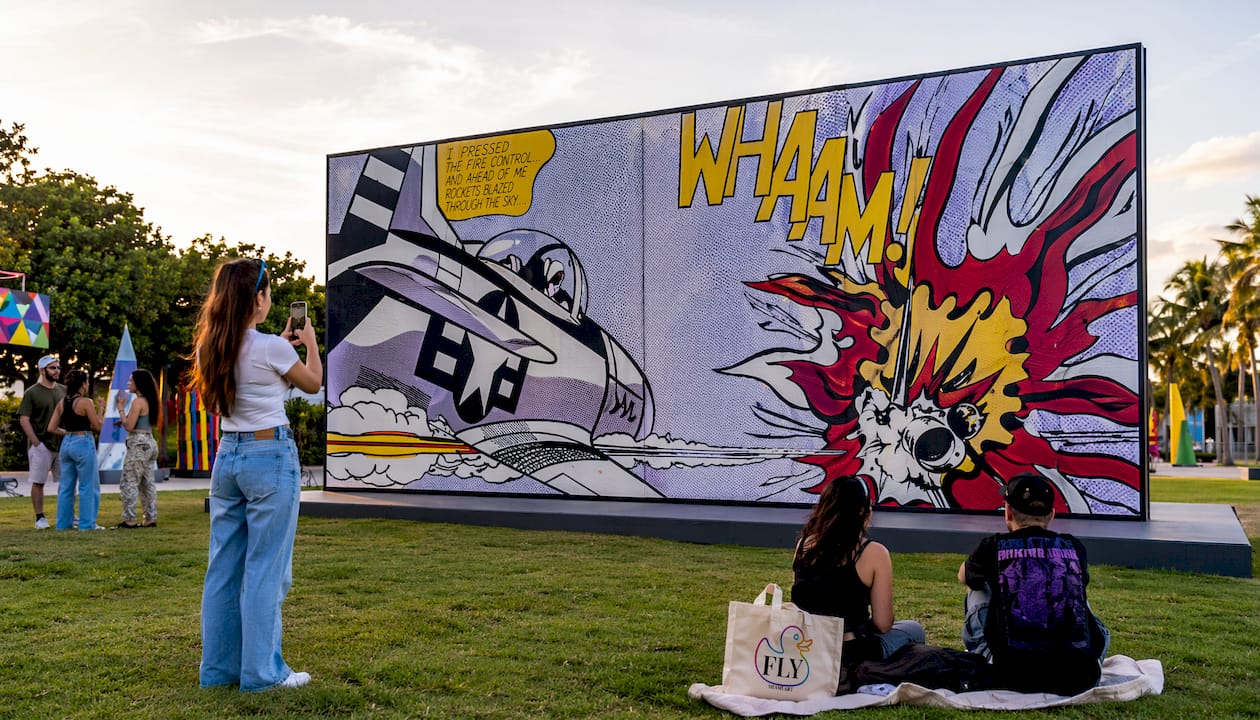
“Whaam!” is a two-panel acrylic painting measuring roughly 5 by 13 feet. Lichtenstein lifted the image directly from a DC Comics war comic, then removed the speech balloons that gave the original scene its narrative. That removal is the critical move. Without the story, the explosion becomes a pure visual object, loaded with art-historical weight rather than plot. The Tate Modern in London holds the work permanently, which confirms its status as canonical fine art.
Roy Lichtenstein’s “Torpedo…Los!” (1963)
“Torpedo…Los!” uses the same Ben-Day dot technique and the same source material: American war comics. Ben-Day dots were the mechanical printing method used in cheap mass-market publications. Lichtenstein reproduced them by hand at large scale, which turned a symbol of industrial cheapness into a mark of deliberate craft. The contradiction is the point.
Andy Warhol’s Campbell’s Soup Cans (1962)
Warhol painted 32 canvases, each depicting a different variety of Campbell’s Soup. Displayed together, they mimicked a supermarket shelf. Placed in a gallery, they asked one question: what separates a product from an artwork? The answer, Warhol argued, was context alone.
Andy Warhol’s Marilyn Monroe Prints
The Marilyn silkscreens took a press photograph and repeated it across color fields. Repetition drained the image of intimacy and replaced it with the logic of mass production. The result was a portrait that said more about celebrity culture than any traditional painted likeness could.
Richard Hamilton’s “Just What Is It That Makes Today’s Homes So Different, So Appealing?” (1956)
This collage assembled American consumer imagery, bodybuilder magazines, television sets, and branded food products into a compact domestic scene. Hamilton made it for a poster, not a gallery wall. Its later elevation to fine art status is itself a demonstration of the movement’s thesis.
Pro Tip: When studying these works, look at what the artist removed, not just what they kept. Lichtenstein’s deletion of speech balloons and Warhol’s removal of personal brushwork are the conceptual moves that convert popular imagery into fine art objects.
2. How contemporary exhibitions continue to demonstrate pop art’s influence
Pop art’s crossover into fine art is not a historical footnote. Institutions treat it as a permanent condition in art culture, not a period style that ended in 1970.
The Guggenheim’s exhibition “Guggenheim Pop: 1960 to Now” is the clearest institutional statement on this point. It placed works by Warhol and Lichtenstein alongside pieces by Maurizio Cattelan and Lauren Halsey, collapsing six decades of production into a single argument: pop art’s logic never stopped operating. Cattelan’s use of taxidermied animals and Halsey’s community-sourced murals both draw on the same principle Warhol used. They take imagery from outside the fine art tradition and force the institution to reckon with it.
| Artist | Era | Method | Fine art context |
|---|---|---|---|
| Andy Warhol | 1960s | Silkscreen, repetition | MoMA, Tate Modern permanent collections |
| Roy Lichtenstein | 1960s | Ben-Day dots, comic source | Tate Modern, Guggenheim |
| Richard Hamilton | 1950s | Consumer image collage | Gallery exhibitions, museum retrospectives |
| Maurizio Cattelan | 1990s–present | Conceptual provocation | Guggenheim, major biennials |
| Lauren Halsey | 2010s–present | Community imagery, installation | Guggenheim, Whitney |
Art markets reflect the same trend. Events like the Broadway Art Market at The Goldfinch bring pop-influenced works into direct contact with collectors who would previously have sought only traditional fine art. The market has absorbed the movement’s logic completely.
Pro Tip: When visiting a contemporary exhibition, check whether the wall text uses the word “vernacular.” Curators use it as shorthand for pop art’s method of pulling everyday imagery into a fine art frame. Spotting it tells you the curator is working in pop art’s tradition.
3. What production methods define the pop and fine art intersection?
The techniques pop artists used were not accidents of style. They were deliberate subversions of fine art values around authenticity, manual craft, and the singular genius of the artist’s hand.
-
Silkscreen printing. Warhol’s Factory used assistants and industrial silkscreen processes to produce works at volume. Traditional fine art valued scarcity and the unique touch of the maker. Warhol’s method made both irrelevant by design.
-
Ben-Day dot reproduction. Lichtenstein applied Ben-Day dots by hand using stencils and brushes, mimicking a mechanical process through manual labor. The irony was intentional. The work looked machine-made but was not, which placed it in a permanent conceptual tension between craft and industry.
-
Collage of commercial sources. Hamilton and others cut directly from magazines, catalogs, and advertisements. The source material carried its own visual language, and placing it in a fine art context did not erase that language. It amplified it.
-
Stripping narrative context. Removing comic narratives to isolate iconic imagery converts popular visuals into high art objects loaded with art-historical commentary. The image no longer tells a story. It becomes a subject for contemplation.
-
Cross-style collaboration. The Warhol-Basquiat partnership merged Warhol’s recognizable commercial logos with Jean-Michel Basquiat’s raw expressive figures. The result was a new visual language that neither artist could have produced alone. It crossed pop art’s commercial clarity with fine art’s emotional directness.
These methods collectively challenged the idea that authorship, uniqueness, and manual skill were the only valid measures of artistic worth. That challenge is still unresolved, which is why the debate remains alive in galleries and auction houses today.
Pro Tip: When you look at a Lichtenstein painting, get close enough to see the individual dots. Understanding that a human hand placed each one changes how you read the work’s relationship to mechanical reproduction.
4. In what ways did pop art democratize fine art?
Pop art argued that separating commercial imagery from fine art was a class performance, not an aesthetic judgment. That argument had real consequences for who felt welcome in galleries and who did not.
Before pop art, fine art’s visual language was largely inaccessible to viewers without formal training. Abstract Expressionism, which dominated American galleries in the 1950s, demanded fluency in art history and critical theory to engage with. Pop art replaced that barrier with imagery everyone already knew. A Campbell’s Soup can required no art education to recognize. The recognition itself became the entry point.
“Pop art helped make fine art resonate with broader audiences outside elite galleries by admiring and satirizing everyday life and consumer society. The dual nature of the movement allowed viewers to engage critically and appreciatively with popular imagery in art contexts.” Christie’s
Pop art reveals the political and social construction of the high/low culture divide rather than merely glorifying consumer goods. That political dimension is what separates pop art from decoration. It did not just use popular imagery. It used popular imagery to ask who decided that certain images were beneath serious attention, and why.
The movement also reflected post-war consumer society with clarity no abstract style could match. Pop art simultaneously admired consumer aesthetics and subjected them to critique, which gave viewers permission to hold both responses at once. You could enjoy the color and energy of a Warhol print while also reading it as a comment on the emptiness of celebrity. That dual engagement is what pop art’s cultural reach made possible.
Key Takeaways
Pop art’s most lasting achievement is proving that the line between commercial imagery and fine art was always a cultural choice, not an aesthetic law.
| Point | Details |
|---|---|
| Landmark works set the standard | Lichtenstein’s “Whaam!” and Warhol’s soup cans redefined what fine art institutions would accept and collect. |
| Technique was conceptual, not decorative | Ben-Day dots, silkscreen, and collage were chosen to challenge fine art values around authorship and craft. |
| Institutions confirmed the crossover | Exhibitions like “Guggenheim Pop: 1960 to Now” treat pop art as a permanent condition, not a historical phase. |
| Democratization was the political act | Pop art made fine art accessible by using imagery every viewer already recognized, removing the education barrier. |
| The conversation continues today | Contemporary artists like Lauren Halsey and Maurizio Cattelan extend pop art’s logic into current fine art practice. |
Why pop art’s challenge to fine art still matters
I have spent years working at the intersection of popular imagery and fine art craft, and the question I hear most often is whether pop art was serious. The answer is that it was the most serious thing happening in art in the 1960s, precisely because it refused to look serious.
What Warhol and Lichtenstein understood, and what most of their critics missed, is that the gatekeeping function of fine art institutions was never about quality. It was about exclusion. Pop art did not just sneak commercial imagery through the gallery door. It kicked the door open and asked why it had been locked in the first place.
The lesson I take from that is practical. When I work on a piece, I ask what imagery carries genuine cultural weight for the people who will live with it. Not weight in the art historical sense, but weight in the sense of recognition, memory, and shared experience. That is exactly what Lichtenstein found in a war comic and what Warhol found in a soup can. The conceptual foundation of pop art is not nostalgia for the 1960s. It is a permanent method for making art that connects.
The artists working today who matter most are the ones who understand that method and apply it to the imagery of their own moment. Lauren Halsey does it with community signage. Cattelan does it with objects so familiar they become invisible until he places them in a gallery. The movement did not end. It became the default condition of serious contemporary art.
— Facundo
Flymiami: where pop art and fine art meet in three dimensions
Flymiami brings the same logic that drove Warhol and Lichtenstein into sculptural form. Artist Facundo Yebne creates handcrafted pieces that use UV-reactive materials to reveal hidden patterns and colors under blacklight, turning the viewing experience into something active rather than passive.
The wall art collection at Flymiami draws directly on pop art’s tradition of bold color and recognizable imagery, while the UV-reactive rubber duck sculptures take one of the most universally recognized objects in consumer culture and transform it into a fine art statement. Each piece is handcrafted and one of a kind. Flymiami’s work has appeared in prestigious exhibitions and earned significant media coverage, placing it firmly within the institutional conversation that began with Warhol’s Factory.
FAQ
What is pop art crossing into fine art?
Pop art crossing into fine art is the practice of using commercial and mass media imagery, such as comic strips, product packaging, and celebrity photographs, as the subject matter of gallery-exhibited works. The movement collapsed the boundary between elite fine art and commercial visual language.
What are the most cited examples of pop art in fine art?
Roy Lichtenstein’s “Whaam!” (1963), Andy Warhol’s Campbell’s Soup Cans (1962), and Richard Hamilton’s “Just What Is It That Makes Today’s Homes So Different, So Appealing?” (1956) are the most frequently cited works. All three are held in or have been exhibited by major fine art institutions.
How did Warhol’s production methods challenge fine art traditions?
Warhol’s Factory used assistants and silkscreen printing to produce works at volume, directly undermining fine art’s emphasis on the singular, handmade object. That challenge to authorship and scarcity remains one of the most debated ideas in contemporary art theory.
Why did pop art make fine art more accessible?
Pop art used imagery that required no art education to recognize, replacing Abstract Expressionism’s demand for critical fluency with the instant recognition of a soup can or a comic panel. Pop art’s success lies in proving that separating art by class is arbitrary.
How do contemporary artists continue the pop and fine art tradition?
Artists like Maurizio Cattelan and Lauren Halsey apply pop art’s core method, taking imagery from outside the fine art tradition and placing it in institutional contexts, to the visual culture of their own era. The Guggenheim’s “Pop: 1960 to Now” exhibition confirmed this lineage as a permanent feature of contemporary fine art.