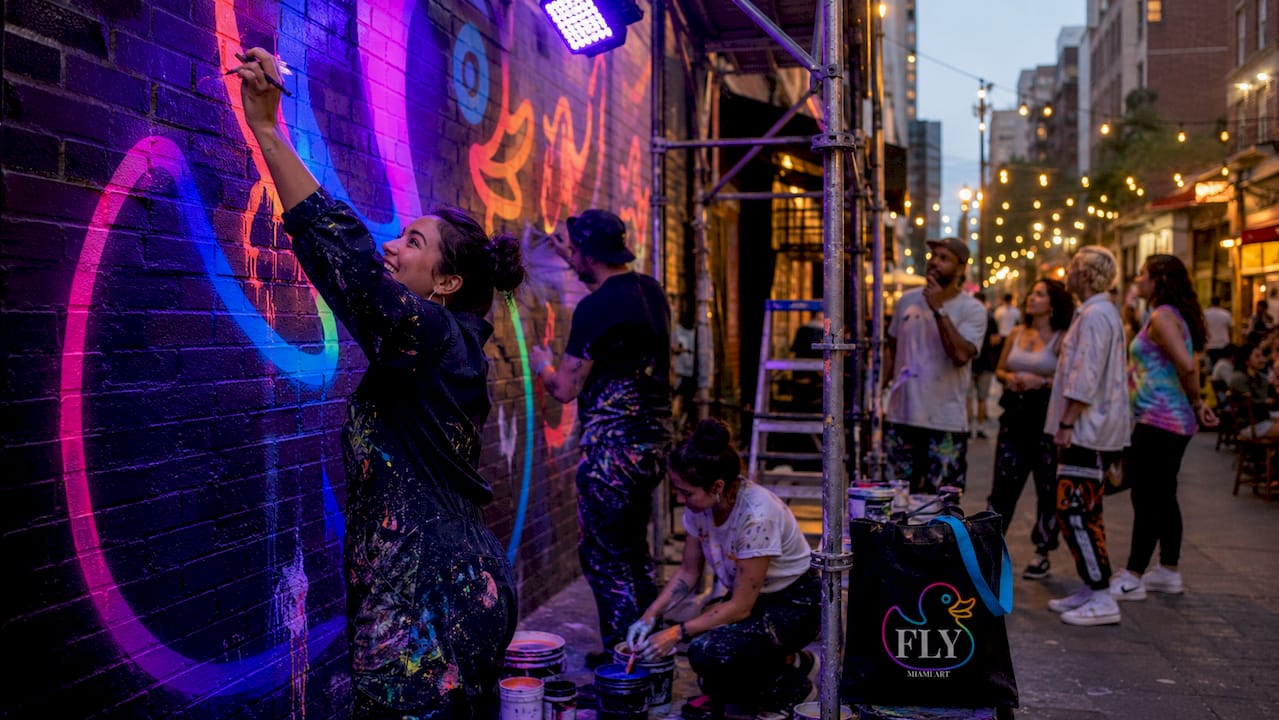
Pop Art vs Street Art: What Sets Them Apart
Pop Art is defined as a fine art movement that elevates mass media imagery and consumer goods into gallery-worthy subjects, while Street Art is defined by its environment: urban public spaces serve as its canvas for direct, real-time communication with everyday audiences. What distinguishes pop art from street art goes far deeper than aesthetics. Pop Art emerged in the mid-1950s as a deliberate rejection of traditional high art and emotional abstraction, whereas Street Art grew from urban graffiti culture decades later as a DIY, public-facing movement. Both share a commitment to accessibility and recognizable imagery, but they differ sharply in origin, technique, and cultural purpose.
What distinguishes pop art from street art historically?
Pop Art and Street Art each arose from a specific cultural frustration. Pop Art’s mid-20th century origins sit squarely in postwar consumer culture, when artists in Britain and the United States grew restless with the emotional intensity of Abstract Expressionism. They turned instead to the visual language already surrounding them: advertisements, comic strips, product packaging, and celebrity photographs.
Street Art’s roots run through a different kind of rebellion. It grew from the graffiti subcultures of New York City and Philadelphia in the late 1960s and 1970s, where writers used subway cars and building walls to assert identity in spaces that ignored them. Street Art evolved into a broader term encompassing murals, stencils, paste-ups, and mixed media, distinct from graffiti’s focus on lettering and name-based handstyles.

The cultural environments could not be more different. Pop Art entered the gallery system almost immediately, with artists like Andy Warhol and Roy Lichtenstein showing work in established New York venues. Street Art, by contrast, operated outside institutional permission for decades. Its legitimacy came from the street itself, not from curators or collectors.
Pop Art normalized commercial “found” imagery as worthy of serious artistic consideration. That shift in thinking laid the groundwork for Street Art’s eventual acceptance as a form of social critique worth taking seriously.
- Pop Art reacted against Abstract Expressionism and elitist gallery culture in the 1950s.
- Street Art grew from urban graffiti subcultures in the late 1960s and 1970s.
- Pop Art entered galleries quickly; Street Art operated outside institutions for decades.
- Both movements rejected the idea that art belonged only to educated, wealthy audiences.
Pro Tip: When studying either movement, look at the institutional context first. Where a work was made and shown tells you more about its meaning than the image alone.
How do Pop Art and Street Art differ in style and technique?
Pop Art is characterized by bold colors, repetition, irony, and the direct appropriation of consumer products and celebrities as subject matter. Think of Andy Warhol’s repeated silk-screen portraits or Roy Lichtenstein’s enlarged comic-book panels with visible Ben-Day dots. The aesthetic is polished, studio-produced, and deliberately mimics the look of commercial advertising.
Street Art uses a far wider range of techniques. Stencils allow for fast, repeatable application on rough surfaces. Paste-ups let artists prepare work in a studio and install it quickly in public. Large-scale murals require spray paint, rollers, and sometimes scaffolding. Graffiti emphasizes lettering and handstyles focused on artist identity, while Street Art is broader, including mixed media with expanded techniques and social messages.
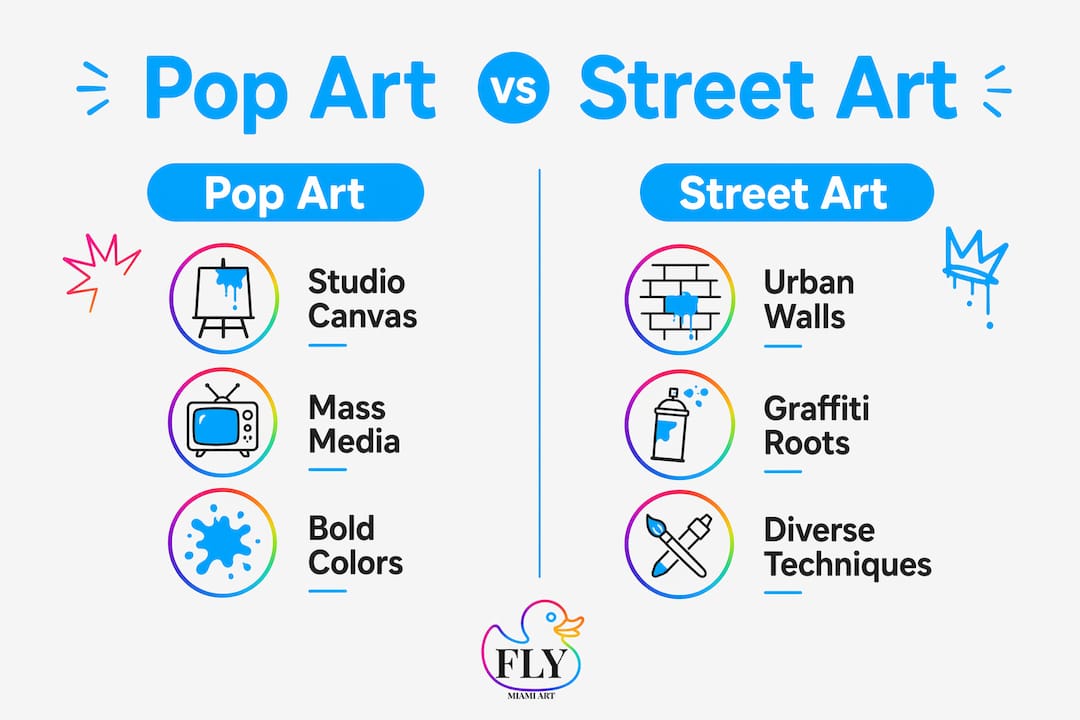
The subjects also diverge sharply. Pop Art focuses on consumer goods, celebrities, and mass media icons, treating them with a mix of admiration and irony. Street Art focuses on the site itself: a crumbling wall, a highway overpass, a neighborhood storefront. The urban texture becomes part of the artwork’s meaning.
Both art forms use symbols like soda bottles or cartoon icons to represent bigger ideas, but Pop Art is polished and studio-based, while Street Art is raw and site-specific. That contrast is the clearest visual shorthand for telling them apart.
Pro Tip: To identify which movement a work belongs to, ask two questions: Was it made for a controlled surface in a studio? And does it reference consumer culture with irony? Two “yes” answers point strongly to Pop Art.
The table below summarizes the core stylistic differences:
| Feature | Pop Art | Street Art |
|---|---|---|
| Primary surface | Studio canvas, print, sculpture | Building walls, sidewalks, public infrastructure |
| Key techniques | Silk-screen, lithography, repetition | Stencils, murals, paste-ups, spray paint |
| Subject matter | Consumer goods, celebrities, mass media | Urban life, protest, community identity |
| Aesthetic finish | Polished, commercial, graphic | Raw, site-specific, often ephemeral |
| Institutional context | Gallery and museum-based | Public space, often without permission |
What cultural messages do Pop Art and Street Art send?
Pop Art mimics commercial advertising aesthetics to critique consumer culture, while Street Art borrows protest urgency to interact directly with public spaces. The irony in Pop Art is often subtle. Warhol’s Campbell’s Soup Cans do not shout their critique. They hold a mirror up to consumer culture and let viewers decide what they see.
Street Art’s messages tend to be more direct. Artists like Shepard Fairey built careers on bold, graphic imagery that communicates a clear political or social point within seconds of being seen. Public art in social movements has long served as a tool for communities without institutional platforms to speak loudly in shared spaces.
Both movements share a core commitment to accessibility. Pop Art and Street Art share a language of accessibility, using recognizable imagery to create immediate impact and bypass academic art traditions. That shared quality is what makes both movements feel democratic, even when their contexts differ.
- Pop Art critiques consumerism through irony, parody, and polished appropriation.
- Street Art engages public discourse through protest imagery, murals, and community-specific references.
- Both movements democratize art by using imagery that requires no art education to understand.
- Street Art often responds to local conditions; Pop Art tends toward universal consumer symbols.
- Street Art’s remix culture was directly inspired by the remix mentality pioneered by Pop Art.
The influence runs both ways. Pop Art opened the door by proving that everyday imagery deserved serious attention. Street Art walked through that door and took the argument into the street, where it could reach people who would never set foot in a gallery.
How are Pop Art and Street Art collected and experienced today?
The experience of each movement remains fundamentally different, even as both gain mainstream recognition. Pop Art lives primarily in galleries, museums, and private collections. A Warhol print or a Lichtenstein canvas is a controlled object: framed, insured, cataloged, and sold through established art market channels. Collectors interested in original Pop Art works navigate auction houses, galleries, and specialist dealers.
Street Art’s natural home is the city itself. Street Art is experienced in situ in urban environments like laneways and building facades, designed to be encountered in everyday public life as visual communication. That ephemerality is part of its power. A mural can be painted over, weathered, or demolished, and that impermanence carries meaning.
The collecting landscape for Street Art has shifted significantly. Works by artists like Banksy now sell at major auction houses for prices that rival established fine art. Institutions like the Andy Warhol Museum in Belfast demonstrate how Pop Art continues to draw serious institutional investment and public interest decades after its peak.
- Identify the context. Pop Art works are typically found in galleries, museums, and private collections. Street Art is found on public surfaces in urban environments.
- Assess the object. Pop Art is usually a discrete, portable object: a canvas, print, or sculpture. Street Art is often site-specific and not designed to be moved.
- Research the artist’s market. Pop Art has a well-established auction and gallery market. Street Art’s market is newer and less standardized.
- Consider provenance. Pop Art works come with documentation and exhibition histories. Street Art works sold through galleries may include certificates of authenticity from the artist.
- Think about condition. Pop Art in collections is preserved deliberately. Street Art in public spaces changes with weather, time, and the city itself.
Where Pop Art and Street Art are heading
Pop Art and Street Art are converging faster than most critics acknowledge. The clearest evidence is in the studios of working artists who treat both movements as a shared vocabulary rather than opposing traditions.
I have spent years working at the intersection of these two worlds, and the most interesting creative territory sits exactly where they overlap. Pop Art gave artists permission to take commercial imagery seriously. Street Art gave artists permission to take public space seriously. When you combine those two permissions, the results can be genuinely surprising.
The remix mentality that connects both movements is not a recent development. Pop Art’s democratizing effect on art subject matter enabled Street Art’s rise by proving that mass-produced imagery could carry real artistic weight. Street Art then took that logic outside the gallery and applied it to the city itself.
What I find most compelling is how contemporary artists blend Pop Art’s graphic clarity with Street Art’s urgency. The result is work that reads instantly in a public space but rewards longer looking. UV-reactive materials, sculptural forms, and site-responsive installations all push this hybrid further. The future of both movements is not separation. It is deeper integration, where the boundary between gallery and street becomes less relevant than the quality of the idea.
— Facundo
Flymiami’s Pop Art and Street Art collections
Flymiami brings together the graphic energy of Pop Art and the bold presence of Street Art in handcrafted sculptures and wall works designed to hold their own in any space.

Award-winning artist Facundo Yebne creates pieces that use UV-reactive materials to reveal hidden patterns and colors under blacklight, adding a layer of experience that neither movement alone typically offers. The Wall Art collection features works that draw directly on Pop Art’s bold color language and Street Art’s graphic directness, scaled for home and exhibition environments. For collectors interested in three-dimensional work, the sculpture collection includes statement pieces that blend Pop Art iconography with the tactile, site-aware sensibility of Street Art. Each piece is handcrafted and one of a kind.
FAQ
What is the main difference between Pop Art and Street Art?
Pop Art is a studio-based fine art movement that elevates consumer and mass media imagery into gallery works, while Street Art uses urban public spaces as its canvas for direct social and political communication. The core difference is context: one is made for controlled art spaces, the other for the street.
When did Pop Art begin?
Pop Art originated in the mid-1950s as a reaction against traditional high art and Abstract Expressionism, with artists in Britain and the United States leading the movement. It reached its peak visibility in the 1960s.
Is graffiti the same as Street Art?
Graffiti and Street Art overlap but are not the same. Graffiti emphasizes lettering and handstyles focused on artist identity, while Street Art is a broader category that includes murals, stencils, paste-ups, and mixed media.
Can Street Art be collected like Pop Art?
Street Art works are increasingly sold through galleries and auction houses, though the market is less standardized than Pop Art’s. Some Street Art is created specifically for sale as prints or studio works, while site-specific murals remain tied to their locations.
How did Pop Art influence Street Art?
Pop Art’s remix mentality and its legitimization of everyday imagery directly influenced Street Art’s approach to transforming familiar symbols into bold public statements. Pop Art proved that commercial imagery deserved serious artistic attention, and Street Art took that argument into public space.
Key Takeaways
Pop Art and Street Art share a commitment to accessible imagery but differ fundamentally in origin, technique, institutional context, and cultural purpose.
| Point | Details |
|---|---|
| Origin and context | Pop Art emerged in the mid-1950s in studios and galleries; Street Art grew from urban graffiti culture in public spaces. |
| Technique and surface | Pop Art uses silk-screen, repetition, and polished finishes; Street Art uses stencils, murals, and spray paint on urban surfaces. |
| Cultural message | Pop Art critiques consumerism through irony; Street Art communicates protest and community identity directly to public audiences. |
| Collecting today | Pop Art has an established gallery and auction market; Street Art’s market is newer and still evolving. |
| Shared foundation | Both movements use recognizable imagery to bypass academic art traditions and reach broad audiences. |