

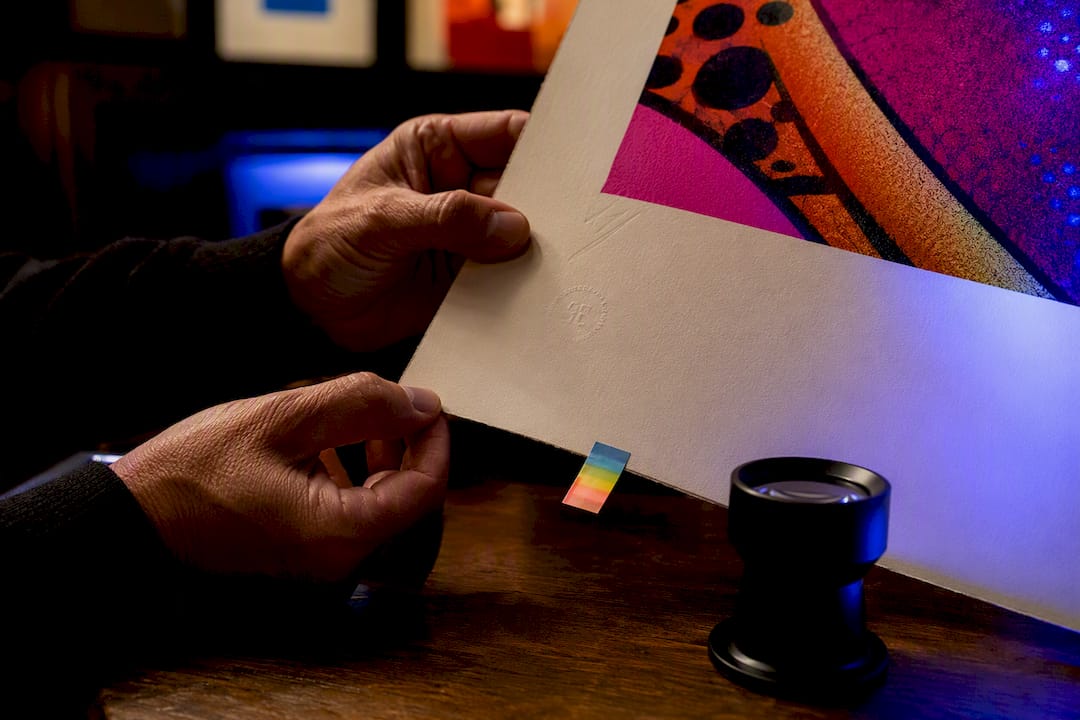
Collectors: Artist Proof Meaning, Why the 10% Rule Matters
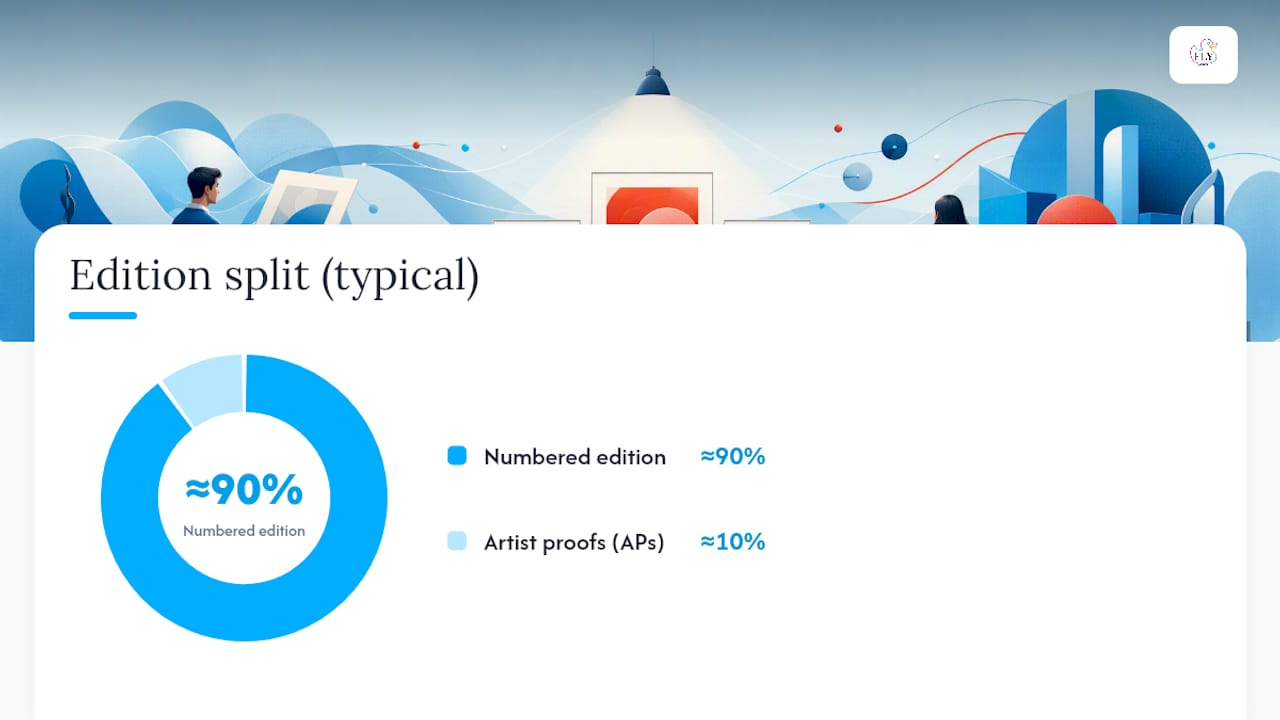
An artist’s proof (A/P) is an impression of a limited-edition print set aside outside the numbered edition, traditionally kept for the artist’s personal use. It usually carries the marking “A/P,” “AP,” or the French “E.A.” instead of a fraction like 1/50. By convention, artist’s proofs run to about 10% of the main edition, which is part of why they attract collector interest, though rarity alone never guarantees a higher price.
TL;DR:
- Artist’s proofs typically represent about 10% of the edition size, but some publishers issue more or fewer APs, affecting rarity and value.
- Confirm whether the printing plate has been canceled, as a canceled plate guarantees no further impressions beyond existing APs and editions.
- Provenance, signature consistency, and condition reporting are more critical for valuation than the mere “AP” mark, especially in resale markets.
- Collectors should verify AP markings, paper stock, and provenance documentation, particularly when APs are available before the main edition sells out.
- The size of AP pools, artist reputation, and detailed documentation influence resale prices more than the AP designation itself.
Table of Contents
- What is an artist’s proof, and where did the term come from?
- Artist’s proof vs. limited edition: what actually separates them?
- What are the different types of proofs?
- How are artist’s proofs actually produced?
- How do you identify and verify an artist’s proof?
- Does an artist’s proof affect resale value?
- How should you buy or sell an artist’s proof?
- What documentation should collectors expect?
- Why editioning discipline matters to us at Flymiami
- Sources
What is an artist’s proof, and where did the term come from?
The A/P designation goes back to traditional printmaking, when an artist working with a master printer needed personal copies to check quality, promote a show, or trade with other artists and dealers. Studios kept a small reserve outside the sale edition for exactly that reason, and the practice carried straight into contemporary print culture. A few markings show up again and again on modern prints:
- A/P or AP: artist’s proof, reserved for the artist
- E.A.: “épreuve d’artiste,” the French equivalent still used by some studios and publishers
- H.C.: “hors commerce,” proofs not intended for sale, sometimes used interchangeably with APs
Today the term applies just as often to giclée and screenprint editions as it does to etchings and lithographs, though the underlying idea hasn’t changed: a proof pulled aside from the numbered run.
Artist’s proof vs. limited edition: what actually separates them?
A numbered print, marked something like 12/50, tells you exactly where it sits inside a fixed edition size. An artist’s proof sits outside that count entirely. It isn’t print number 51 of 50. It’s a separate, smaller reserve that exists alongside the main run.
That separation matters for two reasons:
- Edition finality depends on plate cancellation, the practice of defacing or destroying the printing plate once the numbered run is complete, which guarantees no further impressions can be pulled.
- When APs hit the market at the same time as the numbered edition, buyers sometimes read that as the artist quietly padding supply, which can soften demand for both groups.
Pro Tip: Ask any seller whether the plate or screen has been canceled. A canceled plate is the clearest proof that no more impressions exist beyond what’s already been sold.
What are the different types of proofs?
Not every proof pulled during production becomes an artist’s proof. Printmaking workflows generate several distinct categories, and knowing the difference helps you understand what you’re actually buying.
- Trial or working proof (T/P): an early impression pulled to check the plate’s state mid-process. These can show unfinished passages, color tests, or elements the artist later changed, and collectors sometimes prize them precisely because they capture a stage that no longer exists.
- Printer’s proof (P/P): a copy the printmaking shop keeps for its own archive or as partial payment for the printing work.
- Bon à tirer (BAT): French for “good to pull,” this is the single control impression the artist signs off on to tell the print shop exactly how the final edition should look.
- Artist’s proof (A/P): the finished reserve, identical or nearly identical to the numbered prints, held back for the artist.
The 10% convention is a norm, not a law. Some publishers issue far fewer APs; others, especially in older or less regulated print markets, have issued proof counts that rival the numbered edition itself.
How are artist’s proofs actually produced?
Proofing happens in a specific order, and where an AP falls in that sequence affects both its appearance and its story.
- Test pulls come first, letting the artist and printer evaluate color, registration, and detail before committing to a run.
- BAT approval locks in the standard every subsequent print must match.
- The numbered edition runs, pulled to match the BAT as closely as the medium allows.
- Plate cancellation follows, closing off the edition for good.
- Artist’s proofs are typically pulled during or just after the numbered run, from the same plate, using the same inks and paper.
The technique shapes the process, too. Lithographs and etchings involve hands-on plate work that makes early proofs genuinely different from the final state, while giclée editions, being digital, produce proofs that are usually indistinguishable from the numbered prints. Printshops have long kept proofs as part of their own record or as compensation for the printer’s labor, which is part of why P/P impressions circulate on the secondary market at all. You can see how a working studio documents this process on Flymiami’s studio process page.
How do you identify and verify an artist’s proof?
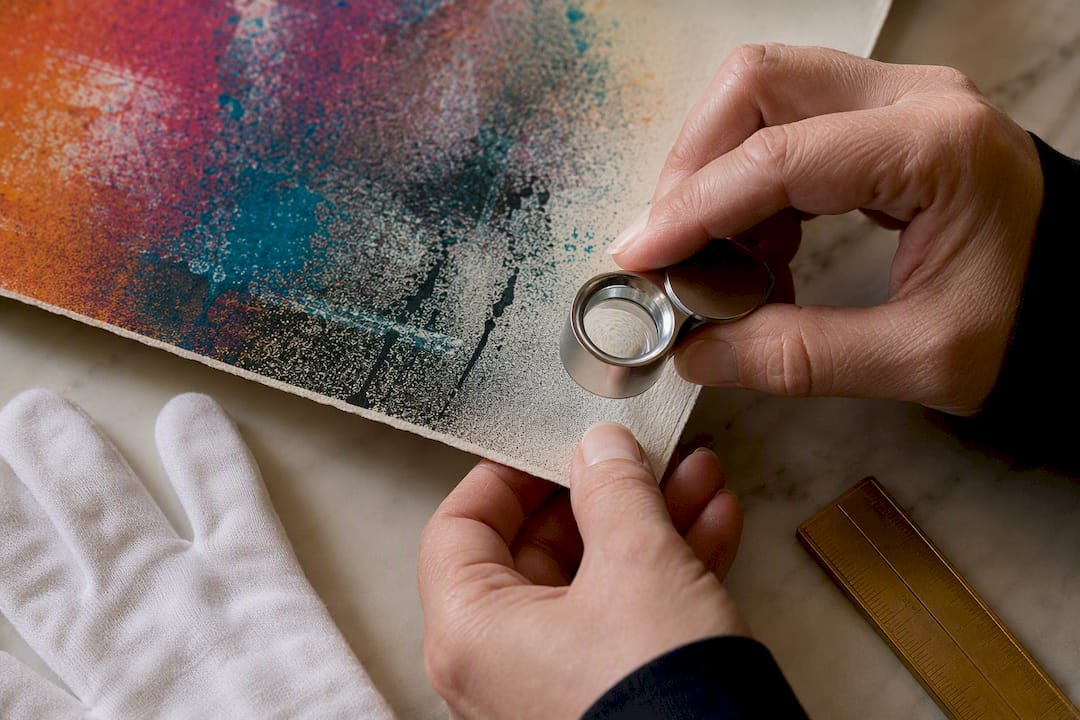
Start with the pencil markings in the lower margin. A genuine AP will show “A/P,” “AP,” or “E.A.” where a numbered fraction would otherwise sit, alongside the artist’s signature, usually also in pencil rather than ink. Check that the signature style matches known examples from the same period; artists’ signatures shift over the decades.
Beyond the markings themselves:
- Compare paper stock and any watermark against the numbered edition from the same run.
- Request a condition report covering fading, foxing, or trimming, since APs handled by artists or studios for years sometimes show more wear than a numbered print that sold immediately.
- Ask for provenance documentation tracing the piece from the studio or publisher to the current seller.
Pro Tip: Treat an AP offered for sale before the numbered edition has sold out as a yellow flag, not a dealbreaker. It’s not automatically fraudulent, but it’s worth asking the seller directly why it’s on the market early.
Does an artist’s proof affect resale value?
Sometimes, and the size of any premium depends on more than the “AP” stamp itself. Sotheby’s guidance on reading print editions points to artist reputation, total edition size, how many APs exist, condition, and documented provenance as the real drivers of price, with the AP marking acting more as a signal than a guarantee.
- A small, well-documented AP pool from a recognized artist can outsell comparable numbered prints at auction.
- An oversized AP run, sometimes issued well beyond the informal 10% convention, tends to erode the rarity argument entirely.
- Damaged condition or a thin paper trail drags down an AP’s price just as it would any print, regardless of the marking.
Working proofs occupy their own lane here. Because each one can show a genuinely different state of the image, some collectors value a trial proof’s uniqueness over a finished AP that’s visually identical to the numbered run. For more on what drives sculpture and print pricing generally, see Flymiami’s guide to what makes pop art valuable.
How should you buy or sell an artist’s proof?
Buyers and sellers each carry their own checklist, and skipping steps on either side tends to show up as a price problem later.
- Request documentation first: provenance history, a certificate of authenticity, and confirmation the plate or screen was canceled.
- Pull comparables: search auction records and gallery listings for the same edition to see what similar APs and numbered prints have actually sold for.
- Get a condition report before finalizing price, especially for older prints.
- Sellers should disclose AP status upfront and time listings after the numbered edition sells through, when possible, to avoid the cannibalization problem described earlier.
Pro Tip: Autograph and memorabilia markets run into the same provenance-versus-price question print collectors face. The lesson carries over directly: documentation moves price more than rarity claims alone.
For a broader walkthrough of the acquisition process, Flymiami’s guide to buying limited edition pop art covers timing and negotiation in more detail.
What documentation should collectors expect?
A certificate of authenticity from the artist or publisher is the baseline, but it shouldn’t stand alone. Look for a catalogue raisonné entry when one exists, since that cross-references the piece against the artist’s full documented output. Auction records and museum holdings, including the Artists’ Proofs category on Wikimedia Commons, give you a second layer of verification beyond the seller’s word. For anything above a modest price point, a third-party authentication opinion is worth the fee, and Flymiami’s own buyer’s guide to collecting original pop art walks through how to request that kind of paper trail.
Why editioning discipline matters to us at Flymiami
Facundo Yebne treats editioning as a discipline, not an afterthought. Every limited run an artist releases can document how many artist’s proofs exist alongside the numbered edition, and ideally that information travels with the piece, not just the invoice. You can browse how editions are labeled across our prints collection, and if you have questions about provenance on a specific piece or want to discuss a commission, reach out directly. We’d rather answer the question before you buy than after.
— Facundo
Ready to see how editioning transparency shows up in an actual piece? Browse Flymiami’s wall art collection to see documented limited editions, or explore the UV glow art collection for blacklight-reactive pieces where every edition detail is disclosed upfront.
Sources
- Artist’s proof — Wikipedia
- Printmaking terms — Tandem Press
- How to read an art edition: signatures, numbers, artist proofs, and more — Sotheby’s
- Artist’s proof vs limited edition — Spire Project
- Proof prints: part one — Folger

%20is%20an%20impression%20of%20a%20limited-edition%20print%20set%20aside%20outside%20the%20numbered%20edition,%20traditionally%20kept%20for%20the%20artist%E2%80%99s%20personal%20use.%20It%20usually%20carries%20the%20marking%20%E2%80%9CA/P,%E2%80%9D...)