Edition Size Meaning: What the Number Tells a Collector
Edition size is the total number of works an artist or publisher declares for one production run. If a sculpture is marked 14/75, the edition size is 75, and your piece is number 14 of them. That one figure shapes scarcity, price and trust, but it is only a promise until you can check it. This guide explains how to read the number, how it relates to value, how open and limited editions differ, and how to verify a limited edition sculpture before you pay.
TL;DR
- Edition size is the total count of works in a declared run. In 14/75, the 14 identifies your piece and the 75 is the edition size.
- Smaller editions are generally more exclusive, but there is no ideal number. Artists choose based on demand, materials, technique and cost.
- Edition size never sets value alone. Quality, provenance, condition, authenticity and comparable sales matter just as much.
- A limited edition is only as good as its paperwork. Get the edition size, your number and any proofs recorded in writing.
- Treat collecting as passion first. Art is illiquid and carries storage, insurance and transaction costs.
Table of Contents
- What edition size means
- Limited edition vs open edition
- Original vs edition sculpture
- What is a good edition size?
- Does edition size affect value?
- Is investing in limited editions a good idea?
- How to verify a limited edition sculpture
- Our perspective on edition size
- Find a piece with a clear story
- Frequently asked questions
- Sources
What edition size means
An edition is a group of works made from the same source and released together under a declared limit. The Getty’s Categories for the Description of Works of Art defines edition size as the total number of works created in a particular production run. In a notation such as 51/250, the first number identifies the individual impression and the second identifies the edition size.
The same Getty entry adds a detail many buyers miss: the numerator identifies the work, but it does not necessarily tell you the order in which the pieces were made. Number 1 is not automatically the first one produced, and number 75 is not automatically the last.
For sculpture, the logic is identical. Christie’s catalog describes Lynn Chadwick’s Sitting Figures in Robes, II as number 1 of an edition of 9. The fraction records which cast you are looking at and how many exist in total.
How to read the fraction
| Notation | What it says |
|---|---|
| 3/10 | Cast or piece number 3 in an edition of 10 |
| 14/75 | Piece number 14 in an edition of 75 |
| AP 2/10 | Artist’s proof number 2, tied to an edition of 10 |
| 1/1 | A unique work, no edition |
The proof marks need their own attention. Tate notes that artist’s proofs are marked AP and printer’s proofs PP, and that working proofs and bon-à-tirer proofs may also exist alongside the numbered edition. Proofs are a normal part of making an edition, but they are extra pieces outside the stated number, so you should know how many exist. We cover the convention in more detail in our guide to artist proof meaning and the 10% rule.
Limited edition vs open edition
A limited edition has a cap announced before or at the time of production. An open edition has no cap: the maker can keep producing as long as demand lasts. Both are legitimate. They simply promise different things.
Tate explains that an edition may be limited because a plate wears out, or because the artist or publisher chooses to restrict the quantity. In the second case, the printing surface is usually destroyed once the edition is complete, so no more can be made.
In sculpture, the equivalent of that destroyed plate is the mold, pattern or master. The principle holds: a limit means something only when the artist genuinely stops.
| Limited edition | Open edition | |
|---|---|---|
| Total quantity | Fixed and declared | No declared cap |
| Numbering | Usually numbered and signed | Usually unnumbered |
| Scarcity | Built in | None promised |
| Typical buyer goal | Collecting, long-term display | Decoration, gifts, affordability |
| What to verify | The cap, the number, the records | Little beyond quality and materials |
If you want a piece to enjoy at a modest price, an open edition is a fair choice. If scarcity matters to you, the cap has to be real and documented.
Original vs edition sculpture
An original, or unique work, exists once. An edition sculpture is one of several made from the same design, each of which is still a genuine work by the artist when produced under the artist’s control. Both can be handmade. The difference is the count: one versus a declared number.
That is why a notation like 1/1 or the word “unique” means something specific. Buying an original means nobody else owns an identical piece. Buying a numbered edition means you belong to a known group of owners, which some collectors like, since it can make a piece easier to place in context.
If you are weighing the two, our collecting original pop art buyer’s guide walks through the decision from the collector’s side.
What is a good edition size?
There is no single answer. The Print Council Aotearoa New Zealand states there are no hard and fast rules and lists what artists weigh: demand, plate durability, technique and materials, printing time, storage and material costs.
Artquest agrees that no ideal number exists. Artists choose according to their objectives, and smaller editions are generally more exclusive while larger ones are more available and affordable. It also observes that common sizes are 3, 5, 7 and 9 for small editions, and 25, 30 and 35 for larger ones, but describes these as conventions rather than rules.
Sculpture adds practical limits. Each piece often involves casting, finishing or hand work, so a small run is usually a function of labor and material, not marketing. A maker who finishes every piece by hand may never want an edition of hundreds.
Here is a plain way to read a number as a buyer:
- 1 to 10: very exclusive. Expect higher prices per piece and fewer comparable sales.
- 11 to 50: a collectible tier. Scarce enough to matter, available enough to find.
- Above 50: more accessible. Fine for enjoyment, but scarcity does less work.
These bands are our rule of thumb for orientation, not an industry standard. The right size depends on what the work is and who it is for.
Does edition size affect value?
Yes, but never alone. The general direction is simple: with everything else equal, fewer copies mean more scarcity. Yet “everything else equal” is the catch.
A real-world example shows how context counts. In 2019, Christie’s offered Umberto Boccioni’s sculpture as one of 10 numbered bronzes, six of which were held by public institutions, with an estimate of $3,800,000 to $4,500,000. Here the edition size matters, and so does where the other casts live, who made the work, and the historical weight of the design. A small edition by an unknown maker would not carry the same value.
UBS’s art collecting guidance makes the same point: valuation depends on several interacting factors, including quality, reputation, provenance, condition, significance, authenticity, title and comparable market evidence. Edition size is one input in that list, so it cannot establish fair value on its own.
When you compare two pieces, ask:
- Who made it, and how established is the artist’s record of public works and exhibitions?
- How many exist in total, including proofs?
- Is the piece in good condition, and are the materials stable?
- Can the seller show where it came from?
- Are there comparable pieces that have actually sold?
Is investing in limited editions a good idea?
Buy because you want to live with the work. Treat any resale as a bonus rather than a plan.
Investopedia cautions that collectibles aren’t always good investments: they can be expensive to acquire and store, produce no income, attract fraudsters, often lack liquidity and can swing widely in valuation. UBS’s white paper likewise describes art as illiquid, with insurance, storage, conservation and transaction costs attached.
In a 2026 article for US readers, UBS recommends due diligence before collecting purchases. Collectors should understand the artist, the artist’s purpose and representation, and the risks involving damage, authenticity and provenance. If a purchase is large relative to your finances, talk to a qualified art advisor or your financial professional before committing.
A sensible frame: decide what you would pay to own and enjoy the piece for ten years with zero resale value. If the answer works, the edition size is a pleasant reassurance rather than a bet.
How to verify a limited edition sculpture
The number on the piece is a claim. Verification turns it into a record. Here is a checklist you can apply to any seller.
- Get the edition size in writing. The invoice or certificate should state the total, your number and whether proofs exist.
- Ask about proofs. How many artist’s proofs or other extras were made, and are they numbered separately? Tate’s overview of AP and PP proofs explains why these sit beside the numbered run.
- Ask whether the edition is closed. The Print Council says that once an edition size is set, the edition should not exceed it, and that artists should keep records of edition size, production details and where each number is held. Ask whether such records exist.
- Ask what happened to the mold or master. The same source describes striking or otherwise disabling the plate or block when the edition is complete as customary, and calls further impressions from an unchanged plate unethical. For sculpture, ask how the maker closes a run.
- Check signature, date and numbering on the object. They should match the paperwork.
- Ask for provenance. Who made it, who owned it, and where has it been shown?
- Inspect condition. Note chips, repairs, fading or restoration, especially on painted or pigment-based surfaces.
Our short guide to three things collectors must verify before buying limited edition art condenses this into a pre-purchase routine, and our limited edition sculpture buyer’s guide covers buying online.
When the records are uncertain
Sometimes the stated edition and the real one differ. The Getty guidance notes that the stated size may not match the number actually made: the edition may be incomplete, or additional works may be unrecorded or undescribed. Its advice is to record what you know and flag doubt openly, for example writing “probably 34/50” rather than guessing.
Follow that habit in your own files. Keep the invoice, photos of the numbering, the certificate and any correspondence together. Once the piece is home, a guide to securing a high-value art collection can help you protect the object and its records alike.
Our perspective on edition size
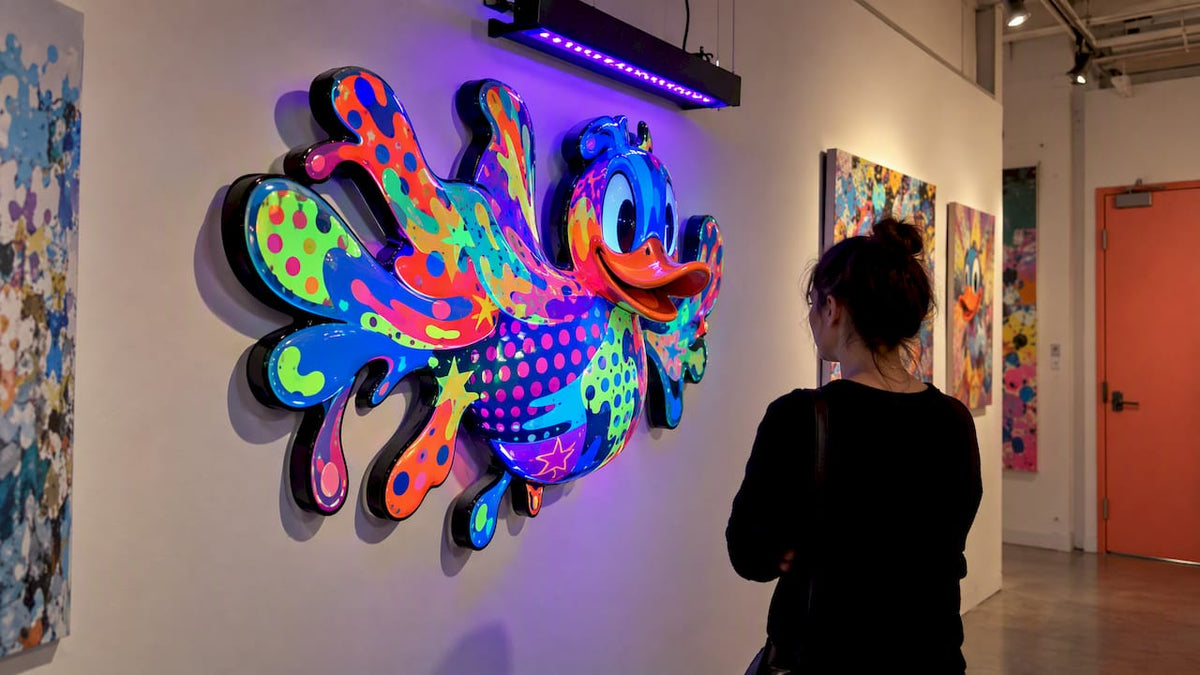
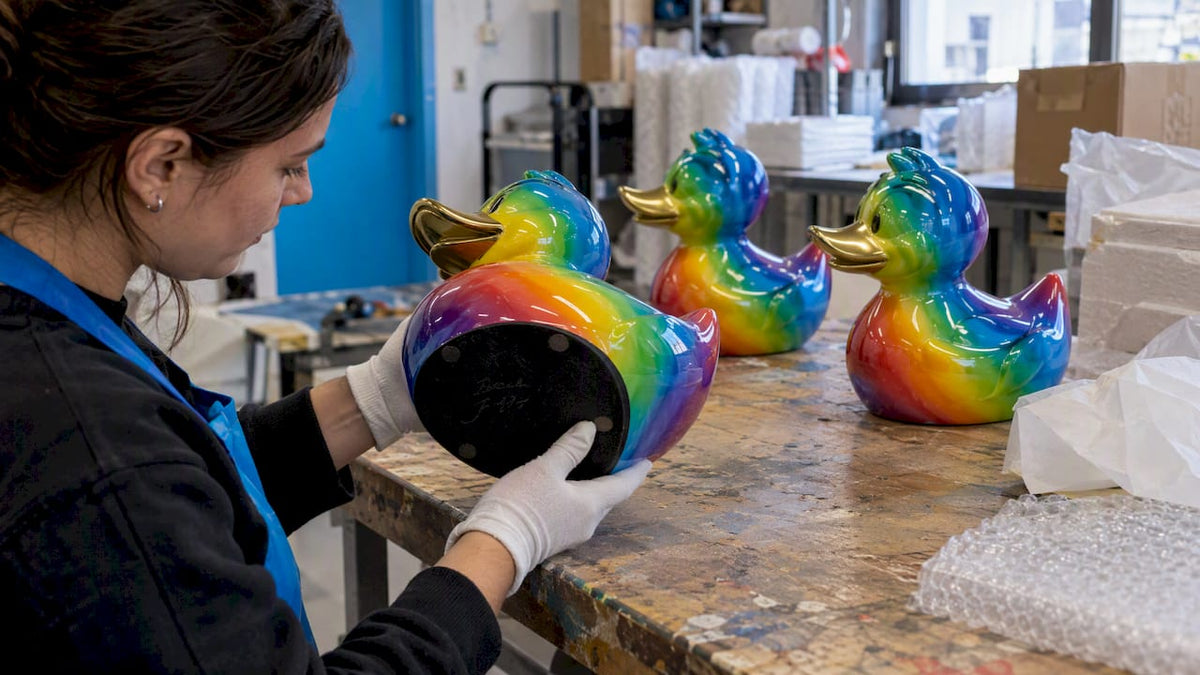
We make sculpture by hand, and that shapes how we think about editions. When every piece is handcrafted, finished and treated with UV-reactive pigments that reveal hidden color under blacklight, an edition number is not a marketing device. It reflects how much honest hand work an artist can put into a run before quality slips.

Here is what we tell collectors. First, do not chase the smallest number for its own sake. A 1/1 with no story is less interesting than a modest edition by an artist with public works, exhibitions and press behind them. Second, ask every seller, us included, to put the edition details in writing. A confident maker will not hesitate. Third, look at the piece under the light it was designed for. With glow work, a blacklight reveals patterns and detail that daylight hides, and that is part of what you are buying.
We care about art that celebrates peace and unity, and we want collectors to feel that the piece on their shelf or in their lobby is real, original and not mass produced. The number is a useful fact. The work itself is the point.
— Facundo
Find a piece with a clear story
If you are ready to collect, browse our original works, sculpture and UV and glow art. Each is handmade, original and not mass produced.
Want something no one else has? We take custom glow piece requests and commissions for private collectors, galleries, hotels, businesses and public art clients. Tell us the space and the idea, and ask us about edition and documentation details for any piece you are considering. Our guide on commissioning exclusive pop-art sculpture explains how that process works.
Frequently asked questions
What does edition size mean in art?
It is the total number of works made in one declared production run. In a notation like 14/75, the 75 is the edition size and the 14 identifies your individual piece. Proofs may exist in addition to that number, so ask about them.
Is a smaller edition always worth more?
Not always. Smaller editions are generally more exclusive, but value also depends on the artist’s reputation, provenance, condition, authenticity and comparable sales. A small run by an artist with little track record may not outperform a larger run by an established one.
How do I know a limited edition is real?
Ask for the edition size, your number and any proofs in writing, and match them to the markings on the work. Ask how the maker closes an edition and whether records show where each number went. A seller who cannot answer those questions is a warning sign.
What is the difference between an open and a limited edition?
A limited edition has a declared cap, and the maker stops once it is reached. An open edition has no cap, so more can be produced as long as there is demand. Open editions suit decoration and affordability, while limited editions suit collectors who value scarcity.
Are limited editions a good investment?
Treat them as something to enjoy first. Collectibles can be illiquid, costly to store and insure, and volatile in value, so any resale gain is uncertain. For a large purchase, speak with a qualified art advisor or financial professional.
Sources
- Edition | Categories for the Description of Works of Art, Getty
- Edition | Tate
- Lynn Chadwick, Sitting Figures in Robes, II | Christie’s
- Christie’s release on Umberto Boccioni’s Unique Forms of Continuity in Space
- Printmaking Terminology | Print Council Aotearoa New Zealand
- Editioning | Artquest
- Art and collecting white paper | UBS
- Incorporating your passion into your portfolio | UBS
- Why collectibles can be risky investments | Investopedia