Fluorescent vs. Phosphorescent: What Really Glows in Art
Fluorescent materials glow only while ultraviolet (UV) light is hitting them. Phosphorescent materials keep glowing after the light is gone. That timing is the whole difference, and it decides how a painting or sculpture behaves when you flip a blacklight on or turn the room lights off.
The American Institute for Conservation’s review of UV examination puts it the same way: fluorescence is visible light emitted while UV stimulation continues, and phosphorescence is emission that carries on after the excitation stops. Below you will find the science in plain words, a quick way to test any piece at home, and what this means if you collect, hang, or commission glowing art.
TL;DR
- Fluorescent: glows only while a UV (blacklight) source is on, then goes dark almost instantly.
- Phosphorescent: stores energy and releases it slowly, so it keeps glowing in the dark for seconds, minutes, or hours. This is the classic “glow-in-the-dark” effect.
- Blacklight art is mostly fluorescent. It looks one way in daylight and another under UV, and it does not glow on its own in a dark room.
- Pigment chemistry and lighting decide how long a piece looks vivid, so plan your lighting before you buy.
Table of Contents
- The difference in one table
- What happens inside the material
- Is glow-in-the-dark phosphorescent?
- Blacklight vs. glow-in-the-dark art
- How to tell which one you have: a 60-second test
- Which one is right for your space
- Lighting and care: what keeps the glow alive
- Our perspective: design the glow, then the room
- See it glow: our UV and glow art
- Is phosphorescence the same as bioluminescence?
- A note on the science behind the words
- FAQ
- Sources
The difference in one table
| Fluorescent | Phosphorescent | |
|---|---|---|
| Needs a light source to glow | Yes, continuously | Only to “charge” it |
| Glow after the light is removed | Essentially none | Seconds to hours, depending on the material |
| Typical trigger | UV (blacklight), sometimes ordinary light | Any bright light, UV charges it fastest |
| Everyday example | Blacklight poster, highlighter ink | Glow-in-the-dark stars on a ceiling |
| What you see in a dark room with no light | Nothing | A soft, fading glow |
What happens inside the material
Both effects start the same way. A pigment absorbs light energy, which pushes its electrons into an excited state. The material then gives that energy back as light, and the emitted light has a longer wavelength than the light that went in. That is why invisible UV can come back out as visible green, pink, or blue. Chemistry LibreTexts notes that both processes emit at longer wavelengths than the radiation that excites them.
The split comes from what the electrons do next.
Fluorescence: an immediate return
In fluorescence the excited electron drops back almost at once. A Western Washington University chemistry text puts the typical return at roughly 10^-8 to 10^-5 seconds. To your eye that is instantaneous. Switch the UV lamp off and the glow stops with it, which is why the University of Southampton describes the glow as normally disappearing almost immediately when the UV stops.
Phosphorescence: a detour that delays the glow
In phosphorescence the electron takes a detour. It crosses into a longer-lived excited state, and it is released slowly rather than all at once. The same Western Washington text says this can last from milliseconds to days or years, depending on the chemical system. In practice, what you see on a nightstand or a ceiling is a glow that is brightest right after charging and fades gradually.
Is glow-in-the-dark phosphorescent?
Yes. Glow-in-the-dark materials work by phosphorescence, and Southampton’s chemistry outreach team explains the mechanism the same way: energy is held in a longer-lived state and let go after the light source is removed.
Not all afterglow is equal, though. In a documented test of a painting at the Smithsonian American Art Museum, conservators found that zinc sulfide gave an afterglow lasting minutes, while strontium aluminate can last hours. The tested artwork glowed for more than two hours. The pigment chosen matters more than the label on the tube.
The history explains why. According to a peer-reviewed study in the journal Materials, early non-radioactive phosphorescent pigments of the 1930s were copper-doped zinc sulfide, and brighter, longer-lasting aluminates arrived in 1992. That is why a vintage glow toy fades in minutes and a modern glow piece can stay lit through an evening.

Blacklight vs. glow-in-the-dark art
Many people searching “UV reactive” and “glow in the dark” assume these are one thing. They are two behaviors, and a single artwork can have one, the other, or both.
- Blacklight (UV-reactive) art uses fluorescent colors. It needs a UV lamp to light up. Turn the lamp off and it returns to its daylight look.
- Glow-in-the-dark art uses phosphorescent pigment. It charges under light and glows after the room goes dark.
- Daylight-fluorescent art is a third case. The Materials study separates daylight fluorescent paints, meant for ordinary visible light, from black-light art, whose colors are meant to be seen under UV.
The same study points to what artists can do with this: pieces designed for separate viewing states, with a daylight look, a UV look, and a dark-room afterglow.
What museums show
The Smithsonian gives a clear fluorescent example. The 1959 Alameda Theatre murals in San Antonio were painted with fluorescent paint, and the conservators note that they glow under ultraviolet light but do not keep glowing when the UV source is removed. The murals are a documented example of a trend in theater interiors of the 1940s and early 1950s.
The museum’s phosphorescent example is different. A painting looks like an ordinary daylight scene, then after the lights go out and the work is viewed under UV, a moon, stars, and a nightscape appear. Remove the UV and the phosphorescent parts keep glowing.
Nature mixes the two as well. The Smithsonian reports that the Foxfire diamond fluoresces intensely blue under blacklight, then shows a lingering phosphorescent afterglow for several minutes.
A short history of blacklight paint
The Smithsonian Libraries and Archives records that brothers Robert and Joseph Switzer developed early black-light fluorescent paint in the 1930s, combining fluorescent compounds with pigment and shellac. They went on to develop daylight-fluorescent pigment around the start of World War II. Today’s blacklight wall art and sculpture descend from that work.
How to tell which one you have: a 60-second test
You need a blacklight and a room you can darken.
- Look in normal light. Note the colors. Daylight-fluorescent colors may already look unusually saturated.
- Turn off the room lights and turn on the blacklight. Any piece that lights up is reacting to UV.
- Switch the blacklight off. If the glow vanishes at once, the effect is fluorescent. If it lingers and fades, you are seeing phosphorescence.
- Time the fade. A few seconds suggests a basic pigment. Many minutes or hours point to a high-performance one.
- Test without UV. Hold a bright white light on the piece for a minute, then darken the room. If it glows with no blacklight, part of the piece is phosphorescent.
Most blacklight art passes step 2 and fails step 5. That is normal, not a flaw.
Which one is right for your space
| If you want | Choose | Why |
|---|---|---|
| A dramatic reveal at a gallery opening or party | Fluorescent, blacklight-driven | Strong color under UV, controllable on and off |
| A night-light feel with no equipment | Phosphorescent | Glows by itself after charging |
| A piece that changes through the day | A combination | Daylight look, UV look, and afterglow in one object |
| A hotel lobby or public space | Fluorescent with planned lighting | You control when the effect happens |
Fluorescent pieces give you the most intense, saturated color, because they re-emit light continuously while the lamp is on. Phosphorescent pieces are gentler and more atmospheric. Neither is better, and they answer different design questions.
Lighting and care: what keeps the glow alive
UV is energy, and energy ages materials. The Journal of the American Institute for Conservation reports that daylight-fluorescent pigments often contain dyes and optical brighteners in polymer resins, and that blacklight exposure can speed fading and polymer degradation. A separate peer-reviewed study in npj Heritage Science looks at how these paints age, showing that the vivid effect has to be weighed against light exposure and long-term change.
The practical rules are simple:
- Run the UV lamp only when you are enjoying the piece, not all day.
- Keep ambient light low and indirect. We walk through the numbers in our guide to blacklight art care at home.
- Choose the right lamp. Our comparison of 365 nm and 395 nm UV explains the trade between visible purple haze and clean color reveal.
- Set the room up with intent. A blacklight room setup needs darkness control, lamp placement, and one clear focal piece.
- If you want to know whether UV is a risk to your collection, read our rules on whether blacklight damages art.
For galleries, hotels, and public spaces, lamp spec and safety matter as much as the art. See our notes on blacklight exhibition lighting and a collector’s five-step lighting plan.
Our perspective: design the glow, then the room
We make pop art sculptures and wall pieces that use UV-reactive pigments, so we think about this question every day. Our view is that the label matters less than the experience. Collectors rarely ask “is this a fluorescent or a phosphorescent pigment?” They ask “what will I see when the room goes dark, and will it still look good in five years?”
So we start with two states: the piece in daylight, and the piece under blacklight. Both must work as art. A sculpture that is only interesting when it glows is a novelty. One that holds up in a lit living room and then reveals hidden patterns and colors under UV is something you live with.
We also treat lighting as part of the work. A well-placed lamp at the right wavelength, at the right distance, is the difference between a quiet reveal and a washed-out purple cloud. Our one piece of advice for new collectors: give the piece one focal wall or corner, control the ambient light, and let it be the star. Our guide to blacklight interior design that lasts covers that approach.
Every piece we make is handmade and original, not mass produced, and made to celebrate peace and unity. The glow is how we get your attention. The meaning is why we hope you stay.
— Facundo
See it glow: our UV and glow art
If you would rather see this than read about it, browse our UV/Glow Art collection, where each piece is designed to reveal a second layer under blacklight. You can also look at original works, sculpture, and wall art.

Want something made for your space, a hotel lobby, a gallery, or a public installation? Our custom glow piece and commission options start with a conversation about the room, the lighting, and the story you want the piece to tell.
Is phosphorescence the same as bioluminescence?
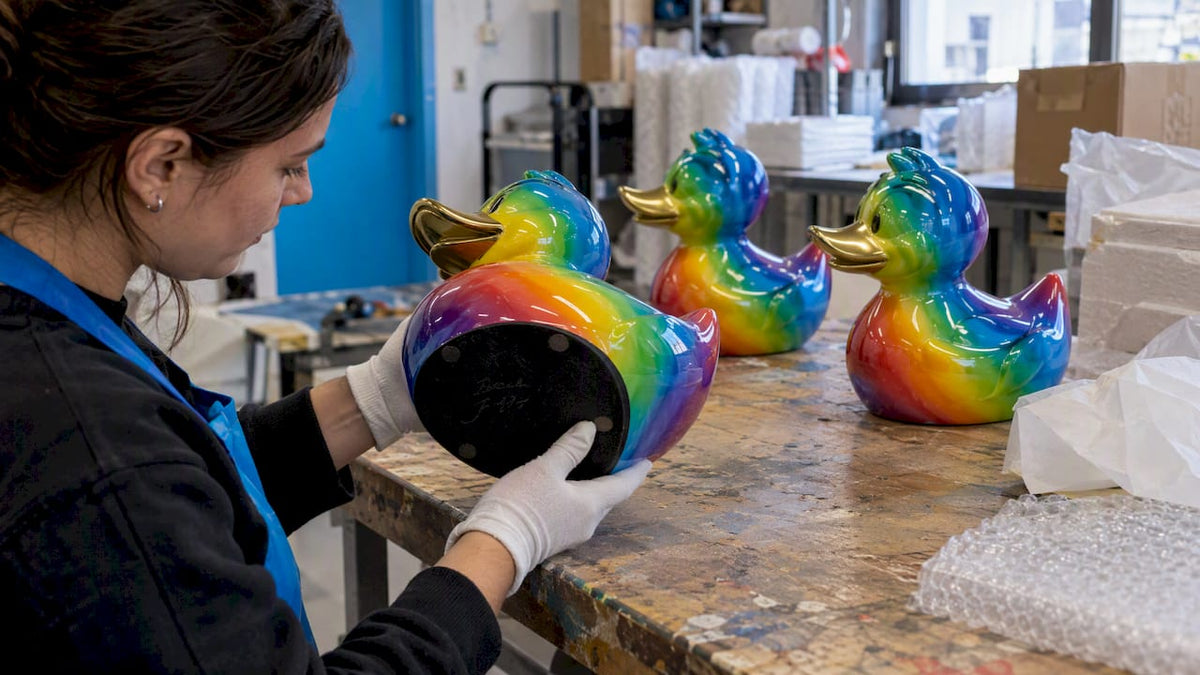
No, although both make light. Phosphorescence is a material re-releasing stored light energy. Bioluminescence is light produced by an organism through a chemical reaction, as in fireflies or deep-sea animals. A glowing duck sculpture is the first kind. A firefly is the second. Nothing in a piece of art is alive or making its own light from chemistry.
A note on the science behind the words
If you want the rigorous version, fluorescence is often described in three stages: absorption of an excitation photon, a short excited-state lifetime of about 1 to 10 nanoseconds, and emission as the molecule returns to its ground state. Part of the energy is lost on the way, which is why the emitted light is always a longer wavelength than what went in. Phosphorescence adds a spin-changing step, a forbidden-looking transition that is why it is slow. For choosing art, the only thing you need from all this is the timing test above.

FAQ
Is glow-in-the-dark the same as UV reactive?
Not exactly. Glow-in-the-dark means phosphorescent: it keeps glowing after the light is removed. UV reactive usually means fluorescent: it glows only while a blacklight is on. Some artworks combine both.
Does blacklight art glow without a blacklight?
Usually not. Fluorescent colors stop glowing the moment the UV source is switched off, as the Smithsonian notes of the Alameda murals. Only phosphorescent parts of a piece keep glowing in the dark, and only after being charged by light.
Which lasts longer, fluorescent or phosphorescent art?
The glow does not last in either case in the sense of a battery. What matters is the pigment and the light exposure. Strong or constant UV can speed fading of fluorescent dyes, so run your lamp only when viewing. Phosphorescent pigments vary: afterglow can last minutes or hours, depending on the compound.
Can I use a regular blacklight bulb for art?
Often yes, but wavelength and power matter for both color and safety. We compare the common options in our guide to 365 nm vs 395 nm UV, and for public or gallery use, read the notes on exposure and safety before you install.
Can a sculpture be both fluorescent and phosphorescent?
Yes. Artists can use daylight, UV-reactive, and afterglow pigments on one piece, so it reads differently in daylight, under blacklight, and in a dark room after the UV goes off.
Sources
- A review of ultra-violet light and examination techniques (American Institute for Conservation)
- Glowing Murals Get a Facelift (Smithsonian Museum Conservation Institute)
- Lunder Conservation Center: A Conservator Finds Art in the Dark (Smithsonian American Art Museum)
- Glow Up! The Science of Fluorescence (University of Southampton)
- Fluorescence and Phosphorescence (Western Washington University, Chemistry LibreTexts)
- Fluorescence and Phosphorescence (Chemistry LibreTexts)
- Special-Effect and Conventional Pigments in Black Light (Materials)
- Foxfire Diamond Has an Eerie Glow (Smithsonian Institution)
- Strange Brew: Creating Fluorescent Pigments (Smithsonian Libraries and Archives)
- Shedding Light on Daylight Fluorescent Artists’ Pigments (Journal of the American Institute for Conservation)
- The light aging behavior of daylight fluorescent paints (npj Heritage Science)
- Fluorescence Fundamentals (Thermo Fisher Scientific)
- What is bioluminescence? (NOAA Ocean Exploration)