Inclusive Office Art: 6 Types, From Tactile Works to UV Glow
Inclusive office art is work that reflects the people who use a space and remains physically and culturally accessible to them, not just decoration chosen for color coordination. The strongest approach combines three moves: curate diverse and emerging artists, pair every piece with an artist story or didactic label, and commission original work when budget allows rather than defaulting to stock prints. For teams exploring custom or glow-reactive pieces, FLY Miami offers direct commissioning alongside ready-to-buy collections.
TL;DR:
- Choose artists with a genuine connection to the communities depicted, verify secondary market provenance, and document compensation and licensing terms before approval.
- Build accessibility into concept, design, installation, and programming reviews; provide strong contrast, nonreflective frames, descriptions, and paid input from lived experience advisors.
- Keep representative art in shared spaces, rotate hallway exhibitions quarterly, and plan full commissioned installation changes no more often than annually.
- Before commissioning, define the goal, audience, access needs, timeline, deliverables, and budget; request standard and glow view images for UV reactive work.
Table of Contents
- 1. Art categories that signal genuine inclusion
- 2. How to find and brief artists for inclusive commissions
- 3. Accessibility rules that make art welcoming to everyone
- 4. Placement, rotation, and keeping the program alive
- 5. FLY Miami Art: inclusive commissions and glow installations
- 6. Benefits of inclusive office art for culture and well-being
- 7. Evaluating authenticity and cultural sensitivity in art pieces
- 8. Case studies of inclusive art programs in corporate spaces
- What the conventional advice gets wrong
- Ready to commission inclusive art for your office?
- FAQ
- Sources
1. Art categories that signal genuine inclusion
Before buying anything, it helps to know what inclusive art actually looks like in practice. A handful of categories cover most workplace needs, and each does a different job depending on where it hangs.
- Employee portrait projects turn staff into subjects, which works especially well in lobbies and onboarding areas; a public-sector example, the NIH Recognition Project, created stylized staff portraits and quotes that were well received enough that other institutes requested copies for their own walls.
- Multicultural prints from artists with lived connections to the cultures depicted belong in shared corridors and meeting rooms, where they signal values to visitors as well as employees.
- Disability-positive works, meaning art made by or depicting disabled artists and subjects without pity framing, fit well near HR or wellness areas and in any space meant to feel welcoming to new hires.
- LGBTQ+ identity-affirming art works as a quiet, permanent signal rather than a seasonal gesture when placed in common areas year-round instead of swapped in only during a single month.
- Tactile and sculptural pieces invite touch and add a sensory dimension that flat prints cannot, making them strong candidates for reception areas or wayfinding landmarks near elevators.
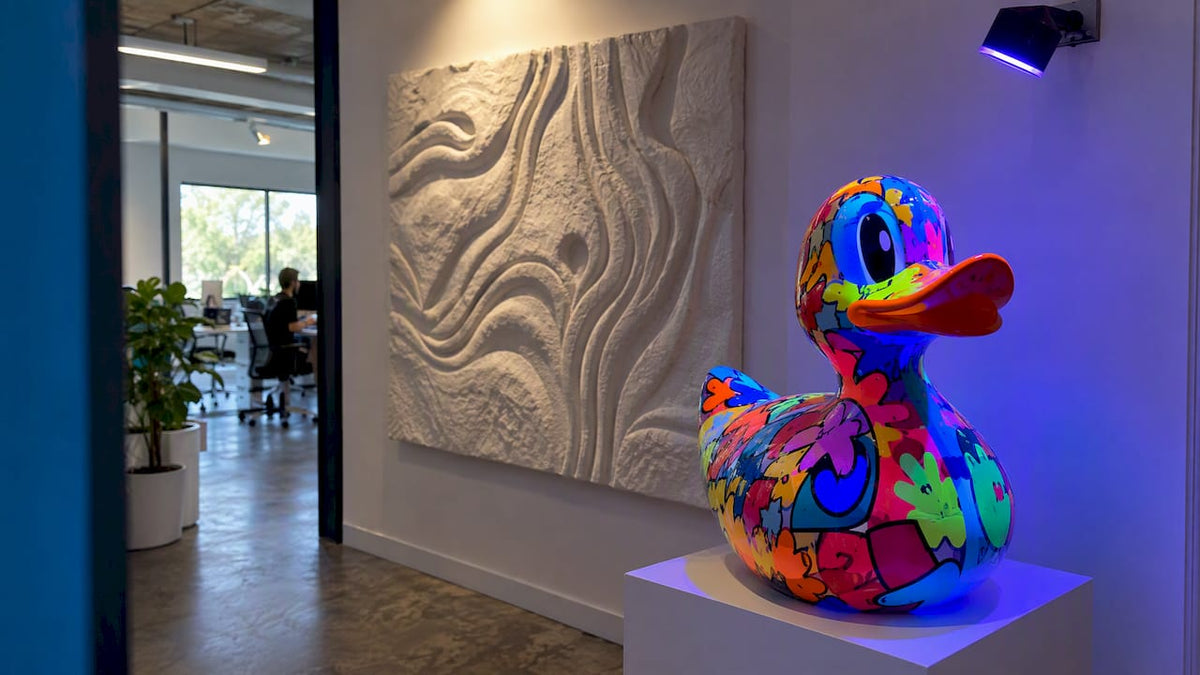
- UV and glow-reactive installations shift in appearance under blacklight, which makes them effective as a destination piece in a break room or event space rather than a hallway afterthought.
None of these categories carries weight without context. Steelcase’s research on art and belonging found that organizations do better investing in emerging or local artists from underrepresented backgrounds than relying on generic, mass-produced decor, and that pairing the work with artist stories or rotating programs deepens the connection employees feel to it. A short label with the artist’s name, background, and a sentence about the piece turns a purchase into a meaningful statement.
2. How to find and brief artists for inclusive commissions
Sourcing inclusive art well takes more intention than browsing a stock catalog, but the channels are straightforward once you know where to look.
- Local disability arts collectives and regional artist directories surface talent that national stock sites miss entirely.
- Curated agencies that specialize in diverse representation can shortlist artists faster than an open call.
- Direct studio commissions, like the custom glow piece process at FLY Miami, let you brief a specific concept, material, and install date with one point of contact.
Before signing off on any piece, run it through a short vetting pass: confirm the artist’s connection to the community represented, check provenance on any secondary-market work, ask how the artist is paid, and get licensing terms in writing for reproductions or marketing use.
A commission brief should cover six things: the goal (belonging, wayfinding, brand signal), the primary audience, any accessibility constraints, the timeline, expected deliverables, and a budget band. Prints and limited editions typically move faster than full commissions, which need lead time for concept approval, fabrication, and installation planning.
Pro Tip: Ask any artist or studio for both a standard-view and a glow-view image before approving a UV-reactive piece, so stakeholders know exactly what the work looks like in both lighting states.
3. Accessibility rules that make art welcoming to everyone
Accessible art is not an add-on step after installation. It is a design constraint from the first sketch.
- Keep strong contrast between the artwork and its background, use non-reflective framing, and avoid placing pieces where glare from windows or overhead lighting washes out detail.
- Write a short artist statement for every piece, add alt-text to any digital gallery listing, and offer braille or QR-linked audio descriptions where the budget allows.
- Add seating near larger or tactile works and keep at least one quiet viewing zone away from high-traffic corridors.
- Bring in lived-experience advisors early and pay them for their time rather than treating their input as a favor.
The Tate’s Creative Access Toolkit recommends exactly this combination: tactile supports, audio description, braille labeling, and paid advisory consultation, specifically so accessibility work does not fall on unpaid advocates. Separately, the AAPD’s Inclusive Spaces Playbook frames inclusive design as a system that goes beyond ADA compliance, built around designing for choice rather than a single universal standard. Treat access review as a checkpoint at concept, design, install, and programming stages, not a final inspection.
4. Placement, rotation, and keeping the program alive
Where a piece hangs matters as much as what it depicts. Shared spaces, lobbies, and meeting rooms are the right home for representative work; private offices are not, since art meant to signal company values loses that function behind a closed door.
- Set a rotation cadence. Quarterly micro-exhibitions keep hallway art fresh, while a full commissioned installation might rotate annually at most.
- Build a logistics checklist. Confirm wall anchors, lighting, and insurance before each swap, not during it.
- Run light programming. A short artist talk, a curator’s note card, or a staff nomination process for the next rotation keeps the collection from feeling static.
- Match budget to scope. A small print refresh costs and moves far faster than a rotating commission program or a full custom installation; plan timelines accordingly.
Avoiding the “token object” problem, a single diverse piece bought once and never revisited, is the entire point of a rotation plan. Steelcase’s research ties rotating programs and collaborative mural-making directly to stronger shared employee experience.
5. FLY Miami Art: inclusive commissions and glow installations
We create original pop art sculptures and wall pieces using UV-reactive pigments that reveal hidden patterns under blacklight, with work that has appeared in exhibitions with significant media coverage.
- We take commissions for custom glow pieces, sculpture, and wall art.
- Every finished piece is handmade and original, with UV-reactive materials built into the fabrication from the start.
- We work from client briefs through mockup review and install planning, including guidance on lighting control.
- Readers can browse the UV/Glow Art collection or the commissions page to see current examples before reaching out.
6. Benefits of inclusive office art for culture and well-being
Art that reflects a workforce does more than fill wall space. It functions as a visible, daily signal of what a company claims to value, and employees notice when that signal is absent or generic.
Rotating, artist-attributed work gives people a reason to pause and talk, which Steelcase’s research ties to stronger shared experience among employees, particularly when the program involves collaborative elements like mural-making rather than a one-time purchase. A label that tells an artist’s story turns a transaction into a connection point, and that connection is what separates art that supports belonging from art that merely occupies a wall.
Accessibility-minded art adds a second layer of benefit. The AAPD playbook frames inclusive design as improving the experience for everyone, not only the disabled employees it is nominally built for, since contrast, clear labeling, and sensory consideration make a space easier to navigate for all. Neurodiversity-specific guidance from Haworth’s research on the built environment reinforces the same point: reducing sensory overload and improving navigation benefits the whole workforce, not a narrow segment, which is part of why inclusive art programs tend to pay off broadly rather than narrowly.
7. Evaluating authenticity and cultural sensitivity in art pieces
The fastest way to undermine an inclusion initiative is to hang art that misrepresents the community it claims to celebrate. A few checks catch most problems before they become public ones.
Confirm the artist has a genuine connection to the culture, identity, or experience depicted rather than commissioning an outside interpretation of someone else’s story. Ask for provenance on any secondary-market or antique-style piece, since authenticated history matters for both ethical sourcing and resale value; HD Asian Art’s guide to symbolic and mindful collecting is a useful reference for how collectors evaluate symbolism and meaning before buying traditional or culturally specific work.
Check how the artist is compensated and whether licensing terms are documented in writing, particularly for reproductions used in marketing. Partnering with a specialist curator early in the process, rather than after pieces are already on order, helps translate stated company values into a visual narrative instead of a last-minute, tokenistic display. Treat curation as a strategic decision tied to the organization’s actual commitments, because poorly chosen art can contradict the DEI language in a company’s own materials faster than almost any other visible signal.

8. Case studies of inclusive art programs in corporate spaces
A few documented examples show what a working inclusive art program actually looks like once it moves past the planning stage.
Steelcase’s research describes successful initiatives built around collaborative mural-making and rotating art programs that give employees a shared project to participate in rather than a finished piece delivered with no context. That participatory element, Steelcase notes, is part of what makes the art register as genuine rather than decorative.

In the public sector, the NIH Recognition Project commissioned stylized portraits and quotes representing the diversity of its own workforce. The response was strong enough that other institutes within the organization asked for copies to display in their own buildings, a sign that staff-feature projects can spread organically once one department proves the concept works.
Retail and corporate accessibility pilots referenced in the AAPD playbook, including Starbucks’ Inclusive Spaces Framework, treat ADA compliance as a floor rather than a ceiling, layering in visual displays and low-tech aids that improve the experience for deaf and disabled visitors specifically. The common thread across these examples is participation and iteration: none of them is a single purchase that stayed untouched for a decade.
What the conventional advice gets wrong
Most guidance on inclusive office art stops at representation: buy work by diverse artists, hang it, move on. That is the easy half of the job. The harder half, the one most companies skip, is treating the art as a system that needs maintenance, accessibility review, and rotation rather than a decorating task you finish once.
I’d push back on the instinct to buy a single statement piece and call the initiative complete. A lone portrait or mural in a lobby reads as a checkbox, and employees can tell the difference between a checkbox and a program. The companies that get real value from this work, per the pattern Steelcase documents, treat art as something collaborative and ongoing, not a procurement line item closed out in a single quarter.
If I had to prioritize one thing for a team starting from zero, it would not be finding the perfect artist. It would be setting a rotation and access-review cadence before buying anything, because a program without a maintenance plan degrades into exactly the token display it was meant to avoid.
— Facundo
Ready to commission inclusive art for your office?
We build handmade, UV-reactive sculptures and wall pieces that turn a shared space into something employees actually stop and talk about. Whether you need a custom glow installation or a piece from an existing collection, our studio works directly with you from concept through install.
Browse the commissions and collections page or start a custom glow piece to see what fits your space.
FAQ
What is the 70/30 rule in art?
Definitions vary across design contexts, and this guide does not define any specific ratio for office art. Some designers informally balance statement pieces against supporting work, but percentages should be treated as rules of thumb rather than standards.
What is the best artwork for an office?
There is no single best piece, since the right choice depends on the space and the audience, but the strongest programs favor work by diverse or emerging artists paired with a short artist story rather than generic mass-produced prints, a pattern Steelcase’s research ties to stronger employee connection. For a distinctive statement piece, a UV-reactive sculpture or wall work adds a sensory dimension that flat prints cannot.
What is a symbol for inclusion?
Inclusion is represented through many symbols depending on culture and context, from unity-themed imagery to traditional motifs tied to specific communities. The HD Asian Art guide to symbolic collecting is a useful reference for understanding how specific traditional symbols carry meaning before choosing one for a shared workspace.
What does it mean to be inclusive at work?
Being inclusive at work means designing spaces, policies, and visible culture signals, including art, so that people of different backgrounds, abilities, and identities feel represented and welcome. The AAPD’s Inclusive Spaces Playbook frames this as a systemic design choice that goes beyond legal compliance to actively improve the experience for everyone who uses the space.
Sources
- Designing an Inclusive Workplace Through Art - Steelcase
- Inclusive Spaces Playbook - February 2026
- Creative Access Toolkit - Tate