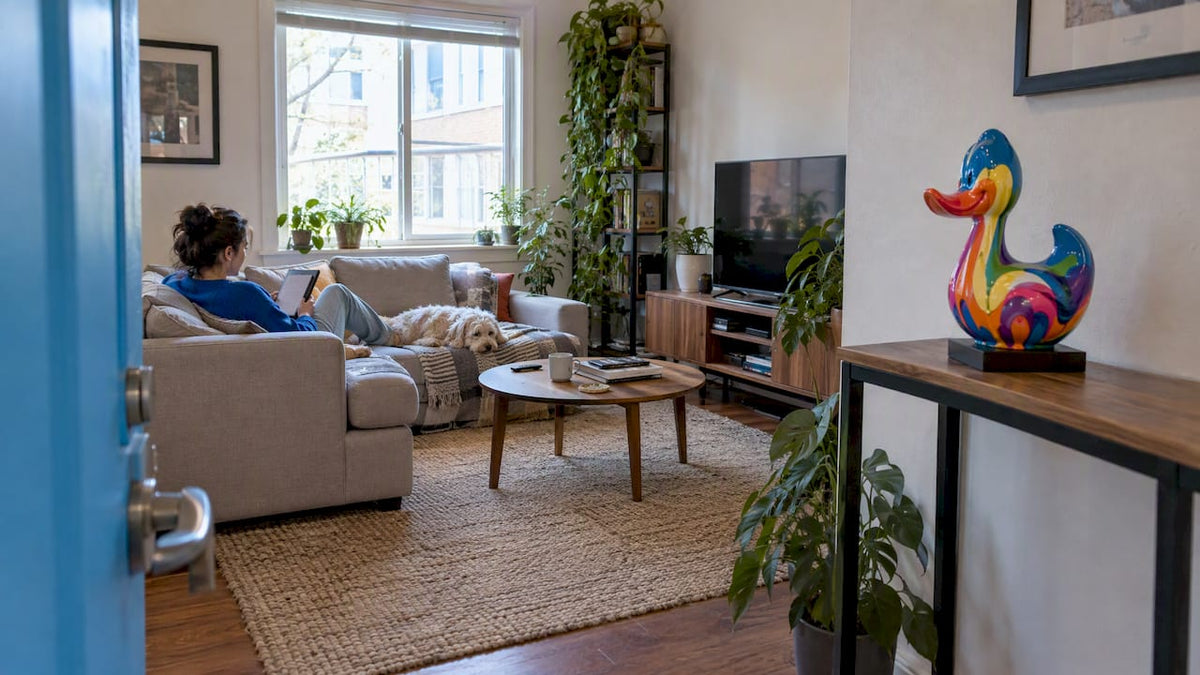
Small Space Sculpture: How to Choose and Place It
The best sculpture for a small space is one deliberate piece, sized to its spot, with empty room around it. Small rooms don’t need tiny objects. They need fewer objects, placed with intent, and a form that rewards a second look from different angles. This guide covers how to size a piece, where it can live, what to do with light, and when a glow-in-the-dark sculpture earns its place.
TL;DR
- One strong piece usually beats several small ones. Clutter, not size, is what makes a compact room feel cramped.
- Leave breathing room: designers suggest at least 5 to 8 centimeters (about 2 to 3 inches) of empty wall around wall art, and the same logic applies to shelf and table pieces.
- Sculpture works where paintings can’t: shelves, gaps between furniture, window bays and corners.
- Open forms and negative space keep a piece from feeling heavy in a tight room.
- Check the real dimensions before you buy, and measure the spot with painter’s tape first.
Table of Contents
- Why sculpture suits small rooms better than you’d expect
- Start with scale, not with the object
- Where a small sculpture can live
- Choose forms that breathe
- Light changes everything in a small room
- Where UV-reactive and glow sculpture fits
- Perspective: what we’ve learned making sculpture people live with
- Common mistakes to avoid
- Small space, big story: when a commission makes sense
- Work with us on your space
- A simple checklist before you buy
- FAQ
- Sources
Why sculpture suits small rooms better than you’d expect
Most people fill a new home’s empty walls first, so most first purchases are paintings, photographs and prints. Sculpture is often overlooked at home for exactly this reason, even though it can be viewed from all sides and so works in places a flat picture can’t: on a shelf, between two pieces of furniture, in an empty window bay.
That matters in a studio apartment or a narrow hallway. A wall may be taken up by a door, a radiator and a bookcase, but there is almost always a console end, a deep windowsill or a bookshelf with one free third. Sculpture turns those leftover spots into the focal point of the room.
We make this argument at more length in why sculptural art beats flat wall decor. The short version: a three-dimensional piece changes as you move around it and as the light changes through the day, so it keeps rewarding attention in a room you see every day.
Start with scale, not with the object
Before you browse, decide where the piece goes and measure that spot. Three numbers matter: width, height and depth. Depth is the one people forget. A 10-inch-deep object on a 9-inch-deep shelf will lean out into the room and get knocked.
A practical routine:
- Choose the spot: a shelf, a console, a sideboard, a window ledge, a wall section.
- Measure the free width and height, then subtract clearance on each side.
- Cut a piece of paper or cardboard to the size you have in mind and tape it up or set it down for two days.
- Walk past it in the morning and in the evening. Does it block a path, a light switch, a window latch?
- Only then shop, and compare against the dimensions listed on the product page, not the photo.
Slightly bigger is often better
A common mistake is assuming smaller art is always right for a small room. Art design professionals say a single, deliberate statement piece, even a slightly larger one, can make a compact room feel calmer than many small items scattered around. The same point holds for prints: one larger piece gives the eye a single place to land.
The test is simple. If you squint and the surface you’ve decorated reads as a handful of separate dots, consolidate. If it reads as one object with some quiet space around it, you’ve got it.
Leave negative space around it
Empty space is part of the display. The guidance above suggests keeping at least 5 to 8 centimeters clear on every side of a wall piece. On a shelf, treat it the same way: one sculpture, one small supporting object at most, and visible shelf surface on both sides.
Where a small sculpture can live
| Spot | What works | Watch out for |
|---|---|---|
| Bookshelf | One piece on a cleared shelf, turned slightly off-axis | Spines behind the piece create visual noise; clear the shelf or use a plain backdrop |
| Console or entry table | A compact piece with a clear silhouette you can read as you walk in | Keys, mail and bowls crowding the surface |
| Windowsill or window bay | Pieces that look good backlit or in changing daylight | Direct sun fading some materials; check care notes |
| Bedside or desk | A small, stable piece with a low center of gravity | Cords, lamps and spills |
| Narrow wall | A wall-mounted sculptural piece, vertical in orientation | Hanging too high; center it around eye level |
| Corner | A taller, slim form to draw the eye up | Blocking a door swing or a walkway |
For a powder room, see our bathroom safe artwork guide.
Use the wall, but keep it sculptural
When shelf and table space is gone, look up. Wall-mounted relief and dimensional wall art give you the depth of sculpture with no footprint on the floor or furniture. Vertical formats are specifically recommended for narrow walls, because portrait orientation draws the eye upward and suggests height. You can browse our wall art collection to see what that looks like in a pop art language.

If you want to plan several pieces across one wall, the same principles carry over from any good wall gallery: pick a clear arrangement, keep consistent spacing, and decide the hero piece first.
Choose forms that breathe
In sculpture, “space” is not only the room. Britannica’s overview of sculpture in the round explains that freestanding sculpture offers a designer free spatial options, and the air within and around a form is as much a part of the work as the material. Henry Moore is the classic example of an artist who gave voids the same weight as solid mass.
For a small room this has a practical meaning. A solid, dark, blocky object has a lot of visual weight. A form with openings, curves or a narrow base lets your eye pass through it and lets the room feel larger. When you compare two pieces of the same size, pick the one you can see through or around.
Color follows the same logic. Designers recommend light, airy compositions in warm, light tones to open up compact rooms, and they warn against hard, high-contrast edges that stop the eye. Pop art complicates that advice in a good way: a saturated piece can be the single bold note in an otherwise quiet, neutral room. The key word is single.
Light changes everything in a small room
Small rooms usually have one or two light sources, so a sculpture’s finish matters. Glossy surfaces bounce light and make the piece seem larger. Matte surfaces absorb it and recede. Placing a piece beside a window gives you daylight movement. A directional picture light or a small spot angled from the side brings out relief and texture.
Two habits help:
- Light the piece from the side or above at an angle, not straight on, so shadows reveal its shape.
- Check it after dark. A piece that looks wonderful at noon can disappear at night, or vice versa.
We go deeper on the second idea in our note on requiring two lighting states for hotel lobby sculpture. The same thinking applies to a living room: design for the lamp-lit evening as well as the daytime.
For paint colors, see our guide to art for grey walls.
Where UV-reactive and glow sculpture fits
This is my territory. Most of my sculptures are UV reactive, so a piece reads one way in daylight and reveals hidden patterns and colors under blacklight. For a small space, that does something unusual: one object gives you two rooms. By day it is a clean pop art form. At night, with a blacklight on, it becomes the whole mood of the room.
A few honest notes on how glow behaves:
- UV-reactive pigment responds to ultraviolet light, so a small blacklight bulb or strip is what shows the hidden layer. Plan where it will plug in or mount before you buy.
- Phosphorescent materials work differently: they store light and release it slowly, so the glow fades as the stored light is spent and then needs to recharge from sunlight or another UV source. Ask the maker which effect a piece uses, so you know what to expect.
- Keep the blacklight on a dimmer or a separate switch if you can, so you can dial the effect up for evenings and off for daily life.
For lighting habits that protect the glow, see our blacklight art care guide.
If you want to see the range, start with our UV/glow art collection and our sculpture collection. My rubber duck pieces are part of that language: playful, recognizable and made to carry a message about peace and unity.
Perspective: what we’ve learned making sculpture people live with
Humor and color are not the enemies of a calm small room. The problem is crowding. If you live in a compact apartment, skip “what’s the smallest thing?” and ask “what is the one thing I want to see when I walk in?”
Every sculpture I make is handmade in my Miami studio. A handmade object has a presence that rewards giving it space. I would rather see one of my sculptures on a cleared shelf with a lamp beside it than three pieces competing on a sideboard.
I also think about the second life of a piece, the one that begins when the lights go down. The UV-reactive layer is not a gimmick for me. It is a way to build a hidden pattern into the work so that the sculpture has something new to say at night, which is exactly what a small room needs: more experience from the same square footage.
If the pieces you’ve seen are too large or too small for your spot, tell me. Commissions exist for that reason.
— Facundo
Common mistakes to avoid
Buying for the photo. Product photos are cropped tight. A piece that looks monumental may be a desk object, and the reverse is also true. Always compare listed dimensions against your taped-out space.

Grouping too many small things. A cluster of five figurines is five small decisions. One sculpture and one quiet companion, a plant or a book stack, is one decision.
Ignoring the viewing angle. Sculpture is meant to be walked around. Place it where you will see it from the sofa, the doorway and the kitchen, not only head-on.
Putting it where it can be knocked. Narrow shelves, busy corners and low tables near doors are high-risk. Use museum putty or a non-slip pad on small pieces if you have children or pets.
Forgetting the lighting plan. If a piece depends on blacklight, decide on the fixture first.
Small space, big story: when a commission makes sense
Sometimes nothing off the shelf fits: an odd alcove, a deep window bay, a hotel nook, a boutique counter. A custom piece lets you set the footprint, the palette and how it behaves under blacklight. If you’re a designer working for a client, a commissioned piece can also solve the opposite problem, a room full of generic decor that needs one distinctive anchor.
If you need an exact fit, see our custom wall sculpture guide.
We describe how sculpture can anchor a room in why sculptural art anchors room design in 2026, and our statement sculpture decor ideas cover how to make one piece carry a space. For a broader look at forms and styles, our collector guide to contemporary pop art sculpture types helps you decide what you’re drawn to before you spend.
For a related read, see our guide to inclusive office art.
Work with us on your space
If you’d like a piece sized for your shelf, wall or alcove, or a glowing rubber duck made around your palette, start with our custom glow piece page or browse the originals. Send us the measurements of your spot and a photo of the room, and tell us how you plan to light it. Prices are not published on the pages listed here, so ask us for a quote directly. To commission a piece, use our commissions page.
A note on scale: some of our works, such as Proud Love, are large-scale pieces made for bigger rooms and public settings. For a compact home, check the dimensions on each product page, or ask us about a commission.
A simple checklist before you buy
- I know exactly where the piece will go and have measured width, height and depth.
- I’ve taped out the footprint and lived with it for two days.
- There is empty space around it on every side.
- It looks good in daylight and at night.
- If it glows under blacklight, I know where the light will come from.
- It’s stable, and it’s out of the way of doors, kids and pets.
- I’m buying one piece I love, not several I merely like.
FAQ
What size sculpture is right for a small room?
There is no single number, because it depends on the surface. A good starting point is to let the piece fill roughly half to two thirds of the width of its shelf or table, leaving clear space on both sides. For wall pieces, designers suggest keeping at least 5 to 8 centimeters of empty wall around the work.
Is one large piece better than several small ones?
Usually, yes. Art design professionals say a single deliberate statement piece can reduce visual noise and make a compact room feel less cluttered than many small items. If you love collecting small works, group them tightly in one place rather than scattering them across every surface.
Where can I put a sculpture if I have no shelf space?
Try a wall-mounted sculptural piece, a deep windowsill, the end of a console, a corner, or the gap between two pieces of furniture. Designers note that sculpture can fill spots like these where a painting can’t. Vertical wall pieces also suit narrow walls.
Do glow-in-the-dark sculptures work in a small apartment?
They can work very well, because one object gives you a daytime look and a nighttime look. You will need a blacklight source for UV-reactive pieces, and it helps to put it on its own switch or dimmer. Phosphorescent materials behave differently, since they fade as they release stored light, so ask the maker which effect a piece uses.