

How to Plan a Private Pop Art Studio Visit With Family
Book your appointment with Flymiami before anything else. Contact the studio directly, state your purpose (evaluate, purchase, or commission a UV-reactive sculpture), and confirm a blacklight demo slot. A successful visit ends with you having inspected the UV behavior of at least one piece, reviewed provenance documentation, and walked away with clear next steps on pricing or commission terms.
Before you confirm the date, run through this checklist:
- Identify which works you want to see (sculptures, wall art, or specific UV-reactive editions)
- State your family composition and any accessibility needs in the booking message
- Confirm whether you need an evening slot for a full blacklight demonstration
- Ask what documentation the studio will have ready (certificates, provenance, condition reports)
- Clarify parking, entry logistics, and whether refreshments are available on site
Success looks like this: you can describe the UV behavior of the piece under blacklight, you hold a signed provenance document, and you have a written quote or commission outline in hand before you leave.
Key Takeaways
A private studio visit to evaluate or commission UV-reactive pop-art sculptures succeeds when you book with a clear purpose, arrive prepared with provenance questions, and request a blacklight demonstration before any purchase decision.
| Point | Details |
|---|---|
| Book with purpose stated | Include visit goal, guest count, budget range, and UV demo request in your first message. |
| Bring measurement data | Scaled photos and room dimensions let the artist curate the showing to your actual space. |
| Request the blacklight demo | UV behavior is only assessable under the correct fixture; confirm this slot when booking. |
| Verify the contract specifics | The agreement must name the UV medium, edition number, and delivery condition standard. |
| Flymiami for private viewings | Flymiami arranges appointment-only studio viewings with in-studio blacklight demos and commission support. |
Table of Contents
- How do you schedule a private studio or gallery visit?
- What should you prepare before the visit?
- How should you conduct yourself during the visit?
- How do you make a private viewing work for the whole family?
- What should you expect when buying or commissioning?
- What happens after the visit?
- Flymiami makes private viewings straightforward
- What the studio actually values in a private visit
- Sources
How do you schedule a private studio or gallery visit?
Galleries and studios typically offer three booking channels: a gallery introduction (where a representative curates the showing), direct artist contact, and open-studio events. For UV-reactive work specifically, direct contact with the artist is usually the most productive route because you can request a blacklight demo and discuss technical finishes in detail.
When you schedule a private viewing, include the following in your message:
- Purpose of the visit (evaluate for purchase, commission scoping, or installation planning)
- Family composition and number of guests
- Preferred date range and whether you need an evening slot for UV demonstration
- Specific pieces or collections you want to see
- Approximate budget range
- Any accessibility requirements (wheelchair access, stroller clearance)
Private appointment workflows often include an intake form where clients state the works they want to see, accessibility needs, and budget range so the host can curate the showing. Artists and studios commonly respond within 24–72 hours of a well-structured inquiry.
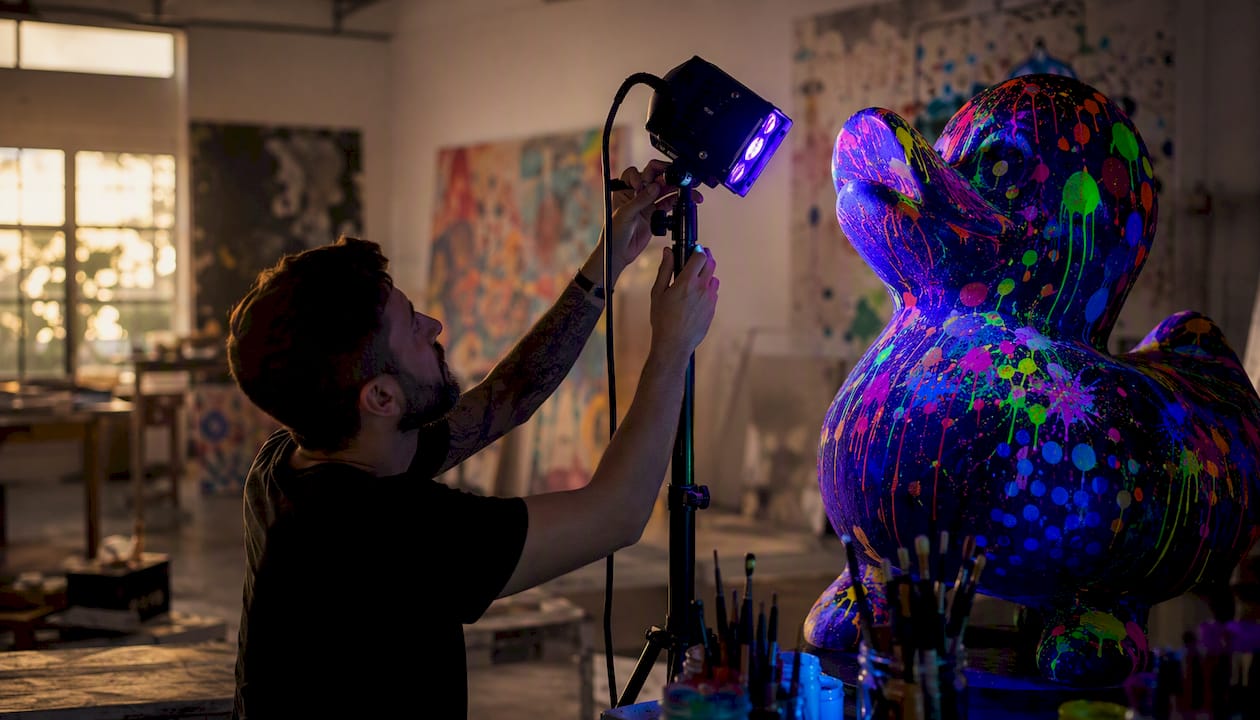
Pro Tip: Request the evening slot explicitly if UV-reactive work is your primary interest. Blacklight behavior is nearly impossible to assess under bright daylight or standard gallery lighting, and studios that work with UV-reactive materials will often set up dedicated fixture rigs for appointment-only demos.
What should you prepare before the visit?
Arrive with a clear objective stated in writing. “Evaluate for purchase” and “commission scoping” require different conversations, and the artist or gallerist will prepare different documentation for each.
Documents and tools to bring:
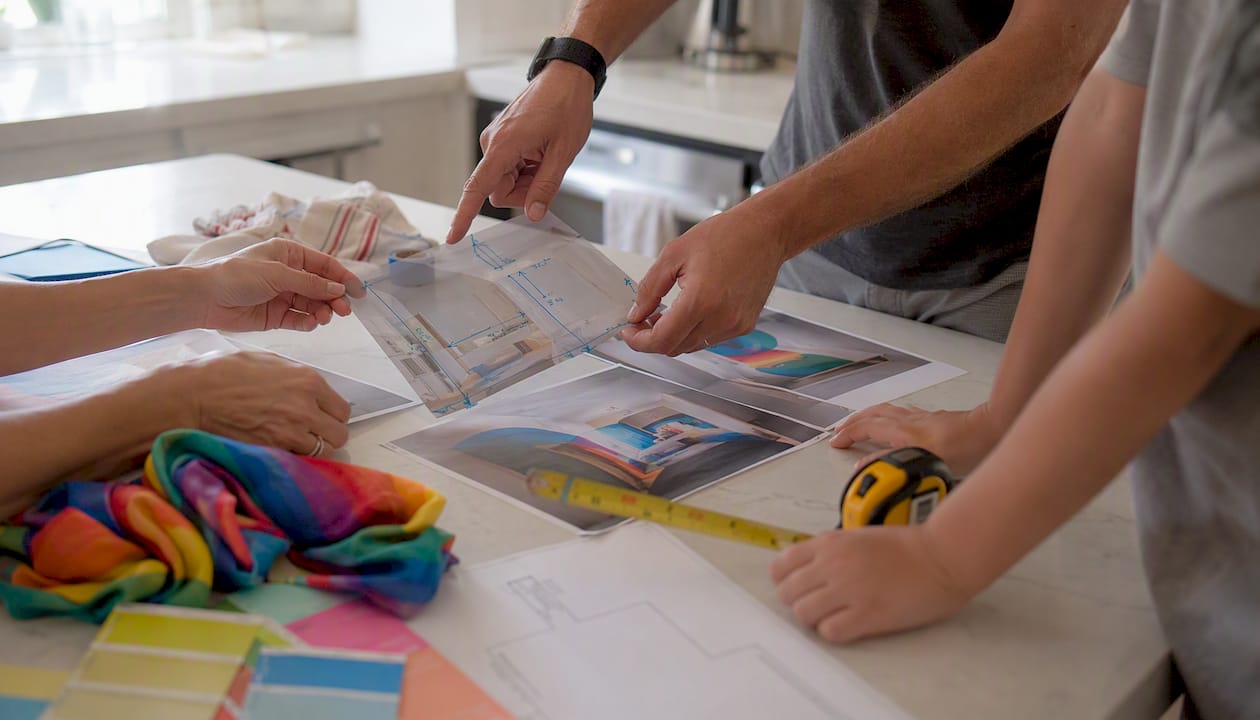
- Measuring tape and scaled photos of the installation space (wall dimensions, ceiling height, floor plan)
- Proof of funds or a letter of intent if you are commissioning a significant piece
- A provenance checklist (certificate of authenticity, edition number, artist signature, exhibition history)
- Your own contract template or a list of purchase policy questions
- A phone or tablet loaded with reference images of the space where the work will live
Questions to prioritize on-site:
- What UV-reactive coating or medium is used, and what is its lightfastness rating?
- What finishing process protects the surface, and is it still curing?
- What blacklight fixture type and wattage does the artist recommend for display?
- Is the piece part of a limited edition, and how many remain?
- What is the provenance chain from studio to current availability?
Pro Tip: State your budget range early and in writing, not as a negotiating floor but as a planning parameter. Collectors who communicate budget upfront are treated as serious buyers. Gallerists use that figure to curate the showing and prepare relevant documentation before you arrive.
How should you conduct yourself during the visit?
Studio visits are most successful when visitors engage in dialogue, ask thoughtful questions about process and materials, and show commitment that builds relationships. Treat the appointment as a professional conversation, not a retail transaction.
Etiquette basics:
- Arrive on time. Studios are working environments, and late arrivals compress the demo time.
- Treat the visit like a private home: no texting, no loud music, and follow any cultural hospitality cues the host offers.
- Never touch artwork, materials, or tools without explicit permission. Skin oils can damage UV-reactive coatings and abrade surfaces that are still finishing.
- Ask before photographing any work.
- Manage family behavior proactively: brief children on the no-touch rule before entering.
Inspection checklist for UV-reactive sculptures:
- Signature, date, and edition label (front and back)
- Surface condition: no abrasions, no tackiness from uncured finishes
- Structural integrity: check joints, mounting points, and base stability
- UV behavior: request a blacklight demo and observe color uniformity, hidden pattern reveal, and any fade at edges
- Documentation: certificate of authenticity, condition report, and any exhibition record
When you bring up price, do it after the technical conversation, not before. A question like “What does the commission process look like for a piece at this scale?” opens pricing naturally without reducing the visit to a negotiation.
Pro Tip: Ask the artist to demonstrate the UV behavior rather than handling the piece yourself. Phrasing like “Could you show me how this reads under the blacklight fixture you recommend?” signals technical seriousness and keeps the surface safe.
How do you make a private viewing work for the whole family?
Limit the guest list to essential decision-makers and one guardian per child. A studio full of observers dilutes the technical conversation and puts fragile work at risk.
Safety and accessibility checklist:
- Confirm walk-path clearance for strollers or wheelchairs before the visit
- Brief every adult on the no-touch rule and assign one adult per child
- Keep bags and coats away from sculpture bases and wall-mounted pieces
- Ask the studio in advance whether food or drinks are permitted on site
Schedule daylight slots for general evaluation and reserve an evening or low-light slot for the blacklight demo. Children often respond strongly to UV-reactive work, and a short, structured blacklight moment can make the visit genuinely memorable without turning it into a distraction. Family-oriented creative activity guidance suggests that brief, focused engagement with visual art keeps younger visitors attentive far longer than open-ended exploration.
Pro Tip: Appoint a single purchasing lead before the visit. When multiple decision-makers attend, the conversation fragments. Agree on who asks the technical questions and who handles pricing discussions, then share measurement photos and condition notes with the wider group afterward.
What should you expect when buying or commissioning?
Studio-direct pricing is often lower than gallery retail because the gallery markup covers curation, promotion, and resale support. That said, if a gallery introduced you to the artist, buying direct without going through that gallery is a breach of professional etiquette and can close future access.
Commission timeline and payment stages:
- Scope agreement and written brief (materials, dimensions, UV finish specifications, deadline)
- Deposit: typically 30–50% of the agreed price at contract signing
- Mid-point milestone payment (often at 50% completion, confirmed by studio photos)
- Balance due before shipping or on delivery, per contract terms
- Delivery and installation, with condition report signed by both parties
Contract checklist:
- Scope, materials, and UV-reactive finish specifications in writing
- Ownership and copyright terms (reproduction rights, resale royalty if applicable)
- Delivery schedule and what constitutes a delay
- Insurance responsibility during transit
- Cancellation and refund terms for both parties
- Cross-border shipping clauses if the studio and destination are in different countries
Red flags: unsigned agreements, vague materials descriptions (“UV paint” with no brand or specification), inconsistent provenance, or any request to pay through informal channels.
Before signing, confirm that the contract names the specific UV-reactive medium, the edition number, and the delivery condition standard. A contract that says “similar finish” instead of specifying the coating is a contract that will not protect you if the piece arrives looking different from what you approved in the studio.
For deeper context on provenance and valuation, the collector’s buyer guide covers authentication and edition documentation in detail.
What happens after the visit?
Post-purchase checklist:
- Formal invoice with edition number, dimensions, and materials listed
- Signed condition report before the piece leaves the studio
- Packing and crating specifications in writing (UV-reactive finishes require padding that does not contact the surface)
- Customs paperwork for cross-border moves (HS code, declared value, country of origin)
- Insurance policy in place before transit begins, covering full replacement value including installation costs and any applicable duties
For installation, UV-reactive sculptures perform best under dedicated blacklight fixtures positioned at a distance the artist specifies. Standard UV-A fluorescent tubes (365 nm) or LED blacklight strips at the recommended wattage produce the most consistent glow. Ambient light levels matter: the UV effect is most visible in low ambient light, so display placement should account for natural light sources. For display rotation and installation planning, the guide on rotating pop art displays covers fixture placement and surface protection in practical terms.
Schedule a condition check every 12–18 months. Your total cost of ownership should include transit insurance, installation hardware, any import duties, and the cost of appropriate blacklight fixtures.
Flymiami makes private viewings straightforward
Flymiami’s UV-reactive sculpture collection by Facundo Yebne is available for private studio viewings, with in-studio blacklight demos arranged by appointment. The studio handles commissioned work from brief through delivery, coordinates shipping and crating, and provides aftercare guidance specific to each piece’s finish.
To book, contact Flymiami through the studio’s website with your visit purpose, guest count, preferred dates, and the works you want to see. The studio prepares relevant documentation and lighting setups ahead of each appointment. Facundo’s work has been featured in prestigious exhibitions and covered by major media outlets, and the UV glow art collection includes both available editions and commission-ready formats. Browse the sculpture collection to identify pieces before your visit, then reach out to confirm your appointment and blacklight demo slot.
What the studio actually values in a private visit
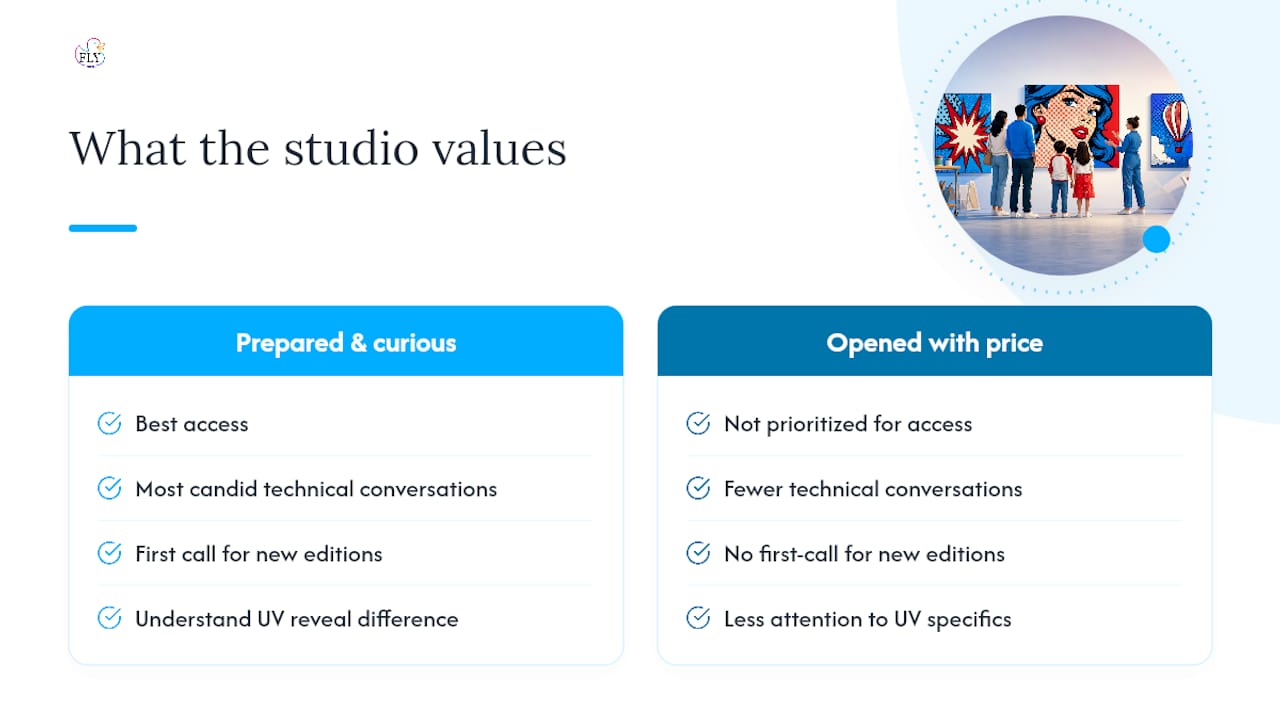
Most guides on planning a family visit to a pop art exhibition focus on the logistics: parking, timing, what to wear. What they miss is that a private studio visit is a relationship, not a transaction. The collectors who get the best access, the most candid technical conversations, and the first call when a new edition drops are the ones who showed up prepared and curious, not the ones who opened with price.
UV-reactive work adds a layer of complexity that rewards that preparation. The piece you see under gallery lighting and the piece you see under a dedicated blacklight fixture are genuinely different objects. Collectors who understand that difference, who ask about coating specifications and fixture distances, signal something important: they will care for the work properly. That matters to an artist. It changes what gets shared in the studio and what gets offered first.
Flymiami welcomes families at private viewings because the work is designed to be experienced together. The UV reveal is a moment. Bring the people who will live with the piece, brief them on the etiquette, and let the work do what it was made to do. Then ask your questions. The conversation that follows is usually the most useful part of the visit. To arrange yours, reach out through the Flymiami studio contact page.
Sources
- 9 Things To Know About Studio Visits (Artsy editorial)
- A guide to doing studio visits (ArtNews)
- Studio visit etiquette—what every art lover should know (Artists Village)
- Contact Sophia | Sophia Williams
- Creative activities at home: Stress relief, learning, and fun
,%20and%20confirm%20a%20blacklight%20dem...)