Installation Site Prep for Art: Survey, Access, Sign-Off
Site prep for an art installation means three things done before the artwork ships: a written site survey, a fix for every condition the survey flags (wall, ground, power, access, lighting), and a sign-off from everyone who controls the space. Skip any of them and the problems show up on installation day, when a lift cannot reach the wall or the outlet is 80 feet away. This guide walks through the process for indoor, outdoor, private and public projects, with the checklists that city arts programs use.
TL;DR
- Run a site survey first. Record the address, measurements, surfaces, ground, overhead wires, utilities, access routes, storage and security in one written record with photos.
- Match the prep to the piece. Outdoor sculpture can need footings, conduit and utility coordination. A wall piece may need only a structural check and a power source.
- Settle permits, accessibility and fire-safety clearances before delivery, not after.
- Agree in writing who pays for prep and who supervises installation.
- Confirm readiness with a pre-installation walk-through and a signed checklist.
Table of Contents
- What site prep covers for an art installation
- Start with a site survey
- Check the conditions that damage or delay artwork
- Plan delivery, access and installation-day logistics
- Permits, safety and accessibility
- Perspective
- A step-by-step readiness checklist
- Who pays for prep, and who decides
- Work with us on your installation
- FAQ
- Sources
What site prep covers for an art installation
Site prep is everything that has to be true about a location before the work arrives. For a small framed piece, that may be a stud-finder and a clear afternoon. For a large outdoor sculpture, it is closer to a construction project.
Public agencies spell this out. A city public art commission handbook tells artists to identify the equipment and site preparation needed for delivery and installation, and to arrange off-site storage if the schedule requires it. Pierce County, Washington, shows how far the scope can stretch: its project specifications for a park art installation list clearing and grading, concrete footings with reinforcement, conduits and anchors, offloading and assembly, electrical service, and site restoration as part of the installation scope.
The takeaway: ask early which category your project falls into. Prep for a lobby is a day of coordination. Prep for a plaza can be weeks of civil work, and it has to be scheduled before the artwork is finished, not after.
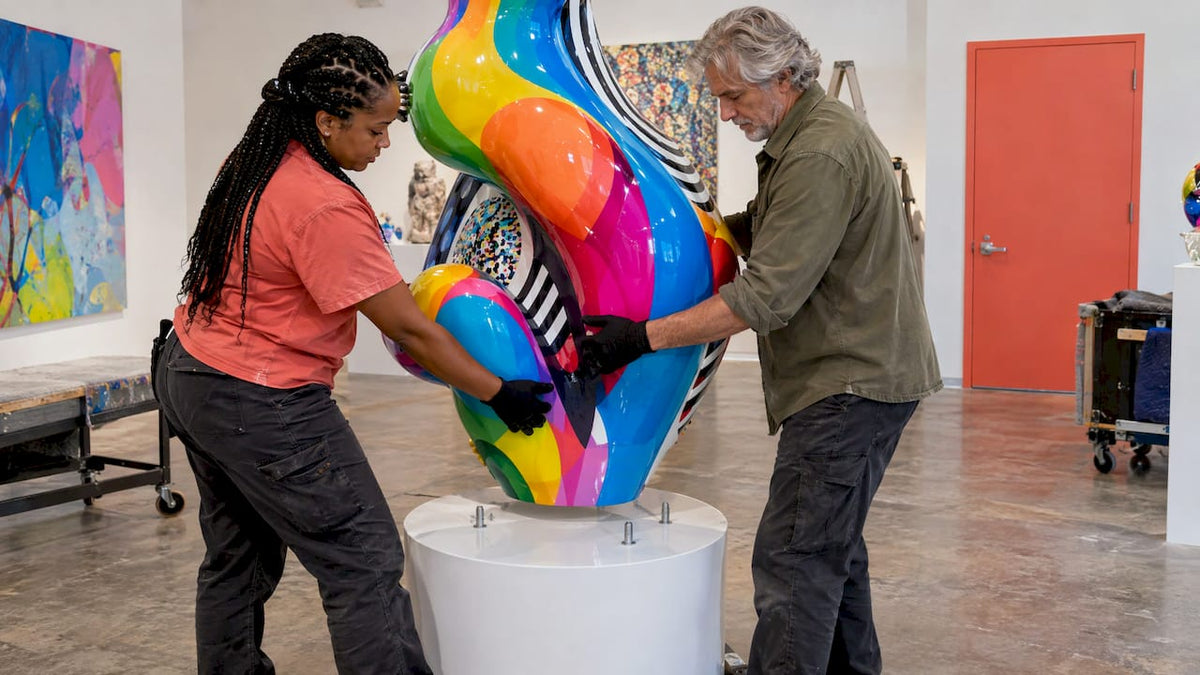
If your project is a larger one, our guides on modular sculpture installation planning and logistics and displaying large-scale art installations go deeper on the physical side.

Start with a site survey
The survey is the foundation of everything else. It turns “we think it will fit” into numbers, photos and a list of open issues. Do it before the final design is locked, and repeat a short version just before delivery.
The basic sequence from the City of Frankfort, Kentucky, is simple: get permission, inspect and measure the wall and its features, and assess the adjacent workspace, ground stability, overhead wires, storage, water, restrooms and security. That guide was written for murals, but the logic holds for any installation that needs a crew, equipment and a few days of access.

What the survey should record
Different agencies ask for different details. Combined, they make a useful template:
- Identity and context. Address, coordinates, date of the survey, who performed it, installation type, how long the piece will stay and whether it is permanent. The City of Laredo’s public art procedures use a site-assessment form that records exactly these items, along with terrain, elevation, slopes, nearby structures, trees, poles, power lines and visual relationships.
- Boundaries and underground or overhead constraints. The University of Michigan’s preconstruction survey specification covers property boundaries, rights-of-way, easements, flood zones, topography and drainage, and public and private utilities including electric, gas, sewer, water and communications. For a footing or anchor project, this is the part that prevents a dig-in disaster.
- Condition and access. A professional archives best-practice report says a site examination should produce a written and pictorial report that identifies the property, location, date and examiner, and documents accessibility, structural condition, weathering, damage and ownership restrictions.
- Everyday logistics. Parking, debris or brush, sidewalks or streets, cameras, security staff, storage, water and restrooms for the crew.
Two habits make the record far more valuable. First, photograph everything with a tape measure or a person in frame for scale. Second, keep the file. The same archives report treats survey documentation as a management tool for later conservation, ownership and maintenance decisions, so the record you make today answers questions years from now.
Check the conditions that damage or delay artwork
The survey tells you what is there. This step asks whether it is suitable.
Walls, floors and structure
For wall-mounted work, check wall condition, moisture and, outdoors, roof and flashing above it. Frankfort’s guide lists wall condition, moisture, roof and flashing, and sunlight among the items to evaluate. For heavy or large pieces, an engineering review matters more than a visual check. Laredo’s engineering checklist asks for artwork weight, load-bearing capacity, anchoring, foundation or structural support, and wind and seismic effects. If you are a commissioner weighing this, our overview of structural engineering for public sculpture explains what an engineer will want from you.
Weather and exposure
Outdoors, record climate, precipitation, wind, coastal or humid exposure, extreme temperatures and pollution. Laredo’s form directs assessors to note these climate factors because they affect materials, structural integrity and maintenance. Oklahoma’s public art guide adds that sun exposure, moisture and weather can damage outdoor murals, and that anti-graffiti coatings and UV-resistant sealants can extend service life. The same guide says to budget for maintenance and touch-ups from the start.
If vandalism is a concern at your site, see our notes on vandal-resistant sculpture for commissioners.
Light, power and the glow factor
Power and lighting are easy to forget until the crew arrives. Laredo’s form asks for electricity, water, drainage, power-source voltage and phase where known, wiring and conduit needs. For lighting, the Washington State artist handbook recommends durable, long-life, energy-efficient lighting with accessible fixtures, transformers and lamps for replacement, and suggests considering downlighting for the night sky, with uplighting discussed with the partner agency.
For UV-reactive work, add questions of your own. Where can a blacklight fixture be mounted and powered? Can the room or the area be dimmed during viewing? Is there a switch the owner can reach without a ladder? Our piece on why UV art works in public spaces covers how to think about those choices.
Plan delivery, access and installation-day logistics
Most installation-day failures are access failures. The artwork is ready, but the truck cannot reach the dock, the freight elevator is too small, or the ground will not hold a lift.
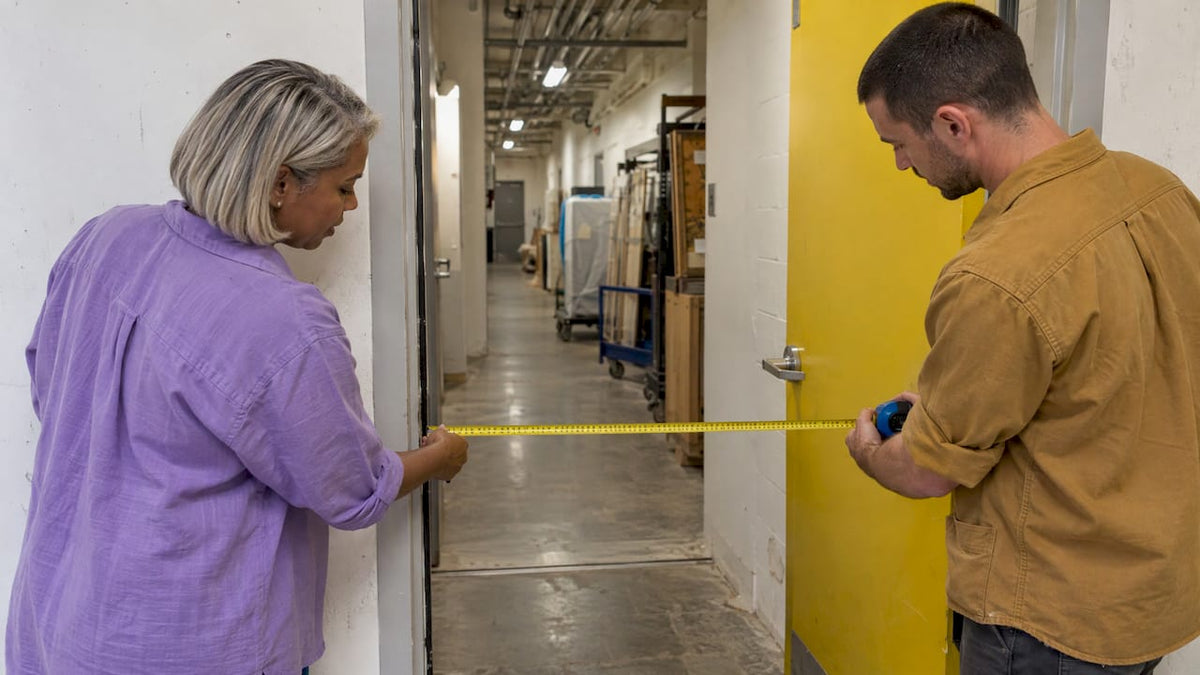
Walk the route from the curb to the final spot and note:
- Vehicle access. Laredo’s form asks for access for transportation and equipment, vehicle restrictions, loading and unloading areas, and pathways.
- Ground and overhead. Is the surface stable and level enough for scaffolds or lifts, and are there overhead wires? Both are on Frankfort’s survey list.
- Staging. Where does the crate sit, where do tools go, where does packing material go?
- Crew needs. Water, restrooms and storage, as in Frankfort’s guide.
- Protection. Pierce County’s specifications call for a pre-construction meeting, protection of adjacent property and existing work, coordination with the electrical utility, and restoration of the laydown area.
For temporary public exhibits, San Diego goes one step further. Its toolkit requires a pre-installation site inspection where staff review site conditions, approved design, permits, agreements, insurance, logistics and the installation timeframe before authorizing work. Even on a private project, borrowing that idea is smart: hold a short walk-through with the owner, the installer and the site contact, and write down what you agreed.
Budget matters here too. The College Art Association recommends budgeting travel, specialized hardware and rigging. Our guide to cutting sculpture installation costs shows where those lines usually land in a commission budget.
Permits, safety and accessibility
This is where private and public projects diverge most.
Permits and approvals
Washington’s artist handbook states that artwork and installation must comply with local, state and federal health, safety and building codes, with electrical permits as one example. It also notes that exterior installations may require geological surveys and shoreline permits near water, and hardwired electrical artwork may require an electrical permit.
Some practical cases from city guides:
- Sidewalk or street work needs a city or state closure permit, work from adjacent property needs that owner’s permission, and historic-district properties may need a Certificate of Appropriateness.
- In San Diego, applicants must obtain permits and agreements before work begins, and installing without them can lead to fines, while deviations from approved plans can bring citations or removal.
Rules differ by city and county. Call the local planning or arts office, and ask the building department about electrical work.
Accessibility
The 2010 ADA Standards define an accessible path of travel as a continuous, unobstructed pedestrian route connecting the altered area with exterior approaches, entrances and other facility areas. They also require alterations affecting a primary-function area to provide that path, including restrooms, telephones and drinking fountains, to the maximum extent feasible unless cost and scope are disproportionate.
In practice: do not let the base, cables or a roped-off zone shrink a walkway. San Diego requires exhibits to preserve safe accessible paths and keep a safe distance from the curb on sidewalks. Washington’s handbook adds that plaques should use readable fonts and placement considerate of wheelchair users and people with limited sight. We cover this in more detail in our ADA accessibility guide for public sculptures.
Fire and life safety indoors
Indoor installations have their own rules. Portland State University’s guidance requires that exits and egress routes stay unobstructed, hallways keep at least 4 feet of clearance, and extinguishers, hose cabinets and alarm pull stations remain visible and accessible. It also prohibits hanging anything from sprinkler piping or heads and requires work to stay at least 36 inches below sprinkler heads. A university’s rules are not your building’s code, but they are a good checklist for what a fire marshal will look at.
Perspective
Every installation we have seen go smoothly had one thing in common: someone walked the site with a tape measure and a phone before the piece was finished, not after.
Our work is handmade and one of a kind, and it is built to glow under blacklight. That makes the site conversation richer, not harder. We want to know where the light will come from, how dark the space gets, who will switch it on, and what the viewer sees on the walk up. Those answers shape the piece as much as the color palette does.
For commissioners, my advice is to treat the survey as part of the creative brief. A good record of the wall, the ground, the power and the approach lets us design for the place, so the finished work looks as though it was always meant to be there.
Facundo
A step-by-step readiness checklist
Oklahoma’s public art guide lays out a sequence that works as a spine for any project: confirm ownership and written permission, verify zoning and historic status, assess the surface, visibility, access and safety, obtain permits, coordinate equipment and access, communicate the schedule, prepare the site, confirm safety protocols, document the installation and plan maintenance. Here is that sequence turned into a working list.
- Get written permission from the property owner, and from neighbors if work happens from their land.
- Run the survey. Measurements, photos, surfaces, ground, overhead wires, utilities, access routes, storage and security.
- Flag open issues. Each issue gets an owner and a date: structural review, utility locate, power run, wall repair, lighting plan.
- Confirm approvals. Zoning, historic status, electrical permit, street or sidewalk closure, insurance.
- Do the prep work. Footings, conduit, grading, wall repairs, clear paths, cleared staging area.
- Hold a pre-installation meeting with the artist, the installer, the site contact and anyone who controls access.
- Re-check the day before. Is the route clear, is the power live, is the ground dry, is the crew list approved?
- Install under the artist’s supervision. The College Art Association says installation should occur under the artist’s supervision.
- Document and hand over. Final photos, hardware list, lighting settings, care instructions.
- Restore the site. Pierce County requires cleanup and restoration of the laydown area to its original condition.
For developers and public-sector buyers, our piece on what makes a public sculpture development-ready shows how this checklist fits into the bigger approval picture.
Who pays for prep, and who decides
The most common source of friction is not technical, it is contractual. Who pays for the footing? Who hires the electrician? Who signs off on the final position?
The College Art Association says site preparation and associated costs should be negotiated between the artist and the commissioning agency and should follow the artist’s specifications as closely as possible. It also says maintenance and conservation should be addressed in the initial proposal. A sensible commission agreement therefore names:
- the party responsible for each prep item (foundation, power, permits, lift rental);
- the deadline for site readiness before delivery;
- who attends the pre-installation walk-through;
- who handles ongoing care, cleaning and lighting maintenance.
If you are preparing a formal request or proposal, our seven-stage public art proposal guide is a good place to see where site prep sits in the timeline.
Work with us on your installation
We create handmade, original and limited edition pop art sculptures, wall art and installations with UV-reactive pigments that reveal hidden color under blacklight. If you are a collector, designer, hotel, brand or public art client planning a space, we can design the piece with your site in mind. Start with a custom commission, or browse our sculpture collection and UV and glow art to see what might suit the room. Our hotel and installation page shows how we approach commercial spaces.

Send us your survey notes, photos and rough measurements, and we will tell you what the piece needs from the space.
FAQ
What is the difference between a site survey and site preparation?
The survey is the inspection: you measure, photograph and record what the site is like. Preparation is the work that follows, such as pouring a footing, running power or repairing a wall. The survey tells you which prep tasks you actually need.
Who should perform a site survey for an art installation?
A person who can measure accurately and read the conditions, often the artist or installer working with the property owner or facilities manager. For structure, utilities or boundaries, bring in an engineer or licensed surveyor. Public agencies like Laredo use a standard site-assessment form so every site is recorded the same way.
Do I need a permit to install a sculpture or wall piece?
It depends on the place and the work. Electrical wiring, street or sidewalk use and historic districts commonly trigger permits or approvals, as the Washington State handbook and Frankfort’s guide describe. Ask your local building or planning office before work begins. A private interior piece that is simply hung may need none.
How far ahead should I start site prep?
Start at the design stage. Simple indoor pieces may need only days of coordination. Outdoor work with foundations, utility coordination or permits can take much longer, so settle the survey, approvals and responsibilities before the artwork is finished.
What should be on hand the day the artwork arrives?
A clear route from the curb, a stable staging area, live power if the piece needs it, the right equipment, and a site contact with authority to make decisions. Hold a short walk-through first, as San Diego’s pre-installation inspection does.
Sources
- Public Art Commission Handbook
- Pierce County art installation project specifications
- College Art Association: Public Work guidelines
- City of Frankfort Mural Installation Guide
- City of Laredo Public Art SOPs
- University of Michigan preconstruction review and surveys
- Spaces Archives best practice report
- Oklahoma Walls That Work guide
- Washington State Public Artist Handbook (2010)
- Washington State Public Artist Handbook (2025)
- San Diego Temporary Exhibit Toolkit
- 2010 ADA Standards for Accessible Design
- Portland State University art and installation safety guidelines