Sculpture vs. Painting: Which Is Right for Your Space?
A painting is a flat surface that creates the illusion of space. A sculpture is a physical object that occupies the same space you do. That one difference decides almost everything else: how you look at the work, how you light it, where it can live, and how it changes the feel of a room. Neither is better. They do different jobs, and the right choice depends on the wall, the floor, the light, and what you want people to feel when they walk in.
This guide compares the two on the points that matter when you are buying, commissioning, or curating: the 2D vs. 3D distinction, materials and making, lighting, placement, upkeep, and the cases where the line between the two blurs.
TL;DR
- Painting is two-dimensional: it projects an illusion of depth onto a flat support. Sculpture is three-dimensional: it has real height, width, and depth, and you can walk around it.
- Paintings suit walls, close viewing, and rooms where you want a calm, inward focus. Sculptures suit floors, shelves, plinths, and open areas where you want movement and a focal point.
- Light matters more for sculpture. Its form is revealed by the direction of the light, so lighting plan and placement go together.
- The categories overlap more than people expect: relief, installation, and UV-reactive work borrow from both.
- For small rooms, the choice is about footprint and sightlines, not about which medium is “bigger.”
Table of Contents
- The core difference: illusion versus presence
- 2D vs. 3D art at a glance
- Materials and making
- How each one changes a room
- Lighting and placement
- Choosing by situation
- Where the line blurs
- Our perspective on sculpture vs. painting
- Bring a sculpture home or commission one
- FAQ
- Sources
The core difference: illusion versus presence
The Getty’s teaching materials put it plainly: a painting traditionally represents an illusion of three-dimensional space on a flat surface, while sculpture inhabits the space shared by the viewer, is tactile, and changes as you move. You can stand still in front of a painting and take it in. A sculpture asks you to move. The side you see from the doorway is not the side you see from the sofa.
Guggenheim curator Barbara Rose made the same distinction in a 1967 talk. She described painting as a flat surface onto which an imaginary space is projected, and sculpture as a three-dimensional form coexisting with the human body in real space. That phrase “coexisting with the body” is why a sculpture can feel like a presence in a room, almost like a guest, where a painting feels more like a window.
There is an old joke in art circles that sculpture is what you bump into when you back up to look at a painting. It is funny because it is true. A sculpture takes up real floor or shelf room, and that is both its power and its constraint.
2D vs. 3D art at a glance
The terms two-dimensional and three-dimensional are the simplest way to sort the two. Two-dimensional art occurs on flat surfaces; three-dimensional art goes beyond the flat surface to encompass height, width, and depth. Painting sits in the first group and sculpture in the second.
Here is how that plays out in practice:
| Painting (2D) | Sculpture (3D) | |
|---|---|---|
| Space | Illusion of depth on a flat support | Real depth, occupies real space |
| Viewing | Mostly from the front | From every side, changes as you move |
| Typical home | Walls | Floors, shelves, consoles, plinths, corners |
| Color | Built up across the whole surface | Carried by the material or applied to the form |
| Light | Needs even, glare-free light | Needs directional light to show form |
| Touch | Usually not touched | Often invites touch (check with the maker) |
| Best for | Quiet focus, gallery walls, narrative scenes | Focal points, movement, conversation |
The table is a guide, not a rule. A deep-relief wall piece hangs like a painting and behaves like a sculpture. A painted sculpture carries color like a canvas and casts shadows like an object.
Materials and making
The way each is made explains why they feel so different.
How paintings are made
Tate defines painting as applying paint or another medium to a surface, using tools such as brushes, palette knives, sponges, or airbrushes. The support is typically canvas, paper, wood panel, metal plate, or a wall. Tate’s own examples of painting media are oil paint on canvas and watercolor on paper. The artist controls every pixel-equivalent of the surface: color, light, atmosphere, even the illusion of transparency.
How sculptures are made
Sculpture has more routes. Humanities LibreTexts names four principal methods for producing three-dimensional art: carving, modeling, casting, and assembly. Carving removes material, modeling builds it up, casting reproduces a form in a mold, and assembly joins parts together. Tate lists bronze and marble among the classic sculpture media, and notes that modern artists widened the field to found or appropriated objects, with assemblage and installation becoming distinct three-dimensional media, often made from mixed materials.

Material choice also affects where a piece can live. The Getty notes that stone and bronze make durable sculptures and monuments able to withstand outdoor elements, which is why public art leans on them. A canvas, by contrast, is a poor candidate for a sunny patio.
What each does better
Leonardo da Vinci argued the case for painting at length. In the notes collected by the National Gallery of Art’s learning resources, he holds that sculpture lacks painting’s color, color perspective, atmospheric effects, and ability to depict transparent or veiled effects. He saw painting as inventing light, shadow, and perspective, while sculpture receives much of its form from natural light and physical projection.
That is a painter’s view from the 1500s, and it holds up as a statement of what each medium is good at. Painting excels at atmosphere, narrative, and illusion. Sculpture excels at physical presence, scale, and the way it changes your relationship to the room.
How each one changes a room
Mood and depth are where the two diverge most.
A painting pulls the eye to a plane. It can open up a wall, add color, and suggest a view that does not exist. Because the viewing angle is fixed, it is a good fit for a hallway, a bedroom, or a gallery wall where people stop, look, and move on.
A sculpture reorganizes the space around it. People walk around it, adjust their path, and talk about it. The Getty adds that later sculptors used wires and cables to allow movement, assembled found or discarded objects, and combined sculpture with sound, light, video projection, and two-dimensional images, and that installation can create an immersive, multisensory experience in which viewers participate. That is the direction much contemporary work has taken: art you step into, not just look at.
We have written more about this on our blog, including why sculptural art beats flat wall decor and why sculptural art anchors room design. The short version: a sculpture gives a room a center of gravity, while a painting gives it a surface to rest on.

Lighting and placement
This is where buyers most often get surprised.
Paintings want even light and no glare. Avoid hanging them opposite a bright window, and keep them out of direct sun, which fades pigments over time.
Sculptures want directional light. The National Gallery of Art’s Leonardo resource notes that sculpture depends on illumination, and that a sculpture can look strange when lit from below. In practice, a light from above and slightly to one side makes shadows that reveal the form. Flat, overhead-only light makes a sculpture look dull. Before you buy, stand where the piece will go at the time of day you will see it most.
A few practical placement checks:
- Sightlines. Where will people first see the piece? A sculpture needs an approach, not just a spot.
- Clearance. Leave enough room to walk around it. If a wall blocks the back, choose a piece designed to be seen from the front or a relief.
- Traffic and households. In homes with kids or pets, think about stability, base weight, and height.
- Surface or floor load. Heavier pieces need a solid console or floor position.
- Light source. Plan for a spotlight, a track fixture, or a dedicated lamp.
For tight rooms, our guide to small space sculpture and how to place it goes through footprint, sightlines, and scale. For galleries, what makes a sculpture exhibition engaging covers flow and spacing.
Choosing by situation
For a home
If your walls are crowded and your floors are open, a sculpture can give you a focal point without adding to the clutter. If your surfaces are full but your walls are bare, a painting is the easier fit. Many collectors end up with both: a painting to set the tone and a sculpture to anchor the room.
For a gallery or commercial space
Visitors need things to look at and things to move through. Paintings define walls and pace the viewing. Sculptures break up sightlines and create stopping points. Hotels, restaurants, and retail spaces often use sculpture because it photographs well from many angles and gives guests something to gather around. Designers can find a useful overview in our piece on types of sculptural art for design projects.
For public space
Public art has to survive weather, crowds, and decades. That favors durable three-dimensional work in materials that tolerate outdoor exposure. It also favors pieces people can walk around and photograph. We explore this in sculpture’s role in urban placemaking, and in the story of UnityBeak on Lincoln Road in Miami Beach.
For a first-time collector
Start with what you want to live with. If you find yourself drawn to color and mood, look at paintings. If you keep circling objects in a gallery, you are probably a sculpture person. Seeing work in person helps more than any guide, because photos flatten sculpture. If you are in Miami, you can visit our studio on Collins Avenue and see pieces at scale.
Where the line blurs
The split between 2D and 3D is useful, but artists ignore it all the time. The Nasher Sculpture Center presents the two as interconnected: artists use preparatory sketches to define sculptural ideas before working in three-dimensional materials, and may use drawing, photography, or collage afterward to study new views and contexts. Sketches, paintings, photographs, collages, and sculpture all feed each other.
The same goes for what you buy:
- Relief and wall sculpture hang like paintings but cast real shadows.
- Painted sculpture carries color across a form, so the color shifts as you walk around it.
- Installation combines objects, light, and space into a single experience.
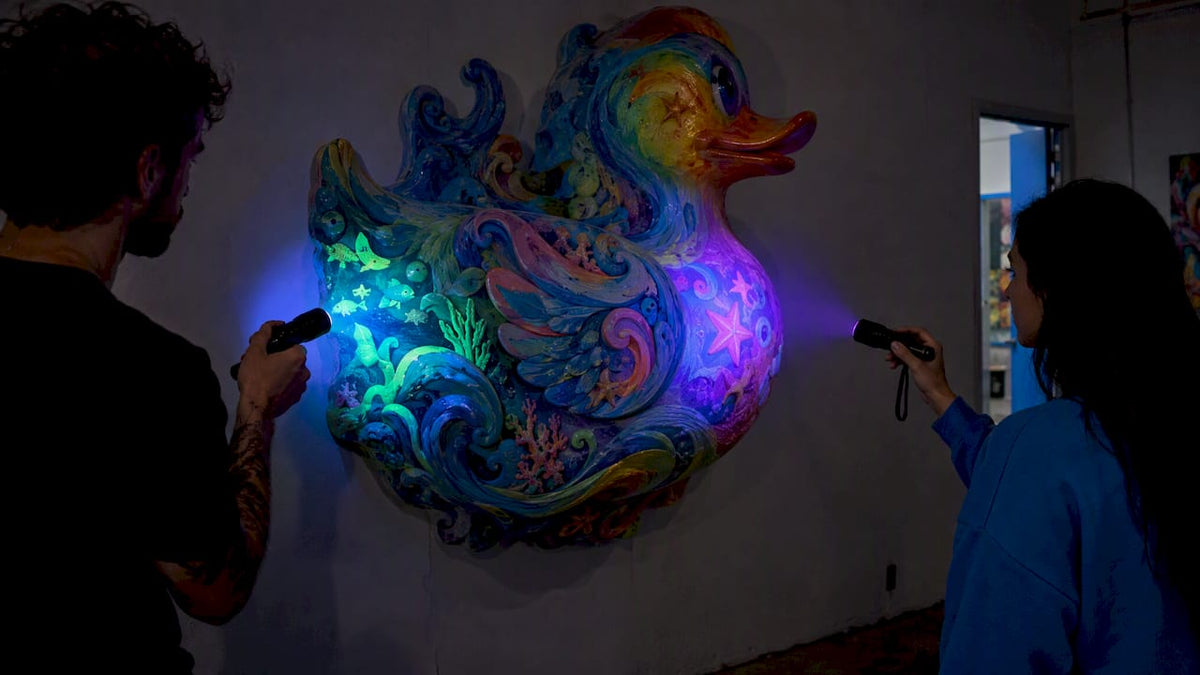
- Reactive materials, such as UV pigments, add a second image that appears only under blacklight. The piece you see in daylight is not the piece you see in the dark.
If you document or share work digitally, three-dimensional pieces are harder to represent than paintings. Tools that turn a phone video into 3D models of art objects can help collectors and galleries show a sculpture from every angle, which a single flat photo cannot do.
Our perspective on sculpture vs. painting
We make sculpture, so we are not neutral, but we are not against painting either. Most of what we do starts on paper and in color before it becomes an object. What we have learned from making and showing work is this: a painting asks to be looked at, and a sculpture asks to be met.
Our work is built around that idea. Every piece is handmade and original, not mass produced, and many use UV-reactive pigments so the piece changes under blacklight and reveals patterns and colors you cannot see in normal light. We use pop imagery, including rubber ducks, because it is approachable. People who would never step into a gallery will walk up to a glowing duck, and then they start asking about peace, unity, and pride. That conversation is the point. We showed work at Art Basel Miami Beach, and you can read what we showed and why.
If you are deciding between the two, our advice is simple. Pick the one you want to walk toward. Then plan the light, because the best piece in the wrong light is a missed opportunity.
— Facundo
Bring a sculpture home or commission one
If you want three-dimensional work, you can browse our sculpture collection, look at UV and glow art, or explore wall art if you want something that hangs. For a piece made for a specific room, hotel, gallery, or public site, see our commissions. Pricing is not published on the collection pages, so reach out through the site for details on a specific piece or project.
FAQ
Is sculpture harder to make than painting?
They are hard in different ways. Painting demands control of color, light, and illusion on a flat surface. Sculpture adds structure, balance, weight, and the need to resolve a form from every side. Artists often train in both, and many use sketches and paintings to plan sculpture.
Which is better for a small room?
It depends on what is free: wall or floor. A painting uses no floor space and works well in tight rooms. A compact sculpture on a shelf or console can add depth without crowding, as long as people can see it from more than one angle.
Do sculptures need special lighting?
They benefit from it. Sculpture depends on illumination to reveal its form, and light from below can make a piece look odd. A light from above and slightly to the side usually works best, and you should test it at the time of day the piece is most often seen.
Can a sculpture go outdoors?
Only if it is made for it. Stone and bronze are traditional outdoor materials because they stand up to weather. Pieces with delicate finishes, reactive pigments, or mixed materials may need indoor or covered placement, so ask the maker about outdoor use before you buy.
What is the difference between 2D and 3D art?
Two-dimensional art lives on a flat surface and has height and width. Three-dimensional art adds depth, so you can move around it and see it change. Paintings and drawings are 2D. Sculptures, installations, and assemblages are 3D.
Sources
- Working with Sculpture, Education at the Getty
- Image and Object in Contemporary Sculpture, Guggenheim Museum Archives
- 2.3: Art Forms, Humanities LibreTexts
- Painting, Tate
- Medium, Tate
- Leonardo on Painting versus Sculpture, Italian Renaissance Learning Resources
- Teacher’s Introduction, Nasher Sculpture Center