Custom Wall Sculpture: How to Commission One That Works
A custom wall sculpture is a three-dimensional artwork made for your wall, your light and your room, not pulled from a catalog. To get a good one, settle five things early: where it will hang, how far it can project, what it weighs, how it will be lit, and who is responsible for installation. Get those right and the artist can spend the project on the work itself.
This guide is for collectors, designers, hotel and restaurant owners and public art managers. It covers how wall sculpture differs from freestanding work, how to size and mount a piece, how a commission usually moves, and what changes when the piece is made with UV-reactive materials that glow under blacklight.
TL;DR
- Choose a wall sculpture when floor space is scarce, the viewing angle is fixed, or you want art at eye level that visitors cannot bump into. Choose freestanding when people should walk around the work.
- Fix the wall, the projection depth and the weight before the design starts. They drive the mounting method and the budget more than style does.
- Plan the lighting with the artwork. Ordinary light, a spotlight and blacklight can each make the same piece read very differently.
- UV-reactive pieces need a conversation about exposure. Fluorescent pigments can fade under strong light, so display planning is part of owning one.
- Ask any studio for a written scope, a milestone schedule and an installation plan before you pay a deposit.
Table of Contents
- Wall sculpture or freestanding: how to decide
- What “custom 3D wall art” actually covers
- Five decisions to make before design begins
- Materials and what they mean for a wall
- Designing for blacklight
- How a commission usually works
- Public and commercial walls
- Our perspective
- Start your piece
- FAQ
- Sources
Wall sculpture or freestanding: how to decide
A freestanding sculpture stands on its own, with no attachment to a wall or support, and viewers can walk around it. A wall sculpture gives up that all-around view in exchange for other advantages. The question people usually type as “wall vs pedestal” really comes down to how the space is used.
| Question | Wall sculpture | Freestanding or pedestal |
|---|---|---|
| Floor space | Uses none | Needs a footprint plus clearance |
| Viewing | One main direction, with depth and shadow | 360 degrees |
| Foot traffic | Out of the way above bump height | Can be knocked, so needs a buffer or plinth |
| Installation | Needs a structural wall and hardware | Needs a level, stable floor |
| Changing rooms | Leaves holes when moved | Moves with a trolley |
| Lighting | Light comes from one side, so shadow becomes part of the work | Needs light from several angles |
When the wall wins
Hallways, stairwells, narrow lobbies, restaurant booths and bedroom headboard walls are the classic cases. The wall gives the piece a backdrop, so a restrained color or texture behind it can carry as much as the sculpture. Wall work also suits spaces where children, pets or crowds are close by.
When freestanding wins
Open lobbies, gallery floors, courtyards and living rooms with a clear center are better for freestanding work. If the form depends on a silhouette or a back view, do not flatten it onto a wall. Many rooms work best with both: one anchor piece on a stand and a wall piece that echoes its palette. Our statement sculpture decor ideas cover that pairing, and the Sculpture collection shows the freestanding side.
What “custom 3D wall art” actually covers
Search results for this topic mix very different things. Mass-produced metal panels sold by the thousand sit next to one-off carved or cast works. Both are “3D wall art,” but they are not the same purchase.
- Catalog 3D wall decor. Ready to ship, a fixed size, usually made in volume. Fine for filling a wall quickly.
- Made-to-order from a template. The artist adjusts size or color within a set design.
- True commission. The concept, proportions, materials and finish are developed for your site. This is where depth, shadow, lighting and the room’s story can be designed together.
If a piece will anchor a room or represent a brand, a true commission is usually worth the extra time. If you just need something nice over a sofa, browsing existing work is faster. Our Wall Art collection and Originals are the place to start for ready pieces. For a design built around your space, see commissions.
Five decisions to make before design begins
1. The wall
Know what the wall is made of: drywall over studs, plaster, brick, concrete, glass or a movable partition. Heavy sculpture must transfer its load into studs, blocking or masonry, never into drywall alone. Tell the artist the wall type and, if you can, share a photo with a tape measure in frame. Public projects spell this out. When the City of Berkeley sought artists for wall-mounted three-dimensional works at a senior center, the call separated one large exterior piece from four smaller interior ones, each tied to its own wall. Treat your project with the same discipline: each wall is its own brief.
2. Projection depth
Depth is what makes a sculpture a sculpture rather than a painting. It also sets the safety margin. In a corridor, a piece that projects far into the walkway is a hazard and may run into accessibility rules. Keep deep forms above head height, or place them where circulation goes around them. For commercial and public spaces, check local building and accessibility requirements with your architect or facilities team before approving depth.
3. Weight
Ask for the finished weight, including hardware, in writing. It determines whether one anchor, a French cleat, a rail system or a structural backing plate is needed. Lightweight materials such as foam cores, resin and hollow forms open up large scale without heavy hardware. Dense stone and metal need engineered mounting. For pieces made from several parts, see our modular sculpture installation guide.
4. Scale
A common rule of thumb for hanging art is to fill about two thirds of the width of the furniture beneath it, and to center the piece at about eye level. Sculpture bends those rules because its shadow and depth extend the visual footprint. For large rooms, think in series: three medium pieces can hold a long wall better than one oversized one. Our guide to 3D wall art ideas and scale rules goes through proportions in more detail.
5. Light
Sculpture reads through shadow, so a flat, even light removes what you paid for. A single directional source, such as a picture light or an adjustable track head, gives relief and form. Decor retailers and lighting specialists have written on how sculptural accents work by format, scale and placement in different rooms, which is a useful companion when you are choosing fixtures. Avoid placing a piece where direct sun hits it for hours, particularly if it uses fluorescent colors. For wall color, see our guide to art for grey walls.
Materials and what they mean for a wall
The material decides weight, durability, finish and how the piece ages.
- Wood and cedar. Warm, can be carved or layered, sensitive to humidity swings.
- Metal. Strong and crisp, heavier, can suit exteriors if finished for it.
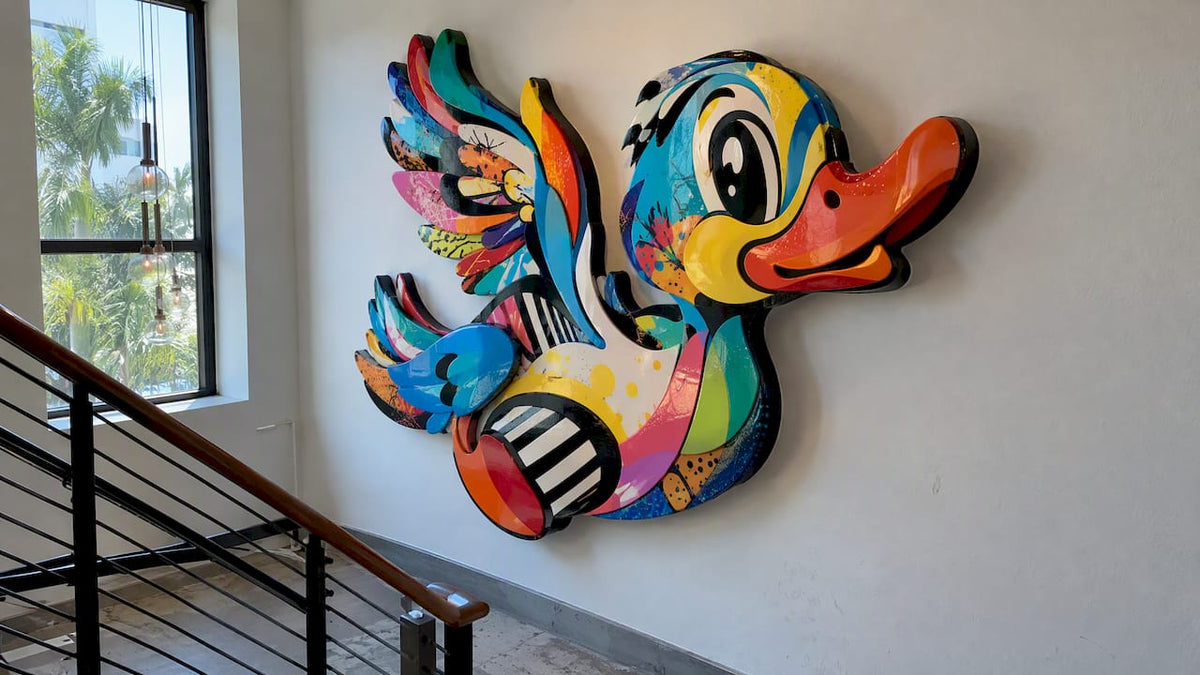
- Resin, fiberglass and composites. Light, can be molded into smooth forms and saturated color, and well suited to large wall work.
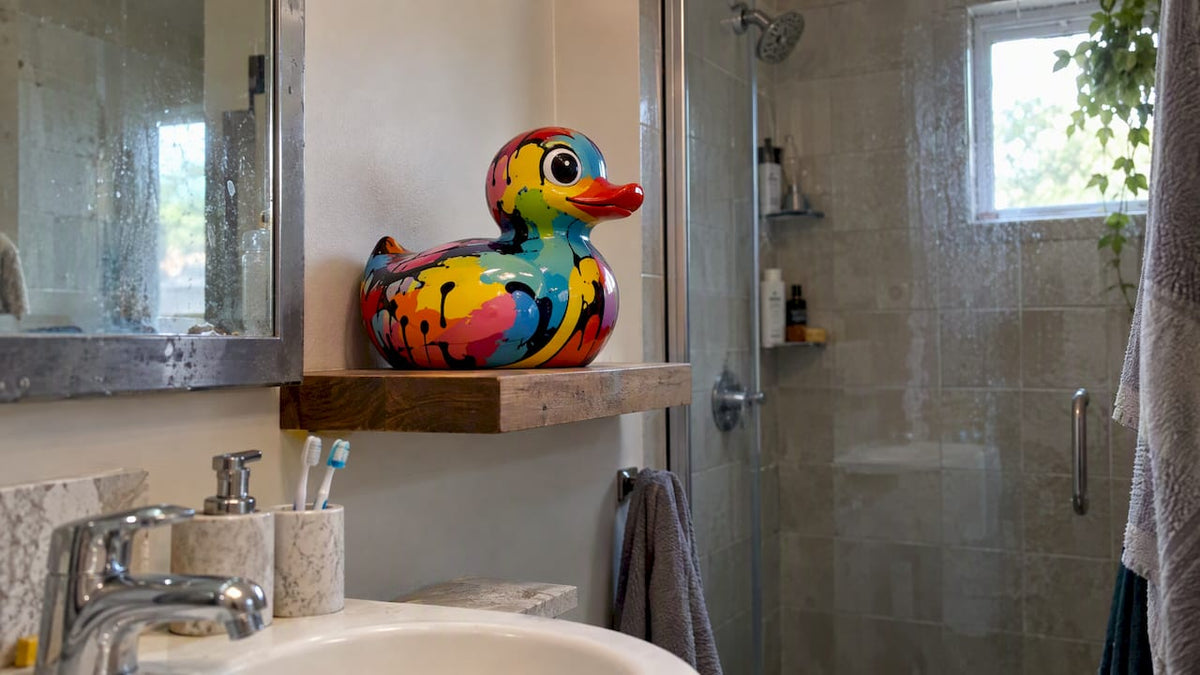
- Found and rubber-duck objects. Playful, recognizable, and a way to pull pop culture into a serious composition.
- UV-reactive finishes. Pigments that glow under blacklight and reveal hidden patterns that are invisible in ordinary light.
At FLY Miami Art, every sculpture is handmade in the Miami studio, and most of my work is UV reactive, so it shows one face in daylight and another under blacklight. Browse the UV/Glow Art collection to see what that looks like. For humid rooms, see bathroom safe artwork.
Designing for blacklight
A wall sculpture that glows is really two artworks on one wall. In daytime or standard lighting you see the colors and forms you chose. Switch to blacklight and patterns, outlines and colors appear that were hidden. That second image must be designed, not left to chance.
Plan both views
Tell the artist how the room will be used. A hotel lobby may run warm light during the day and a blacklight program at night. A home may only use blacklight for gatherings. Where, how often and for how long the UV source is on shapes the choice of lamps and how the piece is composed.
Respect the pigments
Conservators know that fluorescent colors need care. A published conservation study of a 1980s fluorescent-painted leather jacket, designed to be worn under black lights, describes an ethical dilemma around exhibiting it under ultraviolet because the exposure itself brings degradation concerns. Further research on daylight fluorescent artists’ pigments examines their light stability. The practical takeaway for owners: do not leave a glow piece under strong sun or constant UV. Run blacklight when you want the effect, keep it off when you do not, and ask the studio for care guidance on your specific piece.
Choose the right UV source
Low-intensity LED blacklight fixtures give a clean glow with little visible light leakage. Place them so the beam grazes the surface from above or below, and keep them out of sight lines. Test at the actual location before the final installation. Walls painted in light colors reflect stray light and flatten the effect, while a dark or matte wall makes the glow pop.

How a commission usually works
Processes differ between studios, but the stages are consistent across private and public work. Washington State’s Public Artist Handbook is a good picture of the formal version: a selected artist may sign a proposal development contract first, then a separate commission contract. That split is a good model for private clients too: pay for design first, then commit to fabrication once you approve it.
- Brief. Share the wall, the room, the audience, photos, any brand or theme, and a time frame.
- Concept. The artist develops sketches or renderings, often placed on a photo of your wall.
- Revisions and approval. Settle size, palette, materials and the blacklight version.
- Written agreement. Scope, schedule, payment milestones, rights to the image, and installation responsibility. Our art commission contract terms guide lists what to put in writing.
- Fabrication. The handmade work itself, with progress photos.
- Delivery and install. Hardware, mounting, lighting test, and care instructions.
To start a commission, use our commissions page. If you are planning a venue, our pieces on nightclub glow art and immersive art for hotels show how timing and rework risk play out in commercial spaces.
What to ask any studio
- What is the finished weight and projection depth?
- What hardware is included, and who installs it?
- How many revision rounds are included?
- How should the piece be lit, and what should I avoid?
- What happens if the wall or site changes mid-project?
- Who owns the reproduction rights?
Before you pay anything, read our guide to the art commission deposit.
Public and commercial walls
City staff, developers and property managers have extra layers: approvals, durability, maintenance and liability. A public call for wall work will often list site dimensions, a budget, a selection committee and a requirement to conserve the finished piece. If you manage a public installation, write the maintenance expectations into the contract and ask the artist for a care sheet. Our public art proposal guide walks through seven stages of a proposal, including how UV-reactive studies fit in, and our large-scale installation guide covers display planning. For hospitality spaces, see our installations page.
Our perspective
We make wall sculpture because a wall is the most honest place to meet a piece of art. It is at eye level, it stays put, and the light on it changes through the day. The mistake we see most is treating the wall as an afterthought: buying the art, then finding that the wall, the lighting or the traffic pattern fights it.

Start with the room. Ask what happens there at 10 a.m. and what happens at midnight, because a glow piece has to hold up in both. We want the daytime version to be a complete artwork on its own, with the blacklight reveal as a second chapter rather than a trick. And we use rubber duck imagery and pop color on purpose: they invite people in, and once they are in, the themes of peace and unity have room to land.
If you are choosing between a wall piece and a freestanding one, our advice is simple. Stand where visitors will stand. If they approach from one direction and pass by, go to the wall. If they gather and circle, go freestanding. When you cannot decide, tell us about the space and we will tell you honestly which suits it.
— Facundo
Start your piece
If you want a wall sculpture made for your space, we take commissions. Start with a custom glow piece, or browse ready-to-hang Wall Art if you would rather see finished work first. Pricing is not published, so send us your wall, your timeline and your idea.
FAQ
Is a custom wall sculpture more expensive than a catalog piece?
Usually, yes, because the artist designs and makes it for one site, and design time is part of the cost. What you get is exact fit, original work and a say in the concept. Ask for a written scope so you know what the price includes.
How long does a commission take?
It depends on size, materials and how many revisions you need. Design approval comes first, then fabrication, then installation. Ask any studio for a milestone schedule before you pay a deposit.
Will a UV-reactive piece fade?
Fluorescent pigments are sensitive to strong light, and conservation research on fluorescent artworks shown under UV raises exactly this concern. Keep pieces out of direct sun, use blacklight only when you want the effect, and follow the care instructions from your artist.
Can I hang a heavy wall sculpture myself?
Only if it is light and your wall type is known. For heavy or large work, use a professional installer who can find studs or masonry and use rated hardware. Share the weight and wall details with your studio before delivery.
Should I pick a wall piece or a pedestal sculpture?
Pick the wall if floor space is tight or traffic is heavy, and the pedestal or floor if people should walk around the piece. Many rooms work best with one of each.
Sources
- Public Art Opportunity RFQ, City of Berkeley
- Public Artist Handbook, State of Washington
- Seeing the light: fluorescent painted leather jacket study, Journal of the American Institute for Conservation
- Shedding Light on Daylight Fluorescent Artists’ Pigments, Part 2