365nm vs 395nm UV: Which Blacklight Should You Buy?
Choose 365nm if you want the strongest glow against the darkest room. Choose 395nm if you want a cheaper light that makes bright, forgiving effects and you don’t mind a visible violet haze. Both are UV-A, and the 30nm gap between them changes how much visible light leaks out, how intensely many materials fluoresce, and how much you pay. Below we explain the difference in plain terms, then walk through art, room lighting, glass collecting, curing and eye safety.
TL;DR
- 365nm sits deeper in the UV-A band and gives off little visible light, so fluorescent colors look cleaner and the room looks darker.
- 395nm sits about 30nm closer to visible violet. It throws a noticeable purple glow, costs less, and still excites many bright pigments.
- For art displays, immersive rooms and detecting subtle fluorescence (uranium glass, for example), 365nm is the stronger choice. For casual party effects and budget setups, 395nm is enough.
- Neither is harmless to stare at. Keep beams out of eyes, limit skin exposure, and plan lighting for the artwork’s longevity too.
Table of Contents
- What the numbers mean
- 365nm vs 395nm at a glance
- How each wavelength changes fluorescent art
- Choosing for a glow room or immersive space
- Uranium glass, minerals and other collectibles
- Curing resin: the exception
- Is UV safe? Eyes, skin and your artwork
- Our perspective
- Which one should you buy?
- Glow art made to be seen under blacklight
- FAQ
- Sources
What the numbers mean
UV-A runs from roughly 315 to 400nm. A 365nm LED sits in the middle of that band. A 395nm LED sits right at the top, next to the violet you can see. According to Waveform Lighting’s comparison, the 365nm light carries a dull, bluish-white residual glow, while the 395nm light emits a pronounced violet color.
That visible leakage is the whole story in one sentence. Every blacklight LED has a spread of wavelengths, and the 395nm spread spills into what your eye can see. The 365nm spread mostly does not. The result is practical:
- With 365nm, the light source itself is dim to your eye. Fluorescent objects stand out because nothing else competes with them.
- With 395nm, the room is bathed in purple. Fluorescent objects still glow, but they sit on a violet wash that lowers contrast.
Neither wavelength makes light “stronger” in a way you can read from the number alone. Output power, beam angle and distance matter as much. Still, at equal output, the same source describes two different experiences.
365nm vs 395nm at a glance
| Factor | 365nm | 395nm |
|---|---|---|
| Visible light from the lamp | Very little, dull bluish-white | Noticeable violet |
| Fluorescence strength | Stronger on many materials | Good on bright pigments, weaker on subtle ones |
| Room darkness | Darker, higher contrast | Purple haze, softer contrast |
| Cost | Higher | Lower |
| Best for | Art, gallery and immersive rooms, uranium glass, inspection | Parties, casual decor, budget setups, thick pigmented curing |
| Skin and eye caution | Avoid direct beams | Avoid staring, still limit exposure |
On price, one industrial lighting note says 365nm LEDs can cost up to ten times more than 395nm LEDs, and that 95% of machine-vision applications will work with 395nm. That is a manufacturing view, but the logic carries to your living room: if your goal is not the very faintest glow, 395nm often does the job.
How each wavelength changes fluorescent art
Fluorescent pigments absorb UV and re-emit it as visible color. Artists use them alone or mixed with conventional pigments so a work reads one way in daylight and another under UV. A 2022 academic review of black light art describes how fluorescent and phosphorescent pigments can carry different aesthetic messages under UV or visible light.
Which wavelength you use decides how much of that second message you see.
Under 365nm
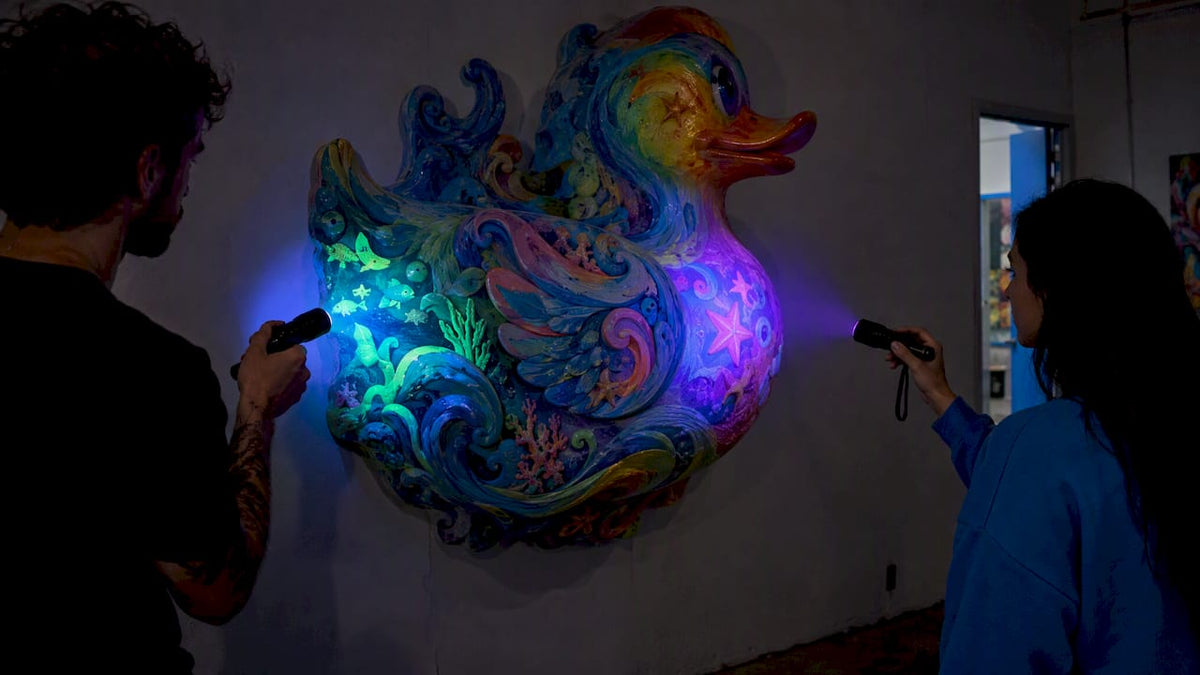
Waveform notes that 365nm emits much less visible violet light, and that many objects fluoresce most strongly at 365nm. For painted or sculpted pieces, that means hidden patterns appear crisply, fine details separate from the background, and colors look saturated instead of washed with purple. A manufacturer’s technical paper calls 365nm the sweet spot for ultra-bright black light effects.
Under 395nm
You still get glow, and bright neon-type pigments often respond well. What changes is the surroundings. The purple light falls on everything, including the non-fluorescent parts of the piece, so a black or dark background looks violet rather than disappearing. Some people like that nightclub feel. If the artwork depends on a clean reveal, it works against you.
A quick test at home
- Darken the room fully.
- Shine each light on the same piece from the same distance, about 3 feet.
- Compare how the dark areas look. If the surrounding surface turns purple, you are seeing 395nm’s visible spill.
- Compare how vivid the fluorescent colors are, not how bright the lamp looks.
If you want a fuller walkthrough of lighting a space, our guide to blacklight room setup covers placement, darkness and fixtures.
Choosing for a glow room or immersive space
For rooms, the wavelength is only one decision. Waveform’s guidance on room blacklights recommends 365nm for the maximum fluorescent effect. It also points to these variables:
- Fixture type. A floodlight targets a specific wall or object. Strip lights give a more diffused wash.
- Distance. UV intensity falls off quickly as you move away, so a light that looks fine at 2 feet may be weak at 10.
- Covers and panels. Polycarbonate blocks UV, so a diffuser or protective panel in front of the LED can kill the effect you paid for.
Practical rule: for a hallway, bar or party room where a purple vibe is the goal, 395nm strips are a sound budget pick. For a gallery wall, a collector’s room, a hotel feature or any space where the artwork is the point, go 365nm and aim it deliberately. We go deeper on exhibition lighting for galleries and on building a lighting plan for a collection.
Uranium glass, minerals and other collectibles
Collectors ask this one constantly. Uranium glass fluoresces green, and the question is which light shows it best. One collector-focused guide reports that 365nm is more effective at exciting the uranium in the glass, giving a more intense green, while 395nm adds a visible purple glow on top. The practical consequence: with 395nm, a piece can look dull or ambiguous. With 365nm, weakly fluorescent items are easier to confirm.

If you collect glass, minerals or vintage items and want to catch faint reactions, 365nm is worth the extra money. If you only want to show off pieces you already know glow brightly, 395nm will do.
Curing resin: the exception
The ranking results include industrial curing, and there the answer flips in part. Curing depends on the photoinitiator in the resin matching the light, not on how pretty the glow is. As the same machine-vision note suggests, 395nm is widely adequate and far cheaper. For hobby resin, check what your resin’s maker specifies and match that wavelength. Don’t assume the more expensive 365nm is automatically better for curing.
Is UV safe? Eyes, skin and your artwork
This is where people get casual, so be specific.
Eyes
A retailer’s guidance says 395nm lights are generally fine for casual exposure but you shouldn’t stare into them, and that you should avoid direct skin and eye exposure to 365nm beams, which can be harmful over time (product guidance). A torch maker adds that consumer UV torches emit high-energy UV-A that can strain or damage eyes if misused, and recommends UV-blocking glasses during prolonged inspection.
If you handle a handheld 365nm torch for long sessions, wear UV-blocking eyewear and never point the beam at anyone’s face. If you have a medical eye condition or take photosensitizing medication, ask an eye doctor or dermatologist before regular use.
Not all sunglasses are protection. An academic review notes that the ANSI Z80.3 standard is voluntary and that price or brand does not ensure adequate protection. The same review says most UV damage to the eye comes from scattered and reflected light reaching it from the sides, so wraparound coverage matters.
Skin
The US EPA states that UV-A exposure is associated with premature skin aging and some skin cancers. A party blacklight for an evening is a different dose from daily work under a high-output lamp, but the sensible habit is the same: keep exposure short, keep skin covered at close range, and keep powerful lamps off people.
Exposure limits
Product safety testing often follows IEC 62471, which sets limits including near-UV eye exposure over 315 to 400nm and actinic UV limits for eye and skin at 200 to 400nm, as shown in a sample test report. If you are lighting a public venue, ask your fixture supplier for photobiological safety data. Our UV art safety guide covers handling for artists and collectors.
Your artwork
UV light fades materials over time, including some pigments. Lower intensity, shorter run times and sensible distance protect a collection. We explain how in our blacklight damage rules for collectors and home art care guidance.
Our perspective
We make sculptures and wall pieces with UV-reactive pigments, so we watch what happens when someone switches on the wrong light. A piece that was designed to reveal hidden patterns can look flat under a cheap purple lamp, and the owner blames the art. It is almost always the light.
Our view is simple. If you are buying art that is meant to glow, light it with 365nm where you can. The reveal is the point of the work: a dark, quiet room, a small bright effect, color that looks like it comes from inside the piece. 395nm is a fine way to start, and for a festive room it is often the right call. But when someone has invested in a handmade original, the extra cost of a cleaner light is small next to what the piece cost.
Two habits matter more than the wavelength. Give the piece normal, comfortable daylight or gallery lighting most of the time, and treat the blacklight as an event, not a permanent bath. And never aim a handheld lamp at faces to show a friend how it works.
— Facundo
Which one should you buy?
Use this decision list.
- You are lighting art, a gallery wall or a hotel feature. Buy 365nm, with a floodlight for a focused piece or strips for a wash.
- You are decorating a party room or bar on a budget. 395nm strips are fine. Expect purple ambience.
- You collect uranium glass or minerals. Choose 365nm. If you can afford only one torch, make it this.
- You are curing resin. Follow your resin’s specified wavelength; 395nm is common and inexpensive.
- You are unsure. A dual-LED torch with both wavelengths lets you compare on your own objects.
Whatever you choose, check that the beam is not passing through polycarbonate or a plastic cover that blocks UV, and test from the distance you will actually use.
Glow art made to be seen under blacklight
If you would rather start with the artwork than the lamp, our UV/Glow Art collection brings together handmade pieces with UV-reactive pigments that reveal color and pattern in the dark. For a one-of-a-kind piece for a home, hotel, gallery or public space, a custom glow piece can be designed around the room and the lighting you plan to use. Prices are not published, so reach out through the FLY Miami Art site to discuss a commission.
FAQ
Is 395nm UV harmful to humans?
It is generally considered fine for casual exposure, but you shouldn’t stare into the lamp, and long skin exposure is not a good idea. UV-A as a category is linked by the EPA to premature skin aging and some skin cancers. Keep sessions short and beams away from faces.
Is 365nm UV bad for your eyes?
Direct exposure to a 365nm beam can be harmful over time, so never look into it or point it at others. Wear UV-blocking eyewear with side coverage for prolonged use. If you have eye or skin concerns, ask an eye doctor or dermatologist.
Is 365 or 395 better for uranium glass?
365nm. It excites the uranium more effectively, giving a more vivid green, while 395nm adds a purple glow that can mask faint reactions. For glass that already glows brightly, 395nm can still work.
Can I use 395nm lights for a blacklight art display?
Yes, bright fluorescent pieces will glow under 395nm. You will see more violet spill on the walls and the artwork’s background, which lowers contrast. For a clean reveal, 365nm looks better.
Sources
- What is the Difference Between 365 nm and 395 nm UV LED Lights, Waveform Lighting
- 365nm vs 395nm: room blacklights, Waveform Lighting knowledge base
- Special-Effect and Conventional Pigments in Black Light Art, PMC
- Which Technologies Are Most Effective in Producing Black Light, Musson
- Ultra Violet: 365 nm or 395 nm LED Lights, Smart Vision Lights
- 365nm vs. 395nm UV Light, Uraniumware
- LED Blacklight Flood Light, Super Lighting LED
- UV Black Light Torch Guide: 365nm vs 395nm, Olight
- Photoprotection: a Review of the Current and Future Technologies, Wiley
- Health and Environmental Effects of Ozone Layer Depletion, US EPA
- IEC 62471 sample report, Smart Vision Lights