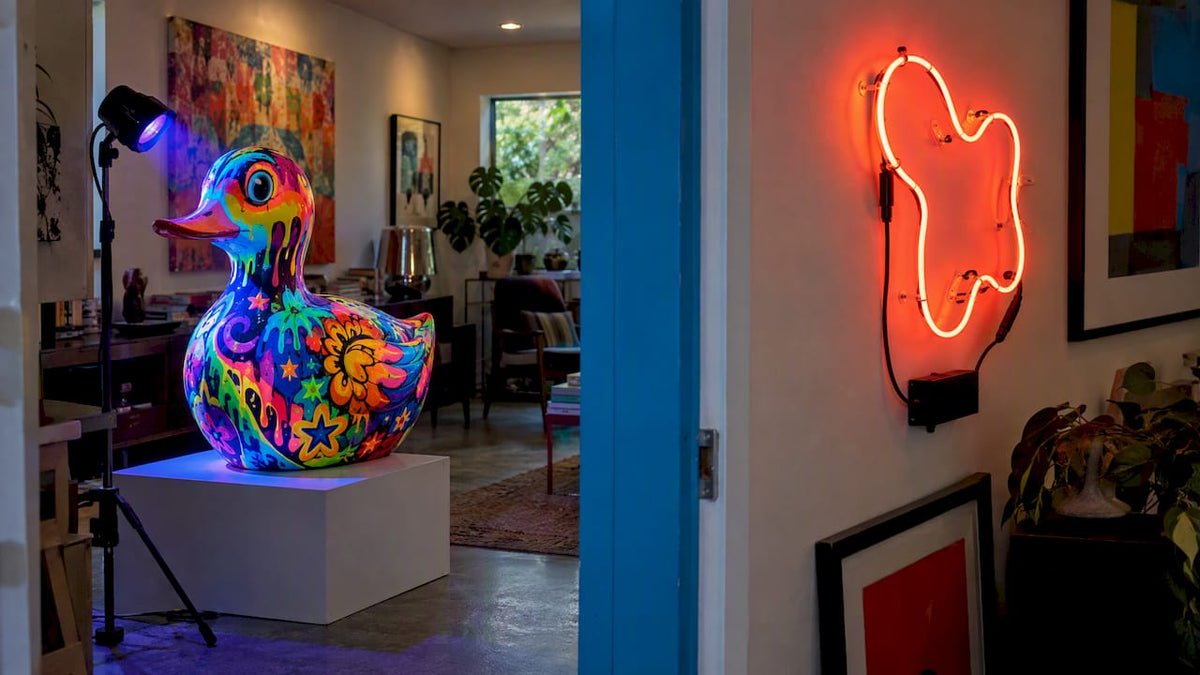
Neon vs Blacklight Art: What Actually Glows, and Why
Neon art and blacklight art are different things that people often mix up. Neon art is glass tubing filled with gas that lights itself when electricity passes through it. Blacklight art is paint or material that looks ordinary in daylight and glows only while an ultraviolet lamp shines on it. One makes its own light. The other answers to someone else’s.
The confusion comes from the word “neon,” which has also become a label for any hot-pink, acid-green or electric-orange color. Below, we separate the two art forms, explain the color terminology, and cover what to know about blacklight bulbs (LED versus fluorescent) before you hang a piece.
TL;DR
- Neon art is a glass tube with gas inside, lit by high voltage. It glows on its own, anywhere, anytime it is powered.
- Blacklight art uses fluorescent pigments that glow only while a UV-A lamp is on them. Switch the lamp off and the glow stops.
- “Neon colors” usually means very bright, saturated colors. Truly fluorescent pigments are the ones that react to blacklight.
- LED or fluorescent lamp? The technology label matters less than the lamp’s actual wavelength and output. Check the specs for the piece you own.
- Glow-in-the-dark paint is a third thing: it stores light and keeps glowing afterward.
Table of Contents
- The short answer: two ways of making light
- How neon tube art works
- How blacklight art works
- Neon colors vs fluorescent colors
- Where glow-in-the-dark fits
- LED vs fluorescent blacklight: which lamp should you use?
- Choosing between them for your space
- Our perspective
- Bring a glow piece home
- FAQ
- Sources
The short answer: two ways of making light
The cleanest way to tell them apart is to ask where the light comes from.
In neon art, the artwork is the light source. A glass tube is bent into a shape, filled with gas, and driven by high voltage. The Getty describes neon tubes as handmade, fragile glass containing gases that glow under high voltage. Plug it in and it shines in a lit room or a dark one.
In blacklight art, the artwork is a surface. Pigments in the paint absorb invisible ultraviolet energy and re-emit it as visible color. The Smithsonian’s write-up on the blacklight murals at the Alameda Theatre notes that fluorescent paints glow under UV and stop fluorescing without a UV source. The painting needs a lamp to perform, and the room needs to be fairly dim for the effect to land.

That difference drives everything else: how you install the work, what it costs to maintain, how safe it is around kids and pets, and what it looks like at 2 p.m. on a Tuesday with the curtains open.
How neon tube art works
Neon sculpture is a glassworking craft. Artists bend glass tubing by hand, seal it, and fill it with a noble gas. According to Kunstplaza’s guide to the medium, current passes through the gas, and neon itself gives an orange-red light while other noble gases produce other hues. That is a detail most people miss: many “neon signs” in blue, green or pink are not pure neon at all. Different gases and coated tubes create the wider palette.
Two practical points follow from the physics.
- It is fragile. Glass breaks in shipping, in moves and in busy rooms.
- It uses high voltage. The Getty’s conservation team warns that neon works involve fragile glass and potentially lethal high voltage, and that installation, repair and packing need specialized knowledge. A transformer sits behind the piece, and repairs belong to a trained tube bender or electrician, not a weekend DIY.
If you want a sign that glows crisply in a bright bar or a shop window, neon is built for that job.
How blacklight art works
Blacklight art relies on fluorescence. A blacklight lamp emits mostly UV-A, which a California Energy Commission document defines as the 315 to 400 nm band. Fluorescent pigments absorb that energy and release part of it as visible light, which is why a yellow-green stripe can seem to hover in a dark room.
A few things make blacklight work different from neon.
The piece is passive. There is no glass, gas or transformer in the artwork. It can be a canvas, a panel, a sculpture or a mural. The only electrical part is the lamp, which you can place, move and replace.
It can be two artworks in one. The 2022 peer-reviewed study in Heritage Science found that black-light artworks may combine fluorescent, phosphorescent and conventional synthetic organic pigments, so the same surface can look different in daylight, under UV and in the dark. Artists can hide patterns that only appear when the lamp switches on. That reveal is the whole appeal for many collectors.
The room matters. Blacklight designs aim at the UV and keep visible light low, because stray ambient light washes out the glow. A dimmed room with one good lamp beats a bright room with three. If you are planning one, our blacklight room setup guide walks through the essentials for a home or gallery.
Neon colors vs fluorescent colors
This is where most of the searching confusion lives, so here is the plain version.
“Neon” is a popular word for a bright, saturated color. “Fluorescent” is a technical word for a pigment behavior. DayGlo, a maker of fluorescent pigments, explains that fluorescent pigments absorb and reflect more light than conventional ones, and “neon” is commonly used as a synonym for these intense colors. A color guide from HomeEdit draws the same line between a material phenomenon and a vivid appearance.
So does a “neon” color glow under blacklight? Often yes, but check what it actually is.
- Truly fluorescent pigment: reacts to UV and glows only while the lamp is on. DayGlo’s FAQ says fluorescent materials generally respond to blacklight, though it also notes that blacklight response is not necessarily a quality-control specification for every product.
- A conventional paint sold as “neon”: may simply be a loud color with no special UV reaction. It looks the same under a blacklight, only dimmer, because the room is dark.
The practical test is cheap. Shine a UV-A lamp on a swatch in a dim room. If it lights up, it is fluorescent. If it turns dull, it is just a bright color.
Where glow-in-the-dark fits
Glow-in-the-dark is a separate effect and often confused with blacklight. The Heritage Science study describes the difference: fluorescent paint emits visible light only while it is being excited, whereas phosphorescent (glow-in-the-dark) paint stores energy and keeps emitting after the light is removed. DayGlo’s comparison puts it the same way: fluorescent pigments give intense color while light is present, and phosphorescent ones store energy and release it later in darkness.
In practice:
| Effect | Needs a light source to glow? | Glows after the lamp is off? | Typical look |
|---|---|---|---|
| Neon tube | Needs power, no external lamp | No, off when unplugged | Crisp lines of colored light |
| Fluorescent (blacklight) paint | Yes, a UV-A lamp | No | Intense color that seems to float |
| Phosphorescent (glow-in-the-dark) paint | Charged by light first | Yes, fading over time | Soft, pale afterglow |
Our own piece on what really glows in art goes deeper if you want to tell the two effects apart on a finished work.
LED vs fluorescent blacklight: which lamp should you use?
Both lamp types can display UV-reactive art. The honest answer is that the label on the box matters less than the numbers behind it.
The U.S. Department of Energy notes that LEDs commonly emit in relatively narrow spectral ranges, while fluorescent lamps rely on phosphors with their own emission characteristics. In other words, two products with the same technology can behave differently, and two with different technology can behave similarly. NIST’s work on 365 nm sources says that both mercury lamps and UV LEDs can serve as blacklight sources, but their different spectral distributions can produce measurement differences. Wavelength and irradiance are what count.
Here is how that translates into a buying decision.
Check the wavelength. For most fluorescent pigments, a lamp centered near 365 nm gives a strong response with less visible purple haze than cheaper lamps. Bulbs that spill more visible violet light reduce the contrast of the effect.
Look at the output on the artwork. Brightness at the surface depends on lamp power, distance and beam angle. A narrow-beam LED can make a hot spot on a canvas; a long tube can wash an even field across a wall. Pick for the size and shape of the piece.
Think about the footprint. LED lamps tend to be compact and easy to aim, which suits a single focal piece. Tube fixtures suit larger walls and murals. Both are fine when matched to the art.
Keep exposure sensible. The U.S. Department of Energy’s museum-lighting presentation says that risk to collections depends on material sensitivity, intensity, exposure time and the source spectrum, and that reducing UV and exposure duration is part of controlling it. A simple habit helps: run the blacklight when you are showing the piece, not 24 hours a day. We cover practical numbers in our guides to blacklight art care at home and exhibition lighting for galleries.
On human safety, a 2016 peer-reviewed study identifies blacklight as UV-A in the 315 to 400 nm range and reports that measured exposures from the tested lamps under reasonably foreseeable conditions stayed below recommended occupational limits. That study looked at insect light traps, not art rooms, so treat it as context rather than a guarantee. Follow the manufacturer’s instructions for your lamp, avoid staring into the bulb, and ask a lighting professional about spaces with children or staff who work under the lamps all day.

Choosing between them for your space
Pick by what you want the room to do.
Choose neon art when you want a piece that works with the lights on, reads from across a room, and acts as a statement sign or sculpture. Budget for a specialist if it ever needs repair, and place it where nobody will bump it.
Choose blacklight art when you want a piece with two personalities: a calm, colorful artwork by day and a glowing, patterned one when you dim the room and switch on the lamp. It suits a media room, a bar corner, a boutique hotel hallway, a gallery wall or a single focal point in a living room. Our guides on blacklight interior design and setting room mood with art lighting show how to stage it without turning the whole home into a party.
Mix them thoughtfully. Neon tubes put out visible light, which can wash out a blacklight piece next to it. If you want both in one room, separate them on different walls or put them on different switches so you can control the scene.
For collectors, a short plan helps: decide the wall, decide the lamp position, then buy. Our five-step blacklight art lighting plan covers that sequence, including how to check how a piece reads under UV before you commit.
Our perspective
We make UV-reactive pop art sculptures, and the question we hear most is whether glow is a gimmick or a medium. We treat it as a medium. A fluorescent pigment is a material choice, as real as oil or enamel, and it lets us hide a second image inside a piece that only appears when the lamp comes on.
That is why we pair color with meaning. Our work celebrates peace and unity, and the reveal under blacklight is how we invite people to look twice. Daylight shows one piece; the dark room shows another. A neon tube can only do one thing, which is shine. A UV-reactive sculpture can surprise you.
Every piece we make is handmade and original, not mass produced. If you are choosing between neon and blacklight, ask what you want the room to feel like at 9 p.m. with the lights low. If the answer is wonder, we would start with a glow piece.
Facundo
Bring a glow piece home
If you want to see how blacklight art behaves, start with our UV/Glow Art collection of blacklight-reactive paintings and sculptures. Prefer something made for your space? We take commissions for private collectors, galleries, hotels, commercial spaces and public projects, including a custom glow piece built around our UV-reactive rubber duck themes.

Tell us the wall, the room and the mood. We will help you plan the lamp and the placement so the piece performs the way it should. You can start from our main shop page or browse the Originals, Sculpture and Wall Art collections.
FAQ
Is neon art the same as blacklight art?
No. Neon art is glass tubing filled with gas that lights itself with electricity. Blacklight art is paint or material with fluorescent pigments that glow only under a UV-A lamp. One is a light source; the other reflects and transforms light from a source you supply.
Do neon colors glow under a blacklight?
Truly fluorescent “neon” colors generally do, because they contain pigments that convert UV into visible light. A color that is simply bright, without fluorescent pigment, will not. Test a swatch under a UV-A lamp in a dim room to know for sure.
Is fluorescent paint the same as glow-in-the-dark paint?
No. Fluorescent paint glows only while a UV or similar light is on it. Glow-in-the-dark paint is phosphorescent: it stores energy and keeps glowing, fading, after the light is gone. Some artworks combine both so they change between daylight, UV and darkness.
Are LED blacklights better than fluorescent blacklight tubes?
Neither is better by default. What matters is the lamp’s wavelength, output and beam, since individual products differ widely within each technology. For most UV-reactive pigments, look for a lamp centered near 365 nm and test it on the artwork before committing.
Can I hang blacklight art in a bright room?
Yes, as a normal painting or sculpture. The glow effect needs a dim room and a UV-A lamp, because ambient light washes out the fluorescence. Many collectors keep the lamp on a switch and use it only when showing the piece.
Sources
- Shining a Light on Neon, Getty News
- Glowing Murals Get a Facelift, Smithsonian MCI
- Neon Art: Evolution of neon art and light painting, Kunstplaza
- California Energy Commission docket, blacklight lamp definition
- Special-Effect and Conventional Pigments in Black Light Art, Heritage Science (PMC)
- What is fluorescent color? DayGlo
- Understanding Fluorescent and Neon Colors, HomeEdit
- DayGlo FAQ
- Fluorescent vs. Phosphorescent, DayGlo
- LED Color Characteristics factsheet, U.S. Department of Energy
- UV scale calibration transfer, NIST
- Selecting a Spectrum of Light to Reduce Risk to Museum Collections, U.S. Department of Energy
- Ultraviolet safety assessments of insect light traps, PMC