Article: Art Loans for Exhibitions: The 6–24 Month Registrar Checklist
Art Loans for Exhibitions: The 6–24 Month Registrar Checklist
To borrow art for an exhibition, you need a formal written request, a standard facility report, and a budget for crating, two-way shipping, nail-to-nail insurance, couriers, and conservation. Plan on 6 to 12 months of lead time, and 12 to 24 months for large or complex loans. A signed loan agreement and condition reports follow approval.
TL;DR:
- Submit a formal request with accession numbers, exhibition dates, a concise curatorial rationale, a facility report, an insurance plan, and one named contact.
- Boijmans requires six months for standard requests and one year for eight or more works; MUNCH asks for 24 months for extensive loans.
- Budget for crating, shipping both ways, continuous insurance, courier travel, and conservation; Art Bridges covers these costs for participating partner venues.
- Provide HVAC and humidity records, display site light readings, fire and alarm details, storage information, and security staffing; ask lenders for their specific limits.
- Maintain all risk coverage from packing through return, including deinstallation and repacking; photograph condition at handoffs, and keep crates closed for 48 hours before unpacking.
Table of Contents
- 1. Who lenders loan to and what they check
- 2. How to submit a request and what lead times to expect
- 3. Which loan costs you should budget for
- 4. Crating, transport, couriers, and insurance basics
- 5. What your facility report must prove
- 6. What a loan agreement covers
- 7. Registrar tips that prevent denials and surprise costs
- 8. Handling and display for UV-reactive and pop art sculptures
- 9. What to do after the exhibition closes
- 10. Why I’d start with paperwork, not the wish list
- FAQ
- Sources
1. Who lenders loan to and what they check
Lenders treat a loan as a risk-management partnership. Major institutions evaluate the object’s availability alongside your facility, security, environmental controls, and professional staff capacity. Accredited institutions and venues with trained staff get the easiest hearing, and lenders also ask whether the work can travel safely and whether your exhibition adds curatorial value.
Expect them to look at:
- Security, including 24/7 monitoring and alarm coverage
- HVAC stability and humidity control
- Light exposure at the display location
- Storage space for crates and unpacked works
- Handling capability and the experience of your installers
Gather your facility report, a short exhibition narrative, object accession numbers, and any provenance details before you write to anyone. Arriving with these in hand signals that you understand how registrars work, and it shortens the back-and-forth that eats months of your schedule.
2. How to submit a request and what lead times to expect
A strong request is short, specific, and complete. The National Portrait Gallery borrower checklist asks for a formal letter with object details and accession numbers, a standard facilities report, and insurance information.
- Name a single contact person with phone and e-mail.
- List each object with its accession number.
- Give exhibition dates, venues, and a one-paragraph description of how the work will be interpreted.
- Attach your completed facility report.
- State your insurance plan, or your willingness to accept the lender’s policy.
- Confirm who will handle packing and transport.
For timing, Museum Boijmans Van Beuningen sets 6 months for standard requests and one year for loans of eight or more works. MUNCH asks for 12 months on standard loans and 24 on extensive ones. Smithsonian guidance asks for a written request one year ahead. Between request and approval come the lender’s review, possible conservation surveys, scheduling conflicts, condition photos, and a final checklist.
3. Which loan costs you should budget for
Borrowers generally carry most of the bill. The National Museum of American History lists loan fees when charged, crating, packing, two-way shipping, insurance premiums, courier travel, and conservation charges as borrower responsibilities.
Your budget should include:
- Crating and packing, plus customs handling on international moves
- Insurance premiums, or acceptance of the lender’s policy
- Courier flights, hotels, and per diems
- Conservation work and hourly conservation fees
- Framing, mounting, and special installation hardware
Some programs break the pattern. The Art Bridges Partner Loan Network manages logistics and covers crating, shipping, insurance, conservation, and courier expenses for partner loans, at no cost to the borrowing venue. Otherwise, ask the lender for an itemized estimate early, and hold a contingency for conservation findings or expedited shipping.
4. Crating, transport, couriers, and insurance basics
Lenders usually specify who packs. Many require recognized fine-arts packers and purpose-built crates, and climate crates for sensitive materials. Our own notes on museum-grade crating requirements and sculpture crate shipping show what registrars and insurers tend to expect.
- Packing: the lender may pack, or require an approved fine-arts mover.
- Couriers: a courier can be a traveling curator or conservator, or an agent overseeing handling, so confirm scope early.
- Courier costs: expect business-class flights, four-star hotels, and per diems to be on the table.
- Insurance: all-risk wall-to-wall coverage runs from packing at the lender through return, and borrowers sometimes under-insure by counting only transit, missing de-installation and repacking.
- Certificates: request named insured certificates 4 to 6 weeks before release.
- Acclimatization: leave crates closed for at least 48 hours before unpacking.
Pro Tip: Photograph every crate face before it leaves and when it arrives, so any transit damage claim starts with evidence.
Touring logistics guidance adds that insurance for packing, transport, and storage, courier demands, and advance warning belong in the plan from day one.
5. What your facility report must prove
The facility report is a non-negotiable gateway. Fill it in honestly: lenders will often coach you through feasible upgrades instead of refusing.
Lenders typically want:
- HVAC specifications and temperature and relative humidity logs for a representative period
- Light meter readings at the display site
- Fire suppression and alarm system details
- Descriptions of storage rooms
- Names of security and monitoring staff or contractors
Climate and light targets vary by lender and by medium. MUNCH publishes temperature and humidity bands and lux limits, and Boijmans asks for a digital facility report with climate data. Ask your lender for its numbers rather than guessing.
Display requirements often include locked cases, alarms tied to central monitoring, restricted gallery access, and limits on photography or reproduction while the work is on loan. For heavy pieces, our guide to displaying large-scale installations covers mounting and barriers. Venue teams also keep cases pristine, and this partner article on showroom presentation offers useful ideas on display upkeep.
6. What a loan agreement covers
The NMAH outgoing loan agreement is a good model. It describes objects with accession numbers and insurance values, requires borrower facilities to meet preservation and security standards, and calls for condition reporting and conservation surveys.
Look for these clauses:
- Object inventory with accession numbers and insured values
- Special exhibition requirements and installation approvals
- Handling and mounting instructions
- Pre-shipment and post-receipt condition checks with photographs
- Immediate reporting duties for damage or change in condition
- Recall, extension, and cancellation terms, plus governing law
Request amendments in writing and well ahead of your dates, since extension approvals depend on the lender’s own schedule. International loans add export and import paperwork, and lenders expect prompt notice and early sharing of provenance and materials data. Where state indemnity schemes apply, they can reduce commercial insurance costs by transferring some risk to government.
7. Registrar tips that prevent denials and surprise costs
Registrars see the same avoidable problems repeatedly. A few habits fix most of them.
- Be candid in the facility report. A gap you disclose can become an upgrade plan. A gap you hide becomes a denial.
- Put courier scope in writing: travel class, daily per diems, and liability.
- Treat insurance as continuous coverage and schedule condition checks at arrival, installation, deinstallation, and return.
- Keep your insurance values consistent with documented appraisals. Our note on what to document for sculpture insurance appraisals explains what insurers look for.
Pro Tip: Send your draft facility report to the registrar before the formal request. A brief call can help avoid revisions.
8. Handling and display for UV-reactive and pop art sculptures
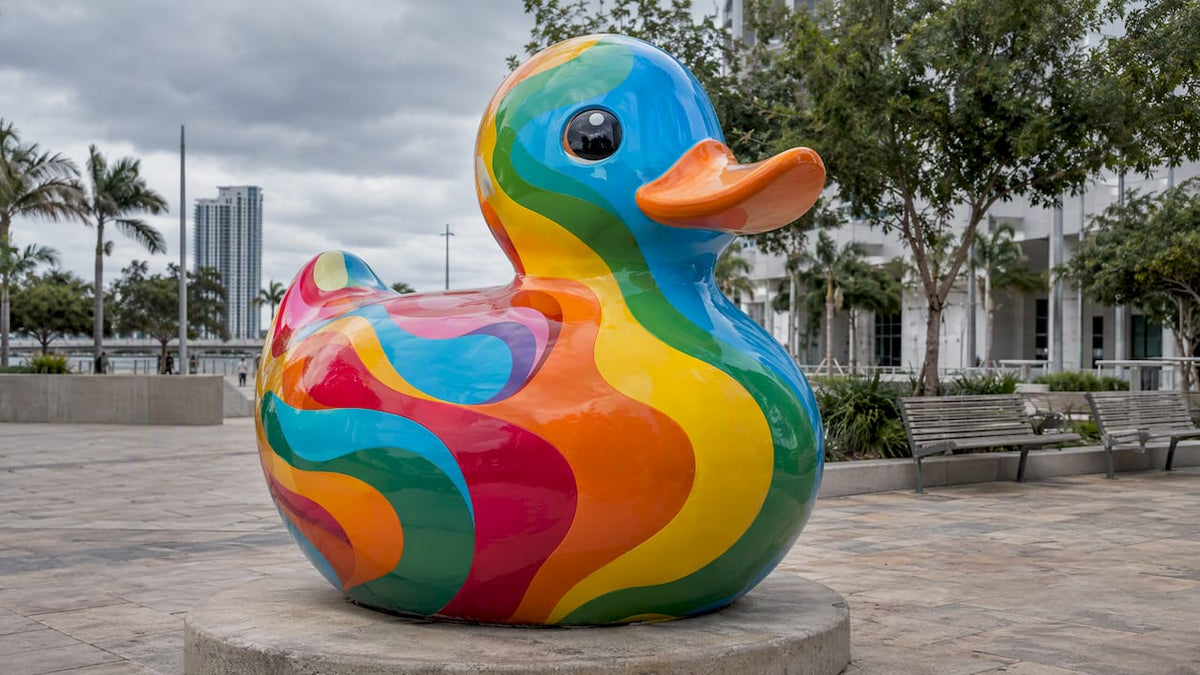
Our UV-reactive sculptures are handled differently from a typical bronze or canvas, and we brief every borrower on this before shipping. Glow pigments reveal their patterns under blacklight, so the display plan must cover the lighting as well as the object. Agree in advance on the blacklight source, where it is mounted, and how long the work sits under it each day. Keep the piece out of direct sunlight and strong ambient light, which can wash out the effect and add unnecessary exposure.

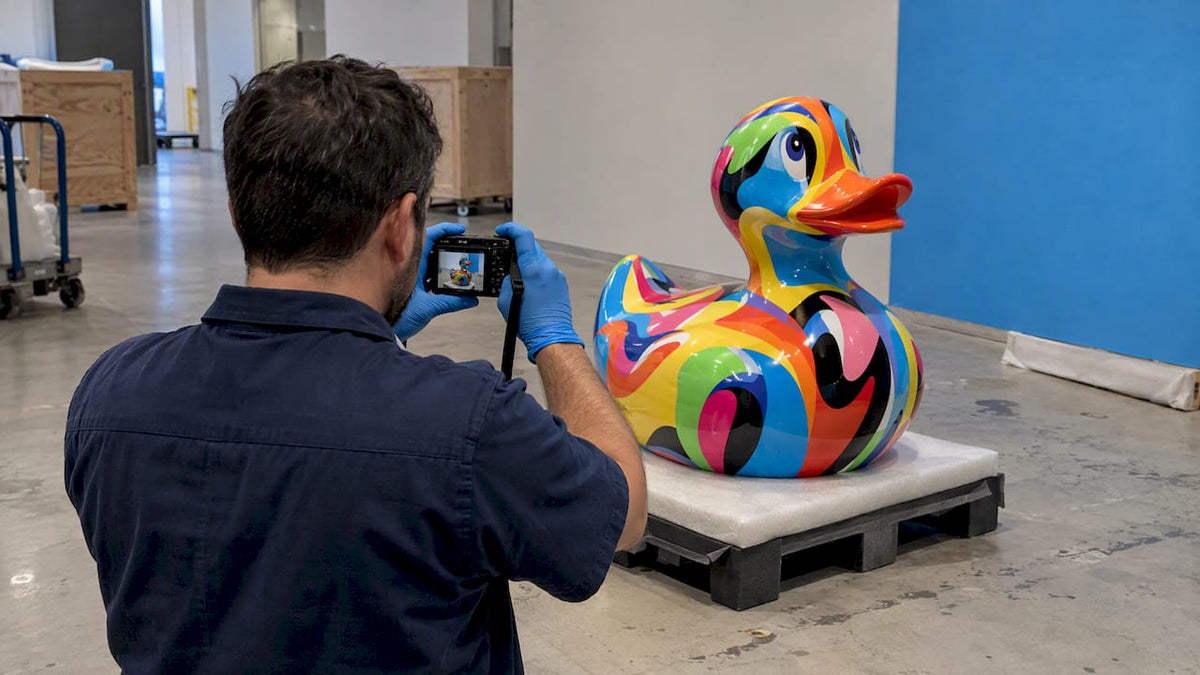
Pop art sculptures often combine smooth glossy surfaces with painted or pigmented finishes, so fingerprints and abrasion show quickly. Handlers should wear clean nitrile gloves, lift from the base or from points the lender specifies, and never grip appendages, edges, or thin extensions. Use padded, form-fitting supports inside the crate and photograph each face before closing it.
On the floor, set a clear visitor boundary: a plinth, floor marker, or low barrier. Large pieces need stable footing and, where relevant, anchoring approved by the lender. For heavier works, our guidance on risk-first shipping for large sculptures and white-glove delivery helps you pick movers who understand sculpture. Finally, document the work under both normal light and blacklight in your condition report, so any change in glow or finish is easy to spot at return.
9. What to do after the exhibition closes
Closing day is when most disputes begin, so treat it as part of the loan rather than an afterthought. Start with a full condition check at deinstallation, comparing the work to your arrival report and the lender’s pre-shipment photographs. Photograph every face, record anything new, and report changes to the lender immediately, as the agreement will require.
Repack using the original crate and the lender’s packing instructions, and keep the object under insurance until it is back in the lender’s care. This is the stage borrowers most often miss, because coverage that stops at transit leaves de-installation and repacking exposed.
If you find damage, stop. Do not attempt a repair. Notify the lender, share your photographs and condition notes, and let the lender’s conservator decide on treatment. Where restoration is needed, expect conservation charges to reach the borrower under most agreements, and some lenders bill hourly for conservation services.
Once the work is received, a final post-receipt condition report closes the loan. File your copy with the agreement, insurance certificate, shipping documents, and photographs. That folder is the proof you will want next time you ask the same lender for another work.

10. Why I’d start with paperwork, not the wish list
I’m Facundo, an artist and studio lead. Most borrowers begin with the artwork they want. I’d begin with the object list, an AAM-style facility report, and a rough budget. Lenders respond to organizers who can show they have done the dull work first, and a clear budget stops a good loan from stalling over crating or couriers.
— Facundo
FAQ
How do I get my art in an exhibition?
Start with a clear proposal and a work list, then submit to venues that show similar art. Give exhibition curators images, dimensions, insurance values, and handling needs. Our studio takes commissions through our main site.
Who pays for shipping and insurance on an art loan?
Usually the borrower. The Smithsonian’s loan program places crating, two-way shipping, insurance premiums, and courier travel on the borrower. Some programs, such as Art Bridges, cover those costs for partner venues.
How far ahead should I request a loan?
Request earlier than you think you need to. Standard loans typically need 6 to 12 months, and large or multi-object loans can need 12 to 24 months, per the Smithsonian loan guidance.
What is a facility report?
It is a standard document describing your building’s climate control, security, fire protection, lighting, and staffing. Lenders use it to decide whether the work will be safe in your space.
Sources
- Naturalhistory
- NMAH Outgoing Loan Agreement_nmah final draft
- Partner Loan Network | Free Art Loans for Museums | Art Bridges