Interactive Pop Art for Makers: Test UV Glow, Design for Repair
An interactive pop art installation invites visitors to trigger bold, recognizable imagery, often with a UV or blacklight glow reveal. Get one thing right first: an interaction people understand quickly, built so technicians can repair it fast. Prototype that rule before you spend on fabrication, or bring in a studio like ours early.
TL;DR:
- A hybrid setup pairs a tactile object with light or projection, while digital systems need calibration and screens, and physical mechanisms wear.
- Test a rough motif and trigger with visitors without coaching, then repeat under room light and blacklight; record hesitation, repeat use, and confusion.
- Use UV stable pigments and durable clear coatings on contact areas; shield the piece when off, and make sensor modules replaceable through accessible panels.
- Ask studios for estimates split across design, hardware, fabrication, installation, and operations, then require prototype approval, on site testing, warranty, spares, and repair response details.
Table of Contents
- What makes an installation interactive, and how is it different from static art?
- Which approach fits: digital, physical, or hybrid?
- How do you design a pop art interactive concept?
- What hardware and UV materials do you need?
- How do you prototype and test before the full build?
- Which materials and finishes survive public use?
- What belongs on the installation and operations checklist?
- What does it cost and how long does it take?
- What can you borrow from successful pop art interactives?
- How do you commission the work and judge a proposal?
- Why we build pop art interactives the way we do
- How can peace and unity shape an interactive pop art piece?
- An editorial take: simplicity and repair beat spectacle
- Commission or buy UV glow pop art from FLY Miami Art
- FAQ
- Sources
What makes an installation interactive, and how is it different from static art?
An interactive installation is site-specific, three-dimensional, participatory and time-based. A painting waits to be looked at. An installation changes while people stand in it, and no two visits look quite the same.
Interaction comes in several shapes. Individual pieces respond to one person at a time. Collective pieces need several people to trigger a result. Emergent pieces produce outcomes nobody scripted, and narrative pieces unfold a story step by step. Some lean on story, others on pure sensation, and the choice shapes every later decision. For a deeper look at the gallery side, our explainer on participatory art covers how audiences take part.

Pop art adds its own demands. Repetition, flat saturated color and instantly recognizable motifs mean visitors arrive already knowing the visual language. Your interaction has to match that clarity. If a rubber duck, a soup can or a comic burst appears, the action that changes it should feel as obvious as the image itself. A pop piece that needs a paragraph of instructions has already lost its audience.
Which approach fits: digital, physical, or hybrid?
Match the approach to your goals, venue and budget. Planning guidance for interactive art groups interaction into digital, physical and hybrid types, and each has a different cost and maintenance profile.
- Digital: projection mapping, AR overlays and responsive visuals. They offer huge expressive range, but they depend on software, calibration and screens that can fail.
- Physical: kinetic or tactile sculptures that visitors push, spin or touch. They are forgiving and charming, though their motion range is limited and moving parts wear.
- Hybrid: a tactile prop paired with projection, light or sound. The hands-on object grounds the experience while the digital layer adds surprise.
- Trade-offs: more expressiveness usually means higher cost and more upkeep, so spend complexity only where visitors will feel it.
For pop art, hybrid often wins. A sculpture people can touch, plus a light response that reveals hidden color, delivers the “wow” without a fragile technology stack.
How do you design a pop art interactive concept?
Start from the image, then add the rule. A single strong icon with one simple trigger beats a crowded scene with five.
- Pick one motif that reads from across the room.
- Define one interaction rule: press, approach, wave or a collective trigger.
- Design the feedback loop so the response is immediate and visible, such as a color shift or a glow reveal that reinforces the pop vocabulary.
- Build in accessibility: clear affordances, alternative inputs for people who cannot reach or press, and sensory options for visitors sensitive to flashing light or loud sound.
- Iterate from sketch to low-fidelity mock to an in-situ prototype.
Pro Tip: Test the interaction with the lights on and then with the lights off. A rule that works under blacklight but confuses people in a lit room will frustrate visitors at the entrance.
Our own checklist on immersive exhibition design pairs well with this framework when you move from concept to layout.
What hardware and UV materials do you need?
Map inputs, compute and outputs before you buy anything. One design process guide advises combining sensor types, such as LiDAR plus a camera, because the combination is often more reliable and more economical than pushing one expensive sensor in difficult lighting. That matters for blacklight rooms, where cameras struggle.
- Inputs: proximity or IR sensors are cheap and robust for simple triggers. Cameras read gestures but dislike darkness. LiDAR tracks position well. Mixing them covers each one’s blind spots.
- Controllers and compute: microcontrollers handle low-latency switching and sensors, while a media server runs complex visuals and sound.
- Outputs: LED, projection mapping, audio and kinetic actuators. Aim for a response fast enough that visitors link their action to the result, and test with several people triggering at once.
- UV considerations: choose UV-stable pigments and coatings, because some fade under repeated exposure. Plan fixture placement so the glow reads evenly, and balance UV intensity with safe working light for visitors and staff. Our explainer on ambient lighting interaction goes further on lighting behavior.
- Infrastructure: budget for power, cable routing and network needs early, since retrofitting them on site is costly.
How do you prototype and test before the full build?
Build cheap prototypes first and watch real people use them. The article on user testing of early prototypes describes testing as a way to assess whether an exhibit is intuitive and engaging. A small mobile station or “Test It Lab” in a lobby can gather quick feedback without a full production.
To judge how people engage, apply the APEX framework, an evidence-based toolkit that looks at physical, social, emotional and intellectual engagement and supports iterative design decisions. Emotional response deserves attention too: mixed-method evaluation using observation, interviews and logging has been used to study emotional engagement in cultural settings.
- Build a rough prototype of the motif and trigger.
- Observe without coaching and note where people hesitate.
- Record uptake, dwell time, repeat triggers and confusion points.
- Fix the biggest confusion, then test again.
Evidence that testing pays off: formative testing of early prototypes helps ensure interactive exhibits are intuitive and engaging before full-scale production, so the cheapest mistakes are the ones you catch first.
Which materials and finishes survive public use?
Choose structure and surface for the crowd that will actually touch the piece. Rigid, sealed substrates hold up best, with UV-stable surface finishes layered over them. Abrasion is the quiet enemy of glow work: hands, bags and cleaning cloths wear pigment away, so protect high-touch zones with clear durable coatings and keep delicate pigment in area visitors only look at.
Design for repair from day one. Practitioners recommend accessible panels, labeled wiring and modular components so a technician can swap a part quickly and avoid multi-day outages. In practice that means a sensor module that unplugs rather than being glued in, a hidden hatch behind the sculpture, and a labeled spare kit stored on site.

Also shield pigments from light exposure when the piece is off. A cover or controlled ambient lighting extends the life of the glow, and it keeps the reveal feeling fresh instead of washed out.
What belongs on the installation and operations checklist?
Commissioning turns a good prototype into a reliable piece. Walk the space with the piece running and break it on purpose before opening day.
- Calibrate sensors in the real lighting, then repeat after any fixture change.
- Stress test with crowds, rapid repeat triggers and several simultaneous users.
- Check latency and confirm fail modes: if a sensor dies, the piece should fall back to a pleasant default, not a blank or broken state.
- Set up simple logging so you can see uptake, errors and downtime.
- Write a maintenance routine and stock spares for the parts most likely to fail.
- Plan security and monitoring for public sites. Zone-based advice, like this event camera deployment guide, helps large outdoor installations stay protected.
Pro Tip: Keep a one-page “reset card” taped inside the access hatch so any staff member can restore the piece to its default state quickly.
What does it cost and how long does it take?
Treat cost as buckets rather than one number. Typical line items are design and prototyping, hardware, fabrication, installation, commissioning and ongoing operations. Prices vary widely with scale, so we do not quote a universal figure here. Ask any studio for a bucket-by-bucket estimate and compare proposals on the same structure.
Timelines follow phases: strategy, concept and prototype, fabrication, installation and commissioning. Interactivity is the main cost driver, because every added sensor, projector or moving part adds design, testing and spares. Larger footprints multiply fabrication and install effort.
Hold a contingency reserve for the surprises that always appear, such as a venue lighting conflict or a late power change. Pop art’s bold simplicity is a budget ally: one strong motif and one clear trigger usually cost less than a sprawling scene, and visitors remember it just as well.
What can you borrow from successful pop art interactives?
Treat examples as lessons to adapt, then turn each lesson into a line in your brief.
- Giant icon, simple trigger: a single oversized motif that reacts when approached. The lesson is scale: let the image dominate and keep the rule obvious.
- Collective color wash: a piece that only fully lights when several people stand together. The lesson is feedback: reward cooperation with an immediate, visible color change.
- Blacklight reveal: surfaces that look flat in room light and burst into hidden patterns under UV. The lesson is implementation: plan pigments, coatings and lamp positions together, as in our glow art commissioning checklist for events.
- Touch-and-respond sculpture: a tactile object that triggers light or sound. The lesson is durability: protect the contact surfaces.
To turn an example into a studio brief, name the rule, the feedback, the scale and the UV requirement in one paragraph. Our guide to curating immersive pop art shows shows how those pieces sit together in a room.
How do you commission the work and judge a proposal?
A strong brief makes proposals comparable. Write it before you contact anyone, then use it to judge every response.
- State your goals, footprint and venue conditions, including ceiling height and ambient light.
- Describe the interaction rule and the feedback you expect.
- Share pop art references and say whether UV glow is required.
- Ask each studio about serviceability, spare parts, warranty and timeline.
- Set decision gates: prototype approval, on-site testing, and commissioning sign-off before final payment.
Ask how repairs work after opening, who can service the piece, and how fast. A proposal that cannot answer those questions clearly is a risk, however striking the renderings look. If you want to start a conversation with us, our commission page is the place to begin.
Why we build pop art interactives the way we do
Our work is led by award-winning artist Facundo Yebne, and our studio focuses on handcrafted pop art sculptures that use UV-reactive materials to glow and reveal hidden patterns under blacklight. We also take on commissioned work for collectors, galleries, commercial spaces and public art clients.
The priorities that guide every piece are a concept that reads at a glance, engagement that rewards a second look, and maintenance planning that keeps the work alive after opening night. If you want similar work for your space, we can talk through a custom piece or a commission.
How can peace and unity shape an interactive pop art piece?
Peace and unity are the themes at the heart of our studio, and interaction gives them a physical form. Instead of painting a message, you let visitors enact it.
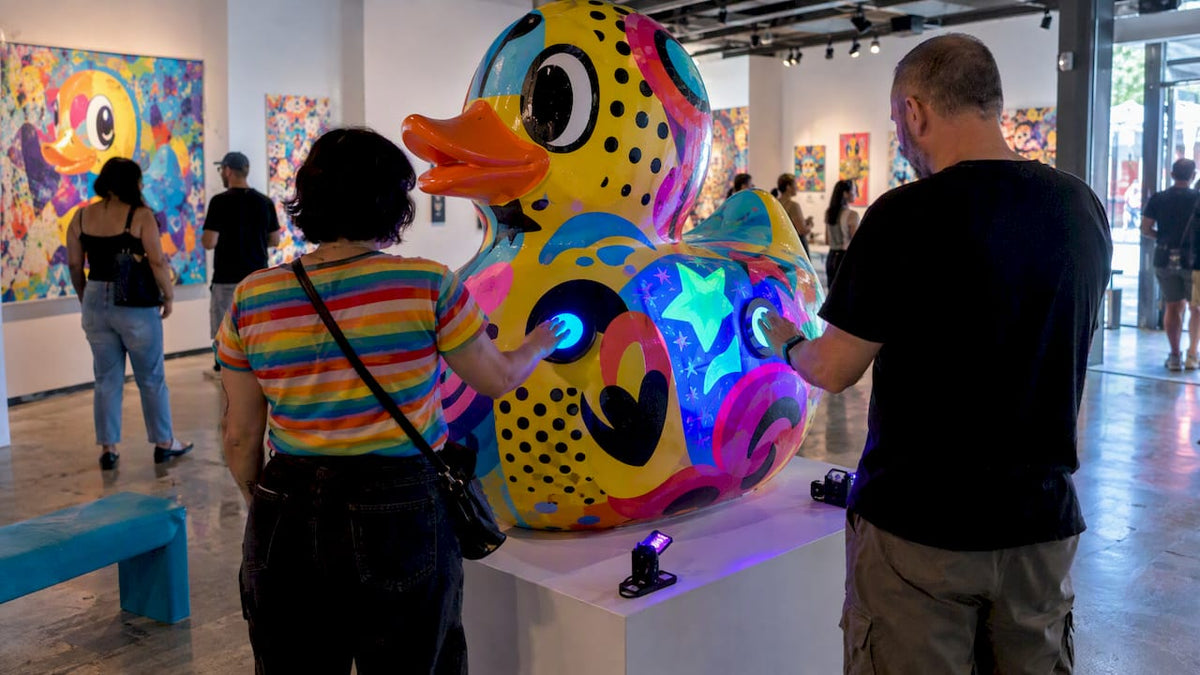
The most direct route is a collective trigger. A piece that only reaches its full glow when several people join in turns “unity” into something people do with their bodies, not something they read on a label. A shared action, such as hands on several touch points at once, makes strangers cooperate, and the pop visual language makes the payoff instantly joyful.
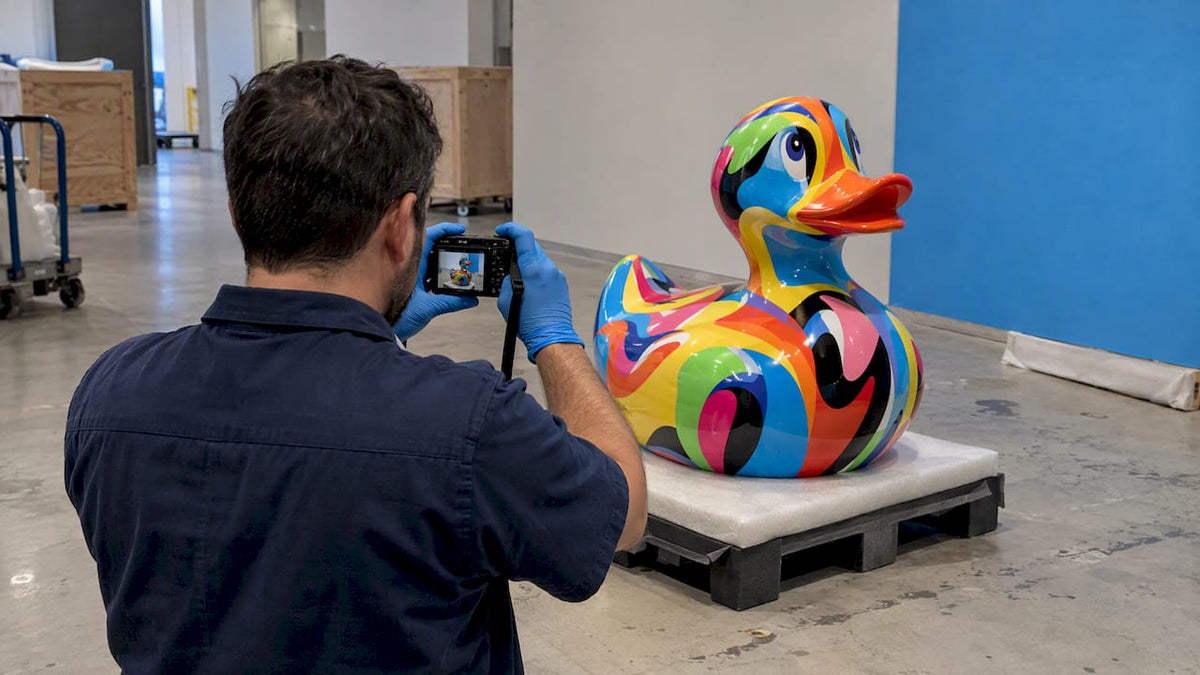
Peace works through tone and symbol. Soft, welcoming color palettes, familiar friendly icons and a calm glow reveal invite people in instead of startling them. Our rubber duck motif does this well because it is playful, instantly recognizable and non-threatening, which lowers the barrier for first-time visitors.
Keep the message light-handed. Pop art succeeds through humor and clarity, so avoid heavy text. Let the interaction carry the idea, and let a short title or a single line frame it.
Finally, make the experience inclusive. Offer alternative inputs so everyone can contribute to the shared effect. A unity theme that excludes some visitors undercuts itself, so accessibility is part of the message, not an afterthought.
An editorial take: simplicity and repair beat spectacle
Most advice about interactive art chases the impressive technology: bigger projections, more sensors, more effects. I think that gets the priority backwards. The work that people remember is clear at a glance and keeps running over time.
The conventional advice underweights two things. First, legibility: a bold pop motif with one obvious rule outperforms a clever system nobody understands, and testing with real visitors can help reveal whether the interaction is clear. Second, serviceability: a stunning piece that breaks and stays broken becomes a sign that says “out of order.”
If you take one action first, build a rough prototype of the motif and the trigger, and watch people use it. Fix what confuses them before you buy a single premium component. Spend your budget on durable surfaces, accessible panels and a spare kit rather than on extra effects. Glow is the garnish, and a piece that survives its audience is the meal.
— Facundo
Commission or buy UV glow pop art from FLY Miami Art
We create handmade, UV-reactive pop art by an award-winning artist, from custom glow pieces and commissions to originals and sculptures. Send us your space, your idea and your timeline, and we will shape the next step together.
FAQ
What is an interactive pop art installation?
It is a three-dimensional artwork that responds to visitors while using pop art imagery such as bold color and recognizable icons. Many add UV or blacklight effects so hidden patterns appear when people trigger them.
How do you test an interactive art installation before building it?
Build a cheap prototype and watch real visitors use it without coaching. Museum practice shows that formative testing improves intuitiveness and take-up. Record uptake, dwell time and confusion points, then iterate.
What sensors work best for interactive installations?
No single sensor wins everywhere. Experts suggest combining types, such as LiDAR plus a camera, because combinations are often more reliable and economical in tricky lighting. Simple proximity or IR sensors suit basic triggers.
How do you keep a UV glow installation durable?
Use UV-stable pigments, protect high-touch surfaces with durable clear coatings, and cover or light the piece carefully when it is off. Add accessible panels and modular parts so repairs are quick.
Sources
- A seat at the table: Giving visitors a voice in exhibition development through user testing | MW2016: Museums and the Web 2016
- Active Prolonged Engagement EXpanded (APEX): A Toolkit for Supporting Evidence-Based Iterative Design Decisions for Collaborative, Embodied Museum Exhibits | Proceedings of the ACM on Human-Computer Interaction
- Full article: Digital storytelling for emotional engagement in museums: design and evaluation of the Hunterian Antonine Wall EMOTIVE experiences