Public Art Grants in the USA: Who Qualifies and How to Apply
There is no single national fund for public art. Money comes from federal programs such as the National Endowment for the Arts (NEA), state arts agencies, city programs, and private foundations. Most of it goes to organizations, not to individual artists, and almost all of it expects you to bring matching funds. This guide shows which grants exist, who can apply, what they pay, and what to line up (permits included) before you ask.
TL;DR
- The NEA’s Grants for Arts Projects funds public art through its Visual & Media Arts discipline, but only organizations can apply, not individuals.
- State and city programs are often the better fit: awards in the research below run from $15,000 in South Carolina to $150,000 for Business Improvement Districts in Washington, DC.
- Expect a 1:1 match in cash, in-kind support, or both.
- Individual artists have fewer options, mainly foundation grants and city programs that accept artist applicants.
- Permits and site approval belong in your plan and budget from day one, because many grant programs ask for proof of installation permission.
Table of Contents
- The federal route: NEA Grants for Arts Projects
- State and city public art grants
- Grants for individual artists
- How to find the right program
- What applications ask for
- Permits and approvals to plan for
- Commission a glow piece for your project
- Our perspective
- FAQ
- Sources
The federal route: NEA Grants for Arts Projects
The NEA’s Grants for Arts Projects (GAP) is its principal program for arts organizations. It covers several disciplines, including Visual & Media Arts and Design & Our Town, and accepts applications in two cycles each year. For FY 2027, the cycles were in February and July, and the earliest project start dates were January 1, 2027 and June 1, 2027 respectively.
Public art sits squarely inside the scope. The Visual & Media Arts instructions list exhibitions, commissions and public art, U.S.-based artist residencies dedicated to creating work, and visual-arts learning projects for people of all ages.
Award sizes for FY27, per the NEA program page:
- $10,000 for Challenge America
- $10,000 to $100,000 for other GAP applicants
- $30,000 to $150,000 for eligible Local Arts Agencies running subgranting projects
Every award requires a 1:1 cost share, which can be cash, in-kind, or both.
The cycle timing repeats from year to year, with a winter and a summer round. Always confirm the current deadlines on the NEA page before you plan, because the dates shift with each fiscal year.

Who can apply to the NEA
The NEA’s eligibility rules are strict. Eligible applicants are U.S. 501©(3) nonprofits, state or local government units, and federally recognized tribes or tribal communities. Applicants generally must have completed at least five years of arts programming and had at least $20,000 in operating expenses in their most recently completed fiscal year.
Individuals, fiscal sponsors, for-profit businesses, state arts agencies, and regional arts organizations are not eligible. The program guidelines say the same thing in plain terms: GAP is project-based funding for eligible organizations, not direct grants to individuals.
So if you are a sculptor, the practical path is to partner. A nonprofit, a city department, or a tribal government applies, and your commission is a line in the project budget. The NEA also publishes applicant resources, including application templates, a project-budget template, and video tutorials on eligibility, award amounts and cost share.
State and city public art grants
State arts agencies and cities fund much of the public art that actually gets built. They also tend to have friendlier eligibility, and some accept individual artists directly. The programs below show the range.
| Program | Who can apply | Award | Match |
|---|---|---|---|
| NEA Grants for Arts Projects | Nonprofits, government units, tribes | $10,000 to $100,000 (more for Local Arts Agencies) | 1:1 |
| DC Public Art Building Communities | Qualified DC-resident artists, nonprofits, Business Improvement Districts | Up to $75,000 (individuals), $125,000 (organizations), $150,000 (BIDs) | Applicants cover costs above the cap |
| Maryland Public Art Across Maryland | Maryland nonprofits, government units, colleges, schools | Up to $30,000 | See program page |
| South Carolina Public Art Grant | South Carolina applicants | Up to $15,000 | 1:1, up to 50% of it in-kind |
| Kansas Public Art & Murals Grant | Kansas applicants | See guidelines | 1:1, cash plus in-kind |
| Kenneth Rainin Foundation Open Spaces | San Francisco Bay Area temporary, place-based projects | $15,000 to $20,000 development; $100,000 to $175,000 production | See program page |
The lesson from the table: geography decides almost everything. A Maryland nonprofit and a Kansas arts group are looking at different programs with different rules. Start with your own state arts agency, then your city’s arts commission or arts council.
A closer look at DC
The DC program is unusual because individuals can win large awards. For FY 2027 the DC Commission on the Arts and Humanities offered up to $75,000 for individuals, $125,000 for organizations and $150,000 for Business Improvement Districts. The FY 2027 round closed in July 2026, so if you are interested, watch for the next round on the commission’s site.
Allowable costs include artist fees, fabrication, installation, materials, insurance, engineering and permits. That list is a useful model for any public art budget, since it reminds you that the artwork itself is only part of the cost.
Local arts agencies and cities
Local arts agencies award grants to organizations and individuals for general operating expenses or, more often, specific projects. Cambridge, Massachusetts is one example: its public art grant guidelines require applicants to consult Public Art staff before applying and to obtain a Statement of Eligibility. Projects on city property need approval from the relevant city staff, and private sites need the owner’s signed approval.
Grants for individual artists
If you are applying as yourself, the pool is smaller and usually not tied to a specific installation.
The Harpo Foundation’s Grants for Visual Artists is a direct grant of up to $10,000 per artist for self-defined under-recognized visual artists. Applicants must be at least 21, U.S. citizens or lawful permanent residents, and generally not current or recent fine-arts students. Funds can support any activity that advances the development of your work, so a grant like this can pay for studio time, materials, or a maquette for a larger proposal. The 2026 cycle carried a $15 application fee, with waivers for financial hardship, and the page said the portal reopens in the new year. Check the official page for the current window.
The DC program above is the other model: some cities and states open public art commissions directly to artists. Percent-for-art programs are the biggest of these, and our guide to U.S. percent for art programs explains how artists win those commissions.

How to find the right program
Finding grants is a search problem, and there is an official way to do it.
- Search federal listings. The Congressional Research Service’s guide for grantseekers says to search Assistance Listings in SAM.gov by keyword, agency, program title, beneficiary, and eligibility. It describes more than 2,200 federal programs, over half of them grants, and points to Grants.gov for many competitive federal applications.
- Call the agencies. The same guidance notes that state-administered subawards may not appear on Grants.gov, so contact relevant federal and state agencies directly.
- Identify your state arts agency. NASAA keeps a roster of state percent-for-art programs, a good starting point for state-level commissions.
- Ask about calls for artists. The Texas Commission on the Arts, for example, advises eligible public entities on percent-for-art projects and lets them post a call for artists on its website at no charge. Other state agencies run similar services.
- Check your city. Many city arts commissions publish their own calls and rules, and a short conversation with staff often saves weeks.
What applications ask for
Public art grants want proof that the project can actually be built. The DC application, a typical example, requires budgets, proposals and agency approvals, along with support materials such as artist resumes, work samples, and detailed artwork proposals with proof of installation permission.
A solid package usually includes:
- Artist resume and work samples, ideally with at least one completed work at similar scale.
- A proposal with renderings, materials, dimensions, maintenance plan and schedule.
- A line-item budget covering fees, fabrication, transport, installation, insurance, engineering and permits.
- Site approval from the property owner or city department.
- A matching-funds plan showing cash and in-kind sources.
If you need a template for the proposal itself, our seven-stage public art proposal guide walks through it, and the notes on what makes a public sculpture development-ready cover what reviewers and developers look for.
Planning your match
The 1:1 rule trips up first-time applicants, so plan it early. In South Carolina, up to 50% of the match can be in-kind donations of materials or contracted services. Kansas also accepts a combination of cash and in-kind expenses, and the NEA allows cash, in-kind, or both.
In practice, in-kind can mean donated fabrication, discounted engineering, volunteer installation labor, or a donated site. Put a documented dollar value on each item and get a letter from the donor.
Permits and approvals to plan for
A grant does not give you the right to install anything. Permits vary by city, so treat the examples below as patterns, not a checklist for your site.
In Boston, the city’s Public Art Policy lists common permits:
- A Street Occupancy Permit for installations that restrict street or sidewalk access
- A Welding Permit from the Boston Fire Department
- A Building Permit from Inspectional Services
On City property, approval is also required from the Boston Art Commission and the department that owns the site.
Other cities add their own layers. Edmonds, Washington asks for a site plan, artwork drawings, context drawings, material and color samples, and a written proposal covering design, maintenance, schedule, artist background, and assumption of liability. San Francisco requires a minimum six-foot pedestrian clearance on sidewalks and ADA compliance for occupancy elements. Los Angeles treats revocable R-Permits as discretionary, meaning the Board of Public Works can change the Bureau of Engineering’s recommendations.
The common thread is early contact. Cambridge arts staff require pre-application consultations because public art involves complex logistics, and that is good advice anywhere. Call the city’s public art or permitting office before you design to a fixed footprint. For accessibility, our ADA guide for public sculptures covers clearances and reach. For durability and maintenance language that reviewers like to see, read about vandal-resistant sculpture. And for residents’ buy-in, which many panels score, see public art community engagement.
Commission a glow piece for your project
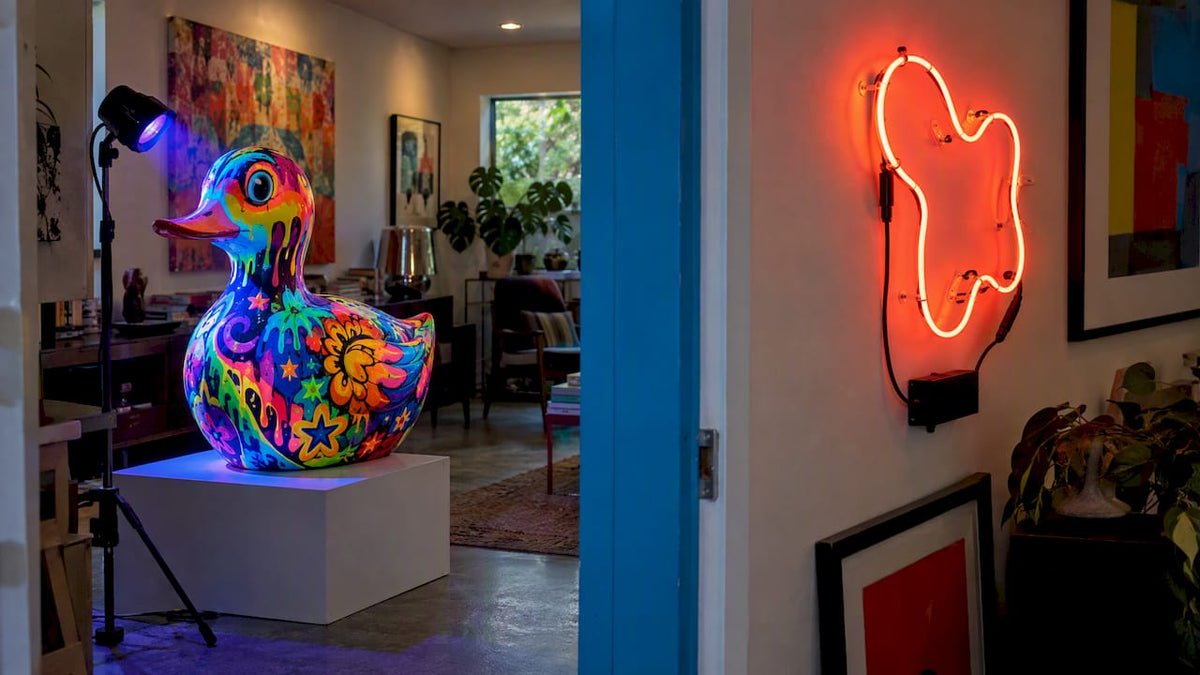
If you are a developer, city employee, hotel, or gallery building a public art budget, a handmade piece can anchor the whole proposal. FLY Miami Art creates original pop art sculptures with UV-reactive pigments that reveal hidden color under blacklight, and we take commissions for private collectors, galleries, commercial spaces, and public clients. Our work is handmade and original, not mass produced.
If you want to see the style first, browse the sculpture collection or the UV/glow art pieces. For a one-off made around your idea, start with a custom glow piece. If you are drafting a site-specific proposal, our notes on site-specific sculpture and on how to display large-scale installations will help you scope it. Past award-winning public art projects are also worth studying before you write your narrative.
Our perspective
Grant panels fund projects that look finished before they are built. The strongest applications we see, and the strongest we try to make, show a clear idea, a realistic budget, a site that has said yes, and a reason the community will care.
That is why we think of a public sculpture as a package: the artwork, the approvals, the maintenance plan and the story. Light and color do real work in that story. A piece that reveals a second layer of pattern under blacklight gives people a reason to come back at a different hour, and a symbol of peace and unity gives a panel something to rally around.
Because every piece we make is handmade, we can shape scale, color and theme to a specific site and its budget. If you are building a grant application around an artwork, talk to the artist early. A good commission conversation sharpens the proposal before a reviewer ever sees it.
Facundo
FAQ
Can an individual artist get a public art grant in the USA?
Sometimes. The NEA’s GAP program does not fund individuals, but some city programs, such as DC’s Public Art Building Communities grant, accept individual artists. Foundations like Harpo also give direct grants of up to $10,000 to eligible visual artists. Otherwise, partner with a nonprofit or government sponsor that can apply.
Do public art grants require matching funds?
Most do. NEA GAP awards require a 1:1 cost share, as do the South Carolina and Kansas programs. In-kind support such as donated materials or services often counts, though South Carolina caps in-kind at 50% of the match. Read each program’s guidelines for what qualifies.
What permits do I need to install a public sculpture?
It depends on the city and the site. Boston, for example, lists street occupancy, welding and building permits, plus Art Commission approval for City property. Contact your city’s public art office or permitting department before you finalize the design, and expect to show proof of site permission in your grant application.
Where do I find current deadlines?
Check each funder’s official page, since dates change every cycle. The NEA runs two GAP cycles a year, and state and city programs publish their own calendars. SAM.gov and Grants.gov list many federal opportunities, and your state arts agency can point you to state-administered funds.
Sources
- NEA Grants for Arts Projects
- NEA GAP Visual & Media Arts application instructions
- NEA FY27 GAP program guidelines
- NEA GAP applicant resources
- DC Public Art Building Communities FY 2027
- Maryland State Arts Council, Public Art Across Maryland
- South Carolina Arts Commission Public Art Grants
- Kansas Public Art & Murals Grant guidelines
- Kenneth Rainin Foundation Open Spaces Program
- Harpo Foundation Grants for Visual Artists
- Cambridge Public Art Grant guidelines
- Congressional Research Service, Resources for Grantseekers
- Texas Commission on the Arts, Public Art
- NASAA State Percent for Art Programs
- Boston Public Art Policy
- Edmonds, Artwork in the Public Right of Way
- San Francisco Public Works order on sidewalk clearance
- Los Angeles Bureau of Engineering, R-Permit purpose and definition